Plastic Upcycling Technology Market (2026-2036)
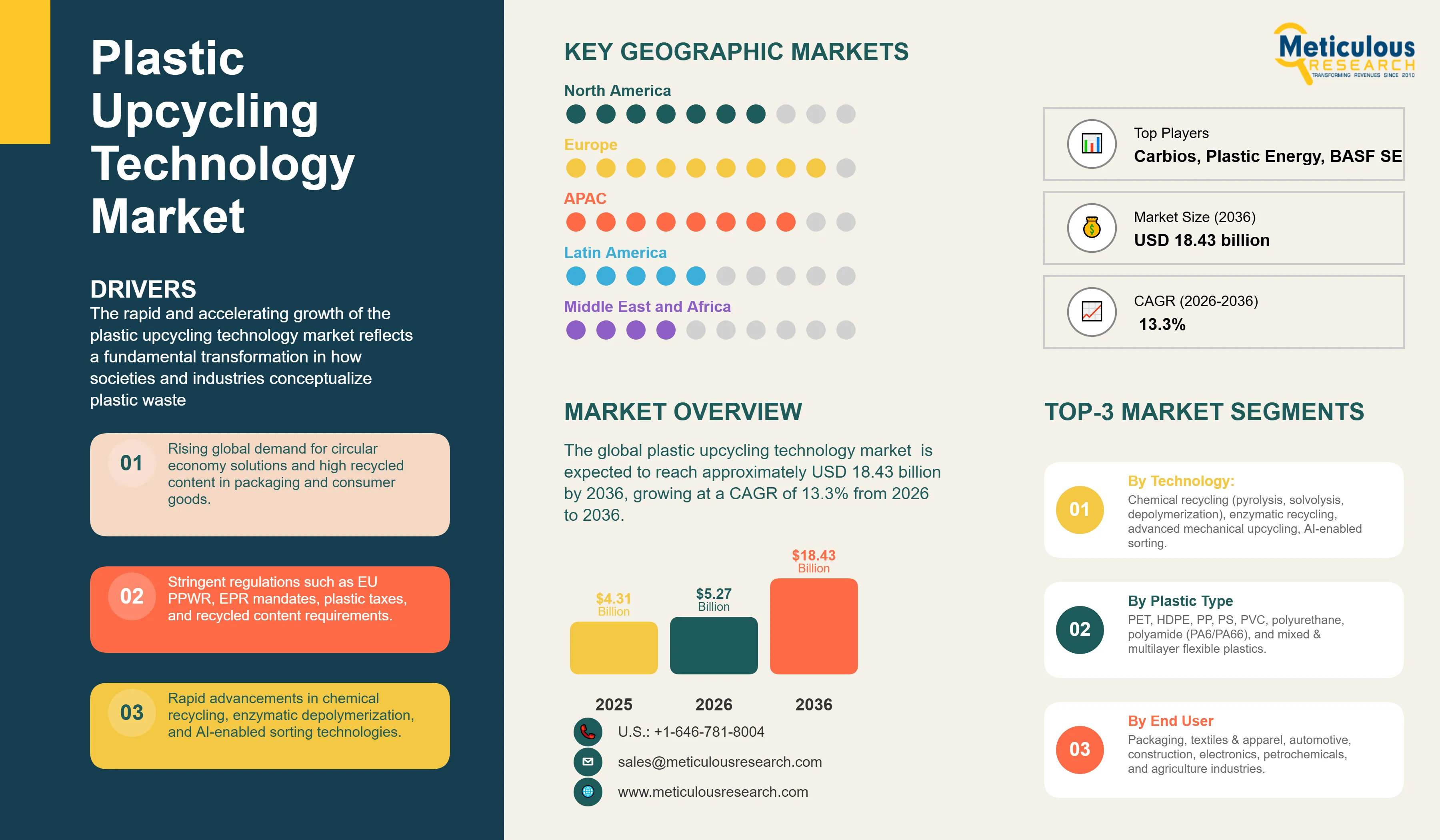
The global plastic upcycling technology market was valued at USD 4.31 billion in 2025. The market is expected to reach approximately USD 18.43 billion by 2036 from USD 5.27 billion in 2026, growing at a CAGR of 13.3% from 2026 to 2036.
- Published
- Mar 2026
- Pages
- 292
- Format
- PDF + Excel
- Report ID
- MR-1836
- Base year
- 2025
- 2025 · BASELINE
- $4.31B
- 2036
- $18.43B
- CAGR 2026–2036
- 13.3%
2025 baseline · 2026–2036 forecast at 13.3% CAGR · hover a bar for the value
Key highlights
In terms of revenue, the global plastic upcycling technology market is projected to reach USD 18.43 billion by 2036.
The market is expected to grow at a CAGR of 13.3% from 2026 to 2036.
Europe dominates the global plastic upcycling technology market with the largest market share in 2026, driven by the most stringent plastic waste and extended producer responsibility regulations globally, mandatory recycled content requirements in packaging under the EU Packaging and Packaging Waste Regulation, and the highest concentration of operational advanced chemical recycling and upcycling facilities supported by substantial public and private investment in circular economy infrastructure.
Asia-Pacific is expected to witness the fastest growth during the forecast period, driven by China's National Sword policy aftermath driving domestic plastic waste processing infrastructure investment, Japan and South Korea's advanced recycling technology development programs, and the enormous plastic waste generation of Southeast Asian nations prompting government and NGO-driven upcycling infrastructure investment.
By technology, the chemical recycling segment -- encompassing pyrolysis, gasification, solvolysis, and depolymerization -- holds the largest market share in 2026, as the technology class capable of processing the widest range of plastic waste types including contaminated and mixed plastics that mechanical recycling cannot economically handle.
By plastic type, the PET segment holds the largest market share in 2026, reflecting the most developed upcycling ecosystem for this polymer including both mechanical bottle-to-bottle recycling with established collection infrastructure and advanced chemical depolymerization technologies producing virgin-equivalent rPET for food-contact packaging applications.
By output product, the recycled monomers and chemical feedstock segment holds the largest value-per-tonne output category, as depolymerization technologies recovering virgin-equivalent monomers from waste PET, polyurethane, and polystyrene command substantial price premiums over pyrolysis oil and lower-value downcycled material outputs.
By end-use industry, the packaging segment holds the largest market share in 2026, as the largest consumer of plastic globally and the most advanced adopter of upcycled plastic content under brand owner sustainability commitments and regulatory recycled content mandates.
Report summary
| Particulars | Details |
|---|---|
| Market Size by 2036 | USD 18.43 Billion |
| Market Size in 2026 | USD 5.27 Billion |
| Market Size in 2025 | USD 4.31 Billion |
| Market Growth Rate (2026-2036) | CAGR of 13.3% |
| Format | PDF, Excel & Cloud Portal · 292 pages |
| Dominating Region | Europe |
| Fastest Growing Region | Asia-Pacific |
| Base Year | 2025 |
| Forecast Period | 2026 to 2036 |
| Segments Covered | Technology, Plastic Type, Output Product, End-Use Industry, and Region |
| Regions Covered | North America, Europe, Asia-Pacific, Latin America, and Middle East & Africa |
Report overview
Segments covered: technology, plastic type, output product, end-use industry.
The rapid and accelerating growth of the plastic upcycling technology market reflects a fundamental transformation in how societies and industries conceptualize plastic waste — shifting from a linear model of produce-use-discard toward circular economy frameworks that recover maximum material value from post-consumer and post-industrial plastic streams through technologies that convert waste plastics into feedstocks, monomers, fuels, and high-value materials equal to or exceeding the quality of virgin petroleum-derived equivalents. Plastic upcycling transcends conventional mechanical recycling by targeting quality retention or enhancement — producing outputs with comparable or superior properties to the original material rather than the property-degraded downcycled products that traditional mechanical recycling generates from contaminated or mixed plastic streams. The scale of the opportunity is staggering: of the approximately 400 million metric tonnes of plastic produced globally each year, less than 10% is effectively recycled, with the remainder entering landfill, incineration, or the natural environment — representing both an enormous environmental liability and an equally enormous feedstock opportunity for upcycling technologies that can economically convert this waste stream into valuable materials and chemicals. The convergence of regulatory mandates requiring recycled content in plastic products, brand owner commitments to circularity targets, and the commercial maturation of advanced chemical recycling, enzymatic degradation, and AI-powered sorting technologies is creating the structural conditions for plastic upcycling to scale from niche pilot operations toward industrial-scale infrastructure capable of meaningful impact on global plastic waste flows.
Plastic upcycling encompasses a spectrum of technologies and processes that convert post-consumer and post-industrial plastic waste into products of equal or greater value than the original material, fundamentally distinguishing itself from conventional mechanical recycling which typically produces lower-quality downcycled outputs with degraded mechanical and aesthetic properties unsuitable for demanding applications including food contact packaging. The upcycling technology landscape is organized around three primary technological approaches: chemical recycling converts plastics back into their constituent monomers or into hydrocarbon feedstocks through thermal, catalytic, or chemical processes; enhanced mechanical recycling applies advanced sorting, decontamination, and compatibilization technologies to produce high-quality recycled polymers meeting demanding specifications; and biological upcycling employs engineered enzymes and microorganisms to depolymerize specific plastic types into recoverable monomers or higher-value biochemicals.
Chemical recycling represents the most technically diverse and fastest-growing segment of plastic upcycling technology, encompassing multiple distinct process routes addressing different plastic types and target outputs. Pyrolysis -- thermal decomposition of plastic waste in the absence of oxygen at temperatures of 400-600 degrees Celsius -- converts mixed polyolefins and polystyrene into pyrolysis oil, a hydrocarbon mixture usable as chemical plant feedstock or as fuel, alongside syngas and char by-products. Gasification converts plastic waste at higher temperatures (700-1200 degrees Celsius) into synthesis gas (carbon monoxide and hydrogen) that can be used for chemical synthesis, power generation, or hydrogen production. Solvolysis processes -- including glycolysis, hydrolysis, methanolysis, and aminolysis -- depolymerize specific condensation polymers including PET and polyurethanes using solvent or reactive agents to recover purified monomers including BHET (bis(2-hydroxyethyl) terephthalate), TPA (terephthalic acid), and EG (ethylene glycol) that can be repolymerized into virgin-equivalent materials. Enzymatic depolymerization using engineered PETase and related enzymes -- most notably Carbios's patented thermophilic enzyme technology -- enables selective depolymerization of PET plastics at moderate temperatures with high selectivity for the target polymer, enabling processing of mixed and contaminated PET streams that chemical processes require pre-sorted feedstock to handle economically.
The commercial landscape of plastic upcycling technology is rapidly evolving from early-stage pilot facilities toward industrial-scale operations, with significant investment from both specialized upcycling technology developers and major petrochemical companies seeking to meet regulatory recycled content mandates and brand owner procurement commitments. SABIC, LyondellBasell, Dow, BASF, and Ineos have all announced substantial investments in pyrolysis-based chemical recycling capacity, integrating upcycled plastic feedstock into existing cracker and polymer production infrastructure. Specialized chemical recycling companies including Plastic Energy, Renewlogy, Pyrowave, Plastic2Fuel, and Neste's plastic waste refinery operations are developing proprietary pyrolysis technologies with differentiated catalyst systems and process optimization. PET depolymerization specialists including Carbios, Loop Industries, gr3n, Rematpet, and Ioniqa Technologies are commercializing enzymatic and solvolysis PET recycling at increasing scale, with Carbios's first industrial facility in France targeting 50,000 tonnes per year PET processing capacity. Brand owners including Unilever, Nestle, PepsiCo, L'Oreal, and Danone have committed to specific recycled content targets in plastic packaging that are creating contractual demand for upcycled plastic outputs, providing the revenue certainty enabling upcycling infrastructure investment at commercial scale.
Report infographic
Market dynamics
4 factors across 3 forcesExtended Producer Responsibility Regulations and Recycled Content Mandates
The primary regulatory driver of plastic upcycling market growth is the global proliferation of extended producer responsibility frameworks and mandatory recycled content requirements that are creating legally enforceable obligations for plastic producers, brand owners, and retailers to source specified proportions of recycled plastic content -- directly generating contracted demand for upcycled plastic outputs that justifies the capital investment in upcycling infrastructure. The European Union's Packaging and Packaging Waste Regulation -- adopted in final form in 2024 -- mandates minimum recycled content percentages in plastic packaging ranging from 10% for contact-sensitive packaging to 35% for PET beverage bottles by 2030 and 65% for all plastic packaging by 2040, creating a multi-million tonne annual demand for high-quality recycled plastic that only advanced chemical recycling and enhanced mechanical upcycling can supply in sufficient volume and quality. The UK Plastic Packaging Tax -- imposing GBP 210.82 per tonne on plastic packaging containing less than 30% recycled content -- has created direct financial incentives for brands to source recycled plastic, with revenues earmarked to support recycling infrastructure investment. California's SB 343 and AB 793 mandate minimum recycled content in single-use plastic bottles and packaging, establishing the most stringent state-level requirements in the United States and creating pressure for similar federal legislation. Brand owner voluntary commitments -- with Unilever targeting 25% recycled plastic content across packaging by 2025, PepsiCo committing to 50% recycled content in primary plastic packaging by 2030, and L'Oreal targeting 50% recycled or bio-sourced plastic in all plastic packaging by 2030 -- translate regulatory pressure into procurement commitments that provide revenue visibility for upcycling capacity investment.
Table of contents
11 chapters · 129 sections · 292 pages · click to expandSegmental analysis
| Segment | Largest share (2026) | Fastest growth (2026–2036) |
|---|---|---|
| By Technology | Chemical Recycling | — |
| By Plastic Type | PET | — |
| By Output Product | Recycled Monomers and Feedstocks | — |
| By End-Use Industry | Packaging | Textiles and apparel end-use |
By Technology
- Chemical recycling technologies command approximately 48-52% of total plastic upcycling technology market revenue in 2026, reflecting the technology class's unique capability to process the widest range of plastic waste types -- including mixed, contaminated, multilayer, and flexible plastic packaging that mechanical recycling cannot economically handle -- while producing outputs including virgin-equivalent monomers and chemical plant feedstocks that command substantial price premiums over downcycled mechanical recycling outputs.
- Pyrolysis-based chemical recycling represents the most commercially mature and widely deployed chemical recycling technology, with multiple commercial-scale facilities operational in Europe and North America processing mixed plastic waste streams into pyrolysis oil for co-processing in steam crackers or for use as refinery feedstock.
- The pyrolysis technology landscape encompasses continuous and batch process configurations from suppliers including Plastic Energy (TACOIL technology), Quantafuel, Pyrowave, Renewlogy, Encina, Brightmark Energy, and Mura Technology (HydroPRS supercritical water process), each with differentiated process conditions, catalyst systems, and target output specifications.
- Depolymerization technologies targeting specific condensation polymers -- Carbios for PET enzymatic recycling, Eastman's Polyester Renewal Technology for PET and PA, Loop Industries' catalytic depolymerization, and Ioniqa's magnetic catalyst-based glycolysis -- produce high-purity monomers that can be repolymerized into certified virgin-equivalent materials carrying International Sustainability and Carbon Certification (ISCC+) and similar chain-of-custody certifications that enable brand owners to make verified recycled content claims.
- Mechanical upcycling technologies -- incorporating advanced sorting, decontamination including supercritical CO2 extraction and solid-state vacuum stripping, compatibilization with reactive extrusion additives, and property-enhancing additives -- are progressively narrowing the quality gap between mechanically recycled and virgin polymers, enabling premium applications including food contact packaging and automotive components that previously required virgin material specifications.
By Plastic Type
- PET (polyethylene terephthalate) commands approximately 30-34% of plastic upcycling technology market revenue in 2026, reflecting the most developed and commercially mature upcycling ecosystem of any plastic polymer type, encompassing both well-established mechanical bottle-to-bottle recycling infrastructure and the most advanced chemical depolymerization technologies reaching commercial scale in this period.
- The PET upcycling advantage stems from PET's widespread use in beverage bottles and food packaging where deposit return schemes and kerbside collection programs have established high-quality feedstock collection rates of 30-70% in leading markets, providing the volume and quality of post-consumer PET necessary to support industrial-scale upcycling operations.
- Chemical depolymerization of PET -- whether through enzymatic (Carbios), methanolysis (Aquafil, Worn Again), glycolysis (multiple operators), or hydrolysis routes -- produces TPA and EG monomers of virgin-equivalent purity suitable for repolymerization into food-contact grade rPET meeting the demanding quality specifications of Coca-Cola, PepsiCo, Danone, and Nestle Waters' commitments to 50-100% recycled content in PET beverage bottles by 2025-2030.
- HDPE and PP represent the second and third-largest plastic type upcycling segments, serving applications including recycled content rigid packaging, agricultural film processing, and automotive parts where mechanical upcycling with enhanced decontamination and compatibilization produces materials meeting the elevated performance specifications demanded by automotive OEMs and premium packaging applications.
- Mixed and multilayer plastic packaging -- representing the most challenging and currently least-recovered plastic waste stream -- is the highest-growth upcycling technology target, as chemical recycling via pyrolysis provides the only economically viable pathway for converting multi-layer food packaging films, pouches, and composite packaging into recoverable value.
By Output Product
- Recycled monomers and chemical feedstocks -- produced by depolymerization of condensation polymers including PET, polyurethanes, polyamides, and polycarbonates to recover their constituent chemical building blocks -- command the highest value per tonne of any plastic upcycling output, with virgin-equivalent TPA, EG, caprolactam, and diols produced by chemical recycling achieving price parity with petrochemical-derived equivalents while qualifying for significant price premiums from brand owners seeking certified circular content for sustainability commitments.
- Virgin-equivalent rTPA from PET depolymerization commands prices comparable to petro-TPA in commodity markets while accessing premium pricing of 10-30% above commodity in sustainability-certified channels where brand owners compete for limited available supply to meet recycled content targets.
- Pyrolysis oil from mixed plastic waste pyrolysis -- trading at discounts of 10-30% to fossil naphtha in commodity channels but qualifying for substantial premiums as certified circular feedstock in mass balance accounting frameworks adopted by major polymer producers -- represents the largest volume output product category by processed tonnage, with the price differential reflecting residual specification differences including higher olefin content and chlorine levels requiring management in co-processing applications.
- High-value polymer outputs from mechanical upcycling -- including food-grade recycled PET pellets, engineering-grade recycled PC/ABS for electronics, and recycled nylon 6 and 6,6 from carpet and fishing net processing -- represent significant value-per-tonne output categories where quality certifications, chain-of-custody documentation, and application-specific performance testing create defensible price premiums over commodity recycled pellets in demanding end-use applications.
By End-Use Industry
- The packaging end-use industry commands approximately 42-46% of plastic upcycling technology market revenue in 2026, reflecting packaging's position as both the largest consumer of plastic globally -- representing approximately 40% of total plastic production -- and the most advanced adopter of upcycled plastic content under regulatory recycled content mandates and brand owner sustainability commitments.
- The packaging application's upcycled content adoption is driven by the specific and legally binding nature of recycled content requirements -- the EU Packaging Regulation's mandatory minimum recycled content percentages, California AB 793's bottle recycled content mandates, and equivalent requirements across multiple national jurisdictions -- that create non-discretionary procurement demand for upcycled plastics in food and beverage packaging, personal care packaging, household product containers, and industrial packaging.
- Major packaging converters including Amcor, Berry Global, Sealed Air, Alpla, and Huhtamaki have established substantial recycled content plastic procurement programs and in some cases direct investments in chemical recycling infrastructure to secure supply of high-quality recycled materials meeting their customers' sustainability specifications.
- The textiles and apparel end-use segment represents the second-largest and fastest-growing application for upcycled plastics, driven by the fashion industry's adoption of rPET fiber from recycled plastic bottles for polyester fabric production -- with brands including Patagonia, H&M, Nike, and Adidas sourcing substantial proportions of polyester fiber from recycled PET -- and emerging chemical recycling-to-fiber pathways converting mixed plastic waste and even worn polyester garments into virgin-equivalent PET fiber bypassing the quality degradation of mechanical textile recycling.
- The automotive end-use segment is a growing and technically demanding market for upcycled plastics, with automotive OEMs including BMW, Mercedes-Benz, Volkswagen, and Toyota setting ambitious recycled content targets for interior, underhood, and body component applications that mechanical and chemical upcycling technologies must supply with consistent quality and traceability documentation.
Geographic analysis
Europe
Europe holds approximately 36-40% of the global plastic upcycling technology market in 2026, driven by the world's most comprehensive and stringent plastic waste regulatory framework -- the EU Packaging and Packaging Waste Regulation, Single-Use Plastics Directive, Extended Producer Responsibility harmonization, and the European Green Deal's circular economy targets -- that collectively create the strongest regulatory pull for plastic upcycling capacity investment of any global region. The European chemical recycling landscape has attracted the largest concentration of advanced upcycling facility investments globally: Plastic Energy operates commercial pyrolysis facilities in Spain and the UK; Mura Technology is developing a supercritical water pyrolysis plant in Teesside, UK; Carbios is commissioning its first industrial PET enzymatic recycling plant in France in partnership with Indorama Ventures; Renewlysis is developing a chemical recycling facility in the Netherlands; and BASF's ChemCycling program is co-processing pyrolysis oil at Ludwigshafen. Germany's Kreislaufwirtschaftsgesetz (circular economy legislation), France's AGEC law mandating recycled content in plastic products, and the Netherlands' national plastic pact have created national-level regulatory environments that reinforce EU-wide requirements and maintain Europe's leading position in upcycling technology deployment. The UK post-Brexit has maintained alignment with EU plastic waste standards while developing its own Plastic Packaging Tax, Extended Producer Responsibility reform, and planned Deposit Return Scheme that collectively create a comparable regulatory environment to EU member states for upcycling investment purposes.
Asia-Pacific
Asia-Pacific demonstrates the highest regional growth rate at approximately 16-18% CAGR, driven by China's post-National Sword domestic recycling infrastructure buildout, Japan and South Korea's advanced technology development programs, and the rapidly increasing awareness and regulatory response to plastic waste accumulation across Southeast Asian coastal nations. China's National Sword policy of 2018 -- banning imports of most plastic waste and raising quality standards for domestic recycling -- triggered a transformation of China's plastic recycling industry from import-dependent processing toward domestic collection, sorting, and upcycling infrastructure investment, with government-supported industrial parks dedicated to plastic recycling and chemical recovery operations being developed in multiple provinces. China's 14th Five-Year Plan explicitly targets increasing plastic waste recycling rates and developing domestic chemical recycling capacity, with state-owned enterprises and private companies including Sinopec, CNOOC, and specialized recyclers investing in pyrolysis and depolymerization capacity. Japan's commitment to plastic resource circulation -- articulated in the Plastic Resource Circulation Act of 2022 requiring businesses to reduce single-use plastic use and expand recycled content -- is driving domestic upcycling technology development, with companies including Teijin (PET chemical recycling), Toray (nylon recycling), and Toyota Tsusho (mixed plastic chemical recycling) developing and deploying domestic upcycling solutions. South Korea's K-REUSE, K-RECYCLE, and Extended Producer Responsibility programs are among the most ambitious in Asia, with recycling rate targets and recycled content requirements creating demand for domestic upcycling capacity serviced by Korean conglomerates including SK Geocentric (formerly SK Global Chemical) which has committed substantial investment in chemical recycling facility development targeting pyrolysis oil production for petrochemical co-processing.
Competitive landscape
- Loop Industries (catalytic depolymerization)
- Eastman Chemical (Polyester Renewal Technology)
- Ioniqa Technologies (magnetic catalyst glycolysis)
- LyondellBasell · Circulen
- Dow (recycled content polyethylene)
- BASF (ChemCycling)
- Ineos (Project Plastic Road)
- Borealis (ReOil). In AI-powered sorting and pre-processing
- AMP Robotics
- TOMRA Sorting
- Steinert
- Machinex
- Erema Group
- Gneuss
- Suez
- Biffa
Frequently asked questions
The global plastic upcycling technology market is expected to grow from USD 5.27 billion in 2026 to USD 18.43 billion by 2036.
Cite this report
Meticulous Research. (2026). Plastic Upcycling Technology Market - Global Opportunity Analysis and Industry Forecast (2026-2036) (Report No. MR-1836). Meticulous Market Research Pvt. Ltd. https://www.meticulousresearch.com/product/plastic-upcycling-technology-market-6519