Resources
About Us
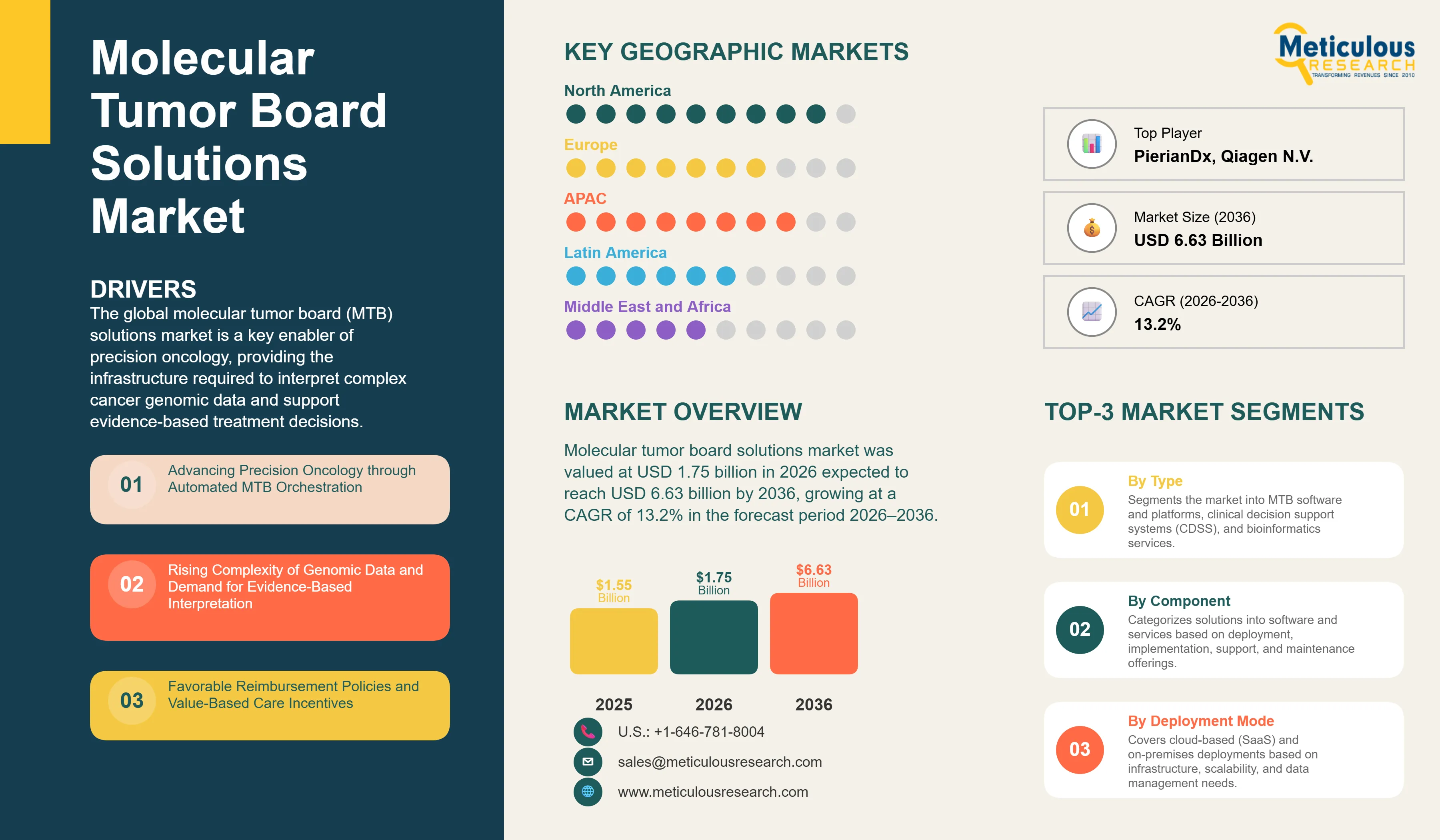
The global molecular tumor board (MTB) solutions market was valued at USD 1.75 billion in 2026. This market is expected to reach USD 6.63 billion by 2036, growing at a CAGR of 13.2% during the forecast period 2026–2036.
 Click here to: Get Free Sample Pages of this Report
The global molecular tumor board (MTB) solutions market is a key enabler of precision oncology, providing the infrastructure required to interpret complex cancer genomic data and support evidence-based treatment decisions. MTB solutions, including specialized software platforms and clinical decision support systems (CDSS), enable multidisciplinary teams comprising oncologists, pathologists, geneticists, and bioinformaticians to integrate data from next-generation sequencing (NGS), clinical guidelines, clinical trials, and real-world evidence into unified patient-level treatment recommendations.
As of 2026, the market is changing rapidly in response to the growing genomic complexity of oncology and the wider adoption of targeted therapies and biomarker-driven treatment approaches. Contemporary MTB platforms are increasingly leveraging AI-powered variant interpretation, evidence curation, and clinical trial matching functionalities, while integrating with electronic health record (EHR) and laboratory information system (LIS) platforms to enhance clinical workflow efficiency. These advancements are designed to improve the accuracy and consistency of molecular interpretation, streamline clinical decision-making, and reduce time-to-treatment across oncology care pathways.
Drivers: Advancing Precision Oncology through Automated Molecular Tumor Board Orchestration
The primary driver for the MTB solutions market is the rapid expansion of precision oncology and the increasing complexity of genomic data, which necessitates a more efficient and data-driven approach to cancer care. According to the American Cancer Society (ACS) 2026 update, the number of cancer patients eligible for targeted therapies based on genomic profiling has increased significantly. This massive patient population is driving the adoption of integrated MTB platforms to manage the high volume of NGS data and clinical documentation. Furthermore, the shift toward digital health and the increasing demand for interoperable healthcare systems are significant drivers. Government initiatives promoting the adoption of genomic medicine and the exchange of health information are compelling oncology centers to invest in MTB solutions that can seamlessly integrate with broader healthcare IT ecosystems.
Restraints: High Implementation Costs and Genomic Data Interoperability Challenges
Market growth is restrained by the high cost of implementing comprehensive MTB solutions and the technical challenges of achieving seamless genomic data interoperability across disparate diagnostic platforms and legacy IT systems. For many oncology centers, the initial capital investment and ongoing maintenance costs of an MTB platform can be a significant barrier. Additionally, the lack of standardized data protocols between different genomic testing providers often leads to data silos, making it difficult to achieve a truly unified molecular patient record. Concerns regarding genomic data privacy and cybersecurity in centralized information hubs also act as deterrents to market expansion. Furthermore, the significant organizational change management and specialized training required for successful MTB implementation can lead to slower adoption rates.
Opportunities: Advancing AI-Driven Genomic Interpretation and Cloud-Native Platforms
The integration of artificial intelligence (AI) and machine learning (ML) into MTB platforms offers substantial growth opportunities. AI-powered tools can analyze complex genomic profiles and clinical evidence to identify subtle therapeutic targets, facilitating more precise treatment planning. By 2026, AI-driven predictive analytics are being used to forecast the efficacy of targeted therapies, enabling proactive intervention and improving patient safety. Furthermore, the shift toward cloud-native (SaaS) MTB platforms provides health systems with superior scalability, flexibility, and lower upfront costs. Cloud-based solutions also facilitate real-time data sharing among diverse specialists, supporting multi-disciplinary collaboration, which is particularly beneficial for regional oncology networks.
Evolution toward Holistic and AI-Powered Oncology Care Orchestration
A defining trend in 2026 is the evolution of MTB platforms from molecular reporting tools into AI-enabled oncology care orchestration hubs. Driven by the growing complexity of precision oncology, these platforms increasingly integrate genomic, pathology, radiology, and longitudinal clinical data within a unified workflow. AI-assisted variant interpretation, evidence curation, and clinical decision support capabilities are being adopted to reduce manual review burdens and improve consistency in molecular assessments. This shift aligns with broader industry efforts to leverage real-world clinical data and EHR-integrated decision support to enhance care coordination, operational efficiency, and treatment selection across oncology pathways. The importance of such capabilities is underscored by the expanding use of biomarker-guided therapies and the growing volume of complex genomic information generated in routine cancer care.
Integration of Real-World Evidence and Clinical Trial Matching
Integration of real-world evidence (RWE) and automated clinical trial matching is becoming a core differentiator for advanced MTB platforms. Regulatory support for RWE continues to strengthen; the U.S. FDA reported that 35 drug, biologic, or vaccine applications had incorporated RWE between 2016 and 2025, while oncology remains a major focus of FDA's dedicated RWE initiatives. Automated trial-matching technologies are also demonstrating strong performance, with recent studies showing AI-based systems can identify relevant oncology trials for more than 90% of patients and achieve over 90% accuracy in eligibility assessment. These capabilities help expand patient access to precision therapies and clinical research opportunities, particularly for rare or biomarker-defined cancer populations.
Analysis by Type
Based on type, the MTB software and platforms segment is expected to hold the largest share in 2026. This dominance is driven by the foundational role of these platforms in managing and interpreting complex genomic data. The clinical decision support systems (CDSS) segment is projected to register the highest CAGR, reflecting the increasing demand for structured interpretation and AI-driven documentation to improve clinical productivity and regulatory compliance. Bioinformatics services remain a critical segment, providing the technical expertise necessary for genomic data processing.
Analysis by Deployment Mode
Based on deployment mode, the cloud-based segment is expected to account for the largest share in 2026. The advantages of cloud deployment, such as scalability, reduced IT burden, and ease of real-time data sharing among specialists, make it highly attractive to oncology centers. Approximately 72% of new MTB installations in 2026 are opting for SaaS models. The on-premises segment continues to serve large research institutes with specific data sovereignty requirements and those with significant existing IT infrastructure.
Geographic Analysis: Regional Growth and Precision Medicine Adoption
North America is expected to account the largest market for Molecular Tumor Board (MTB) solutions in 2026, supported by the widespread adoption of precision oncology, a mature genomic testing ecosystem, and significant investments in clinical decision support technologies across leading cancer centers and integrated healthcare networks. The region also benefits from expanding reimbursement coverage for genomic profiling, a strong regulatory emphasis on precision medicine, and the presence of major oncology informatics vendors and research institutions. These factors continue to position the United States as the primary driver of MTB adoption and innovation.
Asia Pacific is projected to be the fastest-growing regional market during the forecast period. Growth is being driven by the rising cancer burden, increasing adoption of next-generation sequencing (NGS), and government-led initiatives to strengthen precision medicine capabilities across China, Japan, India, and other emerging healthcare markets. Ongoing investments in digital health infrastructure, cloud-based healthcare platforms, and specialized oncology services are accelerating demand for integrated MTB solutions, creating significant opportunities for both global and regional vendors.
The competitive landscape of the global MTB solutions market is characterized by intense innovation and strategic consolidations as vendors seek to provide end-to-end oncology care orchestration platforms. Leading players are differentiating themselves through the sophistication of their AI engines and their ability to provide seamless integration with EHRs and genomic testing platforms. Strategic acquisitions of niche bioinformatics and analytics companies are a common trend as vendors seek to enhance their diagnostic capabilities. The market is also seeing increased collaboration between MTB vendors and pharmaceutical companies to ensure seamless patient matching for clinical trials.
Key players operating in the global MTB solutions market include Roche (NAVIFY) (Switzerland), Illumina, Inc. (U.S.), Thermo Fisher Scientific Inc. (U.S.), Syapse, Inc. (U.S.), Tempus Labs, Inc. (U.S.), PierianDx (U.S.), Qiagen N.V. (Netherlands), Fabric Genomics (U.S.), GenomOncology (U.S.), and various emerging technology providers specializing in oncology informatics and AI-driven diagnostic tools.
The market is projected to reach USD 6.63 billion by 2036, growing at a CAGR of 13.2% from 2026 to 2036.
Oncology centers report a significant reduction in time-to-treatment and an improvement in the accuracy of therapeutic matching.
The clinical decision support systems (CDSS) segment is expected to grow the fastest as oncology centers prioritize AI-driven interpretation and documentation.
Around 65-70% of new deployments are cloud-native, enabling real-time data sharing and scalability.
North America holds the largest share around 40% in 2026, driven by high precision oncology adoption and mature IT infrastructure.
AI enables the prediction of therapeutic efficacy and automates routine data curation, improving diagnostic consistency and patient safety.
The surge in complex genomic data is driving the demand for integrated MTB platforms to manage the high volume of NGS data and clinical documentation.
Cancer research institutes and specialized oncology centers are the primary adopters, managing the highest volumes of complex genomic data.
These systems provide the continuous, data-driven patient management necessary to improve clinical outcomes and reduce the total cost of oncology care.
The top 5 players are Roche (NAVIFY), Illumina, Inc., Thermo Fisher Scientific Inc., Syapse, Inc., and Tempus Labs, Inc.
1. Market Definition & Scope
1.1. Market Definition
1.2. Market Ecosystem
1.3. Currency Considered
1.4. Key Stakeholders
2. Research Methodology
2.1. Research Approach
2.2. Data Collection and Validation
2.2.1. Secondary Research
2.2.2. Primary Research/KOL Interviews
2.3. Market Sizing and Forecast
2.3.1. Market Size Estimation Approach
2.3.1.1. Bottom-Up Approach
2.3.1.2. Top-Down Approach
2.3.2. Growth Forecast Approach
2.3.3. Assumptions for the Study
3. Executive Summary
3.1. Overview
3.2. Segmental Analysis
3.2.1. Market Analysis, by Type
3.2.2. Market Analysis, by Component
3.2.3. Market Analysis, by Deployment Mode
3.2.4. Market Analysis, by End User
3.2.5. Market Analysis, by Geography
3.3. Competitive Analysis
4. Market Insights
4.1. Overview
4.2. Factors Affecting Market Growth
4.2.1. Drivers
4.2.1.1. Advancing Precision Oncology through Automated MTB Orchestration
4.2.1.2. Rising Complexity of Genomic Data and Demand for Evidence-Based Interpretation
4.2.1.3. Favorable Reimbursement Policies and Value-Based Care Incentives
4.2.2. Restraints
4.2.2.1. High Implementation Costs and Multi-Year ROI Cycles
4.2.2.2. Genomic Data Interoperability Challenges Across Fragmented IT Systems
4.2.3. Opportunities
4.2.3.1. Advancing AI-Driven Genomic Interpretation and Predictive Risk Modeling
4.2.3.2. Expansion into Regional Oncology Networks and Telehealth Platforms
4.2.3.3. Integration of Real-World Evidence and Automated Clinical Trial Matching
4.2.4. Challenges
4.2.4.1. Managing Cybersecurity Risks in Centralized Genomic Hubs
4.2.4.2. Addressing Genomic Data Sovereignty and Privacy Regulations
4.2.4.3. Organizational Resistance to Workflow Modernization
4.2.5. Trends
4.2.5.1. Evolution toward Holistic and AI-Powered Oncology Care Orchestration
4.2.5.2. Integration of Real-World Evidence for Personalized Therapeutic Planning
4.3. Porter’s Five Forces Analysis
4.4. Regulatory Landscape
4.5. Value Chain Analysis
5. Global Molecular Tumor Board Solutions Market, by Type
5.1. Overview
5.2. MTB Software and Platforms
5.3. Clinical Decision Support Systems (CDSS)
5.4. Bioinformatics Services
6. Global Molecular Tumor Board Solutions Market, by Component
6.1. Overview
6.2. Software
6.3. Services
7. Global Molecular Tumor Board Solutions Market, by Deployment Mode
7.1. Overview
7.2. Cloud-Based (SaaS) Deployment
7.3. On-Premises Deployment
8. Global Molecular Tumor Board Solutions Market, by End User
8.1. Overview
8.2. Cancer Research Institutes
8.3. Specialized Oncology Centers
8.4. Hospitals and Academic Institutes
8.5. Pharmaceutical and Biotechnology Companies
9. Global Molecular Tumor Board Solutions Market, by Geography
9.1. Overview
9.2. North America
9.2.1. U.S.
9.2.2. Canada
9.3. Europe
9.3.1. Germany
9.3.2. U.K.
9.3.3. France
9.3.4. Italy
9.3.5. Spain
9.3.6. Rest of Europe
9.4. Asia-Pacific
9.4.1. China
9.4.2. Japan
9.4.3. India
9.4.4. South Korea
9.4.5. Australia
9.4.6. Rest of Asia-Pacific
9.5. Latin America
9.5.1. Brazil
9.5.2. Mexico
9.5.3. Rest of Latin America
9.6. Middle East & Africa
9.6.1. GCC Countries
9.6.2. South Africa
9.6.3. Rest of Middle East & Africa
10. Competitive Landscape
10.1. Overview
10.2. Key Strategic Developments
10.3. Market Share Analysis
10.4. Competitive Benchmarking
11. Company Profiles
11.1. Roche (NAVIFY)
11.2. Illumina, Inc.
11.3. Thermo Fisher Scientific Inc.
11.4. Syapse, Inc.
11.5. Tempus AI, Inc.
11.6. PierianDx
11.7. QIAGEN N.V.
11.8. GenomOncology LLC
11.9. Foundation Medicine, Inc.
11.10. Guardant Health, Inc.
11.11. MolecularHealth GmbH
11.12. SOPHiA GENETICS SA
11.13. CureMatch, Inc.
11.14. Flatiron Health (Roche)
11.15. Caris Life Sciences
11.16. NantHealth, Inc.
11.17. OncoDNA SA
11.18. Oncompass Medicine Hungary Kft.
11.19. Variantyx Inc.
11.20. MedGenome Labs Ltd.
12. Appendix
























Published Date: Jan-2025
Published Date: Jan-2025
Published Date: Jan-2025
Published Date: Jul-2024
Published Date: Jun-2024
Subscribe to get the latest industry updates