Floating Wind Turbine Market (2026-2036)
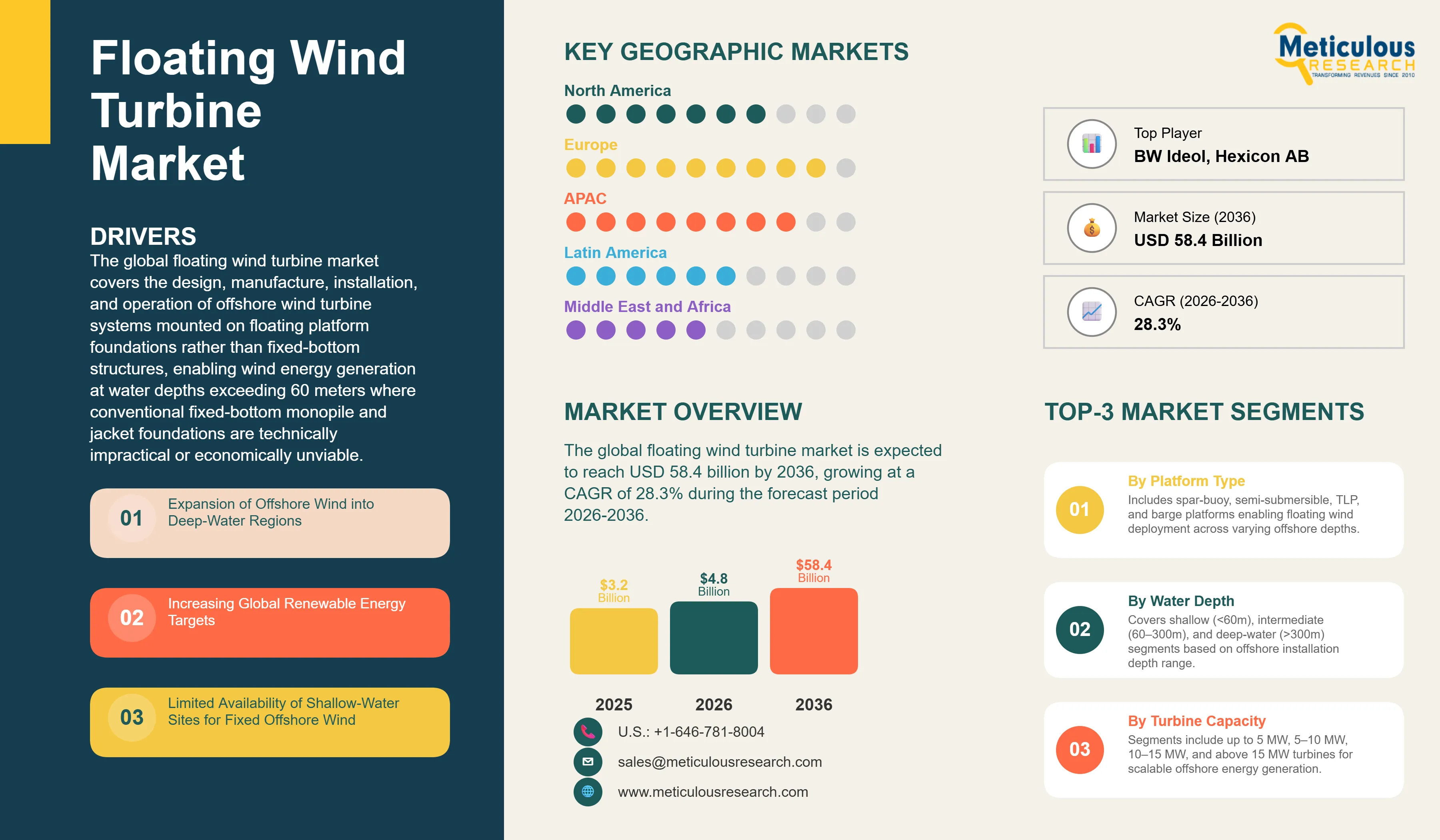
The global floating wind turbine market was valued at USD 3.2 billion in 2025. This market is expected to reach USD 58.4 billion by 2036 from an estimated USD 4.8 billion in 2026, growing at a CAGR of 28.3% during the forecast period 2026-2036.
- Published
- Apr 2026
- Pages
- 290
- Format
- PDF + Excel
- Report ID
- MR-1880
- Base year
- 2025
- 2025 · BASELINE
- $3.20B
- 2036
- $58.40B
- CAGR 2026–2036
- 28.3%
2025 baseline · 2026–2036 forecast at 28.3% CAGR · hover a bar for the value
Key highlights
The global floating wind turbine market is projected to reach USD 58.4 billion by 2036.
The market is expected to grow at a CAGR of 28.3% during the forecast period 2026-2036.
The global floating wind turbine market was valued at USD 3.2 billion in 2025 and is estimated to reach USD 4.8 billion in 2026.
Europe is expected to dominate the global floating wind turbine market with the largest market share in 2026
By platform type, the semi-submersible segment is expected to hold the largest share of the global floating wind turbine market in 2026.
By water depth, the intermediate depth segment (60-300m) is expected to hold the largest share in 2026.
By turbine capacity, the 10-15 MW segment is expected to hold the largest share in 2026.
By application, the utility-scale power generation segment is expected to hold the largest share in 2026.
By project stage, the pilot and demonstration projects segment is expected to hold the largest share in 2026.
Report summary
| Particulars | Details |
|---|---|
| Market Size by 2036 | USD 58.4 Billion |
| Market Size in 2026 | USD 4.8 Billion |
| Market Size in 2025 | USD 3.2 Billion |
| Revenue Growth Rate (2026-2036) | CAGR of 28.3% |
| Format | PDF, Excel & Cloud Portal · 290 pages |
| Dominating Platform Type | Semi-Submersible |
| Fastest Growing Platform Type | Tension Leg Platform (TLP) |
| Dominating Water Depth | Intermediate Depth (60-300m) |
| Fastest Growing Water Depth | Deep Water (>300m) |
| Dominating Turbine Capacity | 10-15 MW |
| Fastest Growing Turbine Capacity | Above 15 MW |
| Dominating Application | Utility-Scale Power Generation |
| Fastest Growing Application | Offshore Hydrogen Production |
| Dominating Project Stage | Pilot & Demonstration Projects |
| Fastest Growing Project Stage | Commercial Projects |
| Dominating Geography | Europe |
| Fastest Growing Geography | Asia-Pacific |
| Base Year | 2025 |
| Forecast Period | 2026 to 2036 |
Report overview
Segments covered: platform type, water depth, turbine capacity, application, project stage.
The global floating wind turbine market covers the design, manufacture, installation, and operation of offshore wind turbine systems mounted on floating platform foundations rather than fixed-bottom structures, enabling wind energy generation at water depths exceeding 60 meters where conventional fixed-bottom monopile and jacket foundations are technically impractical or economically unviable. The market encompasses all major floating platform architectures, including spar-buoy, semi-submersible, tension leg platform, and barge configurations, across the full project lifecycle from development and manufacturing through installation, grid connection, and operations and maintenance.
The growth of the global floating wind turbine market is primarily driven by the progressive exhaustion of accessible shallow-water fixed-bottom offshore wind sites in mature markets including the U.K., Germany, Denmark, and the Netherlands, which is pushing new offshore wind development into deeper waters where floating foundations are required. The availability of significantly stronger and more consistent wind resources at deep-water offshore locations, combined with the removal of visual impact and shipping lane conflict constraints that affect near-shore fixed-bottom developments, provides a compelling resource quality case for floating wind. The national renewable energy transition targets of Japan, South Korea, Norway, France, the U.K., and the United States all specifically identify floating wind as a critical technology for meeting long-term offshore wind capacity ambitions that cannot be met through fixed-bottom resources alone.
However, the market faces key constraints. The levelized cost of energy for floating wind projects currently ranges from USD 100 to 200 per megawatt-hour, representing a substantial premium over fixed-bottom offshore wind costs of USD 60 to 100 per megawatt-hour and an even larger premium over onshore wind. The specialized marine infrastructure required for floating wind installation, including heavy-lift vessels capable of turbine installation at deep-water sites and purpose-built installation ports with sufficient draft for float-out operations, represents a significant supply chain gap that is constraining the pace of project delivery.
Despite these challenges, the market outlook is strongly positive. The learning curve trajectory of floating wind costs is expected to deliver significant LCOE reductions through the forecast period as manufacturing scale increases, installation efficiency improves, and platform designs are standardized. The growing pipeline of commercial-scale floating wind projects in Europe, Asia-Pacific, and North America is creating the demand volume required to drive supply chain investment and manufacturing cost reduction. The strategic entry of major oil and gas companies including Equinor, Shell, TotalEnergies, and Aker Solutions into floating wind is bringing substantial capital, offshore project management expertise, and marine engineering capabilities that are accelerating the technology's commercial maturation.
Report infographic
Market dynamics
7 factors across 3 forcesExpansion of Offshore Wind into Deep-Water Regions
The primary structural driver of the global floating wind turbine market is the progressive depletion of accessible shallow-water fixed-bottom offshore wind development sites in countries with mature offshore wind programs, which is driving the industry's geographic expansion into deeper waters where floating foundations are the only technically viable installation method. The U.K.'s North Sea shelf, the German Bight, and the Dutch North Sea exclusive economic zone all have limited remaining shallow-water development capacity after decades of fixed-bottom offshore wind buildout, and the government renewable capacity targets that require continued offshore wind expansion in these markets necessitate a transition to floating wind in deeper water locations. Similarly, the deep continental shelf topography of Japan, Norway's Atlantic coast, the U.S. Pacific Coast states, and much of the Mediterranean coastline means that the majority of the available offshore wind resource in these markets requires floating foundations, making floating wind technology development a strategic national energy priority rather than an optional premium technology.
Increasing Global Renewable Energy Targets
The escalating national and supranational renewable energy targets adopted across major economies in response to the Paris Agreement climate commitments and the energy security implications of the 2022 European energy crisis are driving unprecedented offshore wind capacity expansion ambitions that explicitly depend on floating wind technology to achieve their most ambitious targets. The European Union's REPowerEU program raised the EU offshore wind capacity target to 300 GW by 2050, with floating wind identified as providing 30 GW or more of this target. The U.K.'s North Sea Transition Deal and offshore wind sector deal identify floating wind as a priority technology for delivering the 50 GW offshore wind target for 2030 that cannot be met entirely from fixed-bottom resources. Japan's GW-class floating wind targets, South Korea's 14.3 GW offshore wind program incorporating substantial floating components, and the U.S. federal government's identification of floating wind as critical for Pacific and Atlantic deep-water leasing all translate directly into project development pipeline and technology investment demand.
Table of contents
13 chapters · 156 sections · 290 pages · click to expandSegmental analysis
| Segment | Largest share (2026) | Fastest growth (2026–2036) |
|---|---|---|
| By Platform Type | Semi-Submersible | Tension leg platform (TLP) |
| By Water Depth | Intermediate Depth (60-300m) | Deep water segment (above 300m) |
| By Turbine Capacity | 10-15 MW | Above 15 MW |
| By Application | Utility-Scale Power Generation | Offshore hydrogen production |
| By Project Stage | Pilot & Demonstration Projects | Commercial projects |
By Platform Type
- Semi-Submersible to Dominate
- The semi-submersible segment is expected to account for the largest share of the global floating wind turbine market.
- The large share of this segment is attributed to the semi-submersible design's superior versatility across water depths from 60 to over 1,000 meters, the broader commercial development pipeline associated with semi-submersible concepts from developers including Principle Power's WindFloat platform, BW Ideol's damping pool design, and Hexicon's TwinWind multi-turbine semi-submersible, and the port-side assembly and wet-tow installation methodology that avoids the need for specialized heavy-lift vessel operations required by spar-buoy installations.
- However, the tension leg platform (TLP) segment is poised to register the highest CAGR during the forecast period.
- The high growth of this segment is attributed to TLP technology's particularly favorable motion characteristics that minimize dynamic loads on turbine components, the smaller structural material requirement relative to semi-submersible designs at moderate water depths, and the growing commercial interest in TLP concepts from developers targeting deployments in the 60 to 200 meter depth range where TLP designs offer compelling cost and performance advantages.
By Water Depth
- Intermediate Depth (60-300m) to Hold the Largest Share
- The intermediate depth segment is expected to account for the largest share of the global floating wind turbine market.
- This dominance reflects the concentration of current and near-term floating wind project development in the 60 to 300 meter depth range, where established floating platform technologies including spar-buoy and semi-submersible designs have demonstrated commercial viability and where the strongest project pipelines across Europe, Asia-Pacific, and North America are located.
- The intermediate depth range also benefits from existing subsea cable and grid connection infrastructure proximity in the North Sea and Japanese offshore energy zones.
- However, the deep water segment (above 300m) is projected to register the highest CAGR during the forecast period.
- This growth is driven by the progressive expansion of commercial floating wind development into deeper offshore zones as platform technology matures and LCOE declines, the large and high-quality wind resource available in deep-water locations off Japan's Pacific coast, the U.S. West Coast, and the Atlantic margins of Europe, and the strategic importance of very deep water floating wind development for countries including Japan and the U.S. Pacific states where the majority of offshore wind resource lies in water depths exceeding 300 meters.
By Turbine Capacity
- The 10-15 MW Segment to Hold the Largest Share
- The 10-15 MW segment is expected to account for the largest share of the global floating wind turbine market.
- This dominance reflects the deployment of current-generation commercial offshore wind turbines from Siemens Gamesa, Vestas, and GE Vernova in the 10 to 15 MW class on floating foundations across the expanding pipeline of pilot, pre-commercial, and early commercial floating wind projects, where this turbine size range represents the optimal balance of available turbine technology maturity, platform engineering compatibility, and energy cost economics.
- However, the above 15 MW segment is projected to register the highest CAGR during the forecast period.
- This growth is driven by the development of next-generation turbine platforms specifically targeting 18 to 22 MW capacity for floating wind applications, the strong cost reduction incentive of maximizing turbine capacity to spread fixed floating foundation costs across greater energy output, and the commitment of major turbine OEMs to develop and commercialize ultra-large offshore turbine platforms specifically optimized for floating wind deployments where the cost reduction benefit of maximum turbine scaling is most pronounced.
By Application
- Utility-Scale Power Generation to Hold the Largest Share
- The utility-scale power generation segment is expected to account for the largest share of the global floating wind turbine market.
- This dominance reflects the focus of the current commercial floating wind project pipeline on grid-connected power generation, driven by the offshore wind capacity targets of European, Asian, and North American governments that are stimulating the development of floating wind farms primarily as large-scale renewable electricity generation assets.
- However, the offshore hydrogen production segment is projected to register the highest CAGR during the forecast period.
- This growth is driven by the rapidly expanding global green hydrogen program pipeline, the technical and economic advantages of combining floating wind generation with offshore electrolysis to produce hydrogen for export by pipeline rather than submarine power cable, and the strategic interest of oil and gas companies in developing offshore hydrogen production capabilities that leverage their existing offshore infrastructure expertise and hydrogen distribution relationships.
By Project Stage
- Pilot & Demonstration Projects to Hold the Largest Share
- The pilot and demonstration projects segment is expected to account for the largest share of the global floating wind turbine market by installed capacity and value, reflecting the current market maturity stage where the majority of operational floating wind capacity globally consists of first-of-kind demonstration deployments including Hywind Scotland, Hywind Tampen, WindFloat Atlantic, Provence Grand Large, and the EDP Kincardine project that collectively represent the operational technology validation base of the industry.
- However, the commercial projects segment is projected to register the highest CAGR during the forecast period.
- This growth is driven by the transition of the global floating wind pipeline from demonstration and pre-commercial stages toward full commercial project delivery, supported by the advancing government tender programs in the U.K., France, Norway, Japan, and South Korea that are awarding commercial floating wind development rights, the accumulating operational evidence from pioneer deployments that is enabling project finance underwriting of commercial-scale projects, and the supply chain investment being mobilized in response to the commercial project pipeline.
Geographic analysis
Europe
Largest shareIn 2026, Europe is expected to account for the largest share of the global floating wind turbine market. The largest share of this region is mainly due to Europe's first-mover advantage in floating wind technology development and deployment, anchored by Equinor's Hywind Scotland project as the world's first commercial floating wind farm since 2017, the strong national floating wind development programs in the U.K., Norway, France, and Portugal, and the European offshore wind industry's accumulated technical expertise, established supply chain, and regulatory frameworks that provide a structural head start over other regions. The U.K.'s ScotWind leasing round awards representing the largest commercial floating wind capacity allocation globally to date, Norway's Utsira Nord development process, France's 250 MW commercial floating tender program, and Portugal's Atlantic offshore wind zone development collectively constitute the world's most advanced commercial floating wind pipeline.
Asia-Pacific
Fastest growthHowever, the Asia-Pacific floating wind turbine market is expected to grow at the fastest CAGR during the forecast period. The region's rapid growth is driven by Japan's geographic imperative for floating wind given the deep-water bathymetry surrounding most of the country's coastline, the Japanese government's designated floating wind promotion zones and capacity targets representing several gigawatts of commercial pipeline, South Korea's 14.3 GW offshore wind target that incorporates substantial floating wind components in deep-water sites off the southwestern and eastern coasts, China's expansion of offshore wind development into deep-water East China Sea and South China Sea zones, and Taiwan's emerging floating wind program driven by the deep-water conditions off its eastern coast. The strong domestic turbine manufacturing capability of China's Mingyang Smart Energy and the technical collaboration programs between Korean shipbuilders and floating wind developers are creating Asia-Pacific supply chain capabilities that will support the region's commercial floating wind scale-up.
North America
North America is establishing a substantial floating wind development pipeline concentrated on the U.S. West Coast states of California, Oregon, and Washington, where the deep-water continental shelf makes floating wind the only viable offshore wind technology, and on the U.S. East Coast deep-water lease areas in the Gulf of Maine. The Biden administration's 15 GW floating wind target for 2035 and the Bureau of Ocean Energy Management's floating wind commercial lease auctions for the Pacific Coast and Gulf of Maine are creating a large U.S. floating wind development pipeline. The strong involvement of oil and gas companies including Shell and TotalEnergies in U.S. floating wind lease holdings and development programs is providing capital and technical resources that are advancing the U.S. market toward commercial project delivery.
Competitive landscape
- Siemens Gamesa Renewable Energy · Spain
- Vestas Wind Systems A/S · Denmark
- GE Vernova (U.S.)
- Equinor ASA · Norway
- Orsted A/S · Denmark
- Principle Power Inc. (U.S.)
- BW Ideol · France
- Aker Solutions ASA · Norway
- Hexicon AB · Sweden
- Mingyang Smart Energy · China
- Iberdrola S.A. · Spain
- Shell plc (U.K./Netherlands)
- TotalEnergies SE · France
- EDF Renewables · France
- RWE Renewables · Germany
Frequently asked questions
The global floating wind turbine market is expected to reach USD 58.4 billion by 2036 from an estimated USD 4.8 billion in 2026, at a CAGR of 28.3% during the forecast period 2026-2036.
Cite this report
Meticulous Research. (2026). Floating Wind Turbine Market - Global Opportunity Analysis and Industry Forecast (2026-2036) (Report No. MR-1880). Meticulous Market Research Pvt. Ltd. https://www.meticulousresearch.com/product/floating-wind-turbine-market-6563