Nonwoven Filter Media Market (2025-2035)
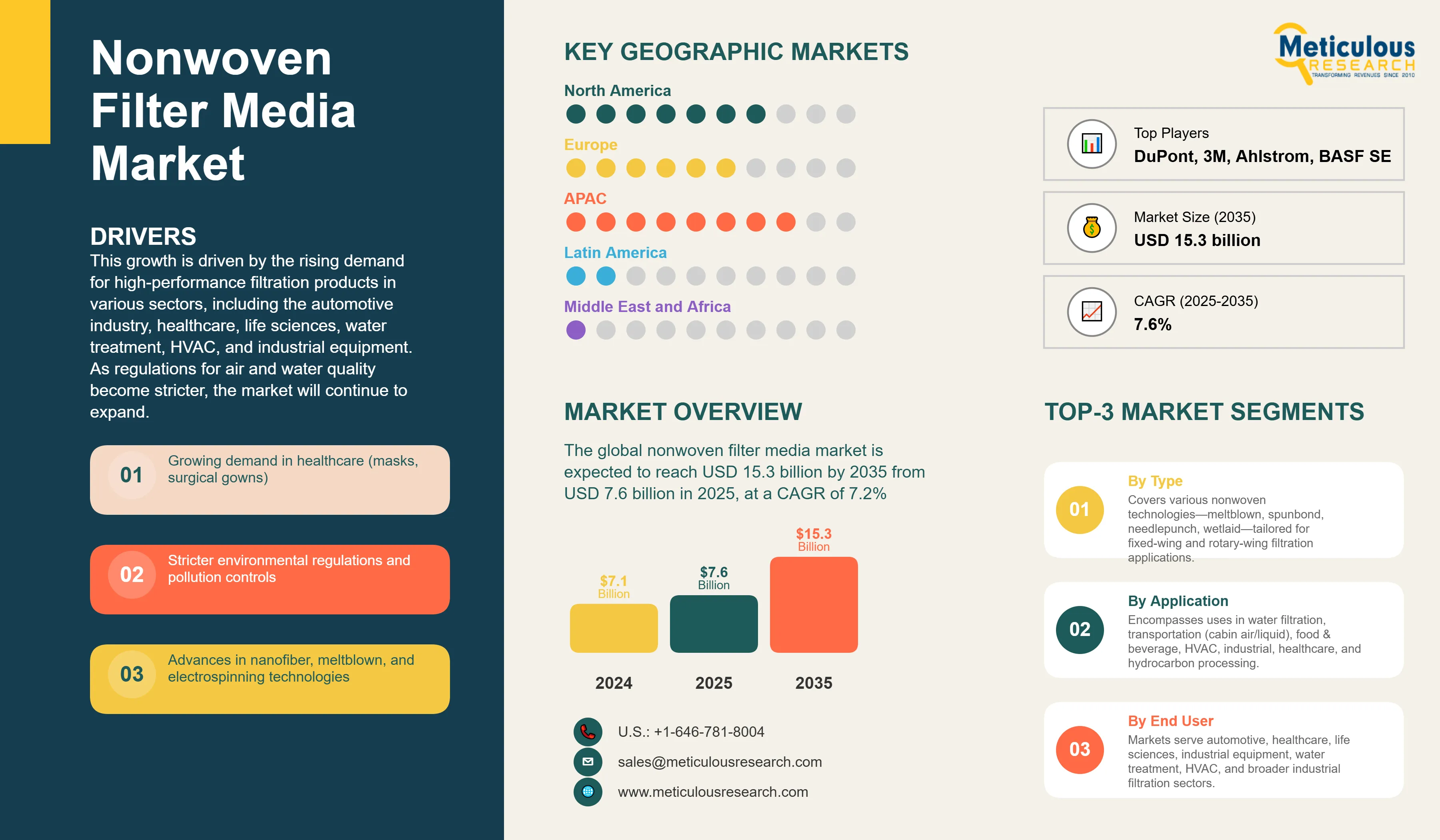
The global nonwoven filter media market was valued at USD 7.1 billion in 2024. The market is expected to reach USD 15.3 billion by 2035 from USD 7.6 billion in 2025, at a CAGR of 7.2%.
- Published
- Sep 2025
- Pages
- 210
- Format
- PDF + Excel
- Report ID
- MR-1582
- Base year
- 2024
- 2024 · BASELINE
- $7.10B
- 2035
- $15.30B
- CAGR 2025–2035
- 7.2%
2024 baseline · 2025–2035 forecast at 7.2% CAGR · hover a bar for the value
Key highlights
Spunbond Segment Leads Market with Largest Revenue Share of 25-30% in 2025
Healthcare Segment Drives Market Growth Through Medical Device Integration
Asia Pacific Leads the Global Nonwoven Filter Media Market
China Strengthens Nonwoven Filter Media Market Leadership in Asia
Report summary
| Particulars | Details |
|---|---|
| Market size (2025) | USD 7.6 billion |
| Revenue forecast in 2035 | USD 15.3 billion |
| CAGR (2025-2035) | 7.6% |
| Format | PDF, Excel & Cloud Portal · 210 pages |
| Base Year | 2024 |
| Forecast period | 2025 – 2035 |
| Report coverage | Market size and forecast, competitive landscape and benchmarking, country/regional level analysis, key trends, growth drivers, and restraints |
| Segments covered | Platform (Fixed Wing and Rotary Wing), Application, and Geography |
| Regional scope | North America, Europe, Asia-Pacific, Latin America, and the Middle East & Africa |
| Key companies profiled | DuPont, 3M, Ahlstrom, Berry Global Inc., BASF SE, Cerex Advanced Fabrics, Inc., Glatfelter Corporation, DelStar Technologies, Inc., PFNonwovens Holding s.r.o., Kimberly-Clark Corporation, Honeywell International, Inc., and Other Key Players. |
| Customization | Comprehensive report customization with purchase. Addition or modification to country, regional & segment scope available |
| Pricing Details | Access customized purchase options to meet your specific research requirements. Explore flexible pricing models. |
Report overview
Segments covered: platform, application.
This growth is driven by the rising demand for high-performance filtration products in various sectors, including the automotive industry, healthcare, life sciences, water treatment, HVAC, and industrial equipment. As regulations for air and water quality become stricter, the market will continue to expand. Industrial uses like HVAC systems, vehicle air filtration, and water management highlight ongoing growth, as manufacturers aim to improve functionality and air quality.
Technological advances include using nanofiber technologies, antimicrobial treatments, and biodegradable materials. These developments address environmental concerns while greatly improving filtration performance. The use of new nonwoven manufacturing methods, efficient raw materials, and better durability from nanofiber integration also supports market growth.
With a growing global focus on sustainability and stricter regulatory compliance, nonwoven filter media are expected to play a key role in providing clean air, safe water, and industrial safety across various industries.
The nonwoven filter media market is highly competitive, with global leaders and specialized manufacturers driving innovation, scale, and strategic expansion.
Key players, including DuPont, 3M, Ahlstrom, Berry Global Inc., BASF SE, Cerex Advanced Fabrics, Glatfelter Corporation, DelStar Technologies, PFNonwovens Holding, Kimberly-Clark Corporation, and Honeywell International, dominate the landscape through diversified product portfolios and strong global footprints.
These companies are investing heavily in R&D to develop advanced nonwoven technologies, including nanofiber-based, biodegradable, and high-performance filter media that address evolving regulatory and sustainability requirements.
Strategic initiatives such as mergers and acquisitions, joint ventures, and capacity expansions are being pursued to strengthen market share and enhance geographic reach.
North America maintains a considerable revenue share in the nonwoven filter media market, propelled by stringent environmental regulations, healthcare advancements, and rising demand for high-performance filtration systems.
The US leads regional growth, with strong regulatory enforcement from agencies such as the EPA (Environmental Protection Agency) and OSHA, which are driving the adoption of advanced air and water filtration technologies across industrial, residential, and municipal sectors.
Canada complements this growth with initiatives focused on clean water programs and green building standards, creating new opportunities for filtration solutions. The momentum is also supported by significant industry investments; for example, in early 2023, WPT Nonwovens Corp. announced a USD 18.5 million investment in a new synthetic-fiber nonwoven production line in Kentucky to address surging demand.
With the combination of policy-driven demand, technology development, and growing needs for clean air and water, North America is positioned to sustain its growth potential in the coming years.
Germany’s strong industrial base and rigorous environmental standards position it as one of the key markets for nonwoven filter media in Europe. With a well-established presence in automotive, chemical, and manufacturing sectors, Germany generates significant demand for advanced filtration solutions to meet both industrial process requirements and regulatory compliance. Moreover, the country’s adherence to strict EU-wide directives such as the Energy Performance of Buildings Directive (EPBD) and the Industrial Emissions Directive (IED), along with national laws on air quality and water treatment, compels industries to adopt high-performance nonwoven materials.
In addition, Germany’s leadership in green technology and sustainable manufacturing is accelerating the adoption of eco-friendly and recyclable nonwovens, aligning with the nation’s long-term decarbonization targets under the Energiewende (energy transition). Backed by its robust R&D ecosystem and strong focus on quality, Germany continues to act as both a major consumer and innovator in the nonwoven filter media market, setting benchmarks in environmental compliance and industrial-scale adoption.
Nonwoven Filter Media Market Assessment—By Technology Meltblown
Spunbond
Needlepunch
Wetlaid
Other Technologies
Water Filtration
Transportation (Automotive Cabin Air, Liquid Filtration)
Food & Beverages
HVAC
Manufacturing & Industrial Filters
Advanced Technology Filters
Healthcare (Masks, Surgical Gowns, Sterilization)
Hydrocarbon Processing (Oil & Gas)
The market size and forecast for each of the above segment and sub-segment is provided for the following countries and regions:
North America U.S.
Canada
Germany
U.K.
France
Netherlands
Switzerland
Rest of Europe
China
Japan
South Korea
Taiwan
India
Singapore
Australia
Rest of Asia-Pacific
Brazil
Mexico
Argentina
Rest of Latin America
UAE
Saudi Arabia
Israel
South Africa
Rest of Middle East & Africa
The healthcare segment is set for steady growth throughout the forecast period, driven by rising demand for medical masks, surgical gowns, drapes, and wound care products.
Companies like Freudenberg and Ahlstrom have introduced bioactive and antiviral nonwoven layers that improve protection against pathogens, which is vital for patient safety, especially in settings that require strict infection control.
There is also a growing trend toward sustainable, recyclable, and biodegradable medical nonwovens.
This aligns with global efforts for environmental sustainability and regulatory pressures.
These materials meet the strict functional needs of medical applications while helping to reduce environmental impact.
The focus on infection prevention and patient safety has led to broader use of single-use nonwoven products in hospitals and healthcare facilities.
This shift creates significant market opportunities for nonwoven filtration technologies, as disposable medical products become essential tools in fighting healthcare-associated infections and maintaining sterile conditions.
Report infographic
Key Factors Impacting Growth of Global Nonwoven Filter Media Market (2025–2035)
Base CAGR: 7.2%
|
Category |
Key Factor |
Short-Term Impact (2025–2028) |
Long-Term Impact (2029–2035) |
Estimated CAGR Impact |
|
Drivers |
1. Rising Demand in Healthcare & Hygiene Applications |
Increased use of masks, respirators, surgical gowns, and wipes |
Permanent integration in healthcare protocols |
▲ +2.6% |
|
2. Stricter Environmental Regulations & Pollution Control |
Growth in industrial air and water filtration |
Widespread adoption of advanced filtration |
▲ +2.2% |
|
|
3. Technological Advancements in Nonwoven Production |
Adoption of nanofiber and electrospun materials |
Development of smart, self-cleaning, and sustainable filter media |
▲ +2.0% |
|
|
Restraints |
1. Volatile Raw Material Prices |
Cost fluctuations in polypropylene, polyester, and specialty fibers affect margins |
Diversification into bio-based and recycled inputs reduces price sensitivity |
▼ −1.5% |
|
2. Environmental Disposal Concerns |
Growing scrutiny over single-use synthetic nonwovens |
Advances in biodegradable and compostable solutions |
▼ −1.3% |
|
|
Opportunities |
1. Expansion into Bio-Based & Sustainable Materials |
Initial market traction with eco-conscious buyers and premium products |
Large-scale replacement of synthetic nonwovens |
▲ +1.9% |
|
2. Growth in Emerging Markets |
Rising infrastructure for clean water and air solutions |
Long-term demand driven by urbanization and industrialization |
▲ +1.7% |
|
|
Trends |
1. Shift Toward Smart Filtration Systems |
Integration of sensors for air/water quality monitoring s |
Industry-wide adoption of IoT-enabled filtration systems |
▲ +1.5% |
|
Challenges |
1. Limited Recycling Infrastructure |
Restricts the adoption of sustainable disposal solutions |
Expansion of recycling systems and take-back programs |
▼ −1.0% |
Nonwoven Filter Media Market Analysis
Table of contents
11 chapters · 137 sections · 210 pages · click to expandSegmental analysis
| Segment | Largest share (2025) | Fastest growth (2025–2035) |
|---|---|---|
| By Technology | Spunbond | — |
By Technology
- Spunbond Segment Leads Market with Largest Revenue Share of 25-30% in 2025
- The spunbond segment leads the nonwoven filter media market in 2025, with about 25-30% share of the total revenue.
- This is mainly ttributed to spunbond technology’s high tensile strength, lightweight nature, and cost-effectiveness, making it a popular choice for various filtration applications.
- Spunbond media is known for its durability, flexibility, and reliable performance, allowing its wide use in automotive cabin air filters, healthcare protective gear, HVAC systems, and environmental protection.
- Continuous improvements in technology have led to the creation of finer spunbond fibers that boost filtration efficiency.
- Innovations like biodegradable spunbond nonwovens and eco-friendly manufacturing methods are increasingly driving market growth by tackling sustainability issues.
- For example, Freudenberg Performance Materials introduced fine denier spunbond nonwovens made from different polymer blends and either monocomponent or bicomponent fibers, showcasing the segment’s progress and market potential.
Geographic analysis
Asia-Pacific
Largest shareAsia-Pacific leads the global nonwoven filter media market, accounting for 45-50% revenue share in 2025. This market dominance is driven by its strong manufacturing base, rising healthcare demand, and expanding environmental regulations. Countries such as China, India, and Japan are at the forefront, supported by rapid industrialization, large-scale infrastructure projects, and increasing investments in healthcare, water treatment, and air quality management. China dominates regional growth with its extensive nonwoven production capacity and government-led initiatives targeting pollution control and clean energy adoption. India is emerging as a fast-growing market, supported by government programs for clean water and public health, while Japan contributes through innovation in advanced nonwoven technologies and sustainable materials. The region also benefits from cost-competitive raw material supply and large-scale consumer demand, making it the largest and most influential hub for nonwoven filter media globally. With continued investments in sustainability, healthcare, and industrial applications, the Asia-Pacific region is expected to maintain its leadership position while delivering the fastest growth worldwide. China accounts for the largest share of the Asia-Pacific nonwoven filter media market in 2025. This leadership is supported by the country's large industrialization, strong manufacturing infrastructure, and growing adoption of filtration solutions in the automotive, water treatment, and healthcare sectors. China's automotive industry, the world's largest has significantly increased demand for nonwoven filter media in cabin air filters, engine intake systems, and emission control, resulting in consistent market growth. Furthermore, the country's rapid urbanization and stringent environmental regulations have prompted investments in advanced filtration systems for cleaner air and water. China's strong production capacity and cost advantages enable it to meet both domestic and international demand, reinforcing its position as the region's market leader. These factors ensure that China remains the primary source of innovation and growth in Asia-Pacific nonwoven filter media market. Asia Pacific Leads the Global Nonwoven Filter Media Market China Strengthens Nonwoven Filter Media Market Leadership in Asia
Competitive landscape
- April 2023
Ahlstrom introduced a cutting-edge line of environmentally friendly and sustainable filtering solutions designed specifically for automotive applications. This technology, known as Ahlstrom ECOTM, addresses the global transportation industry's increasing sustainability demands while also providing filter manufacturers with an innovative and environmentally conscious alternative.
- November 2024
Johns Manville opened a modern micro-fiberglass manufacturing line at its Wertheim facility in Germany. This line focuses on producing Evalith® filtration materials. This filter media captures very fine particles, including viruses, bacteria, and dust as small as one micrometer. It greatly improves indoor air quality in important places like hospitals, schools, and offices.
- —
The healthcare sector is a significant growth driver for the global nonwoven filter media market, as demand for high-quality filtration solutions expands across medical, pharmaceutical, and personal protection applications.
- —
Nonwoven filter media is widely used in surgical masks, respirators, gowns, drapes, and sterile packaging, where filtration efficiency, breathability, and safety standards are critical. The expansion of this sector is reinforced by growing healthcare expenditures. In addition, the increasing prevalence of chronic respiratory diseases and rising investments in biopharmaceutical manufacturing are boosting demand for advanced filtration in cleanrooms and sterile environments.
- —
Environmental Policies and Pollution Concerns are Driving Nonwoven Filter Media Growth: The growing emphasis on environmental policies and rising concerns over pollution is a major catalyst for the expansion of the nonwoven filter media market. Governments worldwide are implementing stricter regulations on air quality, water treatment, and industrial emissions, compelling industries to adopt advanced filtration technologies that rely heavily on nonwoven materials. For instance, the World Health Organization (WHO) estimates that 99% of the global population breathes air exceeding safe pollution limits, highlighting the urgent need for efficient air filtration solutions in both urban and industrial environments. As pollution concerns intensify and regulatory frameworks tighten, nonwoven filter media are positioned as a critical enabler of compliance, sustainability, and long-term environmental protection.
- DuPont
- 3M
- Ahlstrom
- Berry Global Inc.
- BASF SE
- Cerex Advanced Fabrics, Inc.
- Glatfelter Corporation
- DelStar Technologies, Inc.
- PFNonwovens Holding s.r.o
- Kimberly-Clark Corporation
- Honeywell International, Inc.
- Other Key Players
Frequently asked questions
The nonwoven filter media market is estimated to be USD 7.6 billion in 2025 and grow at a CAGR of 7.2% to reach USD 15.3 billion by 2035.
Cite this report
Meticulous Research. (2025). Nonwoven Filter Media Market - Global Opportunity Analysis And Industry Forecast (2025-2035) (Report No. MR-1582). Meticulous Market Research Pvt. Ltd. https://www.meticulousresearch.com/product/nonwoven-filter-media-market-6265