Electric Mining Equipment Market (2026-2036)
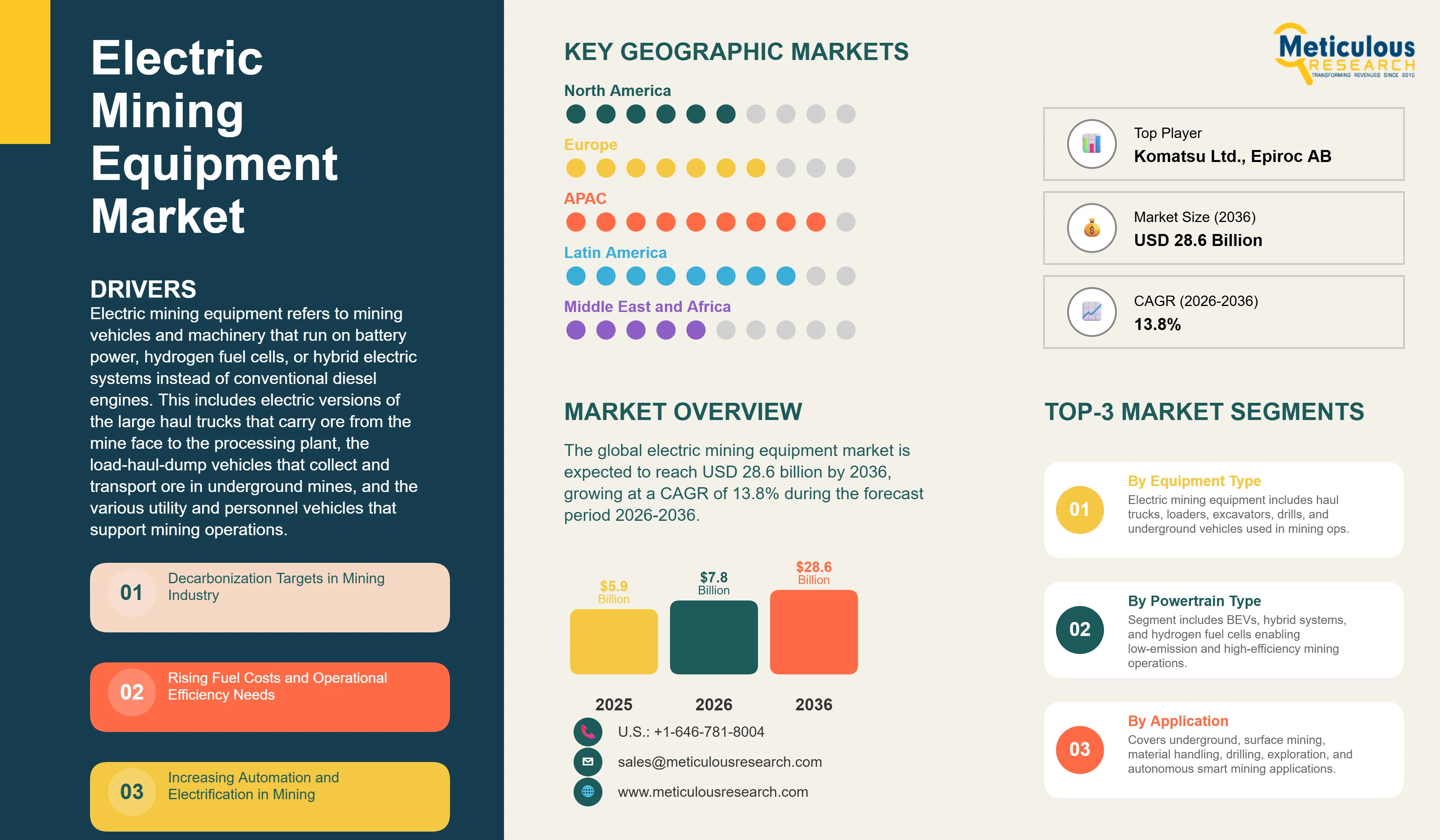
The global electric mining equipment market was valued at USD 5.9 billion in 2025. This market is expected to reach USD 28.6 billion by 2036 from an estimated USD 7.8 billion in 2026, growing at a CAGR of 13.8% during the forecast period 2026-2036.
- Published
- Apr 2026
- Pages
- 290
- Format
- PDF + Excel
- Report ID
- MR-1925
- Base year
- 2025
- 2025 · BASELINE
- $5.90B
- 2036
- $28.60B
- CAGR 2026–2036
- 13.8%
2025 baseline · 2026–2036 forecast at 13.8% CAGR · hover a bar for the value
Key highlights
The global electric mining equipment market is projected to reach USD 28.6 billion by 2036.
The market is expected to grow at a CAGR of 13.8% during the forecast period 2026-2036.
The global electric mining equipment market was valued at USD 5.9 billion in 2025 and is estimated to reach USD 7.8 billion in 2026.
Asia-Pacific is expected to dominate the global electric mining equipment market with the largest market share in 2026, while Latin America is projected to register the highest CAGR during the forecast period.
By equipment type, the electric haul trucks segment is expected to hold the largest share of the market in 2026, while the electric drilling equipment segment is projected to register the highest CAGR during the forecast period.
By powertrain type, the battery electric vehicles segment is expected to hold the largest share in 2026, while the hydrogen fuel cell vehicles segment is projected to register the highest CAGR during the forecast period.
By application, the underground mining segment is expected to hold the largest share in 2026, while the surface mining segment is projected to register the highest CAGR during the forecast period.
By end user, the metal mining companies segment is expected to hold the largest share in 2026, while the contractors and mining service providers segment is projected to register the highest CAGR during the forecast period.
By battery type, the lithium-ion batteries segment is expected to hold the largest share in 2026, while the solid-state batteries segment is projected to register the highest CAGR during the forecast period.
By autonomy level, the semi-autonomous systems segment is expected to hold the largest share in 2026, while the fully autonomous systems segment is projected to register the highest CAGR during the forecast period.
Report summary
| Particulars | Details |
|---|---|
| Market Size by 2036 | USD 28.6 Billion |
| Market Size in 2026 | USD 7.8 Billion |
| Market Size in 2025 | USD 5.9 Billion |
| Revenue Growth Rate (2026-2036) | CAGR of 13.8% |
| Format | PDF, Excel & Cloud Portal · 290 pages |
| Dominating Equipment Type | Electric Haul Trucks |
| Fastest Growing Equipment Type | Electric Drilling Equipment |
| Dominating Powertrain Type | Battery Electric Vehicles (BEVs) |
| Fastest Growing Powertrain Type | Hydrogen Fuel Cell Vehicles |
| Dominating Application | Underground Mining |
| Fastest Growing Application | Surface Mining |
| Dominating End User | Metal Mining Companies |
| Fastest Growing End User | Contractors and Mining Service Providers |
| Dominating Battery Type | Lithium-Ion Batteries |
| Fastest Growing Battery Type | Solid-State Batteries |
| Dominating Autonomy Level | Semi-Autonomous Systems |
| Fastest Growing Autonomy Level | Fully Autonomous Systems |
| Dominating Geography | Asia-Pacific |
| Fastest Growing Geography | Latin America |
| Base Year | 2025 |
| Forecast Period | 2026 to 2036 |
Report overview
Segments covered: equipment type, application, end user, battery type.
Electric mining equipment refers to mining vehicles and machinery that run on battery power, hydrogen fuel cells, or hybrid electric systems instead of conventional diesel engines. This includes electric versions of the large haul trucks that carry ore from the mine face to the processing plant, the load-haul-dump vehicles that collect and transport ore in underground mines, excavators, drilling rigs, and the various utility and personnel vehicles that support mining operations. Replacing diesel equipment with electric equivalents in a mine eliminates diesel exhaust and significantly reduces heat generation, which is particularly valuable in underground mines where ventilation is expensive, difficult to maintain, and limited in what it can safely remove. Diesel exhaust in an underground mine requires enormous ventilation systems that consume large amounts of energy and represent a significant share of the mine's total operating cost, so switching to electric equipment reduces ventilation requirements directly and saves money on energy that would otherwise go to pushing clean air through kilometers of underground tunnels.
The market is growing strongly because several powerful forces are pushing the mining industry toward electrification at the same time. Mining companies have made public net-zero emission commitments that require them to reduce or eliminate diesel combustion across their operations. Diesel fuel is one of the largest operating cost items for most mines, and rising fuel prices are making electric equipment increasingly attractive on purely financial grounds as battery costs fall. Regulators in major mining jurisdictions including Canada, Australia, and the European Union are tightening underground air quality standards, creating compliance requirements that are more cost-effectively met through electrification than through increasingly expensive diesel emission control technology. And the pioneering mines that have already deployed battery electric underground equipment from Epiroc, Sandvik, and other manufacturers are reporting real operational cost savings that are proving the business case to the broader industry.
Two significant opportunities are shaping the next phase of market development. The combination of electric mining equipment with on-site renewable energy microgrids is emerging as a very compelling package for remote mines that currently pay very high prices for diesel fuel that must be transported long distances. A mine that installs solar panels and battery storage to generate its own electricity and uses that electricity to power its mining fleet can dramatically reduce its total operating cost while eliminating the carbon emissions and logistical complexity of diesel supply. This renewable plus electric mining model is attracting strong interest from mining operators in sun-rich and remote locations including Australia, Chile, and parts of Africa. In addition, the combination of electric drivetrains with autonomous vehicle technology is creating a new generation of fully autonomous electric mining fleets that can operate continuously without shift changes, human fatigue constraints, or the ventilation requirements of crewed diesel equipment, potentially transforming the productivity economics of mining operations.
Report infographic
Market dynamics
7 factors across 3 forcesDecarbonization Targets in Mining Industry
The primary driver of the electric mining equipment market is the mining industry's growing pressure to reduce its greenhouse gas emissions in response to the climate commitments of individual mining companies, the requirements of investors and lenders who are applying increasingly strict ESG criteria to mining sector financing, and the regulatory requirements of governments in major mining jurisdictions. Mining is an emissions-intensive industry because it uses enormous quantities of diesel fuel to power its heavy equipment fleets, with diesel combustion accounting for 30 to 50% of scope 1 emissions at most surface and underground mines. For mining companies that have committed to net-zero operations by 2050 or to 30 to 50% emission reductions by 2030, fleet electrification is not an optional sustainability improvement but a mathematically necessary component of their climate strategy because no other available technology can reduce diesel combustion emissions at the scale that electrification can deliver. BHP, Newmont, Anglo American, Glencore, and Rio Tinto have all made public emission reduction commitments that require significant fleet electrification, and these commitments create the durable and time-bounded demand for electric mining equipment that is driving rapid market growth.
Rising Fuel Costs and Operational Efficiency Needs
Diesel fuel represents 20 to 35% of the total operating cost at most large mines, making it one of the most controllable and financially impactful cost categories that mine operators can address through equipment investment. Switching from diesel to battery electric equipment eliminates the direct fuel cost entirely, replacing it with electricity costs that are typically 40 to 70% lower per unit of energy for mines that can source electricity from the grid or from on-site renewable generation. For a large open-pit copper mine consuming several hundred million dollars of diesel fuel annually, the operating cost savings from fleet electrification can justify the higher upfront cost of electric equipment within a few years and generate substantial ongoing savings for the remaining equipment lifetime. This strong financial return from reduced fuel costs, combined with the lower maintenance costs of electric drivetrains which have fewer moving parts and do not require oil changes, exhaust system maintenance, or diesel engine overhauls, means that the total cost of ownership of electric mining equipment is increasingly competitive with diesel alternatives even before accounting for the carbon-related benefits of electrification.
Table of contents
15 chapters · 172 sections · 290 pages · click to expandSegmental analysis
| Segment | Largest share (2026) | Fastest growth (2026–2036) |
|---|---|---|
| By Equipment Type | Electric Haul Trucks | Electric drilling equipment |
| By Powertrain Type | Battery Electric Vehicles | Hydrogen fuel cell vehicles |
| By Application | Underground Mining | Surface mining |
| By End User | Metal Mining Companies | Contractors and mining service providers |
By Equipment Type
- Electric Haul Trucks to Dominate
- The electric haul trucks segment is expected to account for the largest share of the global electric mining equipment market.
- Haul trucks are the single most expensive and fuel-consuming piece of equipment at most surface mines and represent the highest-value electrification opportunity on a per-unit basis.
- A large mining haul truck consumes several hundred liters of diesel per hour and costs USD 3 million to USD 5 million per unit, meaning that electric haul trucks also command the highest per-unit revenues in the equipment market.
- The development of trolley-assisted electric haul trucks that run on overhead wires on the main haul roads and switch to battery for off-road sections, as demonstrated by programs at BHP and Anglo American, provides a practical interim solution for large surface mines while fully battery-electric trucks are developed.
- However, the electric drilling equipment segment is projected to register the highest CAGR during the forecast period.
- Electric drill rigs for both underground and surface mining are at an earlier stage of commercial adoption than loaders and haul trucks, meaning the growth rate from a smaller current base is expected to be higher.
- The advantage of electric drilling equipment in underground mines, where diesel fume generation from drill rigs in confined headings is a significant air quality challenge, is creating strong demand for commercial electric drill rig products from Epiroc, Sandvik, and smaller specialists.
By Powertrain Type
- Battery Electric Vehicles to Hold the Largest Share
- The battery electric vehicles segment is expected to account for the largest share of the global electric mining equipment market.
- Battery electric technology is the most commercially mature and most widely deployed electric powertrain in the mining equipment market, with multiple commercially available battery electric loaders, drill rigs, utility vehicles, and haul truck prototypes from established equipment manufacturers.
- The falling cost of lithium-ion batteries, the improving energy density that is extending the operating time between charges, and the proven operational performance of BEV equipment across multiple mining sites globally make battery electric the current dominant commercial technology choice.
- However, the hydrogen fuel cell vehicles segment is projected to register the highest CAGR during the forecast period.
- Anglo American's nuGen demonstration truck and several other hydrogen fuel cell mining vehicle development programs indicate that the mining industry sees hydrogen as an important long-term solution for very large haul trucks where battery weight and charging time present practical challenges.
- Hydrogen fuel cell trucks can refuel as quickly as diesel trucks and do not require the very large and heavy battery packs that would be needed for multi-hundred-tonne haul trucks in long-shift operation, making hydrogen a more practical powertrain solution for the largest and most demanding mining applications as the technology develops.
By Application
- Underground Mining to Hold the Largest Share
- The underground mining segment is expected to account for the largest share of the global electric mining equipment market.
- As discussed above, underground mining has the clearest and most immediately compelling financial case for electrification due to the very large savings from reduced ventilation requirements, and the commercial deployment of battery electric underground equipment is further advanced than any other application category.
- Epiroc and Sandvik have commercially available battery electric underground loaders and drill rigs that are operating productively in multiple mines, and the growing list of mines reporting positive experiences is accelerating adoption across the underground mining sector.
- However, the surface mining segment is projected to register the highest CAGR during the forecast period.
- While the first commercial battery electric surface haul trucks are just beginning to enter the market, the very large number of surface mines globally and the enormous fleet replacement opportunity represented by the existing diesel haul truck inventory means that even modest adoption of electric haul trucks at surface mines represents very large total equipment market value growth.
- The development of electric haul truck solutions by Komatsu, Caterpillar, Hitachi, and Liebherr targeting the massive surface mining market is expected to drive rapid revenue growth in the surface mining application category through the forecast period.
By End User
- Metal Mining Companies to Hold the Largest Share
- The metal mining companies segment is expected to account for the largest share of the global electric mining equipment market.
- Metal miners including copper, gold, nickel, iron ore, and platinum producers are the most active adopters of electric mining equipment for two reasons: first, many of the world's most economically important metal mines are underground operations where the ventilation savings from electrification are most valuable; and second, the major metal mining companies including BHP, Rio Tinto, Anglo American, Newmont, and Barrick have made the strongest public sustainability commitments that translate into concrete fleet electrification procurement programs.
- However, the contractors and mining service providers segment is projected to register the highest CAGR during the forecast period.
- As electric mining equipment becomes more commercially mainstream, the large contract mining companies that operate equipment on behalf of mine owners will increasingly need to offer electric equipment options to win contracts at mines that have made electrification commitments.
- Companies like Thiess, Macmahon, and African Mining Services that operate large fleets of mining equipment are beginning to acquire electric equipment for their fleets, and this trend is expected to accelerate as more mine owners require electric equipment from their contractors as part of their own scope 3 emission reduction strategies.
Geographic analysis
Asia-Pacific
Largest shareIn 2026, Asia-Pacific is expected to account for the largest share of the global electric mining equipment market. The region's market dominance reflects the very large mining sectors of Australia, China, Indonesia, and India, which collectively account for a very large share of global mining output and equipment consumption. Australia is one of the most active markets for electric mining equipment adoption, driven by some of the world's largest iron ore, gold, and nickel mines that have made strong public electrification commitments, favorable solar energy conditions that support renewable energy integration with electric equipment, and a forward-thinking regulatory environment that encourages sustainable mining practices. Fortescue's commitment to eliminate diesel from its entire Pilbara iron ore mining fleet by 2030 is the most ambitious electrification program of any major mining company globally and represents an extraordinary procurement opportunity for electric haul truck suppliers. China's large and active mining equipment sector includes both major domestic manufacturers and significant adoption programs at Chinese mines operated by companies including China Shenhua and Zijin Mining. Australia also hosts the world's most advanced underground electric mining programs with several mines operating all-electric underground fleets in gold, nickel, and base metals mining.
Latin America
Fastest growthHowever, the Latin American electric mining equipment market is expected to grow at the fastest CAGR during the forecast period. Latin America, particularly Chile and Peru, is home to some of the world's most important copper mines and is attracting very large investment in mine electrification driven by the combination of strong corporate ESG commitments from the major copper producers, the very high diesel costs in remote Andean mining locations that make the economic case for electrification extremely compelling, and the exceptional solar energy potential in the Atacama Desert that makes renewable energy integration with electric mining equipment highly practical and economical. Chile's major copper producers including Codelco, Antofagasta Minerals, and Anglo American Chile are all running electric equipment trials and developing fleet electrification roadmaps. Brazil's large iron ore and nickel mining sectors operated by Vale represent an additional major Latin American market for electric equipment adoption. The region's large number of high-altitude mines where diesel engine performance is degraded and ventilation is even more challenging than at sea-level underground mines adds further economic motivation for electrification in the Andean mining belt.
Europe
Europe is a significant and technologically leading market for electric mining equipment, driven primarily by Sweden and Finland where Epiroc and Sandvik are headquartered and where the Nordic mining sectors have been the earliest and most enthusiastic adopters of battery electric underground mining equipment. LKAB, the Swedish state-owned iron ore producer, has committed to fully electric operations at its underground mines and is a reference customer for Epiroc and Sandvik's electric equipment programs. The Scandinavian mines that were among the first to deploy commercial battery electric underground equipment have now accumulated years of operating experience that is providing the performance data and operational learnings that are informing the industry's broader electric adoption plans.
North America
North America is a growing market with active electric equipment programs at Canadian mines including the Borden gold mine and several nickel and base metals mines in Ontario and Quebec, driven by Canada's strong emission reduction policies, the high cost of underground mine ventilation in deep cold-climate mines, and the presence of major equipment manufacturers and technology developers in the region.
Competitive landscape
- Caterpillar Inc. (U.S.)
- Komatsu Ltd. · Japan
- Epiroc AB · Sweden
- Sandvik AB · Sweden
- Hitachi Construction Machinery Co. Ltd. · Japan
- Liebherr Group · Germany/Switzerland
- Volvo Construction Equipment · Sweden
- ABB Ltd. · Switzerland
- Siemens AG · Germany
- Komatsu Mining Corporation (U.S.)
- Normet Group · Finland
- MacLean Engineering · Canada
- Artisan Vehicles/Sandvik (U.S./Sweden)
- Rokion Inc. · Canada
- MEDATech Engineering Services · Canada
Frequently asked questions
The global electric mining equipment market is expected to reach USD 28.6 billion by 2036 from an estimated USD 7.8 billion in 2026, at a CAGR of 13.8% during the forecast period 2026-2036.
Cite this report
Meticulous Research. (2026). Electric Mining Equipment Market - Global Opportunity Analysis and Industry Forecast (2026-2036) (Report No. MR-1925). Meticulous Market Research Pvt. Ltd. https://www.meticulousresearch.com/product/electric-mining-equipment-market-6608