Resources
About Us

Europe Electric Vehicle Market by Vehicle Type (Passenger Vehicle, LCV, HCV, Two-wheeler, e-Scooters & Bikes); Propulsion Type (BEV, FCEV, HEV); Power Output (Less Than 100kW, 100 kW to 250 kW); End Use, Charging Standard, and Country—Forecasts to 2036
Report ID: MRAUTO - 104540 Pages: 200 Feb-2026 Formats*: PDF Category: Automotive and Transportation Delivery: 24 to 48 Hours Download Free Sample Report
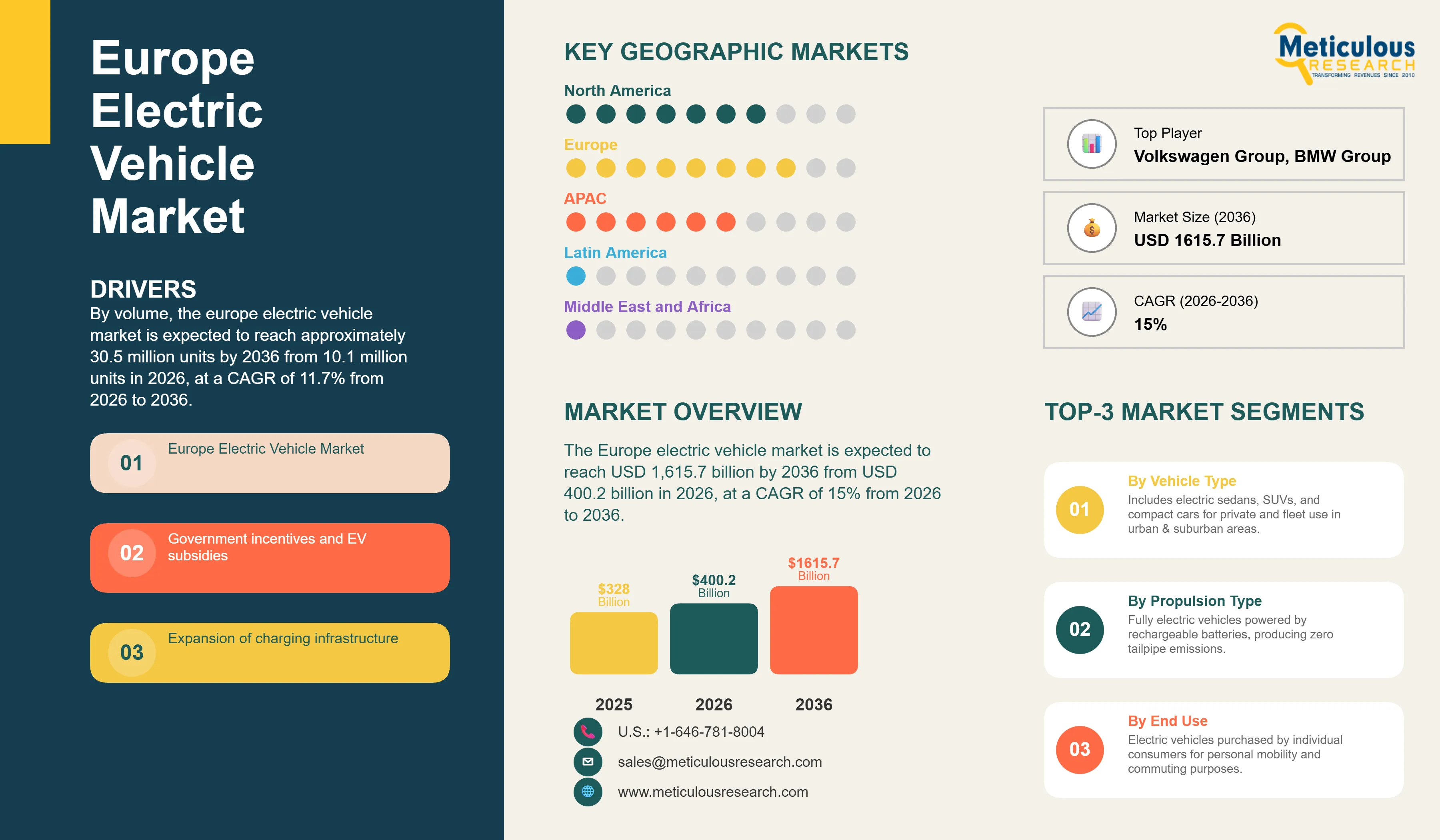
The Europe electric vehicle market was valued at USD 328.0 billion in 2025. This market is expected to reach USD 1,615.7 billion by 2036 from USD 400.2 billion in 2026, at a CAGR of 15% from 2026 to 2036. By volume, the market is expected to reach approximately 30.5 million units by 2036 from 10.1 million units in 2026, at a CAGR of 11.7% from 2026 to 2036. The market growth is primarily driven by supportive government policies and regulations, rising environmental concerns, and increasing adoption of electric mobility in Europe. The growing adoption of autonomous driving vehicles, increasing adoption of electric vans and trucks for delivery, and increasing shared mobility trends offer lucrative growth opportunities for this market’s growth.
 Click here to: Get Free Sample Pages of this Report
The European electric vehicle market is undergoing a significant transformation, driven by a combination of stringent environmental regulations, technological advancements, and changing consumer preferences. The European Union has set ambitious targets for reducing carbon emissions from the transport sector, which is a major contributor to greenhouse gas emissions. This has led to the implementation of various policies and incentives to promote the adoption of electric vehicles.
The market is characterized by a wide range of electric vehicle models, from compact city cars to luxury sedans and SUVs. Key players in the market include established automakers like Volkswagen Group, Stellantis N.V., and Renault Group, as well as new entrants like Tesla, Inc. and various Chinese manufacturers. The competition is fierce, with companies constantly innovating to offer longer range, faster charging, and more advanced features.
The European Automobile Manufacturers' Association (ACEA) reported that in 2025, battery-electric cars accounted for 17.4% of the EU market share. This indicates a strong and growing consumer demand for electric vehicles. The development of charging infrastructure is also a key factor driving the market. The European Commission's Green eMotion initiative is supporting the deployment of a Europe-wide electromobility infrastructure, which will further accelerate the adoption of electric vehicles.
What are the Key Trends in the Europe Electric Vehicle Market?
Expansion of Charging Infrastructure
The expansion of charging infrastructure is a key trend in the European electric vehicle market. Governments and private companies are investing heavily in the deployment of public charging stations to address the issue of range anxiety and make electric vehicles more convenient for consumers. For example, the French government has announced a €100 million funding program to support the installation of fast-charging stations along public motorways. This trend is expected to continue, with a focus on deploying high-power charging stations that can significantly reduce charging times.
Shift Towards Battery Electric Vehicles (BEVs)
There is a clear shift towards battery electric vehicles (BEVs) in the European market. While hybrid electric vehicles (HEVs) and plug-in hybrid electric vehicles (PHEVs) have played an important role in the transition to electric mobility, consumers are increasingly opting for pure electric vehicles. This is due to the improving range of BEVs, the growing availability of charging infrastructure, and the various government incentives that are available for BEV purchases. The Volkswagen ID. series and the Renault Zoe are examples of popular BEV models in Europe.
|
Parameters |
Details |
|
Market Size by 2036 |
USD 1,615.7 Billion |
|
Market Size in 2026 |
USD 400.2 Billion |
|
Market Size in 2025 |
USD 328.0 Billion |
|
Revenue Growth Rate (2026-2036) |
CAGR of 15% |
|
Dominating Vehicle Type |
Passenger Vehicles |
|
Fastest Growing Propulsion Type |
Battery Electric Vehicles (BEVs) |
|
Largest End User Segment |
Private Use |
|
Dominating Country |
Germany |
|
Fastest Growing Country |
France |
|
Base Year |
2025 |
|
Forecast Period |
2026 to 2036 |
Drivers: Supportive Government Policies and Regulations
Supportive government policies and regulations are a major driver of the European electric vehicle market. The EU has set stringent CO2 emission standards for new cars, which is forcing automakers to increase their sales of electric vehicles. In addition, many European countries offer generous financial incentives for the purchase of electric vehicles, such as tax credits, subsidies, and exemptions from registration fees. These policies are making electric vehicles more affordable and attractive to consumers.
Opportunity: Growing Demand for Shared and Autonomous Mobility
The growing demand for shared and autonomous mobility services presents a significant opportunity for the European electric vehicle market. Electric vehicles are well-suited for use in shared mobility fleets, as they have lower operating costs and produce zero tailpipe emissions. The development of autonomous driving technology is also expected to drive the demand for electric vehicles, as they can be easily integrated with autonomous driving systems.
Why Do Passenger Vehicles Dominate the Market?
Based on vehicle type, the passenger vehicles segment is expected to account for the largest share of the market, in 2026. The wide range of electric passenger car models available, from compact city cars to luxury sedans and SUVs, is a key factor driving the growth of this segment. The increasing consumer awareness of the environmental benefits of electric vehicles is also contributing to the demand for electric passenger cars.
How Do Battery Electric Vehicles Lead Growth?
The battery electric vehicles (BEVs) segment is expected to witness the fastest growth by propulsion type through 2026. The improving range of BEVs, the growing availability of charging infrastructure, and the various government incentives that are available for BEV purchases are key factors driving the growth of this segment. The increasing consumer preference for zero-emission vehicles is also contributing to the demand for BEVs.
How is Germany Maintaining Its Leadership in the European Electric Vehicle (EV) Market?
Germany is projected to account for the largest share of the European electric vehicle (EV) market during the forecast period. This is mainly due to its strong automotive manufacturing base, extensive R&D capabilities, and the presence of globally recognized vehicle manufacturers and suppliers. The well-established automotive ecosystem of Germany enables rapid model rollouts, localized EV production, and integration of advanced battery and powertrain technologies.
High consumer awareness regarding sustainability, coupled with rising acceptance of zero-emission mobility, further supports EV adoption. In addition, Germany has one of the most developed public and private charging infrastructures in Europe, including widespread deployment of fast-charging networks along highways and urban centers. Government-backed purchase incentives, tax benefits, and corporate fleet electrification programs have also played a significant role in stimulating demand, reinforcing Germany’s position as the region’s leading EV market.
Which Regions Are Experiencing Rapid Growth?
France is expected to be among the fastest-growing EV markets in Europe over the forecast period. Growth in the country is driven by ambitious national decarbonization targets, supportive policy frameworks, and increasing investments in charging infrastructure. The French government has implemented financial incentives, vehicle scrappage schemes, and low-emission zone policies that encourage the transition from internal combustion engine vehicles to electric alternatives.
France also benefits from a strong domestic automotive sector and growing EV model availability across passenger and light commercial vehicle segments. Expansion of urban charging networks and increased fleet electrification—particularly in shared mobility and public transport—are further accelerating EV adoption, positioning France as a key growth engine in the European market.
The European EV market is characterized by the presence of established automotive OEMs alongside new-generation electric vehicle manufacturers. Key companies profiled in this report include Volkswagen Group, Stellantis N.V., Renault Group, Tesla, Inc., and BMW Group, among others. These players compete through model portfolio expansion, battery technology development, localization of production, and strategic partnerships to strengthen their positions in the rapidly evolving EV landscape.
The Europe electric vehicle market is expected to grow from USD 400.2 billion in 2026 to USD 1,615.7 billion by 2036.
The Europe electric vehicle market is expected to grow at a CAGR of 15.0% from 2026 to 2036.
The key players operating in the Europe electric vehicle market include Volkswagen Group, Stellantis N.V., Renault Group, Tesla, Inc., and BMW Group.
The main factors include supportive government policies and regulations, rising environmental concerns, and increasing adoption of electric mobility in Europe.
Germany will lead the Europe electric vehicle market during the forecast period 2026 to 2036.
























Published Date: Sep-2024
Published Date: Aug-2024
Published Date: Jan-2024
Published Date: Jul-2022
Please enter your corporate email id here to view sample report.
Subscribe to get the latest industry updates


