Automated Guided Vehicle (AGV) & Autonomous Mobile Robot (AMR) Market (2026-2036)
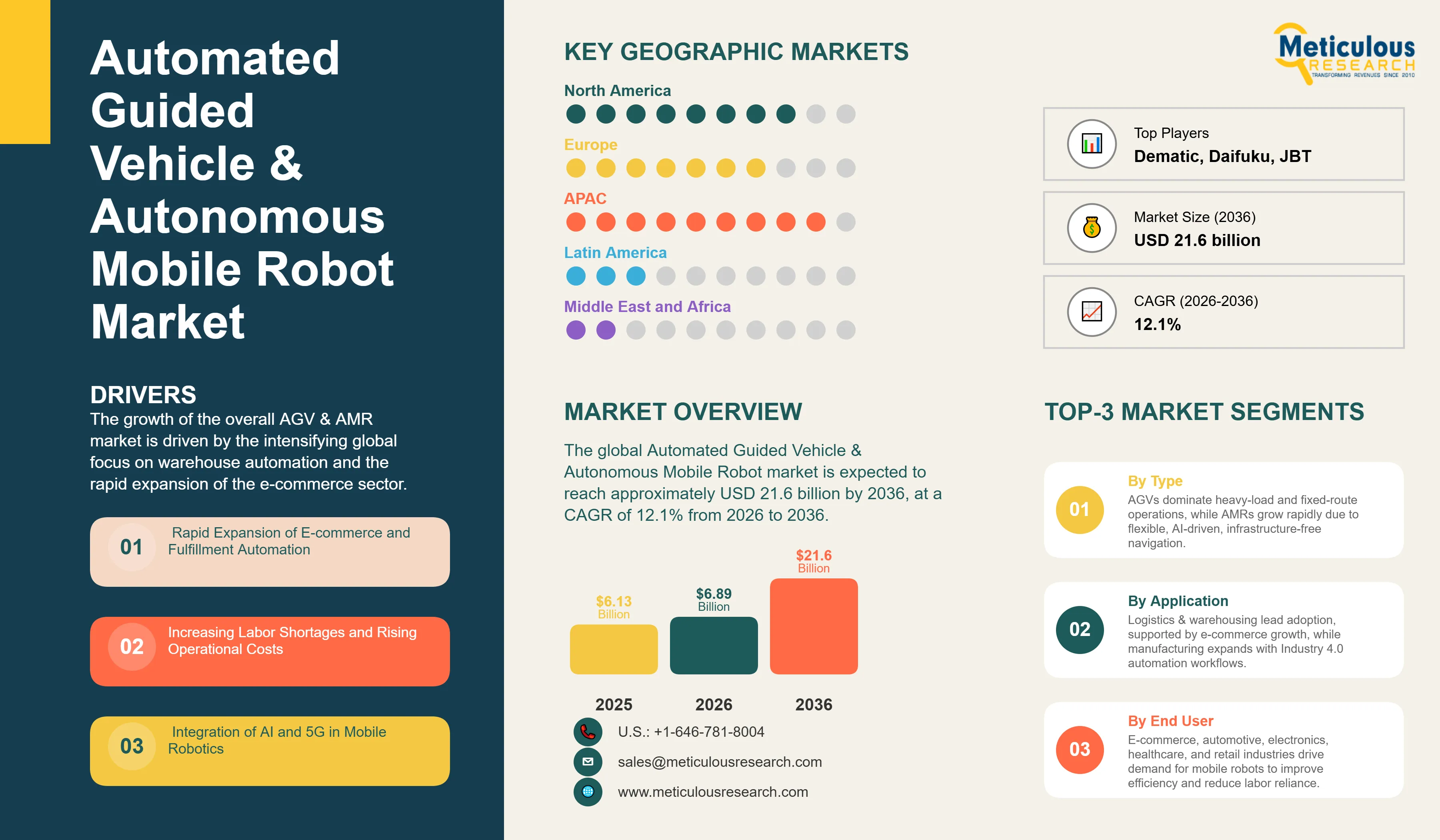
The global Automated Guided Vehicle (AGV) & Autonomous Mobile Robot (AMR) market was valued at USD 6.13 billion in 2025. This market is expected to reach approximately USD 21.6 billion by 2036 from USD 6.89 billion in 2026, at a CAGR of 12.1% from 2026 to 2036.
- Published
- Jan 2026
- Pages
- 225
- Format
- PDF + Excel
- Report ID
- MR-1652
- Base year
- 2025
- 2025 · BASELINE
- $6.13B
- 2036
- $21.60B
- CAGR 2026–2036
- 12.1%
2025 baseline · 2026–2036 forecast at 12.1% CAGR · hover a bar for the value
Key highlights
In terms of revenue, the global AGV & AMR market is projected to reach USD 21.6 billion by 2036.
The market is expected to grow at a CAGR of 12.1% from 2026 to 2036.
Asia Pacific dominates the global AGV & AMR market with the largest market share in 2026, driven by massive investments in smart factories and the presence of leading e-commerce giants in China and Japan.
North America is expected to witness the fastest CAGR during the forecast period, supported by aggressive adoption of AMRs in logistics and the expansion of automated distribution centers.
By type, the Automated Guided Vehicles (AGV) segment holds the largest market share in 2026, particularly in heavy-load transport and assembly line applications.
By type, the Autonomous Mobile Robots (AMR) segment is expected to witness the fastest growth during the forecast period due to their superior flexibility and "natural feature" navigation capabilities.
By application, the logistics & warehousing segment holds the largest share of the overall market in 2026.
By application, the manufacturing segment is expected to witness significant growth, driven by the integration of mobile robots into Industry 4.0 workflows.
Report summary
| Particulars | Details |
|---|---|
| Market Size by 2036 | USD 21.6 Billion |
| Market Size in 2026 | USD 6.89 Billion |
| Market Size in 2025 | USD 6.13 Billion |
| Market Growth Rate (2026-2036) | CAGR of 12.1% |
| Format | PDF, Excel & Cloud Portal · 225 pages |
| Dominating Region | Asia Pacific |
| Fastest Growing Region | North America |
| Base Year | 2025 |
| Forecast Period | 2026 to 2036 |
| Segments Covered | Type, Navigation, Application, and Region |
| Regions Covered | North America, Europe, Asia-Pacific, Latin America, and Middle East & Africa |
Report overview
Segments covered: type, navigation technology, application.
The growth of the overall AGV & AMR market is driven by the intensifying global focus on warehouse automation and the rapid expansion of the e-commerce sector. As industries seek to optimize their intralogistics and overcome labor shortages, mobile robotic technologies have become essential for material handling and internal transport. The rapid expansion of the automotive and electronics manufacturing sectors, coupled with the increasing need for high-precision sorting and collaborative robotics in retail and healthcare, continues to fuel significant growth of this market across all major geographic regions.
Automated Guided Vehicles (AGVs) and Autonomous Mobile Robots (AMRs) are advanced material handling systems used to transport goods within industrial and commercial environments. AGVs typically follow fixed paths using magnetic tape, lasers, or wires, while AMRs utilize sophisticated sensors and AI to navigate dynamically without the need for physical infrastructure. The modern market is increasingly defined by high-efficiency technologies such as Natural Feature Navigation (NFN) and Swarm Intelligence, which significantly enhance operational flexibility and throughput. These systems are indispensable for industries seeking to optimize their intralogistics and meet the demands of high-speed fulfillment.
The market includes a diverse range of vehicle configurations, ranging from compact picking robots for retail fulfillment to massive tow tractors capable of moving up to 65 tons in heavy manufacturing. These systems are increasingly integrated with advanced Warehouse Management Systems (WMS) and Fleet Management Software to provide services such as real-time traffic control and predictive maintenance. The ability to provide stable, 24/7 material movement while minimizing human error has made mobile robots the technology of choice for logistics operators and manufacturers seeking to enhance their competitive edge.
The overall AGV & AMR market is expected to witness robust growth during the forecast period, driven by several factors. The global logistics sector is pushing hard to automate fulfillment centers, aiming to meet the 24-hour delivery expectations of modern consumers. This drive has increased the adoption of AMRs, with advanced picking and sorting robots helping to stabilize warehouse operations. At the same time, the rapid growth in the automotive and electronics markets is increasing the need for flexible assembly line transport.
A major trend reshaping the mobile robotics market is the shift toward Autonomous Mobile Robot (AMR) technology. Manufacturers are increasingly moving beyond traditional fixed-path AGVs to advanced AMRs that utilize LiDAR, 3D cameras, and AI-driven SLAM (Simultaneous Localization and Mapping) to navigate. Leading companies are deploying systems that can dynamically avoid obstacles and recalculate paths in real-time. The recent introduction of "plug-and-play" AMR fleets marks a key milestone in this transition. These advanced designs allow for superior flexibility in dynamic environments, making mobile automation increasingly attractive for a wider range of users seeking to automate without costly facility modifications.
Another major trend driving the market is the development of Swarm Intelligence and collaborative fleet management. As warehouse operations become more complex, manufacturers are creating software platforms that allow hundreds of robots to work in a synchronized manner. This approach involves advanced algorithms that optimize robot paths and task assignments to maximize throughput. Furthermore, manufacturers are investing in interoperability standards that allow robots from different vendors to communicate and share the same workspace, further enhancing the scalability and efficiency of automated facilities.
Report infographic
Market dynamics
2 factors across 2 forcesLabor Shortages and the E-commerce Boom
A key driver of the AGV & AMR market is the rapid movement of the global logistics industry toward automation to address labor shortages and the e-commerce boom. Global trends in online shopping have created significant incentives for the adoption of mobile robotic technologies that can handle high-volume picking and sorting. The surge in e-commerce fulfillment requirements, particularly in North America and Europe, drives manufacturers toward scalable solutions that AMRs can uniquely provide. It is estimated that as labor costs rise and fulfillment windows shrink through 2036, the need for automated material handling increases exponentially; therefore, AGVs and AMRs, with their ability to operate 24/7 with high accuracy, are considered a crucial enabler of modern supply chain strategies.
Table of contents
12 chapters · 119 sections · 225 pages · click to expandSegmental analysis
| Segment | Largest share (2026) | Fastest growth (2026–2036) |
|---|---|---|
| By Type | Automated Guided Vehicles (AGV) | Autonomous Mobile Robots (AMR) |
| By Navigation | Natural Feature Navigation | — |
By Type
- The Automated Guided Vehicles (AGV) segment accounts for around 60-65% of the overall market in 2026.
- This strong position reflects the primary use of this technology in heavy-duty transport and structured manufacturing environments.
- These systems, ranging from tow tractors and pallet trucks to unit load carriers and assembly line vehicles, offer the most reliable way to move bulk materials along fixed routes.
- The automotive and heavy machinery sectors alone consume the vast majority of AGV production, with major projects in Asia Pacific and Europe demonstrating the capability of this technology to handle massive payloads up to 65 tons.
- However, the Autonomous Mobile Robots (AMR) segment is expected to grow at the fastest CAGR during the forecast period, driven by expanding applications in e-commerce fulfillment, retail, and healthcare.
- The ease of deployment, "infrastructure-free" navigation, and superior flexibility of AMRs make them highly attractive for dynamic environments where paths frequently change.
By Navigation
- The Natural Feature Navigation (NFN) and Laser Navigation segments hold the largest share of the overall market in 2026, accounting for around 70-75% of total revenue.
- From high-speed sorting to precision parts delivery, the use of advanced navigation is central to modernizing mobile robotics.
- Current large-scale projects are increasingly specifying NFN for its ability to operate without physical markers like magnetic tape or wires, reducing installation time and costs.
- The Magnetic Tape and Inductive Navigation segments continue to find critical applications in industries where fixed routes are permanent and high reliability is required at a lower cost.
- However, the shift toward flexible automation is pushing the requirement for standardized navigation platforms that allow robots to adapt to changing facility layouts.
Geographic analysis
Asia-Pacific
Largest shareAsia Pacific holds the largest share of the global AGV & AMR market in 2026. The largest share of this region is primarily attributed to the massive investments in smart manufacturing and the presence of the world's largest e-commerce markets, particularly in China and Japan. China alone accounts for more than 45% of global mobile robot deployments, with its position as a leading hub for electronics and automotive manufacturing driving sustained growth. The presence of leading manufacturers including Daifuku, Geek+, and GreyOrange provides a well-developed supply chain serving regional and global customers.
North America
North America and Europe together account for around 30 to 40% of the global AGV & AMR market. The growth of these markets is mainly driven by the need for logistics automation to support the e-commerce surge and the high labor costs in these regions. The demand for AMRs in North America is mainly due to its large-scale distribution centers and the presence of innovators like Teradyne (MiR) and Locus Robotics.
Europe
In Europe, the leadership in Industry 4.0 policies and the push for sustainable logistics are driving the adoption of mobile robots. Countries like Germany, France, and the UK are at the forefront, with significant projects aimed at integrating AGVs into automated manufacturing and providing "last-mile" delivery solutions. The European market also benefits from a strong focus on safety standards and the development of collaborative robotic environments.
Competitive landscape
- Daifuku
- Dematic (KION Group)
- JBT Corporation
- KUKA · Swisslog
Frequently asked questions
The AGV & AMR market is expected to grow from USD 6.89 billion in 2026 to USD 21.6 billion by 2036.
Cite this report
Meticulous Research. (2026). Automated Guided Vehicle (AGV) & Autonomous Mobile Robot (AMR) Market - Global Opportunity Analysis and Industry Forecast (2026-2036) (Report No. MR-1652). Meticulous Market Research Pvt. Ltd. https://www.meticulousresearch.com/product/automated-guided-vehicle-and-autonomous-mobile-robot-market-6335