
Mobile Cobots Market (2025-2035)
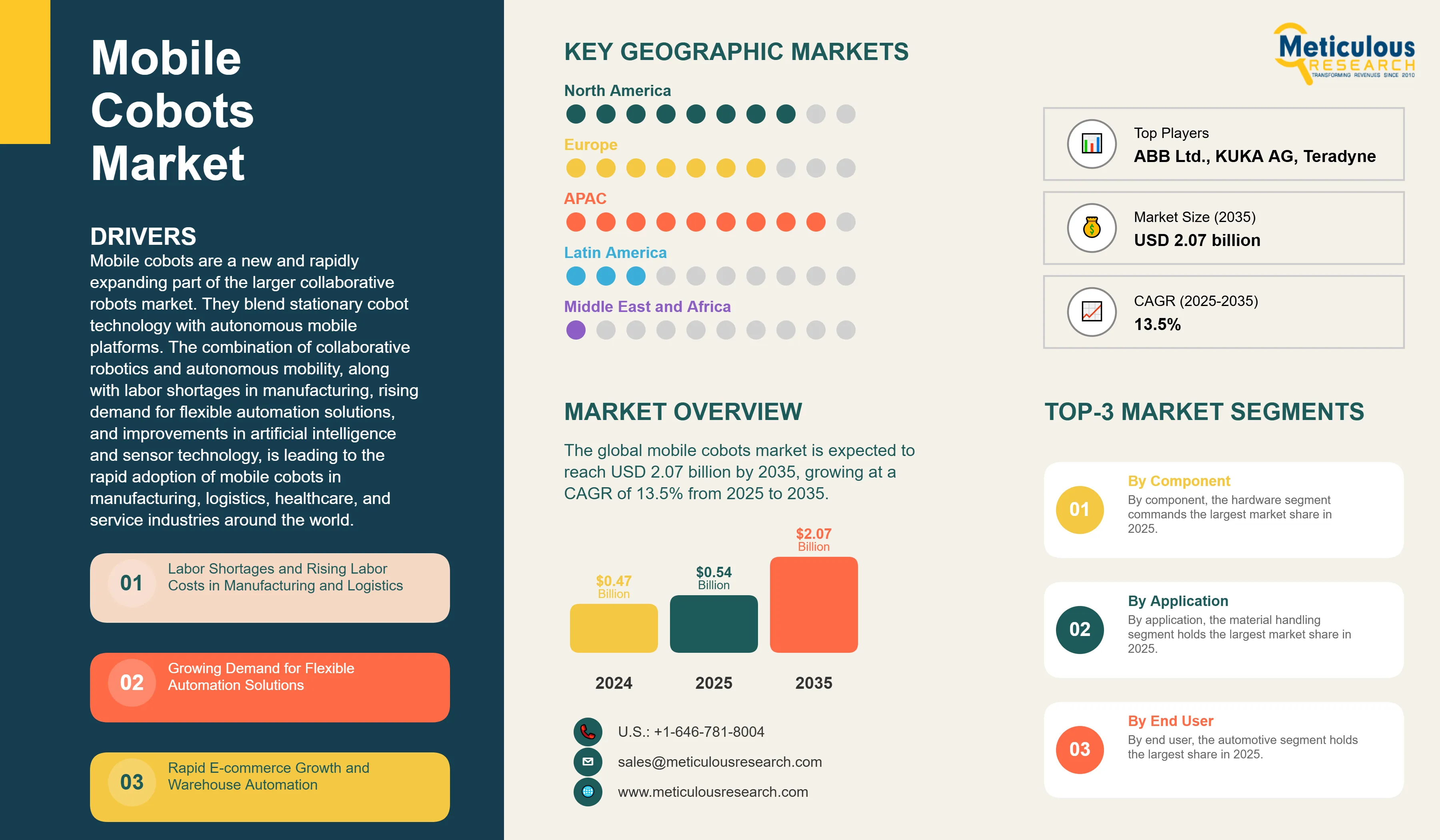
The global mobile cobots market was valued at USD 0.47 billion in 2024. This market is expected to reach USD 2.07 billion by 2035 from USD 0.54 billion in 2025, growing at a CAGR of 13.5% from 2025 to 2035.
- Published
- Oct 2025
- Pages
- 210
- Format
- PDF + Excel
- Report ID
- MRSE - 1041621
- Base year
- 2024
- 2024 · BASELINE
- $470.0M
- 2035
- $2.07B
- CAGR 2025–2035
- 13.5%
2024 baseline · 2025–2035 forecast at 13.5% CAGR · hover a bar for the value
Key highlights
In terms of revenue, the global mobile cobots market is valued at USD 0.54 billion in 2025 and is projected to reach USD 2.07 billion by 2035.
The market is expected to grow at a CAGR of 13.5% from 2025 to 2035.
Asia Pacific dominates the global mobile cobots market with the largest market share in 2025.
North America is expected to witness the fastest CAGR during the forecast period.
By payload capacity, the 5-10kg segment holds the largest market share in 2025.
By payload capacity, the above 20kg segment is expected to witness the fastest CAGR during the forecast period.
By component, the hardware segment commands the largest market share in 2025.
By component, the software segment is expected to witness the fastest CAGR during the forecast period.
By application, the material handling segment holds the largest market share in 2025.
By application, the quality inspection segment is expected to witness the fastest CAGR during the forecast period.
By end user, the automotive segment holds the largest share in 2025.
By end user, the e-commerce and logistics segment is expected to witness the fastest CAGR during the forecast period.
Report summary
| Particulars | Details |
|---|---|
| Report Coverage | Details |
| Market Size by 2035 | USD 2.07 Billion |
| Market Size in 2025 | USD 0.54 Billion |
| Market Size in 2024 | USD 0.47 Billion |
| Market Growth Rate from 2025 to 2035 | CAGR of 13.5% |
| Format | PDF, Excel & Cloud Portal · 210 pages |
| Dominating Region | Asia Pacific |
| Fastest Growing Region | North America |
| Base Year | 2024 |
| Forecast Period | 2025 to 2035 |
| Segments Covered | Payload Capacity, Component, Application, End User, and Region |
| Regions Covered | North America, Europe, Asia-Pacific, Latin America, and Middle East & Africa |
Report overview
Segments covered: payload capacity, component, application, end user.
Mobile cobots are a new and rapidly expanding part of the larger collaborative robots market. They blend stationary cobot technology with autonomous mobile platforms. The combination of collaborative robotics and autonomous mobility, along with labor shortages in manufacturing, rising demand for flexible automation solutions, and improvements in artificial intelligence and sensor technology, is leading to the rapid adoption of mobile cobots in manufacturing, logistics, healthcare, and service industries around the world.
The mobile cobots market includes the design, development, manufacturing, and deployment of integrated robotic systems that combine collaborative robot arms with autonomous mobile platforms. These systems blend the safety and human-interaction capabilities of collaborative robots with the mobility and navigation intelligence of autonomous mobile robots. This creates flexible automation solutions that can move around facilities while carrying out tasks.
Mobile cobots consist of a collaborative robotic arm mounted on an autonomous mobile base. This base is equipped with sensors, navigation systems, batteries, and control electronics. The systems use technologies like LiDAR, vision systems, simultaneous localization and mapping, artificial intelligence, and machine learning for navigation and task execution.
The overall growth of the mobile cobots market is driven by the demand for flexible manufacturing systems, labor shortages in key industries, rising labor costs, the move toward mass customization and small-batch production, advancements in AI and sensor technologies, lower hardware costs, and the growing adoption of Industry 4.0 principles in manufacturing, warehousing, healthcare, retail, and hospitality sectors.
Artificial intelligence is transforming the mobile cobots market by enabling self-directed decision-making, flexible behavior, and smart task performance. These features set them apart from traditional fixed cobots and simple AMRs. AI-enabled perception systems help mobile cobots understand complex environments, recognize objects, spot obstacles, and navigate spaces that change dynamically without needing pre-made maps. Machine learning helps these systems improve their path planning, boost task efficiency over time, and handle differences in workflows and environments. Computer vision, combined with deep learning, allows for capabilities like object recognition, pose estimation, defect detection, and quality inspection without requiring extensive coding.
Natural language processing makes it easier for humans to interact with robots, using voice commands and conversational tools. AI-driven predictive maintenance looks at operational data to predict equipment failures and schedule maintenance ahead of time, reducing downtime. Reinforcement learning helps mobile cobots discover the best ways to handle tasks through practice, speeding up the process for taking on new jobs.
A major trend in the mobile cobots market is the development of advanced fleet management and orchestration platforms that coordinate multiple mobile cobots and other automated systems within integrated workflows. Manufacturers are creating cloud-based software solutions that improve task allocation, traffic management, battery charging schedules, and resource use across fleets of mobile cobots and AMRs. These platforms use artificial intelligence to assign tasks dynamically based on system availability, location, capability, and priority. This maximizes operational efficiency. Integration with warehouse management systems, manufacturing execution systems, and enterprise resource planning systems allows seamless coordination between mobile cobots and broader facility operations. This supports the shift toward fully autonomous smart factories and warehouses. This trend is crucial for justifying the higher investment in mobile cobots compared to fixed cobots by showing better utilization rates and operational flexibility.
Another key trend driving market growth is the shift toward modular, reconfigurable mobile cobot platforms. These allow users to customize systems for specific applications by selecting different robotic arms, grippers, sensors, and accessories. Manufacturers are developing standardized interfaces and mounting systems that make it easy to swap collaborative robot arms from different suppliers, switch out end-effectors for various tasks, and use modular sensor packages. This approach lowers the total cost of ownership by allowing a single mobile platform to handle multiple applications through reconfiguration. It eliminates the need for dedicated systems for each task. The trend supports quick redeployment as production needs change and lets users start with basic configurations, adding capabilities as requirements evolve. This makes the investment in premium mobile cobots more appealing than buying multiple fixed cobots for different locations.
North America is expected to witness the fastest CAGR of 14.3% from 2025 to 2035. This is mainly due to the significant labor shortages in manufacturing and logistics in this region. There is also a lot of activity in e-commerce and warehouse automation. Mobile cobots offer clear benefits over fixed alternatives. Additionally, strong venture capital and corporate investment in robotics technology are fueling this growth.
The U.S. warehouse automation market is growing rapidly as e-commerce becomes more widespread. Major retailers are investing in logistics to compete with Amazon, which creates a strong demand for flexible automation solutions. Mobile cobots can adjust to changing requirements. Efforts to bring manufacturing back to the U.S. and nearshoring trends are driven by concerns about supply chain resilience, leading to new automated production capacity across North America.
Leading technology companies such as Tesla and Apple, as well as many aerospace and defense contractors, are using mobile cobots to tackle specialized manufacturing challenges where mobility is beneficial. The region has a developed robotics ecosystem, including system integrators, application developers, and service providers that support deployment and ongoing operations. Pioneers of collaborative robots, like Rethink Robotics, and leaders in mobile robotics, such as Clearpath Robotics and Fetch Robotics, began in North America. This has fostered technology leadership and a deep understanding of mobile cobot value.
Report infographic
Market dynamics
10 factors across 2 forcesLabor Shortages and Rising Labor Costs in Manufacturing and Logistics
A key factor driving the growth of the mobile cobots market is the severe labor shortage affecting manufacturing, warehousing, and logistics industries worldwide. This issue is worsened by rising labor costs in both developed and developing countries. The United States Bureau of Labor Statistics notes ongoing unfilled positions in manufacturing and warehousing. In Europe, Japan, and South Korea, an aging population reduces the available workforce. The COVID-19 pandemic made these issues worse by exposing weaknesses in supply chains and increasing demand for automation solutions that lessen reliance on manual labor.
Mobile cobots handle labor challenges better than fixed cobots. They automate repetitive and physically demanding tasks, such as transporting materials, tending machines, loading and unloading parts, and fulfilling orders across various locations with a single system. They can work safely alongside human workers. This technology helps manufacturers and logistics operators maintain productivity despite workforce limitations. It also allows human workers to focus on higher-value tasks that require creativity, problem-solving, and complex decision-making.
Government programs in countries like China, Germany, Singapore, and the U.S. offer grants, tax incentives, and subsidies for adopting automation. These efforts create a supportive environment for using mobile cobots as companies look for maximum flexibility in their collaborative robots.
Table of contents
13 chapters · 156 sections · 210 pages · click to expandGeographic analysis
North America
The U.S. mobile cobots market is projected to grow at a CAGR of 14.3% from 2025 to 2035. U.S. Mobile Cobots Market Size and Growth 2025 to 2035 North America
Asia-Pacific
Largest shareAsia Pacific region holds the largest share of 35-40% of the global mobile cobots market in 2025. China leads the global deployment of mobile cobots. The country promotes initiatives like Made in China 2025 and the 14th Five-Year Plan, which emphasize intelligent manufacturing and offer substantial subsidies for robotics adoption. Major Chinese manufacturers, such as SAIC Motor, Geely, BYD, Midea Group, and Haier, are deploying mobile cobots in automotive, electronics, and appliance production facilities where their mobility advantages justify the high investment. Japan’s expertise in robotics technology also plays a key role. Companies like FANUC Corporation, Yaskawa Electric Corporation, Kawasaki Heavy Industries, and Omron Corporation are developing advanced mobile cobot solutions. Japan is both a major market and supplier of technology. The extensive adoption of collaborative robots in the country provides a strong foundation for the growth of mobile cobots as manufacturers seek more flexibility. South Korea is focusing on smart factories. Government programs back this initiative, with major companies like Samsung, Hyundai, and LG pushing for advanced automation, including mobile cobots. India's growing manufacturing sector benefits from the Make in India initiative. There is rising demand for flexible automation in automotive and electronics production. Southeast Asian countries, like Thailand, Vietnam, and Indonesia, are adopting mobile cobots as manufacturing increasingly moves to these lower-cost locations. Labor shortages are emerging, and companies are seeking competitive advantages through advanced automation. By Region Asia-Pacific
Competitive landscape
- —
May 2025 – FANUC Corporation introduced its latest CRX Series mobile cobot variant with enhanced payload of 20 kg, greater reach, and improved obstacle detection sensors for collaborative tasks in warehousing and assembly lines.
- —
April 2025 – Kawasaki Robotics unveiled its new autonomous mobile manipulator, the CX210L, combining a durable 6-axis robotic arm with a mobile base, designed for flexible deployment in small and medium-sized manufacturing environments.
- —
March 2025 – MiR launched a new software suite update for fleet management, incorporating AI-driven predictive maintenance and multi-robot task optimization aimed at reducing downtime and improving operational efficiency.
- —
February 2025 – Mobile Industrial Robots introduced the MiR1200 Pallet Jack cobot featuring enhanced payload capacity up to 1,200 kg, AI-powered 3D vision pallet detection, and autonomous navigation for fast, efficient pallet transport in manufacturing and logistics environments, expanding mobile cobot capabilities into heavy-duty applications.
- —
January 2025 – ABB Ltd. unveiled the GoFa Mobile cobot platform combining the GoFa collaborative robot with an autonomous mobile base, featuring standardized interfaces for rapid deployment and fleet management integration at the Automate Show, targeting manufacturers seeking flexible alternatives to fixed cobot installations.
- —
November 2024 – Omron Corporation announced strategic expansion of its LD Mobile Cobot series with new models featuring improved battery life, faster charging capabilities, and enhanced fleet coordination software for multi-robot deployments across manufacturing facilities.
- —
September 2024 – KUKA AG launched the KMR Cybertech nano mobile cobot specifically designed for electronics manufacturing and laboratory automation applications, featuring a compact footprint and precision positioning capabilities that differentiate it from fixed cobots.
Frequently asked questions
The mobile cobots market is expected to grow from USD 0.54 billion in 2025 to USD 2.07 billion by 2035.
Cite this report
Meticulous Research. (2025). Mobile Cobots Market - Global Opportunity Analysis and Industry Forecast (2025-2035) (Report No. MRSE - 1041621). Meticulous Market Research Pvt. Ltd. https://www.meticulousresearch.com/product/mobile-cobots-market-6304