AI in 3D Printing Market (2026-2036)
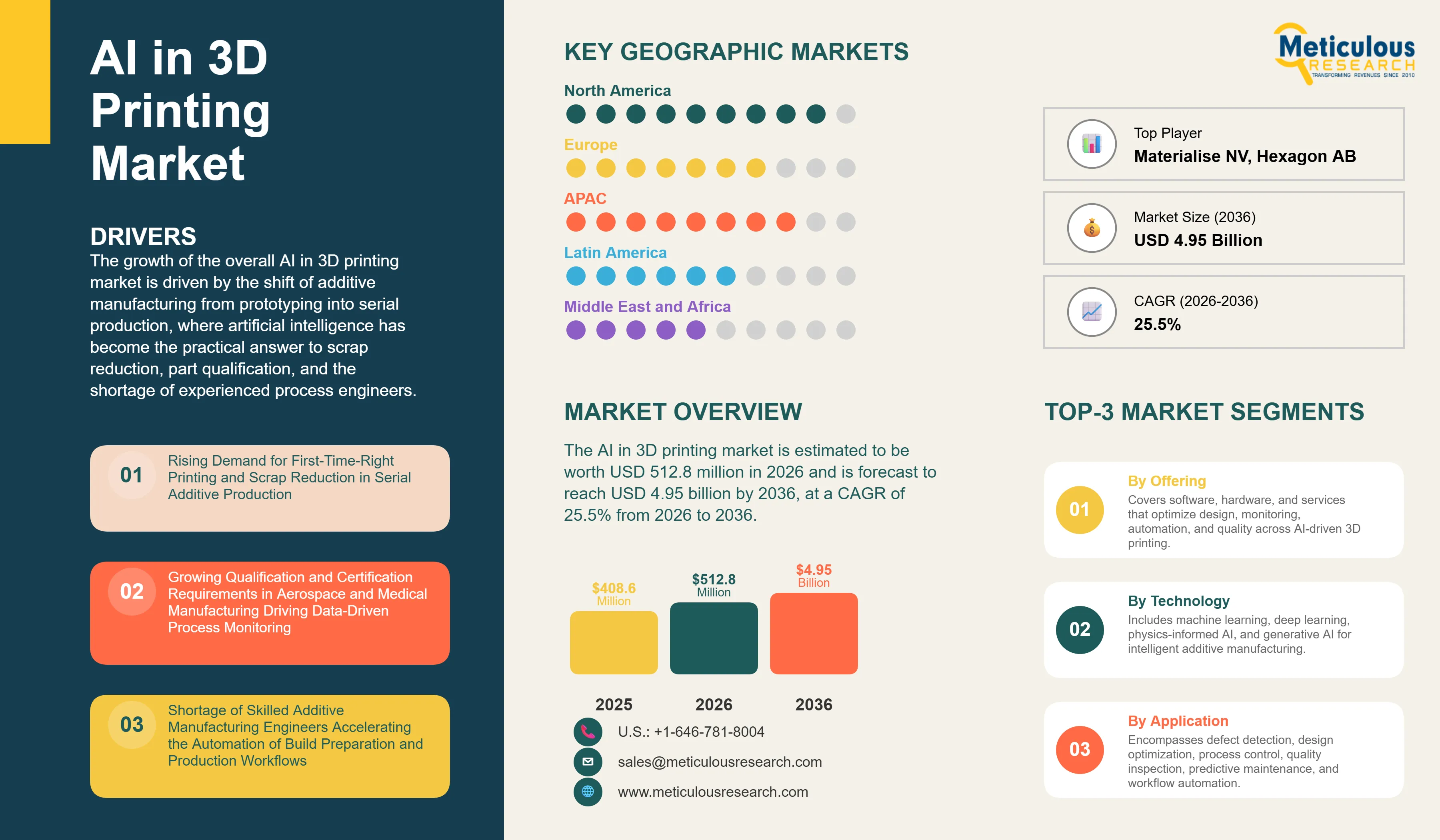
The AI in 3D printing market is estimated to be worth USD 512.8 million in 2026 and is forecast to reach USD 4.95 billion by 2036, at a CAGR of 25.5% from 2026 to 2036.
- Published
- Jul 2026
- Pages
- 185
- Format
- PDF + Excel
- Report ID
- MR-2103
- Base year
- 2025
- 2026 · ESTIMATED
- $512.8M
- 2036
- $4.95B
- CAGR 2026–2036
- 25.5%
2025 baseline · 2026–2036 forecast at 25.5% CAGR · hover a bar for the value
Key highlights
By offering, the software segment leads the market in 2026, holding a share of around 61%, supported by broad adoption of build preparation, process monitoring, and additive manufacturing execution software across mixed printer fleets.
By technology, deep learning & computer vision holds the largest share in 2026, at roughly 38%, as camera- and sensor-based layer inspection has become the most widely deployed form of AI on production printers.
By application, in-situ process monitoring & defect detection leads in 2026, with a share of about 27%, while generative and agentic AI assistants for build preparation record the fastest growth over the forecast period.
By printing technology, powder bed fusion accounts for the largest share in 2026, at close to 44%, reflecting the concentration of high-value metal parts and melt-pool monitoring investments in this process family.
By end user, aerospace & defense leads the market in 2026, with a share of about 33%, driven by flight-part qualification requirements and defense programs funding data-driven process control.
By geography, North America holds the largest share in 2026, at approximately 40%, while Asia-Pacific is projected to grow at the highest CAGR of 28.4% through 2036 on the strength of China's printer installed base and government-backed smart manufacturing programs.
Report summary
| Particulars | Details |
|---|---|
| Market Size Value in 2026 | USD 512.8 Million |
| Revenue Forecast in 2036 | USD 4.95 Billion |
| Growth Rate | CAGR of 25.5% from 2026 to 2036 |
| Format | PDF, Excel & Cloud Portal · 185 pages |
| Base Year | 2025 |
| Estimated Year | 2026 |
| Forecast Period | 2026–2036 |
| Historical Data | 2023–2024 |
| Units | Value (USD Million/Billion) |
| Segments Covered | Offering, Technology, Application, Printing Technology, End User, and Geography |
| Regions Covered | North America, Europe, Asia-Pacific, Latin America, and Middle East & Africa |
| Companies Profiled | Oqton, Inc. (a Hubb Global Holdings company) (U.S.), Materialise NV (Belgium), Autodesk, Inc. (U.S.), Siemens AG (Germany), Hexagon AB (Sweden), EOS GmbH (Germany), Stratasys Ltd. (U.S./Israel), Ai Build Ltd. (U.K.), Authentise, Inc. (U.S.), nTop, Inc. (U.S.), 3YOURMIND GmbH (Germany), Inkbit Corporation (U.S.), 1000 Kelvin GmbH (Germany), Phase3D, Inc. (U.S.), and Dyndrite Corporation (U.S.), among others. |
Report overview
Market value is measured in USD million/billion. Segments covered: technology, application, printing technology, end user, offering.
The growth of the overall AI in 3D printing market is driven by the shift of additive manufacturing from prototyping into serial production, where artificial intelligence has become the practical answer to scrap reduction, part qualification, and the shortage of experienced process engineers. Machine learning is now embedded across the 3D printing workflow, from generative design and build preparation software through in-situ monitoring and defect detection to predictive maintenance of printer fleets.
Print quality in additive manufacturing depends on dozens of coupled parameters, including laser power, scan speed, layer thickness, chamber conditions, and powder characteristics. Trained models read live sensor and camera data during a build, flag porosity, recoater interactions, and geometric deviations layer by layer, and in the newest systems adjust the process before a defect propagates. This is what makes AI-enabled 3D printing attractive to aerospace, medical, and automotive manufacturers, where every failed build carries a high material and machine-time cost and every qualified part needs a documented digital record.
The AI in 3D printing market covers the software, embedded hardware, and services that apply data-driven models to design, prepare, run, inspect, and maintain additive manufacturing systems. The market has moved well past experimentation. Printer manufacturers now ship machines with in-situ sensing and AI-assisted parameter tuning as standard options, while independent software vendors sell printer-agnostic platforms that manage quoting, scheduling, traceability, and machine data across fleets from multiple OEMs. The result is a layered market in which machine-level intelligence, factory-level workflow automation, and enterprise integration each generate distinct revenue streams.
Adoption follows the economics of production. A failed metal build wastes powder that can cost several hundred dollars per kilogram along with days of machine time, and a qualified aerospace or medical part requires documented evidence of process consistency for every unit produced. AI addresses both sides of that equation at once: models trained on historical builds raise first-time-right rates, and layer-by-layer monitoring generates the digital record that qualification demands.
As additive manufacturing scales into distributed, multi-site production networks, the value of software that encodes scarce process expertise keeps rising, which is why the software segment dominates spending and why printer OEMs, industrial software majors, and specialist start-ups are all competing for position.
Report infographic
Market dynamics
10 factors across 4 forcesRising demand for first-time-right printing and scrap reduction in serial additive production
As manufacturers move from prototypes to production quantities, the cost of failure compounds, and AI has become the most direct lever for improving yield.
- Machine learning models trained on historical build data predict defects before they occur and tune parameters so parts print correctly on the first attempt.
- Physics-based AI platforms that automate printability checks and build strategy have demonstrated meaningful reductions in trial-and-error iterations for metal parts.
- Camera and lidar-based failure detection has spread from industrial systems down to desktop-class printers, pausing or correcting builds automatically to prevent material loss.
- AI-driven nesting and scheduling has been shown to raise build volume utilization materially in production settings, increasing throughput without additional hardware.
Growing qualification and certification requirements in aerospace and medical manufacturing
Flight-critical and implantable parts require documented evidence of process consistency, and data-driven monitoring is how that evidence gets produced economically.
- Layer-by-layer heightmap and melt-pool monitoring generates a complete digital record of every build, supporting part-level traceability in regulated industries.
- U.S. defense customers, including programs linked to the Air Force, Navy, and NASA, are actively funding in-situ inspection technologies for metal additive manufacturing.
- The U.S. National Institute of Standards and Technology continues to develop measurement science and data frameworks for additive manufacturing, strengthening the case for standardized, data-rich process records.
Shortage of skilled additive manufacturing engineers
Experienced process engineers who can qualify a new alloy or dial in parameters for a new geometry remain scarce, and software that encodes this expertise lets manufacturers scale output without scaling headcount.
- Machine learning approaches have been shown to cut the number of experimental cycles needed for alloy and parameter development by large margins.
- Workflow automation platforms remove manual preparation steps such as file repair, orientation, support generation, and nesting from the daily workload of engineers.
- AI-managed production has delivered documented efficiency gains above 50% in high-volume patient-specific manufacturing environments such as dental laboratories.
Table of contents
13 chapters · 133 sections · 185 pages · click to expandSegmental analysis
| Segment | Largest share (2026) | Fastest growth (2026–2036) |
|---|---|---|
| By Offering | Software | — |
| By Technology | Deep Learning & Computer Vision | Physics-informed and hybrid models |
| By Application | In-Situ Process Monitoring & Defect Detection | Generative and agentic AI assistants for build preparation |
| By Printing Technology | Powder Bed Fusion | — |
| By End User | Aerospace & Defense | — |
By Offering
- The software segment holds around 61% of the AI in 3D printing market in 2026, spanning generative design and build preparation tools, process monitoring and control platforms, additive manufacturing execution systems, and predictive analytics.
- Printer-agnostic platforms have become the operating layer of additive factories, handling quoting, nesting, scheduling, traceability, and machine data across mixed fleets.
- Hardware, comprising machine vision and in-situ sensing systems along with edge computing modules, contributes a growing share as OEMs make optical and thermal sensing standard on production systems, while services expand with integration and model-deployment projects.
By Technology
- Deep Learning & Computer Vision Holds the Largest Technology Share in 2026
- Camera-based layer inspection is the most mature and widely deployed AI capability on 3D printers, which places deep learning and computer vision at roughly 38% of the market in 2026.
- Convolutional networks classify porosity, cracking, delamination, and surface irregularities from in-situ imagery with accuracy that manual inspection cannot match at production speed.
- Physics-informed and hybrid models represent the fastest-advancing technology class, combining simulation with learned corrections to govern laser-material interaction, and generative and agentic AI is the newest commercial layer.
By Application
- In-Situ Process Monitoring & Defect Detection Leads by Application in 2026
- With about 27% of 2026 revenue, in-situ monitoring is where AI delivers its clearest return: structured-light and melt-pool monitoring systems detect powder bed anomalies, recoater interactions, and lack-of-fusion indicators as they happen, allowing operators to stop or correct a failing build instead of discovering the defect days later in CT inspection.
- Process parameter optimization and build preparation follows closely, and production planning and workflow automation grows steadily as additive operations scale into multi-site networks.
By Printing Technology
- Powder Bed Fusion Accounts for the Largest Printing Technology Share in 2026
- Laser powder bed fusion concentrates the highest-value parts, the most complex parameter space, and the strongest economic case for AI, giving the segment close to 44% of the market in 2026.
- Material extrusion is the second-largest segment, where AI-assisted failure detection has reached even desktop-class machines through camera and lidar systems, and directed energy deposition adopts closed-loop control for large-format repair and near-net-shape applications.
By End User
- Aerospace & Defense Leads by End User in 2026
- Aerospace and defense holds about 33% of the market in 2026.
- The sector prints structurally critical, expensive parts in qualified processes, so every improvement in first-time-right rates and every layer of documented process evidence has direct financial and regulatory value.
- Healthcare is the second-largest end user, where AI-driven workflow platforms already manage high-volume dental and patient-specific implant production, and automotive adoption expands as generative design and printed tooling spread through the supply chain.
Geographic analysis
North America
Largest shareNorth America accounts for approximately 40% of the AI in 3D printing market in 2026, supported by the region's concentration of aerospace primes and defense funding for additive process monitoring, an established base of additive software vendors, and early enterprise adoption of AI across manufacturing operations. North America Leads the Global AI in 3D Printing Market in 2026 North America (U.S., Canada), Europe (Germany, U.K., France, Italy, Spain, Rest of Europe), Asia-Pacific (China, Japan, South Korea, India, Singapore, Australia & New Zealand, Rest of Asia-Pacific), Latin America (Brazil, Mexico, Rest of Latin America), and Middle East & Africa (Israel, UAE, Saudi Arabia, Rest of Middle East & Africa)
Europe
Europe follows with strong positions in industrial printer OEMs and process control research, led by Germany and the U.K., where physics-AI and workflow software specialists are clustered.
Asia-Pacific
Fastest growthAsia-Pacific is projected to record the highest CAGR of 28.4% through 2036, reflecting the scale of China's printer manufacturing and installed base, Japan's and South Korea's precision manufacturing sectors, and national smart factory programs that fund AI adoption in production.
Latin America
Latin America and the Middle East & Africa are earlier in the adoption curve, with Israel and the UAE standing out for additive software talent and government-backed advanced manufacturing initiatives respectively. By Geography
Competitive landscape
The AI in 3D printing market comprises four broad categories of competitors. Printer OEMs, such as EOS GmbH and Stratasys Ltd., are embedding AI into their hardware, machine vision, and software ecosystems to enable intelligent process monitoring, closed-loop control, and autonomous print optimization, making AI a key differentiator for industrial additive manufacturing systems. Industrial software providers, including Siemens AG, Autodesk, Inc., Hexagon AB, and Materialise NV, are integrating AI across design, simulation, digital manufacturing, and production workflow platforms while leveraging their extensive enterprise customer base.
Independent additive manufacturing software providers, including Oqton, Inc., Authentise, Inc., 3YOURMIND GmbH, Dyndrite Corporation, and nTop, Inc., compete by delivering printer-agnostic solutions spanning computational design, build preparation, manufacturing execution, production planning, and AI-driven workflow automation. AI-native innovators, such as Ai Build Ltd., Inkbit Corporation, 1000 Kelvin GmbH, and Phase3D, Inc., are advancing next-generation capabilities in autonomous toolpath optimization, vision-guided printing, physics-informed AI process control, and real-time in-situ quality assurance.
Product launches and partnerships are the dominant growth strategies, with OEM integrations serving as the key distribution channel for specialist software. Consolidation is reshaping the field: platform assets have changed hands as hardware companies refocus, and independent ownership of fleet-level software has become a selling point for buyers who want to avoid lock-in to a single printer brand. The companies profiled in this report were selected for active 2026 operations, verified AI capabilities applied to 3D printing, and current ownership structures.
- June 2026
Phase3D, Inc. closed an oversubscribed USD 2.9 million funding round led by Quest Venture Partners to expand commercialization of its Fringe structured-light in-situ inspection platform for metal powder bed fusion, driven by growing adoption across aerospace, automotive, and U.S. defense programs.
- April 2026
Authentise, Inc. launched Whisper at RAPID + TCT 2026, an agentic AI platform designed to capture engineering intent and autonomously execute workflows across enterprise ERP, PLM, and QMS systems. The platform was introduced under a source-available licensing model with an early access program for select customers.
- January 2026
Stratasys Ltd. announced continued investments in AI-enabled digital manufacturing capabilities through Stratasys Direct, including expanded digital manufacturing infrastructure, AI-powered customer support, and workflow automation tools to accelerate production-ready additive manufacturing and improve manufacturing efficiency.
- Q4 2025
Hubb Global Holdings acquired Oqton's Manufacturing Operating System (MOS) and 3DXpert software business from 3D Systems Corporation, establishing Oqton as an independent provider of AI-driven, printer-agnostic additive manufacturing software while enabling 3D Systems to focus on its proprietary polymer software portfolio.
- April 2025
1000 Kelvin GmbH and SCANLAB GmbH announced the integration of the AMAIZE physics-informed AI platform with SCANmotionControl, enabling AI-driven laser power modulation at the individual scan-vector level through the open 3MF toolpath extension for metal additive manufacturing.
- Oqton, Inc. (Hubb Global Holdings) (U.S.)
- Materialise NV · Belgium
- Autodesk, Inc. (U.S.)
- Siemens AG (Siemens Digital Industries Software) · Germany
- Hexagon AB · Sweden
- EOS GmbH · Germany
- Stratasys Ltd. (U.S./Israel)
- Ai Build Ltd. (U.K.)
- Authentise, Inc. (U.S.)
- nTop, Inc. (U.S.)
- 3YOURMIND GmbH · Germany
- Inkbit Corporation (U.S.)
- 1000 Kelvin GmbH · Germany
- Phase3D, Inc. (U.S.)
- Dyndrite Corporation (U.S.)
Frequently asked questions
The market is estimated at USD 512.8 million in 2026 and is projected to reach USD 4.95 billion by 2036.
Cite this report
Meticulous Research. (2026). AI in 3D Printing Market - Global Opportunity Analysis and Industry Forecast (2026-2036) (Report No. MR-2103). Meticulous Market Research Pvt. Ltd. https://www.meticulousresearch.com/product/ai-in-3d-printing-market-6786