Resources
About Us
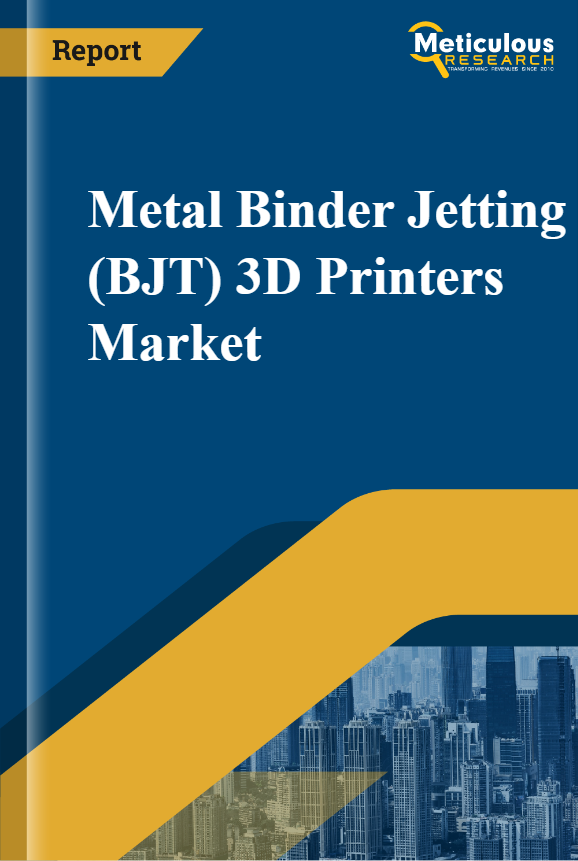
Metal Binder Jetting (BJT) 3D Printers Market by Type (Fully Automatic, Semi-Automatic), Material (Stainless Steel, Titanium, Aluminum, Tool Steel, Nickel Alloys), Application - Global Forecast to 2036
Report ID: MRSE - 1041694 Pages: 268 Jan-2026 Formats*: PDF Category: Semiconductor and Electronics Delivery: 24 to 72 Hours Download Free Sample Report
What is the Metal Binder Jetting 3D Printers Market Size?
The global metal binder jetting 3D printers market was valued at USD 318.4 million in 2025. The market is expected to reach approximately USD 1567.6 million by 2036 from USD 363.0 million in 2026, growing at a CAGR of 15.8% from 2026 to 2036. The growth of the overall metal binder jetting 3D printers market is driven by the accelerating demand for high-volume metal part production and the expansion of additive manufacturing adoption in mainstream industrial applications. As manufacturers seek cost-effective alternatives to traditional metal fabrication methods and laser powder bed fusion systems, binder jetting technology has emerged as a compelling solution for serial production. The rapid scaling of aerospace supply chains, the electrification of automotive platforms, and the growing need for patient-specific medical devices continue to fuel significant growth of this market across all major geographic regions.
-3d-printers-market-(1).webp)
Click here to: Get Free Sample Pages of this Report
Metal binder jetting 3D printers are advanced additive manufacturing systems that use inkjet printheads to selectively deposit liquid binding agents onto metal powder layers, creating complex parts through a room-temperature printing process followed by sintering. Unlike laser-based metal 3D printing technologies, binder jetting separates the shape formation and densification steps, enabling faster build speeds, larger build volumes, and the ability to nest parts in three dimensions without support structures. The market is defined by systems that offer high throughput, multi-material compatibility, and the ability to produce parts with mechanical properties comparable to metal injection molding and casting.
The market includes a diverse range of configurations, from compact benchtop systems for research and development to large-format industrial platforms capable of producing hundreds of parts in a single build. These systems are increasingly integrated with advanced software solutions for distortion prediction, automated depowdering stations, and inline quality control systems. The ability to provide cost-effective serial production while maintaining tight tolerances and excellent surface finish has made metal binder jetting the technology of choice for industries where design freedom and production economics are paramount.
The global manufacturing sector is rapidly embracing digital production workflows, aiming to reduce supply chain dependencies and enable distributed manufacturing. This shift has increased the adoption of metal binder jetting systems, with manufacturers leveraging the technology to eliminate tooling costs, accelerate time-to-market, and produce complex geometries that are impossible with traditional methods. At the same time, the convergence of binder jetting with artificial intelligence-driven process optimization and real-time monitoring is enabling unprecedented levels of repeatability and quality assurance.
What are the Key Trends in the Metal Binder Jetting 3D Printers Market?
Rapid Adoption in Aerospace and Defense for Serial Production
Manufacturers across aerospace and defense sectors are rapidly transitioning metal binder jetting from prototyping to serial production, moving well beyond traditional machining and casting toward scalable additive manufacturing solutions. Recent aerospace programs have demonstrated weight reductions of up to 50% in critical components while maintaining structural integrity, directly translating to fuel efficiency and performance gains. The technology's ability to produce lightweight, complex geometries impossible with conventional manufacturing makes it invaluable for aircraft brackets, rocket engine components, and military hardware. Major defense contractors are integrating binder jetting into their supply chains to streamline production and reduce dependency on traditional machining processes, with the U.S. Department of Defense actively supporting qualification programs for additively manufactured parts through initiatives requiring up to one million certified components by 2027.
Expansion into Automotive High-Volume Manufacturing
Expansion into automotive high-volume manufacturing is rapidly driving the metal binder jetting 3D printers market, as the industry shifts toward electrification and seeks cost-effective solutions for producing complex metal components at scale. Equipment suppliers are now designing binder jetting platforms specifically for automotive applications, with systems capable of simultaneously producing dozens of parts in a single build cycle. This enables manufacturers to meet the growing demand for lightweight structural components, electric motor housings, and customized brackets without the lead times and tooling costs associated with traditional manufacturing.
The automotive industry's transition to electric vehicles creates substantial opportunities for binder jetting technology, as manufacturers require innovative solutions for battery cooling systems, motor components, and structural parts that balance weight reduction with mechanical performance. By combining high-speed printing with precisely controlled sintering processes, modern binder jetting systems support both prototype validation and medium-volume production runs, strengthening the technology's position as a viable alternative to metal injection molding and die casting for automotive supply chains.
The global metal binder jetting 3D printers market was valued at USD 318.4 million in 2025. The market is expected to reach approximately USD 1567.6 million by 2036 from USD 363.0 million in 2026, growing at a CAGR of 15.8% from 2026 to 2036.
|
Parameter |
Details |
|
Market Size by 2036 |
USD 1567.6 Million |
|
Market Size in 2026 |
USD 363.0 Million |
|
Market Size in 2025 |
USD 318.4 Million |
|
Market Growth Rate (2026-2036) |
CAGR of 15.8% |
|
Dominating Region |
Asia Pacific |
|
Fastest Growing Region |
North America |
|
Base Year |
2025 |
|
Forecast Period |
2026 to 2036 |
|
Segments Covered |
Type, Material, Application, and Region |
|
Regions Covered |
North America, Europe, Asia-Pacific, Latin America, and Middle East & Africa |
Drivers: Cost-Effective Production and Elimination of Tooling
A key driver of the metal binder jetting 3D printers market is the technology's ability to deliver cost-effective metal part production without the significant upfront tooling investment required by traditional manufacturing methods. Unlike metal injection molding or die casting, which demand expensive molds and multi-month lead times, binder jetting enables manufacturers to move directly from design to production, eliminating tooling costs that can reach hundreds of thousands of dollars. This economic advantage becomes particularly compelling for low-to-medium volume production runs, where traditional methods struggle with unfavorable unit economics. The ability to batch and nest multiple parts in three dimensions within a single build volume provides further cost advantages over laser powder bed fusion systems, where parts must be attached to build plates with support structures. As manufacturers face increasing pressure to reduce inventory costs and respond rapidly to market demands, binder jetting systems provide the flexibility to produce parts on-demand while maintaining competitive piece-part pricing.
Opportunity: Medical Customization and Patient-Specific Devices
The rapid growth of personalized medicine and patient-specific medical devices provides exceptional opportunities for the metal binder jetting 3D printers market. The healthcare sector's adoption of binder jetting for customized implants, surgical instruments, and dental prosthetics creates compelling demand for systems that can economically produce one-of-a-kind devices. These applications require biocompatible materials, excellent surface finish, and the ability to produce complex internal structures, all attributes that are met with advanced binder jetting platforms. The medical device market is set to expand significantly through 2036, with binder jetting positioned for substantial growth as healthcare providers seek to improve patient outcomes through customized solutions. Furthermore, the increasing demand for rapid turnaround in surgical planning models and anatomical guides is stimulating demand for high-precision binder jetting systems that provide both accuracy and speed.
Why Do Fully Automatic Systems Dominate the Market?
The fully automatic segment accounts for around 65-70% of the overall metal binder jetting 3D printers market in 2026. This is mainly attributed to the industrial requirement for high-throughput production with minimal operator intervention and maximum repeatability. These systems offer the most efficient way to manage serial production workflows and provide consistent part quality across multiple build cycles. The aerospace and automotive sectors alone consume the vast majority of fully automatic binder jetting systems, with major production facilities demonstrating the technology's capability to handle scalable manufacturing operations. Advanced automation features including integrated powder handling, automated build unit exchange, and inline quality monitoring make these systems ideal for production environments where labor costs and process consistency are critical considerations.
However, the semi-automatic segment is expected to maintain steady growth during the forecast period, driven by its cost-effectiveness for research institutions, small to medium enterprises, and manufacturers entering the binder jetting space. The lower capital investment and operational flexibility of semi-automatic systems make them attractive for organizations validating applications or producing smaller batch sizes where full automation may not be economically justified.
How Does Stainless Steel Lead the Market?
Based on material, the stainless steel segment holds the largest share of the overall market in 2026, accounting for around 40-45% of the overall market. Stainless steel alloys, particularly 316L and 17-4PH, dominate binder jetting applications due to their excellent combination of mechanical properties, corrosion resistance, and established sintering processes. Current production applications increasingly specify stainless steel for its proven performance across diverse industries, from medical devices to industrial tooling.
The titanium segment continues to experience significant growth, particularly in aerospace and medical applications where the material's exceptional strength-to-weight ratio and biocompatibility are essential. Tool steel alloys including H13 and D2 are gaining traction in tooling and die applications, while aluminum alloys are emerging as promising materials for automotive and aerospace lightweighting initiatives. Nickel-based superalloys remain critical for high-temperature applications in aerospace propulsion systems, although their processing complexity limits broader adoption. The shift toward multi-material capabilities and material-specific process optimization is pushing manufacturers to develop standardized material portfolios that balance performance requirements with processing economics.
How is Aerospace & Defense Maintaining Dominance in the Global Metal Binder Jetting 3D Printers Market?
Aerospace & defense holds the largest share of the global metal binder jetting 3D printers market in 2026. The largest share of this application segment is primarily attributed to the industry's critical need for lightweight, complex geometries and the ongoing qualification of additively manufactured parts for flight-critical applications. Major aerospace programs, including next-generation aircraft and space exploration initiatives, are driving sustained investment in binder jetting technology. The ability to consolidate multiple components into single printed parts reduces assembly costs and eliminates potential failure points, creating significant value propositions for aircraft manufacturers. Defense contractors are particularly focused on supply chain resilience and the ability to produce replacement parts on-demand, with binder jetting providing a pathway to distributed manufacturing capabilities.
Which Factors Support Automotive and Medical Market Growth?
Automotive and medical & dental applications together account for around 30 to 35% of the global metal binder jetting 3D printers market. The growth of the automotive segment is mainly driven by the need for lightweight structural components in electric vehicles and the elimination of tooling costs for low-volume specialty vehicles. The demand for rapid prototyping and bridge manufacturing solutions enables automotive OEMs to validate designs and maintain production during tooling transitions.
In medical & dental applications, the focus on patient-specific implants and surgical guides is driving the adoption of binder jetting systems. Orthopedic implants, dental prosthetics, and surgical instruments benefit from the technology's ability to produce complex internal structures and customized geometries. Countries with advanced healthcare systems are at the forefront, with significant focus on regulatory compliance and the integration of binder jetting into medical device manufacturing workflows.
How is North America Maintaining Dominance in the Global Metal Binder Jetting 3D Printers Market?
North America holds the largest share of the global metal binder jetting 3D printers market in 2026. The largest share of this region is primarily attributed to advanced manufacturing infrastructure and the presence of leading technology developers and adopters. The United States alone accounts for more than 60% of regional market share, with its position as a hub for aerospace, defense, and advanced manufacturing driving sustained growth. Major aerospace contractors including Boeing, Lockheed Martin, and SpaceX are actively integrating binder jetting into their production workflows, while defense programs supported by the Department of Defense provide substantial validation and funding for technology development.
Recent regulatory developments, including the National Defense Authorization Act requirements restricting procurement of foreign-manufactured additive manufacturing systems, are further strengthening the position of domestically-produced binder jetting platforms. The presence of leading equipment manufacturers and a well-developed ecosystem of material suppliers and service providers creates a robust market for both equipment sales and contract manufacturing services.
Which Factors Support Asia Pacific and Europe Market Growth?
Asia Pacific and Europe together account for around 35 to 40% of the global metal binder jetting 3D printers market. The growth of Asia Pacific is mainly driven by massive automotive production capacity and the rapid expansion of electronics manufacturing. Countries including China, Japan, and South Korea are investing heavily in additive manufacturing infrastructure, with government initiatives supporting technology adoption and local equipment development. The region's strength in electronics and consumer products provides unique application opportunities for binder jetting systems, particularly in producing small, complex metal components at competitive costs.
In Europe, the leadership in sustainable manufacturing and the push for supply chain localization are driving the adoption of binder jetting technology. Countries like Germany, France, and the UK are at the forefront, with significant focus on integrating additive manufacturing into Industry 4.0 frameworks and developing circular economy solutions that leverage the material efficiency of binder jetting processes.
The companies such as Desktop Metal (ExOne), HP Inc., GE Additive (Colibrium Additive), and Markforged lead the global metal binder jetting 3D printers market with comprehensive platform offerings, particularly for large-scale industrial and production applications. Meanwhile, players including Digital Metal (Markforged Sweden), 3DEO, Tritone Technologies, and Rapidia focus on specialized high-precision systems and compact platforms targeting specific application segments. Emerging manufacturers such as AFS (3DPTEK), EasyMFG, and innovative materials developers are strengthening the market through innovations in binder chemistry, powder metallurgy, and integrated software solutions for process optimization and distortion control.
The metal binder jetting 3D printers market is expected to grow from USD 363.0 million in 2026 to USD 1567.6 million by 2036.
The metal binder jetting 3D printers market is expected to grow at a CAGR of 15.8% from 2026 to 2036.
The major players include Desktop Metal (ExOne), HP Inc., GE Additive (Colibrium Additive), Markforged, and Digital Metal (Markforged Sweden), among others.
The main factors include cost-effective production without tooling investment, growing demand for serial production of complex metal parts, and the expansion of aerospace supply chains and defense manufacturing requirements.
North America will lead the global metal binder jetting 3D printers market in terms of market share, while Asia Pacific is expected to witness the fastest growth during the forecast period 2026 to 2036.


















Published Date: Oct-2024
Published Date: May-2023
Published Date: Jul-2022
Please enter your corporate email id here to view sample report.
Subscribe to get the latest industry updates


