Resources
About Us
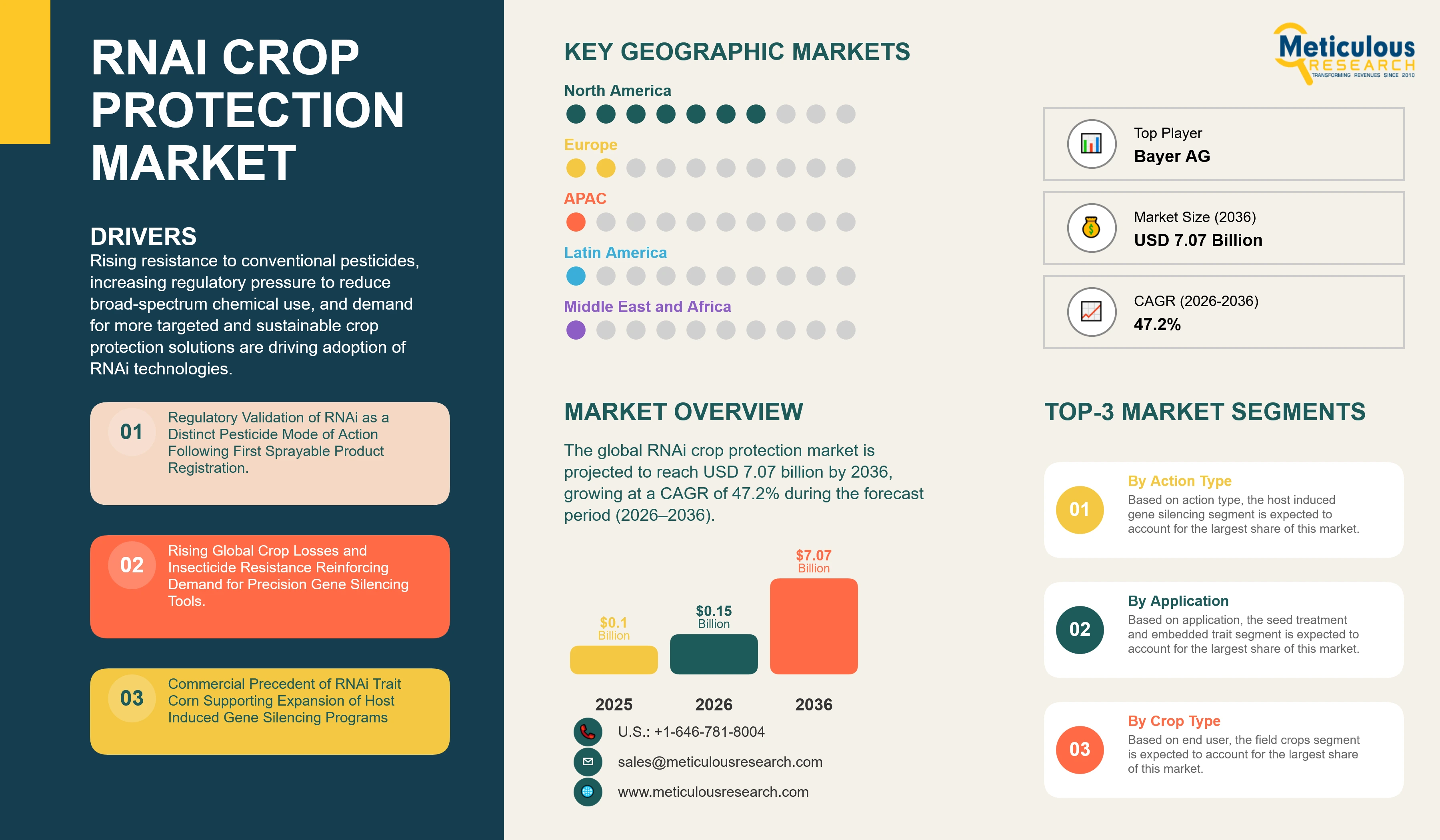
The global RNAi crop protection market was valued at USD 0.10 billion in 2025. The market is projected to reach USD 7.07 billion by 2036, growing from USD 0.15 billion in 2026 at a CAGR of 47.2% during the forecast period (2026–2036).
Click here to: Get Free Sample Pages
The global RNAi crop protection market encompasses pest, disease, and weed management products that silence specific genes in target organisms rather than relying on broad-spectrum chemical toxicity. The market includes sprayable double-stranded RNA (dsRNA) formulations applied through foliar, soil, or trunk treatments, as well as RNAi traits incorporated into seeds for host-induced gene silencing (HIGS). Applications span insect pest control, nematode and disease management, and emerging weed-control technologies across field crops, fruits and vegetables, cereals and grains, and oilseeds and pulses.
Following ingestion or uptake, dsRNA is processed by the target organism's RNA interference machinery into small interfering RNAs (siRNAs), which guide the degradation or suppression of complementary messenger RNA and disrupt genes essential to survival, development, or reproduction. The sequence-specific mechanism enables developers to target particular pests while potentially reducing impacts on non-target organisms compared with broad-spectrum chemistries.
Regulatory progress is strengthening market adoption. In December 2023, the U.S. EPA registered ledprona, the active ingredient in GreenLight Biosciences' Calantha, as the first sprayable dsRNA biopesticide approved for use on a food crop, targeting Colorado potato beetle. IRAC subsequently established Group 35: RNA interference (RNAi), recognizing RNAi as a distinct insecticide mode of action. In parallel, Bayer's SmartStax PRO corn technology represents a major commercial deployment of HIGS-based RNAi for western corn rootworm.
Market growth is supported by substantial global crop losses from pests and diseases, increasing resistance to conventional insecticides, and tighter restrictions on certain chemical active ingredients. However, high dsRNA production costs, formulation and delivery challenges, environmental stability, variable uptake, regulatory complexity, and the relatively narrow target specificity of individual RNAi products remain key constraints.
Continued investment in scalable dsRNA manufacturing, improved delivery technologies, and collaborations between agrochemical companies and RNAi-focused biotechnology firms is expected to reduce production costs and expand RNAi crop protection across additional crops and target pests during the forecast period.
First Commercial Regulatory Approvals Validating RNAi as a Distinct Pesticide Mode of Action
The registration of the first sprayable double stranded RNA biopesticide by the U.S. Environmental Protection Agency in December 2023 represents a foundational turning point for the RNAi crop protection market, converting a technology that had existed largely in research and field trial settings into a commercially registered product category. GreenLight Biosciences' Calantha, built on the ledprona active ingredient, required more than four years of EPA evaluation, an experimental use permit spanning field trials across ten states, and a formal public comment period before registration, establishing the review pathway that subsequent sprayable RNAi products are expected to follow.
The Insecticide Resistance Action Committee's creation of a dedicated mode of action group for ledprona formally distinguishes RNAi from every existing chemical insecticide class, giving growers a genuinely new resistance management tool at a time when resistance to established chemistries continues to erode the effectiveness of conventional pest control programs. Parallel to the sprayable product pathway, RNAi trait corn targeting western corn rootworm has been commercially planted in the United States since 2022 as part of the SmartStax PRO trait stack developed by Bayer and Corteva, giving the host induced gene silencing segment several years of commercial planting history and demonstrated grower adoption ahead of the newer sprayable format. Together, these two approval milestones are shifting industry and grower perception of RNAi from an emerging research concept to a proven, registrable crop protection technology, encouraging further investment and pipeline development across both established agrochemical companies and specialized RNAi biotechnology firms.
Evolving International Regulatory Frameworks Shaping Market Access Beyond the United States
The pace at which RNAi crop protection products gain approval outside the United States is one of the most significant factors shaping the market's near term growth trajectory, given that the technology does not fit cleanly into either the conventional chemical pesticide or the earlier generation genetically modified crop regulatory pathways used in most jurisdictions. The European Food Safety Authority has taken a structured approach to this gap, issuing updated 2025 guidance specifically addressing the risk assessment of RNAi based genetically modified plants, covering the bioinformatic analysis required to confirm the intended silencing trait and identify potential off-target effects, alongside dietary exposure assessment requirements for food and feed derived from RNAi trait crops. This guidance builds on the existing framework under the EU's plant protection product and GMO regulations, which continue to govern the authorization of both RNAi based plant protection products and RNAi trait crops in the region.
At the international level, the Organisation for Economic Co-operation and Development has published guidance specific to the human health risk assessment of externally applied double stranded RNA pesticides, providing a reference framework that regulatory authorities in multiple jurisdictions are drawing on as they build their own review processes for this product category. The European and Mediterranean Plant Protection Organization has similarly contributed methodological guidance supporting the assessment of RNA based active substances under existing plant protection product regulation. As these frameworks mature and more regulatory authorities establish clear review pathways, RNAi developers are expected to expand product submissions beyond the United States, broadening the addressable geography for both sprayable and trait based RNAi products over the forecast period.
Rising Pest Resistance and Crop Loss Pressure Reinforcing Demand for Precision Gene Silencing Tools
The persistent scale of global crop losses attributable to pests, diseases, and weeds continues to underpin long-term demand for new pest management technologies, including RNAi. The Food and Agriculture Organization of the United Nations estimates that pests and diseases account for the loss of between 20 and 40 percent of global crop production annually, with associated economic costs exceeding USD 220 billion a year from plant diseases alone and a further USD 70 billion attributable to invasive insect species. This scale of loss, sustained over decades despite widespread conventional pesticide use, reflects the growing challenge posed by resistance development in target pest populations exposed repeatedly to a limited number of chemical modes of action.
RNAi technology is positioned by developers as a tool that can specifically address resistant pest populations by targeting genetic sequences unique to a given species, reducing the likelihood of cross-resistance with existing chemistries. The Colorado potato beetle, the target pest of the first EPA approved sprayable RNAi product, is itself a well-documented example of a species that has developed resistance to numerous conventional insecticide classes over repeated growing seasons, illustrating the practical resistance management gap that RNAi products are being developed to fill. As resistance pressure continues to build against established chemistries across other major pest species, crop protection companies are expanding RNAi pipeline investment to target additional insect, fungal, and nematode pests where conventional options are becoming less effective.
By Mode of Action: In 2026, the Host Induced Gene Silencing Segment to Dominate the Global RNAi Crop Protection Market
Based on mode of action, the RNAi crop protection market is segmented into host induced gene silencing and spray induced gene silencing. In 2026, the host induced gene silencing segment is expected to account for the largest share of this market. The leading position of this segment is attributed to the multi-year commercial planting history of RNAi trait corn under the SmartStax PRO trait stack developed by Bayer and Corteva, which has been cultivated across meaningful corn acreage in the United States since 2022 for control of western corn rootworm, and to the segment's integration into existing seed distribution, licensing, and royalty structures that give it a substantially larger installed commercial base than sprayable RNAi products at this stage of the market's development.
However, the spray induced gene silencing segment is projected to register the highest growth during the forecast period. The high growth of this segment is driven by its applicability to a far broader range of crops than trait based approaches, since sprayable dsRNA products can be applied to specialty and horticultural crops where the cost and multi-year timeline of trait development and deregulation are not commercially viable, by the precedent set by the EPA registration of Calantha as a foliar applied biopesticide, and by the ability of developers to bring new pest specific formulations to market on shorter development cycles than transgenic trait programs typically require.
By Application Method: In 2026, the Seed Treatment and Embedded Trait Segment to Hold the Largest Share
Based on application method, the RNAi crop protection market is segmented into seed treatment and embedded trait, foliar spray, soil and drench treatment, and trunk and stem injection. In 2026, the seed treatment and embedded trait segment is expected to account for the largest share of this market. The growth of this segment is driven by the scale of RNAi trait corn already under commercial cultivation for corn rootworm control, and by the efficiency of delivering season-long, systemic gene silencing protection through the seed itself rather than through repeated field applications.
However, the foliar spray segment is projected to register the highest growth during the forecast period. The high growth of this segment is driven by the ease of integrating dsRNA sprays into existing crop protection application equipment and spray programs already used by growers, by expanding regulatory approvals following the Calantha registration, and by the segment's applicability to fruit, vegetable, and other specialty crops that fall outside the economic scope of trait development programs.
By Crop Type: In 2026, the Field Crops Segment to Hold the Largest Share
Based on crop type, the RNAi crop protection market is segmented into field crops, fruits and vegetables, cereals and grains, oilseeds and pulses, and other crop types. In 2026, the field crops segment is expected to account for the largest share of this market, reflecting the scale of RNAi trait corn planted for rootworm control across major corn producing regions of the United States and the concentration of large agrochemical company research investment in row crop pest management.
However, the fruits and vegetables segment is projected to register the highest growth during the forecast period. The high growth of this segment is driven by the commercial precedent set by Calantha's approval for use on potato crops against the Colorado potato beetle, by the comparatively higher value per acre of fruit and vegetable production that supports premium biopesticide pricing, and by the limited availability of new chemical pest control options in specialty crop systems where many older chemistries face use restrictions.
Based on geography, the overall RNAi crop protection market is segmented into North America, Europe, Asia Pacific, Latin America, and the Middle East and Africa. In 2026, North America is expected to account for the largest share of this market. This position is driven by the United States being the first and, to date, primary market with EPA registered sprayable RNAi products and commercially planted RNAi trait corn, by the concentration of RNAi crop protection developers including GreenLight Biosciences, RNAissance Ag, AgroSpheres, and Pebble Labs headquartered in the United States, and by the presence of the large-scale corn, soybean, and potato growing regions that represent the primary commercial target crops for currently approved and pipeline RNAi products.
However, the Asia Pacific RNAi crop protection market is expected to grow at the fastest rate from 2026 to 2036. The rapid growth of this market is driven by rising resistance to conventional insecticides across major pest species affecting rice, vegetable, and fruit crops in China and India, growing government interest in biopesticide adoption as an alternative to broad spectrum chemical pesticides, and expanding agricultural biotechnology research investment across China, Japan, South Korea, and India. The region's large and diverse base of specialty and horticultural crop production is also expected to create demand for foliar RNAi products suited to crops where trait based approaches are not commercially applicable.
Europe represents a market shaped primarily by the pace of regulatory clarity for RNAi based products under the existing plant protection product and genetically modified organism frameworks. The European Food Safety Authority's 2025 guidance on the risk assessment of RNAi based genetically modified plants, together with supporting methodological work from the Organisation for Economic Co-operation and Development and the European and Mediterranean Plant Protection Organization, is expected to progressively clarify the pathway for both RNAi trait crops and RNAi based plant protection products in the region, supporting gradual market development as products move through review.
The Middle East and Africa and Latin America regions represent early stage markets for RNAi crop protection, with Latin America's development supported primarily by the scale of soybean, corn, and fruit production in Brazil and Argentina, where interest in RNAi trait crops and biopesticides is building alongside broader adoption of biological crop protection products across the region's agricultural sector.
The global RNAi crop protection market remains at an early and highly fragmented stage, comprising diversified agrochemical companies developing RNAi-based crop protection technologies and specialized biotechnology companies focused on RNA-based pest and disease management. Key competitive differentiators include proprietary dsRNA production and delivery platforms, breadth of target pests and crops, regulatory capabilities, commercial development pipelines, and partnerships that combine RNAi technology with the field-testing, registration, manufacturing, and distribution capabilities of established agricultural companies.
Large agrochemical companies, including Bayer AG, Syngenta Group, Corteva, Inc., BASF SE, and FMC Corporation, participate through RNAi research, trait development, technology partnerships, and broad crop-protection commercialization capabilities. Bayer has established a leading position through commercial RNAi corn traits, while FMC has strengthened its position through its collaboration and investment in AgroSpheres to accelerate the development of RNA-based crop protection solutions.
Specialized RNAi developers, including GreenLight Biosciences, AgroSpheres, Renaissance BioScience Corp., RNAissance Ag LLC, Pebble Labs, Inc., PlantArcBio Ltd., Genolution Inc., Innatrix, and TRILLIUM AG, compete through proprietary RNA production, formulation, delivery, and gene-silencing technologies. GreenLight Biosciences has a particularly advanced commercial position following U.S. EPA registration of its RNA-based Calantha bioinsecticide and subsequent regulatory expansion into Europe. Renaissance BioScience is also expanding its yeast-based RNAi platform toward soil-dwelling pests and developing advanced RNA production and delivery technologies.
Tropic Biosciences UK Ltd. participates primarily through gene-silencing and gene-editing technologies, while Sumitomo Chemical Co., Ltd. represents a major diversified agricultural-input company with potential for RNAi expansion through technology development and partnerships. Nufarm Limited, ICL Group Ltd., UPL Limited, and other agricultural-input companies are better considered secondary or adjacent participants rather than core RNAi competitors.
The report provides a comprehensive competitive analysis based on key players' product portfolios, technology capabilities, geographic presence, partnerships, regulatory developments, and strategic initiatives undertaken during the past few years.
Key players analyzed in the global RNAi crop protection market include Bayer AG (Germany), Syngenta Group (Switzerland), Corteva, Inc. (U.S.), BASF SE (Germany), FMC Corporation (U.S.), GreenLight Biosciences, Inc. (U.S.), AgroSpheres, Inc. (U.S.), Renaissance BioScience Corp. (Canada), RNAissance Ag LLC (U.S.), Pebble Labs, Inc. (U.S.), PlantArcBio Ltd. (Israel), Genolution Inc. (South Korea), Innatrix (U.S.), Tropic Biosciences UK Ltd. (U.K.), and TRILLIUM AG (U.S.), among others.
|
Parameters |
Details |
|
Market Size by 2036 |
USD 7.07 Billion |
|
Market Size in 2026 |
USD 0.15 Billion |
|
Market Size in 2025 |
USD 0.10 Billion |
|
Revenue Growth Rate (2026–2036) |
CAGR of 47.2% |
|
Dominating Mode of Action |
Host Induced Gene Silencing |
|
Fastest Growing Mode of Action |
Spray Induced Gene Silencing |
|
Dominating Application Method |
Seed Treatment and Embedded Trait |
|
Fastest Growing Application Method |
Foliar Spray |
|
Dominating Crop Type |
Field Crops |
|
Fastest Growing Crop Type |
Fruits and Vegetables |
|
Dominating Geography |
North America |
|
Fastest Growing Geography |
Asia Pacific |
|
Base Year |
2025 |
|
Forecast Period |
2026 to 2036 |
The global RNAi crop protection market is expected to reach USD 7.07 billion by 2036 from an estimated USD 0.15 billion in 2026, at a CAGR of 47.2% during the forecast period 2026–2036.
In 2026, the host induced gene silencing segment is expected to hold the largest share of this market, driven by the multi-year commercial planting history of RNAi trait corn for rootworm control and its integration into existing seed distribution and licensing structures.
The spray induced gene silencing segment is expected to register the highest CAGR during the forecast period 2026–2036, driven by its applicability across a broader range of crops than trait based approaches and by the regulatory precedent set by the first EPA registered sprayable RNAi biopesticide.
In 2026, the seed treatment and embedded trait segment is expected to hold the largest share of this market, reflecting the scale of RNAi trait corn already under commercial cultivation.
In 2026, the field crops segment is expected to hold the largest share of this market, reflecting the concentration of currently commercialized RNAi trait products in corn and the scale of row crop production addressed by leading agrochemical companies.
North America is expected to account for the largest share of the global RNAi crop protection market in 2026, driven by the United States being the first market with EPA registered sprayable RNAi products, commercially planted RNAi trait corn, and the concentration of leading RNAi crop protection developers.
The growth of this market is primarily driven by the regulatory validation provided by the EPA's registration of the first sprayable RNAi biopesticide and the commercial precedent of RNAi trait corn; the persistent scale of global crop losses attributable to pests and diseases as estimated by the Food and Agriculture Organization of the United Nations; rising resistance to conventional insecticide chemistries across major pest species; maturing international regulatory guidance from EFSA, the OECD, and EPPO; and expanding collaboration between established agrochemical companies and specialized RNAi biotechnology developers.
Key players in the global RNAi crop protection market include Bayer AG, Syngenta Group, Corteva, Inc., BASF SE, GreenLight Biosciences, Inc., RNAissance Ag LLC, AgroSpheres, Inc., Pebble Labs, Inc., Renaissance BioScience Corp., Tropic Biosciences UK Ltd., TRILLIUM AG, ICL Group Ltd., Nufarm Limited, and Sumitomo Chemical Co., Ltd.
Asia Pacific is expected to register the highest growth rate in the global RNAi crop protection market during the forecast period 2026–2036, driven by rising pest resistance across major food crops, growing government support for biopesticide adoption, and expanding agricultural biotechnology investment across China, India, Japan, and South Korea.
1. Introduction
1.1 Market Definition and Scope
1.2 Market Ecosystem
1.3 Currency and Limitations
1.3.1 Currency
1.3.2 Limitations
1.4 Key Stakeholders
2. Research Methodology
2.1 Research Approach
2.2 Data Collection & Validation Process
2.2.1 Secondary Research
2.2.2 Primary Research & Validation
2.2.2.1 Primary Interviews with Experts
2.2.2.2 Country-/Region-Level Analysis
2.3 Market Estimation
2.3.1 Bottom-Up Approach
2.3.2 Top-Down Approach
2.4 Data Triangulation
2.5 Assumptions for the Study
3. Executive Summary
3.1 Market Overview
3.2 Market Analysis by Mode of Action
3.3 Market Analysis by Application Method
3.4 Market Analysis by Crop Type
3.5 Market Analysis by Geography
4. Market Dynamics
4.1 Overview
4.2 Drivers
4.2.1 Regulatory Validation of RNAi as a Distinct Pesticide Mode of Action Following First Sprayable Product Registration
4.2.2 Rising Global Crop Losses and Insecticide Resistance Reinforcing Demand for Precision Gene Silencing Tools
4.2.3 Commercial Precedent of RNAi Trait Corn Supporting Expansion of Host Induced Gene Silencing Programs
4.2.4 Maturing International Regulatory Guidance from EFSA, OECD, and EPPO Clarifying Market Access Pathways
4.3 Restraints
4.3.1 High Cost and Limited Scale of Double Stranded RNA Manufacturing Relative to Conventional Chemistries
4.3.2 Environmental Stability and Uptake Efficiency Challenges Affecting Field Performance of Sprayable dsRNA Products
4.4 Opportunities
4.4.1 Expansion of Sprayable RNAi Products into Specialty and Horticultural Crops Underserved by Trait Development
4.4.2 Tightening Restrictions on Conventional Chemical Actives Creating Demand for Alternative Modes of Action
4.4.3 Growing Collaboration Between Established Agrochemical Companies and Specialized RNAi Biotechnology Developers
4.5 Challenges
4.5.1 Multi-Year Regulatory Review Timelines for Novel Active Ingredients Outside the United States
4.5.2 Narrow Target Pest Range per Product Requiring Broad Pipeline Investment to Address Grower Needs
4.6 Porter's Five Forces Analysis
5. RNAi Crop Protection Market, by Mode of Action
5.1 Overview
5.2 Host Induced Gene Silencing
5.2.1 Trait Stacked Products
5.2.2 Single Trait Products
5.3 Spray Induced Gene Silencing
5.3.1 Double Stranded RNA Formulations
5.3.2 Small Interfering RNA Formulations
6. RNAi Crop Protection Market, by Application Method
6.1 Overview
6.2 Seed Treatment and Embedded Trait
6.3 Foliar Spray
6.4 Soil and Drench Treatment
6.5 Trunk and Stem Injection
7. RNAi Crop Protection Market, by Crop Type
7.1 Overview
7.2 Field Crops
7.2.1 Corn
7.2.2 Soybean
7.2.3 Cotton
7.3 Fruits and Vegetables
7.4 Cereals and Grains
7.5 Oilseeds and Pulses
7.6 Other Crop Types
8. RNAi Crop Protection Market, by Geography
8.1 Overview
8.2 North America
8.2.1 U.S.
8.2.2 Canada
8.3 Europe
8.3.1 Germany
8.3.2 U.K.
8.3.3 France
8.3.4 Netherlands
8.3.5 Spain
8.3.6 Rest of Europe
8.4 Asia Pacific
8.4.1 China
8.4.2 India
8.4.3 Japan
8.4.4 South Korea
8.4.5 Australia
8.4.6 Rest of Asia Pacific
8.5 Latin America
8.5.1 Brazil
8.5.2 Argentina
8.5.3 Rest of Latin America
8.6 Middle East and Africa
8.6.1 South Africa
8.6.2 Rest of Middle East and Africa
9. Competitive Landscape
9.1 Overview
9.2 Key Growth Strategies
9.3 Competitive Benchmarking
9.4 Competitive Dashboard
9.4.1 Industry Leaders
9.4.2 Market Differentiators
9.4.3 Vanguards
9.4.4 Emerging Companies
9.5 Market Share/Ranking Analysis (2025)
10. Company Profiles
10.1 Bayer AG
10.2 Syngenta Group
10.3 Corteva, Inc.
10.4 BASF SE
10.5 FMC Corporation
10.6 GreenLight Biosciences, Inc.
10.7 AgroSpheres, Inc.
10.8 Renaissance BioScience Corp.
10.9 RNAissance Ag LLC
10.10 Pebble Labs, Inc.
10.11 PlantArcBio Ltd.
10.12 Genolution Inc.
10.13 Innatrix Inc.
10.14 Tropic Biosciences UK Ltd.
10.15 Trillium AG
11. Appendix
11.1 Questionnaire
11.2 Available Customization Options
11.3 Related Reports






















Published Date: Aug-2026
Published Date: Jan-2025
Published Date: Jun-2024
Subscribe to get the latest industry updates