Resources
About Us

Polyvalent Heat Pumps Market by Type (Air-to-Water, Water-to-Water, Ground Source), Capacity (Up to 10 kW, 10-20 kW, 20-30 kW, Above 30 kW), Technology (Conventional, Inverter-Driven, Variable Speed), Application, End User, and Geography - Global Forecast to 2035
Report ID: MREP - 1041606 Pages: 223 Oct-2025 Formats*: PDF Category: Energy and Power Delivery: 24 to 72 Hours Download Free Sample Report
What is the Polyvalent Heat Pumps Market Size?
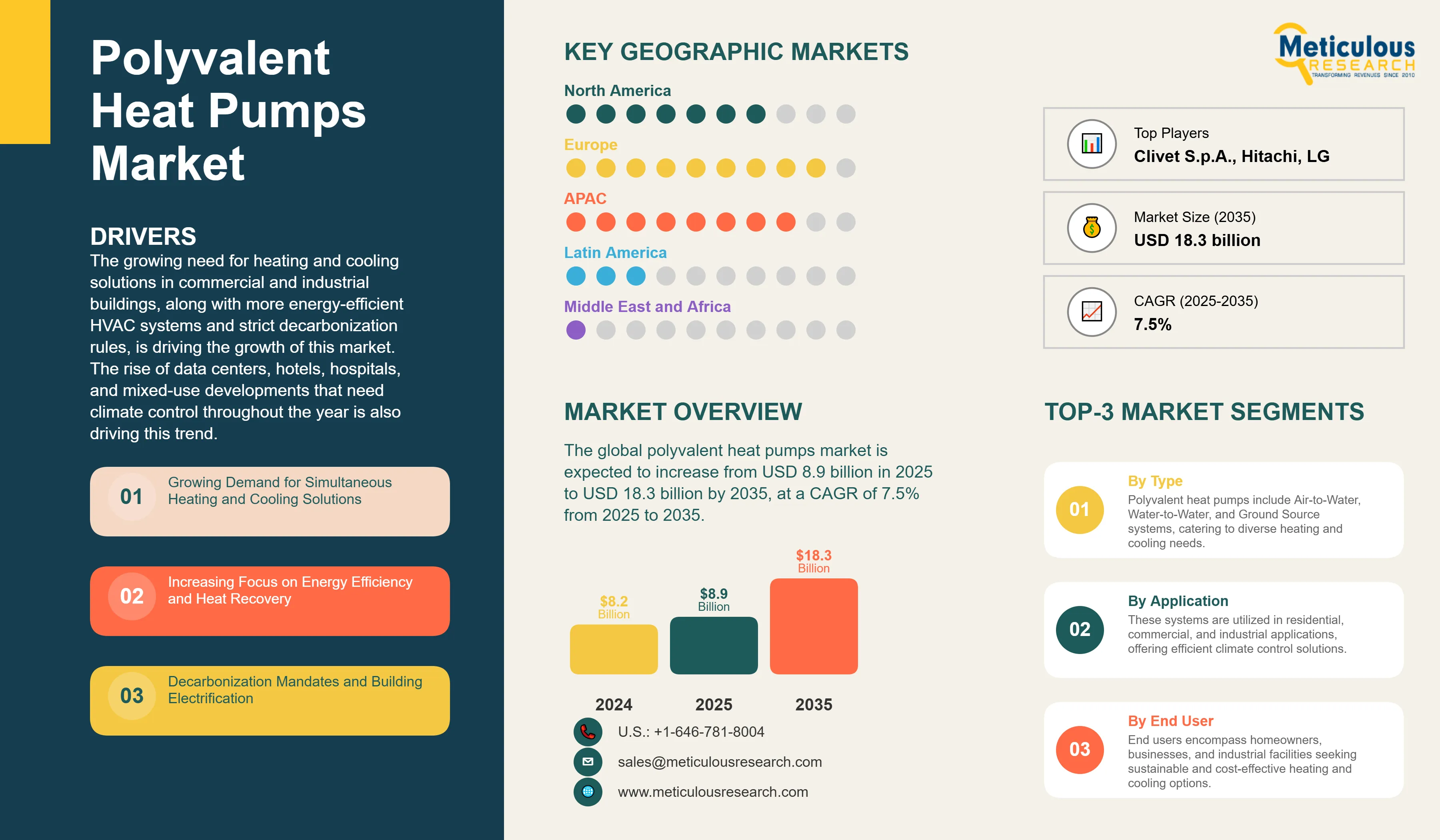
The global polyvalent heat pumps market was valued at USD 8.2 billion in 2024 and is expected to increase from USD 8.9 billion in 2025 to USD 18.3 billion by 2035, at a CAGR of 7.5% from 2025 to 2035. The growing need for heating and cooling solutions in commercial and industrial buildings, along with more energy-efficient HVAC systems and strict decarbonization rules, is driving the growth of this market. The rise of data centers, hotels, hospitals, and mixed-use developments that need climate control throughout the year is also driving this trend.
Polyvalent Heat Pumps Market Key Highlights
Click here to: Get Free Sample Pages of this Report
The polyvalent heat pumps market includes the design, manufacturing, installation, and servicing of reversible heating and cooling systems. These systems can provide heating and cooling to different areas in commercial and industrial buildings at the same time. Unlike standard heat pumps that work in either heating or cooling mode, polyvalent units have dual refrigerant circuits or control systems. This allows them to meet heating and cooling needs simultaneously throughout the year without needing to switch modes seasonally.
Polyvalent heat pumps are vital for applications that need year-round heating and cooling. This includes hotels with varying zone requirements, hospitals that require precise climate control, data centers needing continuous cooling while recovering heat for domestic hot water, and mixed-use commercial buildings.
The polyvalent heat pumps market is growing primarily due to stricter energy efficiency rules, the demand for heat recovery systems that cut down energy waste, the increasing use of low-GWP refrigerants, the rise in green building certifications, and the growing need for decarbonized heating solutions in commercial and industrial spaces worldwide.
How is AI Transforming the Polyvalent Heat Pumps Market?
Artificial intelligence in polyvalent heat pumps improves system efficiency through ongoing performance monitoring and predictive maintenance. By using machine learning, it balances the load between heating and cooling circuits. This enables fault detection, diagnostics, and operation adjustments based on real-time occupancy and weather data.
AI examines operational data to spot inefficiencies, predict component failures, and automatically adjust refrigerant flow and compressor speeds for the best energy performance in both heating and cooling modes. Machine learning models take historical usage, building thermal properties, and external conditions into account to create predictive comfort profiles that lower energy consumption.
Moreover, AI enhances heat recovery by directing waste heat from cooling zones to heating needs. It also manages the switching priority between producing hot water and space conditioning. These features can cut operational costs by 25-35%, improve system reliability, extend equipment lifespan, and increase occupant comfort through accurate multi-zone temperature control.
What are the Key Trends in the Polyvalent Heat Pumps Market?
|
Report Coverage |
Details |
|
Market Size by 2035 |
USD 18.3 Billion |
|
Market Size in 2025 |
USD 8.9 Billion |
|
Market Size in 2024 |
USD 8.2 Billion |
|
Market Growth Rate from 2025 to 2035 |
CAGR of 7.5% |
|
Dominating Region |
Europe |
|
Fastest Growing Region |
Asia Pacific |
|
Base Year |
2024 |
|
Forecast Period |
2025 to 2035 |
|
Segments Covered |
Type, Capacity, Technology, Application, End User, Distribution Channel, and Region |
|
Regions Covered |
North America, Europe, Asia-Pacific, Latin America, and Middle East & Africa |
Market Dynamics
Drivers
Growing Demand for Simultaneous Heating and Cooling Solutions
The key driver of the polyvalent heat pumps market is the growing need for year-round heating and cooling in various building applications. Facilities like hotels, hospitals, mixed-use commercial buildings, and modern offices often have areas with conflicting thermal needs. For example, server rooms and kitchens generate excess heat, while patient rooms or hotel suites need heat. Polyvalent heat pumps effectively address these different demands with a single integrated system, removing the need for separate heating and cooling equipment.
This feature is particularly useful in data centers, where constant cooling of IT equipment creates a lot of waste heat. This heat can be reused for heating office spaces or providing hot water for domestic use, leading to energy savings. Moreover, the rise of mixed-use developments that combine residential, commercial, and entertainment spaces in urban areas increases the demand for polyvalent solutions that can handle various thermal loads efficiently. Government incentives for energy-efficient building systems and stricter energy codes promoting heat recovery technologies are also speeding up the adoption of polyvalent heat pumps in commercial and industrial sectors around the world.
Opportunity
Decarbonization Mandates and Heat Recovery Requirements
The global push for building decarbonization and net-zero emissions targets is creating significant growth opportunities for the polyvalent heat pumps market. More regulations are banning or limiting natural gas use in new constructions, requiring electric heating solutions instead. Polyvalent heat pumps eliminate fossil fuel combustion while providing both heating and cooling, which fits well with these decarbonization goals.
Building codes are also evolving. They increasingly require heat recovery systems to capture and reuse waste energy, especially in large commercial and industrial settings. Polyvalent heat pumps with integrated heat recovery meet these requirements, ensuring compliance and offering considerable energy cost savings.
The focus on circular economy principles in building operations supports technologies that reduce energy waste, making polyvalent systems preferred options. Additionally, carbon pricing and emissions trading schemes encourage reduced energy use and smaller carbon footprints, making the higher initial investment in polyvalent heat pumps financially appealing through savings and compliance benefits.
Type Insights
Why are Air-to-Water Polyvalent Heat Pumps Dominant in the Market?
The air-to-water segment holds the largest market share of approximately 60-65% in 2025. Air-to-water polyvalent heat pumps extract heat from outdoor air and transfer it to water-based distribution systems, making them ideal for retrofitting existing hydronic heating systems in commercial buildings. These systems offer relatively straightforward installation compared to ground source alternatives, as they don't require expensive ground loop drilling or access to water sources, significantly reducing upfront infrastructure costs.
Modern air-to-water polyvalent units incorporate advanced inverter-driven compressors and variable-speed fans that maintain high efficiency across a wide range of ambient temperatures, making them viable in diverse climatic conditions. Their ability to simultaneously produce hot water for heating circuits and chilled water for cooling zones makes them particularly suitable for hotels, hospitals, and office buildings with year-round HVAC demands. The compact outdoor unit design allows for rooftop or ground-level installation without consuming valuable building interior space. Recent advancements in low-ambient temperature operation extend their effective use to colder climates, broadening market applicability.
The water-to-water segment is expected to experience the fastest growth during the forecast period. Water-source polyvalent heat pumps achieve higher efficiency levels (COP of 5.0-6.0) than air-source alternatives by utilizing stable water temperatures from geothermal loops, cooling towers, or nearby water bodies. This efficiency advantage becomes increasingly attractive as energy costs rise and carbon reduction targets tighten. Growing awareness of geothermal heat pump benefits and decreasing ground loop installation costs through improved drilling technologies drive adoption in new construction projects with available land for ground heat exchangers.
Why Are Air-to-Water Polyvalent Heat Pumps Dominant?
The air-to-water segment holds the largest share of about 60-65% of the overall air-to-water polyvalent heat pumps market in 2025. These systems take heat from outdoor air and transfer it to water-based distribution, making them perfect for upgrading existing hydronic heating systems in commercial buildings. They are easier and cheaper to install than ground-source alternatives since there’s no need for expensive ground loop drilling or access to water sources.
Modern air-to-water polyvalent units use inverter-driven compressors and variable-speed fans to maintain high efficiency over a wide range of ambient temperatures, making them suitable for various climates. Their ability to produce hot and chilled water at the same time makes them great for hotels, hospitals, and offices that require year-round heating and cooling.
However, the water-to-water segment is expected to grow at the fastest CAGR from 2025 to 2035. It uses stable water temperatures from geothermal loops, cooling towers, or bodies of water for better efficiency (COP 5.0-6.0). Rising energy costs and tighter carbon targets make these systems more appealing. Improved drilling techniques are also lowering installation costs for ground loops in new buildings with available land.
Technology Insights
How do Inverter-Driven Polyvalent Units Maintain Market Leadership?
Inverter-driven systems hold around 45-50% share of the overall market in 2025. These compressors adjust refrigerant flow based on real-time loads, which improves energy efficiency by reducing cycling losses and lowering peak demand. They maintain stable indoor temperatures by precisely modulating capacity and extend equipment life by reducing mechanical stress.
Control algorithms improve heat recovery between heating and cooling by focusing on the best opportunities. Quieter operation makes them suitable for noise-sensitive areas like hotels and healthcare facilities. Variable-speed units, which also manage pumps and fans, are expected to grow the fastest, offering 40-50% energy savings compared to fixed-speed systems by optimizing each component separately.
Capacity Insights
How does the 20-30 kW Segment Lead the Market?
The 20-30 kW range accounts for 35-40% share of the market in 2025. This range services medium-sized commercial buildings such as boutique hotels, clinics, and offices with 50-150 occupants. This capacity strikes a balance between load matching and modularity, allowing for multiple units that provide redundancy and control without the complexity of large central systems. High production volumes create economies of scale, leading to competitive pricing and simpler design and installation.
The market for units above 30 kW is expected to grow at the fastest CAGR through 2035, driven by large commercial, mixed-use, and industrial buildings needing significant simultaneous heating and cooling.
Application Insights
Why do Commercial Applications Dominate Market Demand?
Commercial buildings hold 65-70% share of the market in 2025 due to their need for simultaneous heating and cooling in different zones. Hotels, hospitals, and office complexes have varied thermal demands, such as cooling kitchens or server rooms while heating guest or patient areas. The growing focus on energy efficiency, cost-cutting, and sustainability drives the demand for modern HVAC technologies like polyvalent heat pumps.
However, the industrial facilities, including manufacturing, food processing, pharmaceuticals, and logistics, are the fastest-growing segment due to the benefits of polyvalent systems in controlling process temperature and recovering heat.
End User Insights
Why have Hotels & Hospitality Found Maximum Application?
On the basis of application, hotels and hospitality command about 20-25% share of the overall market in 2025. Their inherent need for simultaneous heating and cooling across guest rooms, kitchens, laundries, and public spaces makes polyvalent heat pumps a cost-effective solution. By prioritizing guest comfort and operational efficiency, hotels have become early adopters of advanced HVAC technologies that deliver superior performance and energy savings.
On the other hand, data centers are projected to grow at the fastest CAGR from 2025 to 2035 due to the rapid expansion of cloud services, AI, and digital solutions. They need constant high-capacity cooling for IT equipment while also requiring heating for offices and hot water production. Polyvalent heat pumps with heat recovery can capture and repurpose wasted heat from server cooling, significantly improving efficiency. Strict Power Usage Effectiveness targets and the need for reliable systems further drive the popularity of advanced HVAC solutions in this sector.
Distribution Channel Insights
Why are Direct Sales Dominant in the Market?
Direct sales account for a 55-60% share of the market in 2025. This is driven by the technical complexity of polyvalent systems, which require collaboration with manufacturers for system design, hydraulic integration, and building automation. Direct sales channels offer comprehensive engineering support, customization, commissioning, and ongoing technical assistance.
Large commercial and institutional buyers prefer direct relationships to secure volume pricing, consistent product specifications, and dedicated technical resources. This approach ensures reliable warranty and service support throughout the project lifecycle.
However, online sales are projected to grow the fastest, aided by digital HVAC platforms with advanced selection tools, system configurators, and e-commerce capabilities. These platforms simplify the purchase of standardized polyvalent units for smaller commercial applications, lowering transaction costs and speeding up quotations. While direct sales remain essential for complex projects, routine replacements and smaller installations are increasingly moving online for greater convenience and competitive pricing.
U.S. Polyvalent Heat Pumps Market Size and Growth 2025 to 2035
The U.S. polyvalent heat pumps market is projected to be worth around USD 4.2 billion by 2035, growing at a CAGR of 7.1% from 2025 to 2035.
How is the Europe Polyvalent Heat Pumps Market Growing Dominantly Across the Globe?
Europe accounts for about 35-40% of the global polyvalent heat pump market in 2025. This is primarily due to strong decarbonization policies for building heating, strict F-gas regulations that encourage the use of low-GWP refrigerants, established district heating networks that work well with polyvalent systems, and significant financial incentives for heat pump installations in key European markets.
The commitment of the European Union to reach carbon neutrality by 2050 has led to policies like the Energy Performance of Buildings Directive and national building codes. These policies support or require electric heating solutions, which directly promote the use of polyvalent heat pumps. Countries such as Germany, France, the Netherlands, and those in Scandinavia have introduced substantial subsidy programs that cover 30-50% of the installation costs for polyvalent systems. These subsidies make projects much more economically attractive.
The presence of major manufacturers like Daikin, Bosch, Viessmann, and NIBE, which have large production facilities and distribution networks in Europe, further ensures that products are available and that there is technical support and service infrastructure.
Which Factors Support the Asia Pacific Polyvalent Heat Pumps Market Growth?
Asia Pacific polyvalent heat pumps market is expected to grow at the fastest CAGR from 2025 to 2035, driven by rapid commercial construction in major markets like China, Japan, South Korea, Singapore, and emerging Southeast Asian economies.
China's goals for carbon neutrality and its shift away from coal-based heating systems in northern provinces create significant opportunities for electric heating solutions, including polyvalent heat pumps. Government programs such as the "Coal to Clean Energy" initiative specifically encourage the use of heat pumps for commercial and residential heating in China.
The growing hospitality sector, with major hotel chains expanding across Asia Pacific, fuels the need for advanced HVAC solutions provided by polyvalent systems. Rising disposable incomes and higher comfort expectations in tropical and subtropical climates boost the demand for year-round climate control in commercial buildings. Urbanization and the development of modern commercial infrastructure, such as Grade A office buildings, shopping malls, and mixed-use developments built to international standards, favor advanced HVAC technologies like polyvalent heat pumps.
Domestic manufacturing in China, Japan, and South Korea supports competitive pricing for polyvalent systems, making them more affordable for price-sensitive markets. Technology transfers and partnerships between Asian and European manufacturers improve product quality and introduce advanced polyvalent technologies to regional markets. Government initiatives promoting energy efficiency and green buildings, like China's Green Building Label and Singapore's Green Mark scheme, provide more incentives for the adoption of polyvalent systems.
Value Chain Analysis
Recent Developments
Segments Covered in the Report
By Type
By Capacity
By Technology
By Application
By End User
By Distribution Channel
By Region
The polyvalent heat pumps market is expected to increase from USD 8.2 billion in 2024 to USD 18.3 billion by 2035.
The polyvalent heat pumps market is expected to grow at a CAGR of 7.5% from 2025 to 2035.
The major players include Daikin Industries Ltd., Carrier Global Corporation, Johnson Controls International plc, Trane Technologies plc, Mitsubishi Electric Corporation, Bosch Thermotechnology (Robert Bosch GmbH), Viessmann Climate Solutions SE, NIBE Industrier AB, Clivet S.p.A., LG Electronics Inc., Samsung Electronics Co. Ltd., Midea Group Co. Ltd., Lennox International Inc., Rheem Manufacturing Company, Hitachi Ltd., Fujitsu General Limited, Glen Dimplex Group, Panasonic Corporation, Stiebel Eltron GmbH & Co. KG, and Vaillant Group.
The driving factors include increasing demand for simultaneous heating and cooling solutions in commercial buildings, growing emphasis on heat recovery and energy efficiency, decarbonization mandates eliminating fossil fuel heating, expansion of data centers and mixed-use developments, and adoption of low-GWP refrigerants.
Europe region will lead the global polyvalent heat pumps market during the forecast period 2025 to 2035, supported by aggressive decarbonization policies and mature commercial building infrastructure.























Published Date: Apr-2026
Published Date: Sep-2025
Published Date: Jul-2025
Published Date: Jul-2025
Published Date: May-2025
Please enter your corporate email id here to view sample report.
Subscribe to get the latest industry updates


