
Rooftop HVAC Units Market (2025-2035)
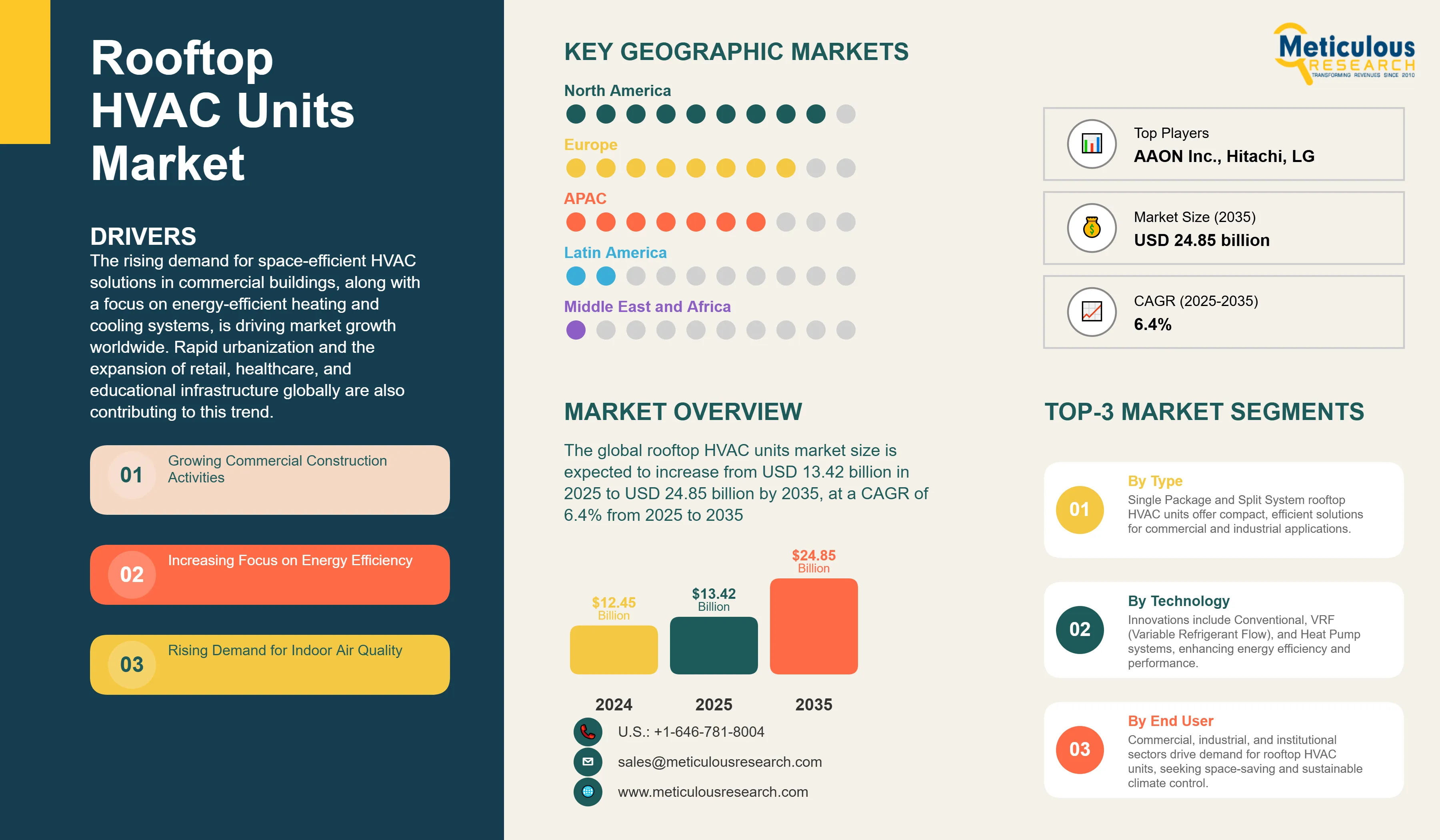
The global rooftop HVAC units market size was valued at USD 12.45 billion in 2024 and is expected to increase from USD 13.42 billion in 2025 to USD 24.85 billion by 2035, at a CAGR of 6.4% from 2025 to 2035.
- Published
- Sep 2025
- Pages
- 210
- Format
- PDF + Excel
- Report ID
- MREP - 1041597
- Base year
- 2024
- 2024 · BASELINE
- $12.45B
- 2035
- $24.85B
- CAGR 2025–2035
- 6.4%
2024 baseline · 2025–2035 forecast at 6.4% CAGR · hover a bar for the value
Key highlights
The global rooftop HVAC units market size was valued at USD 12.45 billion in 2024 and is expected to increase from USD 13.42 billion in 2025 to USD 24.85 billion by 2035, at a CAGR of 6.4% from 2025 to 2035.
The 10-30 tons segment accounts for 45-50% share of the overall market in 2025.
The U.S. rooftop HVAC units market is projected to be worth around USD 8.92 billion by 2035, growing at a CAGR of 6.3% from 2025 to 2035.
Report summary
| Particulars | Details |
|---|---|
| Report Coverage | Details |
| Market Size by 2035 | USD 24.85 Billion |
| Market Size in 2025 | USD 13.42 Billion |
| Market Size in 2024 | USD 12.45 Billion |
| Market Growth Rate from 2025 to 2035 | CAGR of 6.4% |
| Format | PDF, Excel & Cloud Portal · 210 pages |
| Dominating Region | North America |
| Fastest Growing Region | Asia Pacific |
| Base Year | 2024 |
| Forecast Period | 2025 to 2035 |
| Segments Covered | Type, Capacity, Technology, Application, End User, Distribution Channel, and Region |
| Regions Covered | North America, Europe, Asia-Pacific, Latin America, and Middle East & Africa |
Report overview
Segments covered: type, capacity, technology, application, end user, distribution channel.
The rising demand for space-efficient HVAC solutions in commercial buildings, along with a focus on energy-efficient heating and cooling systems, is driving market growth worldwide. Rapid urbanization and the expansion of retail, healthcare, and educational infrastructure globally are also contributing to this trend.
In terms of revenue, the global rooftop HVAC units market is valued at USD 13.42 billion in 2025 and is projected to reach USD 24.85 billion by 2035.
The market is expected to grow at a CAGR of 6.4% from 2025 to 2035.
North America dominates the global rooftop HVAC units market with the largest market share of 42% in 2025.
Asia Pacific is expected to witness the fastest CAGR during the forecast period.
By type, the single package units segment captures the largest market share of 75% in 2025.
By type, the split system units segment is expected to witness the fastest CAGR during the foreseeable period.
By capacity, the 10-30 tons segment contributes the largest market share of 45-50% in 2025.
By capacity, the above 30 tons segment is expected to witness the fastest CAGR during the forecast period.
By technology, the conventional rooftop units segment holds the largest market share of 50-55% in 2025.
By technology, the heat pump rooftop units segment is expected to witness the fastest CAGR during the forecast period.
By application, the commercial segment generates the major market share of 70% in 2025.
By application, the industrial segment is expected to witness the fastest CAGR through 2035.
By end user, the retail & shopping centers segment accounts for a significant market share of 25-30% in 2025.
By end user, the data centers segment is expected to witness the fastest CAGR through 2035.
By distribution channel, the direct sales segment holds the largest market share of 60-65% in 2025.
By distribution channel, the online sales segment is expected to witness the fastest CAGR during the forecast period.
The rooftop HVAC units market includes the design, manufacturing, installation, and servicing of heating, ventilation, and air conditioning systems placed on building rooftops for commercial and industrial use. These self-contained units house all key HVAC components, such as compressors, condensers, evaporators, fans, and controls in weatherproof enclosures. This setup removes the need for indoor mechanical rooms and maximizes usable floor space.
Rooftop units differ from traditional split systems. They allow for easier installation, centralized maintenance access, less noise inside buildings, and flexible zoning options. The market growth stems from rising commercial construction projects, the need to replace old HVAC systems, strict energy efficiency regulations, an increased demand for better indoor air quality, and advancements in variable refrigerant flow systems, smart controls, and eco-friendly refrigerants in retail, office, healthcare, educational, and industrial facilities worldwide.
Artificial intelligence rooftop HVAC units allow for predictive maintenance, improve energy use with machine learning, provide fault detection and diagnostics, and support automatic climate control based on occupancy and weather. AI systems look at real-time data to spot inefficiencies, predict when parts might fail, and adjust settings for the best performance and energy savings. Machine learning models evaluate past usage patterns, outdoor conditions, and building features to create comfort profiles while reducing energy use. AI helps with load balancing among multiple rooftop units, smart economizer control for free cooling, and automatic scheduling based on occupancy predictions. This cuts operational costs by 20-30%, boosts occupant comfort, and extends the life of equipment by optimizing operation.
Integration with Building Automation Systems (BAS): A key trend in the rooftop HVAC units market is the smooth connection with building automation systems and IoT platforms. Modern rooftop units have controllers that communicate with BAS using standard protocols like BACnet and Modbus. This allows for centralized monitoring, control, and optimization of several units across facilities. With this setup, facility managers can monitor performance metrics, energy use, and maintenance needs through cloud-based dashboards. It helps in making informed decisions and allows for proactive maintenance strategies.
Adoption of variable refrigerant flow (VRF) technology: Another significant trend driving market growth is the rising use of VRF technology in rooftop units. This technology provides better energy efficiency and zone control. VRF systems enable simultaneous heating and cooling in different areas. They also offer precise temperature control and heat recovery between zones. As a result, these systems can save 30-40% on energy compared to traditional systems. This technology is especially appealing for buildings with varying thermal loads and occupancy patterns, such as hotels, offices, and mixed-use developments.
The commercial segment holds the largest share of 70% of the overall rooftop HVAC units market in 2025. Commercial buildings, including retail stores, offices, hotels, hospitals, and schools, depend heavily on rooftop units for space-efficient HVAC solutions. This approach keeps valuable indoor space available for revenue-generating activities. The commercial sector focuses on occupant comfort, indoor air quality, and operational efficiency, which drives a continuous demand for new installations and replacements. Shorter replacement cycles in commercial applications result from higher runtime hours and changing efficiency standards, creating steady market demand. The variety of commercial building types and sizes allows for a wide array of rooftop unit configurations and capacities.
The industrial segment is expected to grow at the fastest CAGR during the forecast period. Increased use in warehouses, distribution centers, and manufacturing facilities drives this growth. The expansion of e-commerce and the return of manufacturing create a need for climate-controlled industrial spaces. Modern rooftop units with precise temperature and humidity control meet the requirements of industrial processes.
The retail and shopping centers segment holds the largest market share, nearly 25-30%, in 2025. Retail environments need reliable HVAC systems to ensure comfortable shopping conditions. This comfort encourages customers to spend more time in stores and boosts sales. Rooftop units provide ideal solutions for retail spaces. They preserve sales floor area, offer flexible zoning for different store sections, and allow individual tenant control in multi-tenant properties. The modular design of rooftop units makes it easy to adjust capacity as retail spaces change or are repurposed. The high visibility of energy costs in retail operations leads to the adoption of efficient rooftop units that lower operational expenses while keeping comfort levels high.
The data centers segment is expected to grow the fastest during the foreseeable period. The rapid increase in data center construction and higher heat densities from high-performance computing drive the need for specialized rooftop units. These units require precise temperature and humidity control, high sensible heat ratios, and redundant setups to meet mission-critical cooling needs.
The direct sales segment is expected to hold the largest market share of 60-65% in 2025. Direct sales through manufacturers' sales teams and authorized representatives provide the technical knowledge needed for proper equipment selection, system design, and application engineering. Commercial HVAC projects often require customization, value-engineering, and coordination with mechanical contractors that benefit from direct manufacturer involvement. Having direct relationships allows for better project support, warranty management, and access to technical resources. Large commercial projects and national accounts prefer direct purchasing relationships to get volume pricing, standardization across portfolios, and dedicated support services.
However, the online sales segment is projected to witness the fastest growth rate during the upcoming years. The shift towards digital in HVAC distribution enables online selection tools, configurators, and e-commerce platforms that make purchasing easier for standard rooftop units. Online channels lower transaction costs and improve access for smaller contractors and end-users.
Asia Pacific is expected to grow at the fastest CAGR from 2025 to 2035. This growth is primarily attributed to the rapid urbanization and the development of commercial infrastructure in China, India, Southeast Asia, and other emerging markets. The rising popularity of organized retail, modern warehousing, and international building standards increases the demand for rooftop HVAC solutions. Higher disposable incomes and expectations for comfort in tropical climates create a strong need for cooling, which rooftop units in commercial spaces can effectively meet.
Government programs that promote energy efficiency and green buildings, like China's carbon neutrality goals and India's Energy Conservation Building Code, support the adoption of improved rooftop units. Local manufacturing capabilities and competitive pricing also help expand the market, while technology transfers from global manufacturers enhance product quality and efficiency.
Component Manufacturing This stage focuses on producing key components including compressors, heat exchangers, fans, motors, controls, and sheet metal enclosures optimized for rooftop applications. Key Players: Copeland (Emerson), Danfoss, Bitzer, ebm-papst
System Design and Assembly This stage involves engineering complete rooftop units, assembling components, testing performance, and ensuring compliance with efficiency standards and building codes.
Key Players: Trane Technologies plc
Carrier Global Corporation
Johnson Controls International plc
Daikin Industries Ltd.
Lennox International Inc.
Rheem Manufacturing Company
Goodman Manufacturing (Daikin)
Nortek Global HVAC
AAON Inc.
Mitsubishi Electric Corporation
LG Electronics Inc.
Samsung Electronics Co. Ltd.
Gree Electric Appliances Inc.
Midea Group Co. Ltd.
Hitachi Ltd.
Fujitsu General Limited
Bosch Thermotechnology (Robert Bosch GmbH)
Toshiba Corporation
Panasonic Corporation
York (Johnson Controls)
Report infographic
Market dynamics
8 factors across 3 forcesGrowing Commercial Construction and Retrofitting Activities
A major factor driving the growth of the rooftop HVAC units market is the strong increase in commercial construction around the world. This is especially true in emerging economies where urbanization and economic development are happening quickly. The construction of retail spaces, office buildings, warehouses, healthcare facilities, and educational institutions requires efficient HVAC solutions. These systems need to maximize usable indoor space while ensuring reliable climate control.
Additionally, many existing rooftop units are aging, usually around 15 to 20 years old. This situation offers significant opportunities for replacement as building owners aim to improve energy efficiency, lower maintenance costs, and meet updated building codes. Government incentives for energy-efficient upgrades, like tax credits and utility rebates, also speed up the replacement process. The growing trend of adapting industrial buildings for commercial use drives demand for rooftop units that can be installed easily without major structural changes.
Table of contents
15 chapters · 162 sections · 210 pages · click to expandSegmental analysis
| Segment | Largest share (2025) | Fastest growth (2025–2035) |
|---|---|---|
| By Capacity | How does the 10-30 Tons | Segment above 30 tons |
By Capacity
- The 10-30 tons segment accounts for 45-50% share of the overall market in 2025.
- This capacity range serves most commercial buildings, including retail stores, restaurants, bank branches, and small office buildings.
- These units strike a good balance between capacity and efficiency for typical commercial loads.
- They also fit within standard electrical service capabilities.
- The 10-30 ton range allows for modular setups, where multiple units provide redundancy and control for medium-sized buildings.
- Standardization in this range helps manufacturers achieve economies of scale and competitive prices.
- The segment above 30 tons is expected to grow the fastest in the coming years.
- Rising demand from large commercial facilities, data centers, and industrial applications needing significant cooling capacity drives this growth.
- Improvements in high-capacity scroll and screw compressors enhance the efficiency and reliability of large rooftop units.
Geographic analysis
North America
Largest shareThe U.S. rooftop HVAC units market is projected to be worth around USD 8.92 billion by 2035, growing at a CAGR of 6.3% from 2025 to 2035. North America holds the largest market share of around 40-45% of the global rooftop HVAC units market in 2025. This is mainly attributed to the widespread use of rooftop units as the standard HVAC solution for commercial buildings. This trend is driven by a lot of low-rise commercial construction and a preference for packaged equipment. The established replacement market, with millions of rooftop units reaching the end of their life, creates steady demand. Strict energy codes, such as ASHRAE 90.1 and Title 24 in California, encourage the use of high-efficiency units. Major manufacturers like Trane Technologies, Carrier, Johnson Controls, Lennox, and Rheem have extensive distribution networks that ensure product availability and service support. Features such as economizers, demand-controlled ventilation, and energy recovery are common in North American markets, which supports premium pricing and overall market value. U.S. Rooftop HVAC Units Market Size and Growth 2025 to 2035 By Region
Competitive landscape
- August 2025
- Trane Technologies introduced the IntelliPak™ 2 rooftop units, featuring enhanced energy efficiency and part-load performance, aligning with new industry energy efficiency requirements.
- July 2025
- Daikin Applied expanded its Rebel® and Rebel Applied® rooftop systems, incorporating heat pump technology, low-GWP R-32 refrigerant, and inverter compressors to enhance heating and cooling efficiency.
- February 2025
- Trane Technologies launched the Symbio™ 800 controller, offering advanced integration and control capabilities for IntelliPak™ and other rooftop units, facilitating improved building performance management.
Frequently asked questions
The rooftop HVAC units market is expected to increase from USD 12.45 billion in 2024 to USD 24.85 billion by 2035.
Cite this report
Meticulous Research. (2025). Rooftop HVAC Units Market - Global Opportunity Analysis And Industry Forecast (2025-2035) (Report No. MREP - 1041597). Meticulous Market Research Pvt. Ltd. https://www.meticulousresearch.com/product/rooftop-hvac-units-market-6280