Point of care Diagnostics Market (2026-2036)
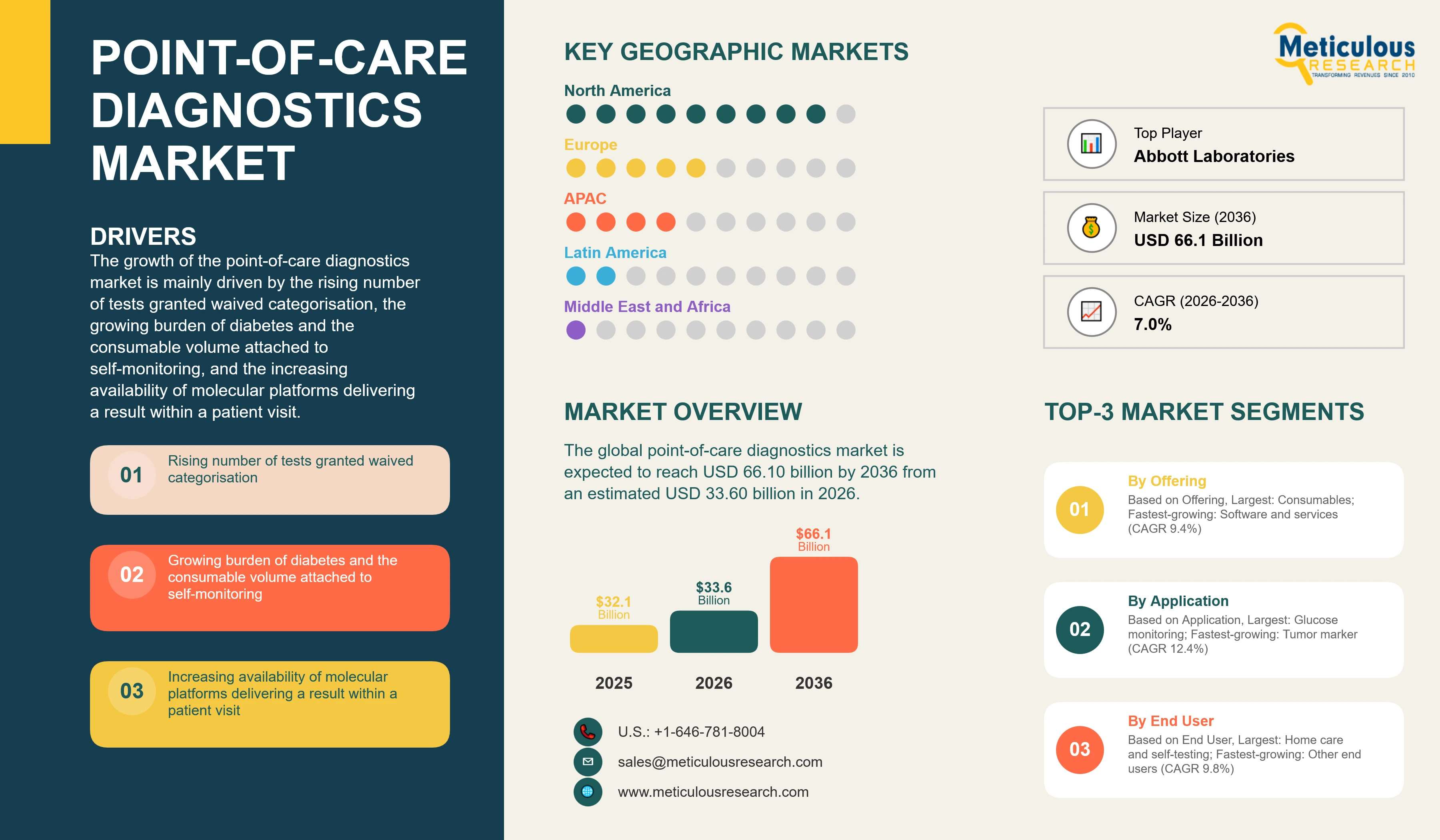
The global point-of-care diagnostics market was valued at USD 32.10 billion in 2025. This market is expected to reach USD 66.10 billion by 2036 from an estimated USD 33.60 billion in 2026, registering a CAGR of 7.0% during the forecast period (2026-2036).
- Published
- Nov 2026
- Pages
- 395
- Format
- PDF + Excel
- Report ID
- MRHC - 10499
- Base year
- 2025
- 2025 · BASELINE
- $32.10B
- 2036
- $66.10B
- CAGR 2026–2036
- 7.0%
2025 baseline · 2026–2036 forecast at 7.0% CAGR · hover a bar for the value
Key highlights
Waived categorisation under section 493.15 is the condition that allows testing without laboratory personnel, and it defines the addressable end-user base rather than analytical performance.
Section 493.17 scores a test from 1 to 3 on seven criteria, with totals of 12 or less categorised as moderate complexity and above 12 as high complexity.
A CLIA Waiver by Application requires flex studies showing insensitivity to environmental and usage variations and clinical studies in the hands of the intended user at intended use sites.
A Dual 510(k) and CLIA Waiver by Application submission carries a Food and Drug Administration decision goal of 180 days, allowing a test to reach the market already waived.
Molecular diagnostics is the fastest-growing platform at a CAGR of 11.8%, from a base of USD 6,182.4 million in 2026.
Saliva is the fastest-growing sample type at a CAGR of 13.6%, from the smallest base among the named sample types.
COVID testing grows at 1.8% across the forecast, the slowest application in the market, as volumes settle at endemic levels.
Tumour marker testing is the fastest-growing application at a CAGR of 12.4%, valued at USD 1,545.6 million in 2026.
By offering, consumables account for the largest share of 78.4% in 2026, while software and services register the highest CAGR of 9.4%.
By platform, other platforms account for the largest share of 47.0%, carried by glucose monitoring systems, while molecular diagnostics registers the highest CAGR.
By application, glucose monitoring accounts for the largest share of 38.6%, while tumour marker testing registers the highest CAGR.
By sample type, blood accounts for the largest share of 62.4%, while saliva registers the highest CAGR.
By end user, home care and self-testing accounts for the largest share of 44.6%, while other end users register the highest CAGR of 9.8%.
By geography, North America accounts for the largest share of 38.4% in 2026, while Asia-Pacific registers the highest CAGR of 8.6%.
Report summary
| Particulars | Details |
|---|---|
| Base Year | 2025 |
| Estimated Year | 2026 |
| Forecast Period | 2026-2036 |
| Market Size in 2025 | USD 32.10 billion |
| Market Size in 2026 | USD 33.60 billion |
| Market Size by 2036 | USD 66.10 billion |
| CAGR (2026-2036) | 7.0% |
| Format | PDF, Excel & Cloud Portal · 395 pages |
| Largest Segment by Offering (2026) | Consumables (78.4%) |
| Fastest-Growing Segment by Offering | Software and services (CAGR 9.4%) |
| Largest Region (2026) | North America (38.4%) |
| Fastest-Growing Region | Asia-Pacific (CAGR 8.6%) |
| Companies Profiled | 17 companies and other companies |
| Segments Covered | Offering, Platform, Application, Sample Type, End User, Geography |
| Countries Covered | U.S., Canada, Germany, U.K., France, Italy, Spain, Rest of Europe, China, Japan, India, Rest of Asia-Pacific, Brazil, Mexico, Rest of Latin America, Saudi Arabia, U.A.E., South Africa, Rest of Middle East & Africa |
Report overview
Segments covered: offering, platform, application, sample type, end user.
The growth of this market is mainly driven by the rising number of tests granted waived categorisation that extends testing to settings without laboratory personnel, the growing burden of diabetes and the consumable volume attached to self-monitoring, the increasing availability of molecular platforms that deliver a result within a single patient visit, and the expanding use of self-testing at home for infectious disease and reproductive health. However, factors such as the categorisation of most sensitive assays as moderate complexity and the laboratory conditions that follow, the evidence burden imposed by flex and intended-user studies in a waiver application, the reimbursement of point-of-care tests at rates that often sit below laboratory equivalents, and the decline in respiratory testing volumes from pandemic levels are expected to restrain the growth of this market to some extent.
Consumables account for the large majority of value because a placed instrument generates cartridge, strip and cassette revenue for years, and the installed base rather than the annual instrument order determines the revenue line. Software and services grow fastest from a small base as connectivity, result reporting and quality control move from an instrument feature to a contracted service.
Point-of-care diagnostics covers tests performed near the patient rather than in a central laboratory, and the commercial boundary of the market is drawn by regulation rather than by technology. Subpart A of Part 493 of Title 42 of the Code of Federal Regulations categorises laboratory tests at section 493.5 into waived tests, tests of moderate complexity including the provider-performed microscopy subcategory, and tests of high complexity, and provides that a laboratory may perform only one category or any combination of them. Beyond the categories themselves, section 493.17 scores a test from 1 to 3 on each of seven criteria and totals the scores, with test systems, assays or examinations receiving scores of 12 or less categorised as moderate complexity and those scoring above 12 categorised as high complexity, while section 493.15 defines waived tests as simple laboratory examinations and procedures that are cleared by the Food and Drug Administration for home use, or use methodologies so simple and accurate as to render the likelihood of erroneous results negligible, or pose no reasonable risk of harm if performed incorrectly. Where a test may be performed, and therefore who can buy it, follows from that categorisation.
A test categorised as moderate complexity cannot be run in a pharmacy, a school, a workplace or an airport without a laboratory meeting personnel, quality control and proficiency conditions that those settings do not meet, so the end-user base available to a product is set before any clinical argument is made. Waived status is consequently the single most valuable regulatory asset in this market, and the growth of testing outside hospitals and physician offices tracks the number of tests that hold it rather than the number that perform well.
Manufacturers whose assays are first categorised as moderate complexity are not permanently excluded, because a manufacturer whose test is initially categorised as moderate complexity may apply to the Food and Drug Administration for categorisation as waived through the CLIA Waiver by Application pathway, which is reviewed by the Office of In Vitro Diagnostics within the Center for Devices and Radiological Health and decided as an approval or a denial, with an approved waived categorisation published in the public CLIA database. In practice the application is expected to include a description showing the device is simple to use, risk analysis with risk evaluation and control, flex studies showing insensitivity to environmental and usage variations, clinical studies showing that the test has an insignificant risk of an erroneous result in the hands of the intended user at intended use sites, and labelling consistent with a simple device, and a Dual 510(k) and CLIA Waiver by Application submission combines both packages with a Food and Drug Administration decision goal of 180 days. Product design is therefore driven toward reducing operator steps and demonstrating insensitivity to misuse rather than toward analytical sensitivity alone, since the scoresheet rewards simplicity and the waiver requires evidence that an untrained user cannot easily produce a wrong answer.
A manufacturer able to file a complete 510(k) and waiver package together reaches the market already waived rather than clearing first and seeking waiver afterwards, which removes a period during which the product can only be sold into laboratories. Molecular point-of-care platforms that took this route reached retail clinics and pharmacies years earlier than those that did not, so the dual submission route has changed the sequence of market entry rather than only its paperwork.
Glucose self-monitoring remains the largest single application and behaves differently from the rest of the market. Volume follows the diagnosed diabetes population rather than clinical ordering, the test is bought by the patient or reimbursed as a supply rather than ordered by a physician, and the revenue is almost entirely consumable. Growth is steady rather than rapid, and it anchors the consumables share of the market at a level that the faster-growing professional applications do not move.
Volumes installed during the pandemic left a large base of placed instruments in pharmacies, urgent care and physician offices, and those instruments are now being used for influenza, respiratory syncytial virus and multiplex panels rather than retired. COVID testing itself grows slowly from an elevated base while the installed capacity it created supports faster growth in other respiratory and syndromic testing, so respiratory testing has settled into a distribution asset rather than disappearing with the pandemic.
Supply is concentrated among a small number of diagnostics groups that hold both the instrument installed base and the waived test menu, alongside specialists in single applications such as glucose, haemostasis, blood gas and rapid lateral flow testing. Menu breadth on a placed instrument is what determines the revenue per site, so competition runs on the number of waived assays a platform can run rather than on the performance of any one of them.
Report infographic
Market dynamics
15 factors across 5 forcesRising number of tests granted waived categorisation
A waived test can be performed by a site holding a Certificate of Waiver without the personnel, quality control and proficiency testing conditions that attach to moderate complexity testing, which opens pharmacies, urgent care centres, schools, workplaces and employer clinics as buyers. Each additional waived assay on a placed platform raises the revenue per site without a new instrument sale, and manufacturers pursue waiver for assays already cleared because the categorisation rather than the clearance governs where the test can be sold. Growth in testing outside hospitals and physician offices tracks that process directly.
Pharmacy testing has become the clearest example, with chains operating under waiver certificates able to offer infectious disease, lipid and glucose testing alongside dispensing and vaccination. The site economics work because the test is performed by existing staff rather than by laboratory personnel, and the visit generates dispensing revenue alongside the test, which supports a test price that a laboratory could not match on cost alone.
Growing burden of diabetes and the consumable volume attached to self-monitoring
Self-monitoring of blood glucose generates repeat consumable purchases over the life of a diagnosed patient, and the volume follows prevalence and diagnosis rates rather than clinical ordering decisions. An installed meter produces strip revenue for years at a cost per test low enough for reimbursement or out-of-pocket purchase, and the instrument is frequently supplied at minimal margin to secure that stream. The application is the largest in the market and the most predictable.
Diagnosis rates rather than prevalence alone drive the increment, since an undiagnosed patient buys nothing. Screening programmes in middle-income countries have moved large numbers of patients into diagnosis and treatment over the last decade, and the consumable demand follows two to three years behind the diagnosis, which is why glucose monitoring grows faster in Asia-Pacific than in markets where diagnosis is already substantially complete and the consumable base is replaced rather than extended year on year.
Increasing availability of molecular platforms delivering a result within a patient visit
Nucleic acid amplification performed on a cartridge in twenty to forty minutes allows a treatment decision in the same visit, which changes the clinical value of the test from confirmation after the fact to a decision the clinician can act on immediately. Antimicrobial prescribing, isolation decisions and discharge decisions all depend on a result arriving before the patient leaves, and a laboratory result returning the following day cannot serve them. Molecular platforms consequently command a price per test several times that of a lateral flow assay.
The constraint has been categorisation rather than capability, since a molecular assay with multiple reagent steps scores highly against the seven criteria and is categorised as moderate complexity. Platforms that integrated extraction, amplification and detection into a single sealed cartridge reduced the operator steps enough to obtain waiver, and those are the platforms that reached the settings where the clinical value is greatest.
Expanding use of self-testing at home for infectious disease and reproductive health
A test cleared by the Food and Drug Administration for home use is waived by definition under the first criterion in section 493.15, so a home-use clearance carries the categorisation with it and the product reaches the consumer without a laboratory in the chain. Pregnancy and ovulation testing established that route decades ago, and infectious disease self-testing for human immunodeficiency virus, hepatitis and respiratory viruses has followed it, supported by distribution through pharmacy retail and online channels.
Consumer purchasing also changes the economics of the test, since the patient pays directly and values privacy and immediacy rather than the lowest cost per result. Prices per test in self-testing hold better than in professional channels under procurement pressure, and the home care and self-testing segment is the largest end user group in this market on that basis, at 44.6% of value in 2026 and the most price-resilient channel in it.
Table of contents
13 chapters · 149 sections · 395 pages · click to expandSegmental analysis
| Segment | Largest share (2026) | Fastest growth (2026–2036) |
|---|---|---|
| By Offering | Consumables | Rapid growth of this |
| Other segments | Other platforms | Rapid growth of this |
By Offering
- The consumables segment is expected to account for the largest share of 78.4% of the global point-of-care diagnostics market, valued at USD 26,342.4 million.
- The large share of this segment is mainly due to cartridges, strips, cassettes and reagents consumed on every test performed on a placed instrument, and to instrument placement models that recover the capital through the consumable stream rather than at the point of sale.
- Instruments account for 16.2%, valued at USD 5,443.2 million, growing at a CAGR of 5.8% as placement rather than outright purchase becomes the normal commercial arrangement.
- However, the software and services segment, valued at USD 1,814.4 million in 2026 and accounting for a share of 5.4%, is projected to register the highest CAGR of 9.4% during the forecast period.
- The rapid growth of this segment is attributed to connectivity and result reporting becoming a condition of purchase for health system customers, to quality control and proficiency documentation required at sites without laboratory staff, and to subscription pricing that recurs with the site rather than with the instrument replacement cycle.
Other segments
- The other platforms segment is expected to account for the largest share of 47.0% of the market, valued at USD 15,792.0 million, covering glucose and cholesterol monitoring systems, coagulation tests and dipsticks.
- The large share of this segment is mainly due to glucose self-monitoring, which generates repeat consumable purchases across the life of a diagnosed patient and is bought as a supply rather than ordered as a test.
- Lateral flow assays account for 34.6%, valued at USD 11,625.6 million, growing at a CAGR of 5.4%, with the advantage of a format simple enough to meet the waived criteria without an instrument.
- However, the molecular diagnostics segment, valued at USD 6,182.4 million in 2026 and accounting for a share of 18.4%, is projected to register the highest CAGR of 11.8% during the forecast period.
- The rapid growth of this segment is attributed to results delivered within a single patient visit that support an immediate treatment decision, to sealed cartridges that integrate extraction, amplification and detection and reduce operator steps enough to obtain waived categorisation, and to a price per test several times that of a lateral flow assay.
- The glucose monitoring segment is expected to account for the largest share of 38.6% of the market, valued at USD 12,969.6 million, growing at a CAGR of 6.9%.
- The large share of this segment is mainly due to repeat consumable purchases across the life of a diagnosed patient and to volume that follows diagnosis rates rather than clinical ordering.
- Urinalysis accounts for 7.2%, valued at USD 2,419.2 million, influenza for 7.4%, valued at USD 2,486.4 million, and pregnancy testing for 6.8%, valued at USD 2,284.8 million, the last reaching the consumer directly on the strength of home-use clearance.
- Hematology accounts for 6.4%, valued at USD 2,150.4 million, human immunodeficiency virus testing for 6.2%, valued at USD 2,083.2 million, pneumonia for 5.4%, valued at USD 1,814.4 million, hepatitis for 4.8%, valued at USD 1,612.8 million, healthcare-associated infections for 4.4%, valued at USD 1,478.4 million, and salmonellosis for 3.0%, valued at USD 1,008.0 million.
- COVID testing accounts for 5.2%, valued at USD 1,747.2 million, and grows at 1.8%, the slowest rate in the market, as volumes settle at endemic levels from a pandemic peak.
- However, the tumour marker segment, valued at USD 1,545.6 million in 2026 and accounting for a share of 4.6%, is projected to register the highest CAGR of 12.4% during the forecast period.
- The rapid growth of this segment is attributed to decentralised monitoring of patients already diagnosed, where a result during the consultation changes the treatment decision, and to a base small enough that individual assay launches move the segment.
- The blood segment is expected to account for the largest share of 62.4% of the market, valued at USD 20,966.4 million.
- The large share of this segment is mainly due to glucose, haematology, coagulation, cardiac marker and blood gas testing all drawing on capillary or whole blood, and to fingerstick collection being simple enough to perform without laboratory personnel.
- Urine accounts for 16.8%, valued at USD 5,644.8 million, covering urinalysis, pregnancy and drugs-of-abuse testing where collection requires no clinical procedure.
- Nasopharyngeal swab accounts for 11.2%, valued at USD 3,763.2 million, growing at a CAGR of 6.2% on respiratory testing performed by trained collectors.
- However, the saliva segment, valued at USD 1,948.8 million in 2026 and accounting for a share of 5.8%, is projected to register the highest CAGR of 13.6% during the forecast period.
- The rapid growth of this segment is attributed to collection that requires no needle, no trained collector and no discomfort, which suits self-testing and screening of large populations, and to assay sensitivity on saliva having improved to the point where the sample no longer limits the clinical claim.
- Other samples including stool, cervical, buccal and vaginal swabs, hair and semen account for 3.8%, valued at USD 1,276.8 million.
- The home care and self-testing segment is expected to account for the largest share of 44.6% of the market, valued at USD 14,985.6 million, growing at a CAGR of 6.4%.
- The large share of this segment is mainly due to glucose self-monitoring and pregnancy testing, both of which reach the consumer directly because a test cleared for home use is waived by definition, and to direct payment that holds price better than professional procurement.
- Hospitals and critical care settings account for 21.8%, valued at USD 7,324.8 million, growing at a CAGR of 7.6% on blood gas, cardiac marker and coagulation testing where minutes change management.
- Clinics and physician offices account for 16.4%, valued at USD 5,510.4 million, and diagnostic laboratories for 9.6%, valued at USD 3,225.6 million, the latter running point-of-care formats for urgent requests alongside their main analysers.
- However, the other end users segment covering nursing homes, long-term care centres, pharmacies, urgent care facilities, schools, airports, hotels and workplaces, valued at USD 2,553.6 million in 2026 and accounting for a share of 7.6%, is projected to register the highest CAGR of 9.8% during the forecast period.
- The rapid growth of this segment is attributed entirely to waived categorisation, since none of those settings can meet the personnel and quality control conditions attaching to moderate complexity testing, so the segment grows with the number of assays that hold waiver rather than with clinical demand.
Geographic analysis
North America
Largest shareIn 2026, North America is expected to account for the largest share of 38.4% of the global point-of-care diagnostics market, valued at USD 12,902.4 million, growing at a CAGR of 6.6% during the forecast period. The large share of this region is mainly due to the waiver pathway that allows testing in pharmacies, urgent care and workplaces at scale, to pharmacy chains operating under waiver certificates as a distribution channel that exists in few other markets, and to the concentration of the diagnostics industry itself in the United States. Canada contributes a smaller base weighted toward hospital and remote community testing where laboratory access is limited by distance and sample transport times run to days rather than to hours, which removes the laboratory alternative rather than only delaying it.
Europe
Europe accounts for 26.8% of the market in 2026, valued at USD 9,004.8 million, at a CAGR of 6.2%. Germany, the United Kingdom, France, Italy and Spain lead, with demand concentrated in hospital critical care, general practice testing and pharmacy services where national arrangements permit them. Public procurement at national or regional level sets price more firmly than in the United States, which holds the value of the regional market below its share of testing volume and favours suppliers able to serve a tender at scale.
Asia-Pacific
Fastest growthAsia-Pacific accounts for 25.6% of the market in 2026, valued at USD 8,601.6 million, and is projected to register the highest CAGR of 8.6% during the forecast period. China, India and Japan lead, with growth driven by diabetes diagnosis moving large patient numbers into self-monitoring, by screening programmes built on decentralised testing rather than laboratory expansion where laboratory access is limited, and by public tenders favouring local manufacture. Japan contributes higher value per test through hospital and clinic testing rather than through volume, with hospital and clinic testing rather than self-testing carrying the regional mix in Japan and South Korea.
Latin America
Latin America accounts for 5.6% of the market in 2026, valued at USD 1,881.6 million, at a CAGR of 6.8%, with Brazil and Mexico carrying most of the activity on public health screening programmes and a growing diagnosed diabetes population.
Middle East & Africa
The Middle East & Africa accounts for 3.6%, valued at USD 1,209.6 million, at a CAGR of 7.0%, concentrated in Saudi Arabia, the United Arab Emirates and South Africa, with donor-funded infectious disease testing programmes accounting for a substantial part of the volume in sub-Saharan Africa.
Competitive landscape
A small number of diagnostics groups holding both an instrument installed base and a broad waived test menu lead this market, alongside specialists concentrated in single applications such as glucose monitoring, haemostasis, blood gas and rapid lateral flow testing. Revenue per site depends on the number of assays a placed platform can run, so the leaders compete on menu breadth while the specialists defend an application in which depth and price outweigh breadth.
Each assay carries its own risk analysis, flex studies and intended-user clinical data rather than inheriting the status of the platform, so a manufacturer with a dozen waived assays has completed the work a dozen times and a competitor cannot match the menu quickly whatever the merits of an individual product, so waiver evidence rather than product performance is what holds a position in this market. Platform selection by a customer is correspondingly a multi-year commitment rather than a purchase.
Instrument placement rather than instrument sale is the normal commercial model, with the capital recovered through a consumable contract over several years. That ties the customer to the supplier for the contract term and makes the installed base the measure of position in this market, which is why the respiratory testing expansion mattered commercially beyond the revenue it produced at the time.
Competition in self-testing runs on different terms, with retail distribution, brand recognition and consumer price point deciding the outcome rather than menu or placement. Suppliers strong in professional channels do not automatically succeed there, and several of the leading consumer self-test positions are held by companies with little presence in hospital testing, and retail shelf position and consumer brand rather than menu breadth decide the outcome in the consumer channel rather than in the clinical one there instead.
Some of the key players operating in the point-of-care diagnostics market are Abbott Laboratories, Roche Holding AG, Siemens Healthineers AG, Danaher Corporation, Becton, Dickinson and Company, QuidelOrtho Corporation, bioMérieux S.A., Thermo Fisher Scientific Inc., Werfen, Nova Biomedical Corporation, Trinity Biotech plc, EKF Diagnostics Holdings plc, Biosynex SA, Sekisui Chemical Co., Ltd., Sysmex Corporation, ARKRAY, Inc., and PHC Holdings Corporation, among others.
- Abbott Laboratories
- Roche Holding AG
- Siemens Healthineers AG
- Danaher Corporation
- Becton
- Dickinson and Company
- QuidelOrtho Corporation
- Thermo Fisher Scientific Inc.
- Werfen
- Nova Biomedical Corporation
- Trinity Biotech plc
- EKF Diagnostics Holdings plc
- Biosynex SA
- Sekisui Chemical Co., Ltd.
- Sysmex Corporation
- ARKRAY, Inc.
- PHC Holdings Corporation
Expert perspectives
Where a test may be performed, and therefore who may buy it, is settled by complexity categorisation rather than by clinical performance, and that single fact organises this market. A test scoring above the waived threshold cannot be run in a pharmacy, school or workplace without a laboratory those settings cannot maintain, so the addressable customer base is fixed before any clinical argument is made. Growth outside hospitals and physician offices tracks the count of assays holding waived status, and the fastest-growing end user group in this market exists only because of it.
Value accrues to the consumable stream and to the menu that feeds it. Instruments are placed rather than sold and the capital is recovered through cartridges and strips, so the installed base rather than the annual instrument order is the measure of a position, and each additional waived assay raises revenue per site without a new placement. Software and services grow fastest from a small base because connectivity and quality documentation have become conditions of purchase at sites with no laboratory staff.
Every assay carries its own flex and intended-user evidence rather than inheriting the status of its platform, and a combined 510(k) and waiver submission with a 180 day decision goal lets a product launch already waived instead of spending its first years confined to laboratory sales. Manufacturers able to fund both packages concurrently reach the decentralised customer at launch, so regulatory capacity rather than research pipeline decides who captures the growth, and that sequencing has decided several platform contests.
The market reaches USD 66.10 billion by 2036 from USD 33.60 billion in 2026, and glucose self-monitoring at 38.6% of it grows steadily rather than rapidly, which holds the headline rate below what the professional applications alone would produce. COVID testing grows at 1.8% from a pandemic-inflated base, so comparisons across the preceding years describe the pandemic rather than the market, while the instruments that expansion placed are the distribution on which menu extension now depends. Reimbursement of point-of-care testing below laboratory equivalents remains the constraint that blocks adoption where the clinical case is strongest, and it resolves only where the site and the payer sit in the same organisation. A broadening of waiver decisions is the largest swing factor in the forecast, since it would move the end-user boundary that currently limits the market more than any improvement in assay performance.
Growth in this market rests on testing moving to settings that cannot operate a laboratory, and it is paced by categorisation decisions, waiver evidence and reimbursement rather than by diagnostic capability. Suppliers with a placed installed base, a broad waived menu and the regulatory capacity to extend it will take a disproportionate share of the increase.
Customer perspectives
Director of Clinical Services, retail pharmacy chain, North America
Waived categorisation sets which settings can buy a test at all, which is why the other end users group covering pharmacies, schools and workplaces grows at 9.8%, the fastest of any end user in this market, and why menu extension on a placed platform is the most direct route to revenue.
Head of Laboratory Medicine, acute hospital group, Europe
Time to result rather than cost per test governs purchasing in critical care, which supports the price of molecular and blood gas testing and is why hospitals and critical care settings grow at 7.6% while diagnostic laboratories grow at 6.0%.
Procurement Director, national public health programme, Asia-Pacific
Absent laboratory access the comparison is against no result rather than a slower one, and public tenders favouring local manufacture are why Asia-Pacific grows at 8.6%, the fastest region in this market, and why screening programmes there are built on decentralised testing rather than on laboratory expansion.
Frequently asked questions
The market was valued at USD 32.10 billion in 2025 and USD 30.60 billion in 2024, and is estimated at USD 33.60 billion in 2026.
Cite this report
Meticulous Research. (2026). Point of care Diagnostics Market - Global Opportunity Analysis and Industry Forecast (2026-2036) (Report No. MRHC - 10499). Meticulous Market Research Pvt. Ltd. https://www.meticulousresearch.com/product/point-of-care-diagnostics-market-4871