Resources
About Us
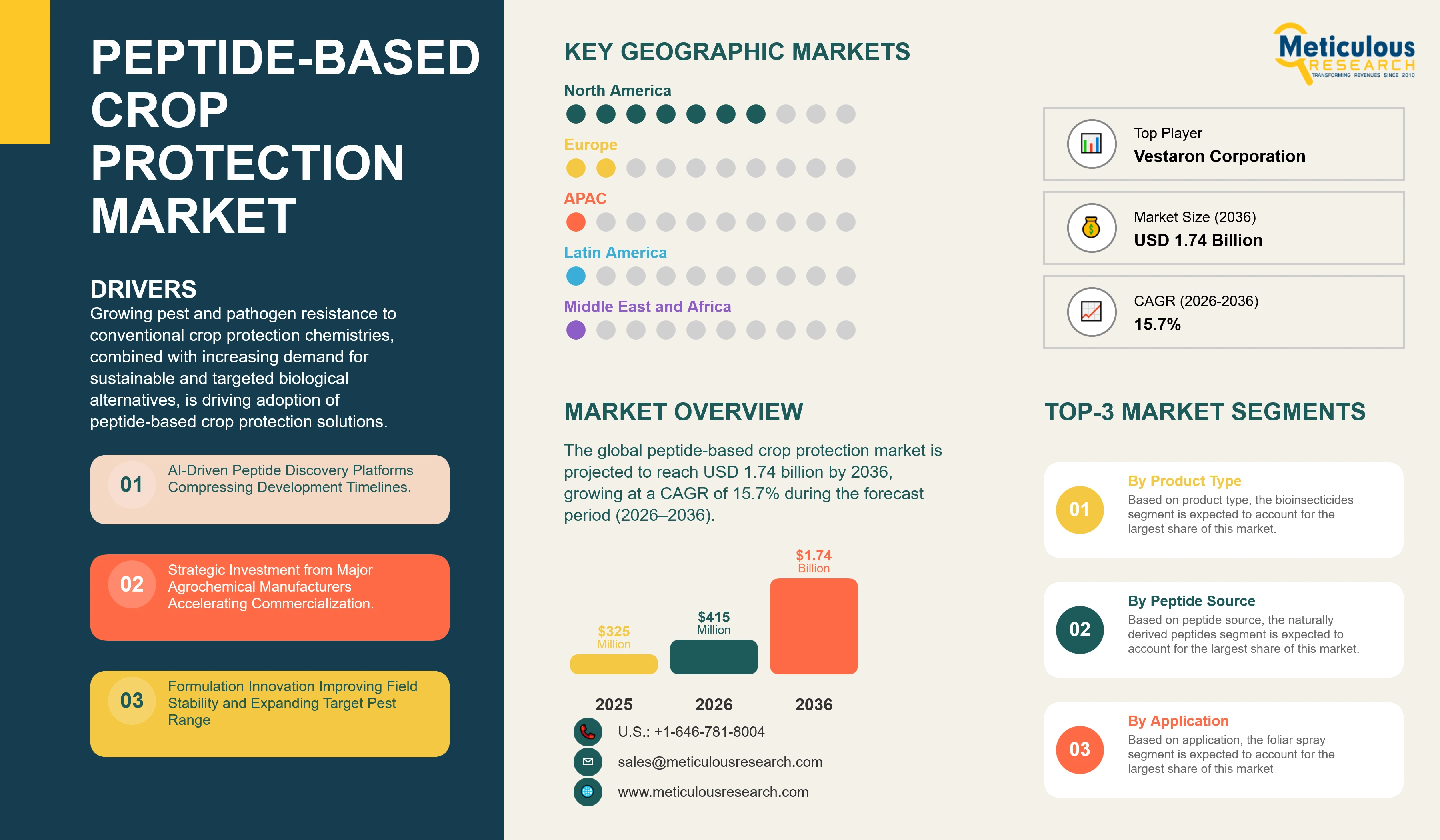
The global peptide-based crop protection market was valued at USD 325 million in 2025. The market is projected to reach USD 1.74 billion by 2036, growing from USD 415 million in 2026 at a CAGR of 15.7% during the forecast period (2026–2036).
Click here to: Get Free Sample Pages
The global peptide-based crop protection market comprises crop protection products that use biologically active peptides or proteins to control pests and pathogens. These actives can be derived from natural sources, including plant, microbial, and venom-derived compounds, or developed through computational discovery and biotechnology platforms. Peptide-based solutions can offer highly specific biological activity and novel modes of action, creating potential advantages for resistance management and reduced impact on beneficial organisms.
Commercial activity remains concentrated among specialized biotechnology companies and major crop protection manufacturers. In May 2026, Suterra, a division of The Wonderful Company, acquired Vestaron’s product lines, active ingredients, and R&D pipeline, including the SPEAR and BASIN peptide bioinsecticide portfolios. Biotalys received U.S. EPA approval for its protein-based biofungicide EVOCA in December 2025 and obtained its first U.S. state registration in Florida in April 2026. Micropep Technologies filed regulatory dossiers for its peptide biofungicide Promisin in Brazil and Paraguay in June 2026, followed by U.S. and EU submissions in July 2026.
Market growth is supported by increasing pest and pathogen resistance to conventional chemistries and advances in AI-enabled peptide discovery. Micropep’s Krisalix platform combines peptide-design algorithms with biological screening, while its collaboration with Corteva supports development of peptide-based biocontrol solutions. Biotalys also achieved a first research milestone in its bioinsecticide collaboration with Syngenta in April 2026. AgroSpheres is developing delivery technologies for active ingredients including peptides, while FMC is a strategic investor and collaborator.
Despite strong innovation momentum, high production costs, regulatory requirements, and challenges related to peptide stability under field conditions remain important constraints. Commercialization is therefore likely to rely heavily on partnerships, licensing, and acquisitions that combine specialized peptide discovery capabilities with the regulatory, manufacturing, and distribution infrastructure of established crop protection companies.
AI-Driven Peptide Discovery Platforms Compressing Development Timelines and Attracting Strategic Investment from Major Agrochemical Manufacturers
The application of computational biology and machine learning-based protein structure prediction to agricultural peptide discovery is fundamentally reshaping how new peptide-based active ingredients are identified and optimized. Platforms such as Micropep Technologies' Krisalix screen genomic sequence data using AI to identify five- to twenty-amino-acid micropeptide sequences suited to a specific biological function, whether disease control in a biofungicide or gene-regulatory activity in a biostimulant, compressing a discovery process that would traditionally take years of empirical screening. This capability has become a direct driver of investment activity: Corteva Agriscience's venture arm, Corteva Catalyst, structured a multi-year collaboration with Micropep specifically to gain access to large-scale peptide screening capacity that Corteva's internal teams would otherwise have taken substantially longer to build. Recent peer-reviewed literature on agricultural peptide design draws an explicit parallel to therapeutic peptide drug discovery, arguing that adopting library-screening and de novo design methods already established in pharmaceutical peptide development could further accelerate the availability of field-ready agricultural peptide candidates.
Strategic Partnerships and Acquisitions Becoming the Primary Commercialization Pathway for Peptide-Focused Biotechnology Companies
Rather than building independent global regulatory and distribution infrastructure, peptide-focused biotechnology companies are increasingly commercializing through partnership with, or acquisition by, established crop protection and biological pest control manufacturers. The clearest example is Suterra's May 2026 acquisition of Vestaron's Spear and Basin peptide bioinsecticide product lines, active ingredients, and R&D pipeline, including Vestaron's Kalamazoo, Michigan research facility; Suterra, a division of The Wonderful Company, plans to begin manufacturing its own branded version of Spear Lep later in 2026, leveraging its existing biological pest control distribution network rather than Vestaron building one independently. A parallel dynamic is visible in Biotalys's partnership with Syngenta Crop Protection AG to co-develop a novel protein-based bioinsecticide, and in Bayer AG's multi-year collaboration with AgroSpheres, alongside FMC Corporation's direct capital investment in AgroSpheres' most recent funding round. This pattern indicates that near-term market growth is likely to be realized substantially through the biologicals divisions of BASF SE, Bayer AG, Corteva Agriscience, FMC Corporation, and Syngenta Crop Protection AG, operating alongside the specialized companies that originate the underlying peptide technology.
Formulation Innovation Addressing Field Stability Limitations to Expand Peptide Products Beyond Their Original Target Pest Range
Peptide active ingredients are inherently more susceptible to degradation from UV exposure, heat, and digestive proteolysis than small-molecule synthetic chemistries, which has historically limited both field persistence and the range of pests a given peptide can effectively control. Recent peer-reviewed research demonstrates that fusing an insecticidal spider venom peptide to a stabilizing carrier protein, snowdrop lectin, meaningfully improves oral toxicity of the peptide toward aphid pests compared with the unmodified peptide, extending the practical target range of an already-commercialized peptide active ingredient. Separately, published research on proteolytic stabilization techniques has demonstrated that a stabilized spider venom peptide variant can achieve oral bioinsecticidal activity, addressing one of the central formulation barriers that has constrained peptide bioinsecticide development to date. These formulation advances are expected to progressively widen the addressable pest and crop range of existing peptide platforms without requiring discovery of an entirely new peptide sequence for each new target.
By Product Type: In 2026, the Bioinsecticides Segment to Dominate the Global Peptide-Based Crop Protection Market
Based on product type, the peptide-based crop protection market is segmented into bioinsecticides, biofungicides, bioherbicides, and biostimulant/plant growth-regulating peptides. In 2026, the bioinsecticides segment is expected to account for the largest share of this market, reflecting the fact that spider venom-derived peptide bioinsecticides, commercialized under the Spear and Basin brands and now held by Suterra, remain the only peptide-based crop protection products with established commercial sales history and multi-year EPA registration in the United States. Basin, targeting aphids, mites, drosophila, and whiteflies, received EPA approval in March 2024, expanding the pest range addressable by this product category beyond the lepidopteran pests originally targeted by Spear-Lep.
However, the biofungicides segment is projected to register the highest growth during the forecast period. This growth is driven by an active late-stage regulatory pipeline: Micropep Technologies has filed for regulatory approval of its lead peptide biofungicide, Promisin, targeting fungal diseases including Asian soybean rust, target spot, and leaf blight, across Brazil, Paraguay, the United States, and the European Union, with commercial launch anticipated from 2027. Biotalys NV's protein-based biofungicide EVOCA received U.S. EPA approval in December 2025 and Florida state registration in April 2026, with its next-generation successor, EVOCA NG, targeting Botrytis and powdery mildew in fruit and vegetable crops across a combined addressable market the company estimates at approximately USD 1.2 billion, with planned launches in the United States, Europe, and Brazil later in the forecast period.
By Peptide Source: In 2026, the Naturally Derived Peptides Segment to Hold the Largest Share
Based on peptide source, the market is segmented into naturally derived peptides, comprising venom-derived, plant-derived, and microbially derived sequences, and synthetic or AI-designed peptides developed through computational discovery platforms. In 2026, the naturally derived peptides segment is expected to account for the largest share of this market, led by the commercially established spider venom-derived peptides in Suterra's Spear and Basin product lines and supported by an established base of peer-reviewed research characterizing naturally occurring insecticidal peptide families, including legume albumin proteins and knottin-family venom peptides.
However, the synthetic and AI-designed peptides segment is projected to register the highest growth during the forecast period. This growth is driven by the maturation of computational discovery platforms such as Micropep's Krisalix, which designs short protein molecules to precisely regulate plant gene expression rather than relying on naturally occurring sequences, and by the broader application of protein structure prediction tools to agricultural peptide design following their earlier validation in pharmaceutical peptide drug discovery.
By Application Method: In 2026, the Foliar Spray Segment to Hold the Largest Share
Based on application method, the market is segmented into foliar spray, soil and drench treatment, seed treatment, and post-harvest treatment. In 2026, the foliar spray segment is expected to account for the largest share of this market, consistent with the labeled application format of the currently commercialized Spear, Basin, and EVOCA products, which are applied as contact or systemic foliar sprays for above-ground pest and disease control.
By Crop Type: In 2026, the Fruits and Vegetables Segment to Hold the Largest Share
Based on crop type, the market is segmented into fruits and vegetables, row crops, cereals and grains, turf and ornamentals, and other crop types. In 2026, the fruits and vegetables segment is expected to account for the largest share of this market, reflecting the specialty crop focus of currently registered products, including Spear-Lep's original 2018 approval for fruits, vegetables, and specialty field crops, and EVOCA NG's targeted launch against Botrytis and powdery mildew in fruit and vegetable crops.
However, the row crops segment, including soybean, is projected to register the highest growth during the forecast period, driven by Micropep's Promisin regulatory filings in Brazil and Paraguay targeting Asian soybean rust and related soy diseases, positioning peptide biofungicides for the first time toward large-acreage field crop production rather than solely specialty crop applications.
Based on geography, the peptide-based crop protection market is segmented into North America, Europe, Asia Pacific, Latin America, and the Middle East and Africa. In 2026, North America is expected to account for the largest share of this market. This is supported by the presence of the U.S. EPA's dedicated Biopesticides and Pollution Prevention Division, which provides a defined regulatory pathway for biochemical and microbial pesticides distinct from conventional chemistries, and by the concentration of commercial and R&D activity in the region, including Suterra's Oregon headquarters, the former Vestaron Kalamazoo, Michigan research facility now held by Suterra, and AgroSpheres' Charlottesville, Virginia platform.
Europe represents an important and growing market, anchored by Biotalys NV's Ghent, Belgium headquarters and Micropep Technologies' Toulouse, France research origins, alongside active EU regulatory filings for both companies' lead biofungicide products. Regulatory conditions in the region have shifted since 2024, however, following the European Commission's withdrawal of the proposed Regulation on the Sustainable Use of Plant Protection Products, which would have introduced binding EU-wide pesticide reduction targets; pesticide governance in the EU now continues under the existing Sustainable Use Directive and national action plans, without new binding reduction mandates.
Latin America, particularly Brazil and Paraguay, is emerging as an important early market for peptide biofungicides targeting soybean disease, reflecting Micropep's initial regulatory filing sequence in the region ahead of its U.S. and EU submissions, and the scale of the region's soybean production base. Asia Pacific and the Middle East and Africa remain in earlier stages of peptide-based crop protection adoption, with initial commercial activity emerging through partnerships such as Elemental Enzymes' 2026 biofungicide launch with Adama in the Australian wheat market.
The global peptide-based crop protection market remains highly fragmented and early-stage, with competition centered on discovery platform capability, speed to regulatory registration, formulation stability, and access to established distribution and regulatory infrastructure through partnership with larger agrochemical manufacturers. Specialized peptide technology originators, including Micropep Technologies, Biotalys NV, and AgroSpheres, compete primarily on the strength of their discovery platforms and pipeline breadth, while Suterra competes on its established biological pest control distribution network following its acquisition of Vestaron's commercial peptide bioinsecticide portfolio. Diversified agrochemical manufacturers, including Bayer AG, BASF SE, Corteva Agriscience, FMC Corporation, and Syngenta Crop Protection AG, are engaging with this segment principally through strategic investment, venture financing, and co-development partnerships rather than in-house peptide discovery, positioning themselves to commercialize peptide-based actives originated by smaller technology companies at global scale.
Some of the key players operating in the global peptide-based crop protection market include Suterra (a division of The Wonderful Company) (U.S.), Micropep Technologies (France/U.S.), Biotalys NV (Belgium), AgroSpheres, Inc. (U.S.), Elemental Enzymes, Inc. (U.S.), Bayer AG (Germany), BASF SE (Germany), Corteva Agriscience (U.S.), FMC Corporation (U.S.), and Syngenta Crop Protection AG (Switzerland), among others.
|
Parameters |
Details |
|
Market Size by 2036 |
USD 1.74 Billion |
|
Market Size in 2026 |
USD 415 Million |
|
Market Size in 2025 |
USD 325 Million |
|
Revenue Growth Rate (2026–2036) |
15.7% |
|
Dominating Product Type |
Bioinsecticides |
|
Fastest Growing Product Type |
Biofungicides |
|
Dominating Peptide Source |
Naturally Derived Peptides |
|
Fastest Growing Peptide Source |
Synthetic/AI-Designed Peptides |
|
Dominating Application Method |
Foliar Spray |
|
Dominating Crop Type |
Fruits and Vegetables |
|
Fastest Growing Crop Type |
Row Crops (incl. Soybean) |
|
Dominating Geography |
North America |
|
Fastest Growing Geography |
Europe and Latin America |
|
Base Year |
2025 |
|
Forecast Period |
2026 to 2036 |
The global peptide-based crop protection market was valued at USD 325 million in 2025. The market is projected to reach USD 1.74 billion by 2036, growing from USD 415 million in 2026 at a CAGR of 15.7% during the forecast period (2026–2036).
In 2026, the bioinsecticides segment is expected to hold the largest share of this market, driven by the established commercial and regulatory track record of spider venom-derived peptide products now held by Suterra.
The biofungicides segment is expected to register the highest CAGR during the forecast period 2026–2036, driven by active late-stage regulatory filings from Micropep Technologies and Biotalys NV across the United States, European Union, and Latin America.
In 2026, the naturally derived peptides segment is expected to hold the largest share of this market, reflecting the venom-derived origin of the currently commercialized Spear and Basin product lines.
In 2026, the fruits and vegetables segment is expected to hold the largest share of this market, consistent with the specialty crop focus of currently registered peptide bioinsecticide and biofungicide products.
North America is expected to account for the largest share of the global peptide-based crop protection market in 2026, supported by the U.S. EPA's dedicated biopesticide regulatory pathway and the concentration of commercial and R&D activity among leading peptide crop protection companies in the region.
Growth is primarily driven by the application of AI-driven and computational discovery platforms that are compressing peptide identification timelines; the growing strategic investment and co-development activity from Bayer AG, BASF SE, Corteva Agriscience, FMC Corporation, and Syngenta Crop Protection AG into specialized peptide technology companies; sustained pest and pathogen resistance pressure on conventional chemistries; and formulation advances that are improving the field stability and target range of peptide active ingredients.
Key players include Suterra (a division of The Wonderful Company) (U.S.), Micropep Technologies (France/U.S.), Biotalys NV (Belgium), AgroSpheres, Inc. (U.S.), Elemental Enzymes, Inc. (U.S.), Bayer AG (Germany), BASF SE (Germany), Corteva Agriscience (U.S.), FMC Corporation (U.S.), and Syngenta Crop Protection AG (Switzerland).
Europe and Latin America are expected to register above-average growth during the forecast period 2026–2036, driven by active regulatory filings for peptide biofungicides in the European Union, Brazil, and Paraguay, though Europe's growth trajectory should be assessed against the 2024 withdrawal of the EU's proposed binding pesticide reduction regulation.
1. Introduction
1.1 Market Definition and Scope
1.2 Market Ecosystem
1.3 Currency and Limitations
1.3.1 Currency
1.3.2 Limitations
1.4 Key Stakeholders
2. Research Methodology
2.1 Research Approach
2.2 Data Collection & Validation Process
2.2.1 Secondary Research
2.2.2 Primary Research & Validation
2.2.2.1 Primary Interviews with Experts
2.2.2.2 Country-/Region-Level Analysis
2.3 Market Estimation
2.3.1 Bottom-Up Approach
2.3.2 Top-Down Approach
2.4 Data Triangulation
2.5 Assumptions for the Study
3. Executive Summary
3.1 Market Overview
3.2 Market Analysis by Product Type
3.3 Market Analysis by Peptide Source
3.4 Market Analysis by Application Method
3.5 Market Analysis by Crop Type
3.6 Market Analysis by Geography
4. Market Dynamics
4.1 Overview
4.2 Drivers
4.2.1 AI-Driven Peptide Discovery Platforms Compressing Development Timelines
4.2.2 Strategic Investment from Major Agrochemical Manufacturers Accelerating Commercialization
4.2.3 Pest and Pathogen Resistance to Conventional Chemistries Sustaining Demand for Novel Modes of Action
4.2.4 Formulation Innovation Improving Field Stability and Expanding Target Pest Range
4.3 Restraints
4.3.1 High Production Costs Relative to Conventional Chemistries and Established Microbial Biopesticides
4.3.2 Extended Regulatory Review Timelines for Novel Peptide-Based Modes of Action
4.4 Opportunities
4.4.1 Residue-Sensitive and Organic Production Base Creating a Natural Early-Adopter Segment
4.4.2 Expansion of Peptide Biofungicides into Large-Acreage Row Crop Applications
4.4.3 Partnership and Licensing Pathways for Specialized Peptide Technology Companies
4.5 Challenges
4.5.1 Field Stability of Peptide Actives Under UV Exposure, Heat, and Proteolytic Degradation
4.5.2 Narrow Target Pest and Pathogen Range of Individual Peptide Sequences
4.6 Porter's Five Forces Analysis
5. Peptide-Based Crop Protection Market, by Product Type
5.1 Overview
5.2 Bioinsecticides
5.3 Biofungicides
5.4 Bioherbicides
5.5 Biostimulant and Plant Growth-Regulating Peptides
6. Peptide-Based Crop Protection Market, by Peptide Source
6.1 Overview
6.2 Naturally Derived Peptides
6.2.1 Venom-Derived Peptides
6.2.2 Plant-Derived Peptides
6.2.3 Microbially Derived Peptides
6.3 Synthetic and AI-Designed Peptides
7. Peptide-Based Crop Protection Market, by Application Method
7.1 Overview
7.2 Foliar Spray
7.3 Soil and Drench Treatment
7.4 Seed Treatment
7.5 Post-Harvest Treatment
8. Peptide-Based Crop Protection Market, by Crop Type
8.1 Overview
8.2 Fruits and Vegetables
8.3 Row Crops
8.3.1 Soybean
8.3.2 Other Row Crops
8.4 Cereals and Grains
8.5 Turf and Ornamentals
8.6 Other Crop Types
9. Peptide-Based Crop Protection Market, by Geography
9.1 Overview
9.2 North America
9.2.1 U.S.
9.2.2 Canada
9.3 Europe
9.3.1 Belgium
9.3.2 France
9.3.3 Germany
9.3.4 Rest of Europe
9.4 Asia Pacific
9.4.1 China
9.4.2 India
9.4.3 Australia
9.4.4 Rest of Asia Pacific
9.5 Latin America
9.5.1 Brazil
9.5.2 Paraguay
9.5.3 Rest of Latin America
9.6 Middle East and Africa
10. Competitive Landscape
10.1 Overview
10.2 Key Growth Strategies
10.3 Competitive Benchmarking
10.4 Competitive Dashboard
10.4.1 Industry Leaders
10.4.2 Market Differentiators
10.4.3 Vanguards
10.4.4 Emerging Companies
10.5 Market Share/Ranking Analysis (2025)
11. Company Profiles
11.1 Vestaron Corporation
11.2 Micropep Technologies
11.3 Biotalys NV
11.4 Elemental Enzymes, Inc.
11.5 Invaio Sciences
11.6 SOLASTA Bio
11.7 Genvor Incorporated
11.8 Ventera Bio Ltd.
11.9 Bayer AG
11.10 BASF SE
11.11 Corteva Agriscience
11.12 FMC Corporation
11.13 Syngenta Crop Protection AG
11.14 UPL Limited
11.15 AgroSpheres, Inc.
12. Appendix
12.1 Questionnaire
12.2 Available Customization Options
12.3 Related Reports
























Published Date: Aug-2026
Published Date: Jan-2025
Published Date: Jun-2024
Subscribe to get the latest industry updates