Resources
About Us
Industrial Robot Gearboxes & Reducers Market Size, Share, & Forecast by Gear Type, Precision Class, Torque Rating, Backlash, and Robot Payload Capacity: 2026-2036
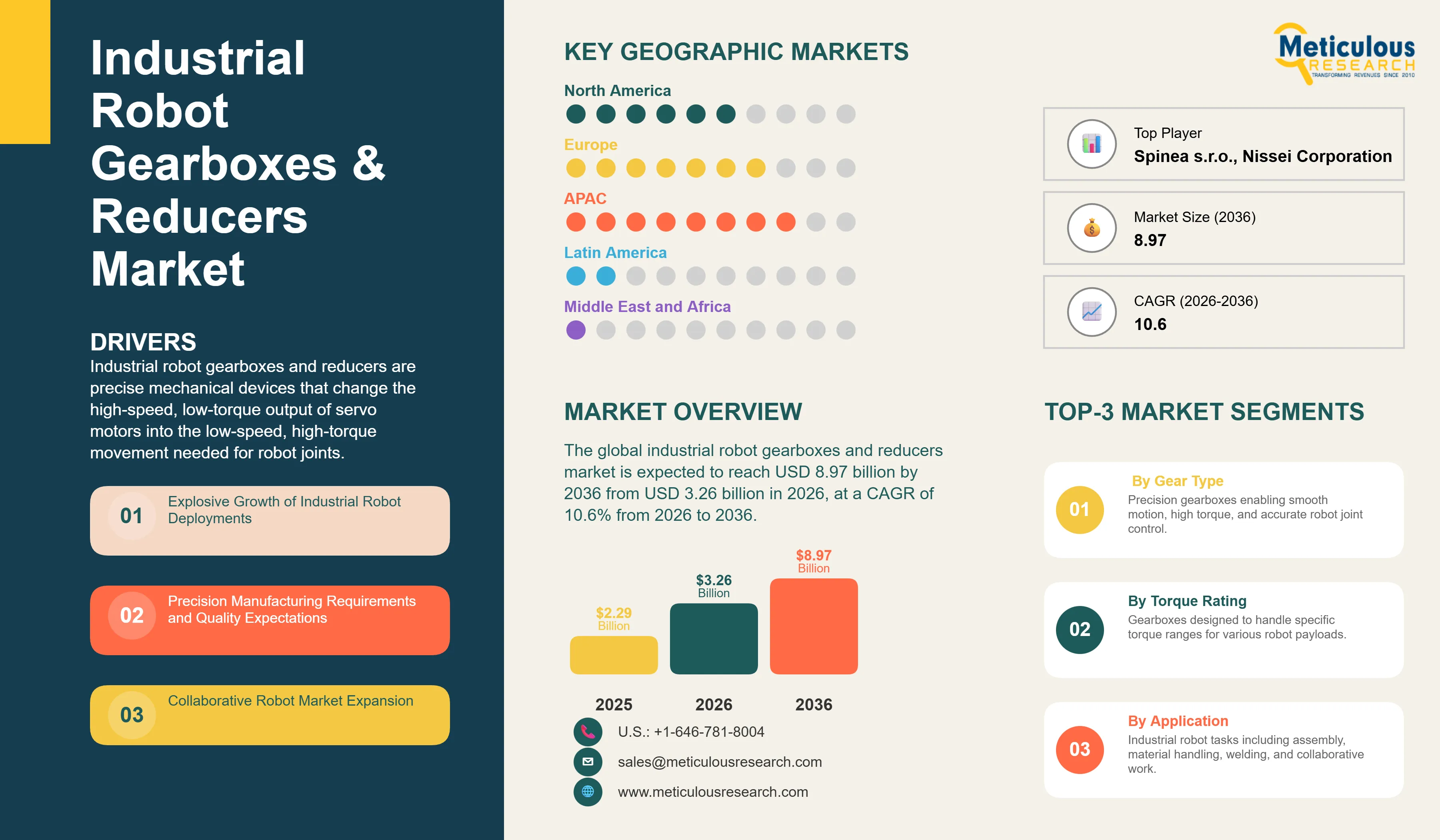
Report ID: MRSE - 1041668 Pages: 282 Jan-2026 Formats*: PDF Category: Semiconductor and Electronics Delivery: 24 to 72 Hours Download Free Sample ReportThe global industrial robot gearboxes and reducers market is expected to reach USD 8.97 billion by 2036 from USD 3.26 billion in 2026, at a CAGR of 10.6% from 2026 to 2036.
Industrial robot gearboxes and reducers are precise mechanical devices that change the high-speed, low-torque output of servo motors into the low-speed, high-torque movement needed for robot joints. These important components act as the link between robot motors and moving joints. They allow for accurate positioning, smooth motion control, high torque transfer, and repeatability crucial for industrial automation tasks.
Modern robot reducers use advanced gear systems. These include harmonic drive technology, which uses flexible spline deformation for zero-backlash operation; cycloidal disk designs that provide high shock load capacity in compact sizes; and planetary gear setups that maximize efficiency and torque density.
By using precise manufacturing methods and advanced materials like case-hardened alloy steels and special bearing systems, these gearboxes deliver outstanding performance essential for today’s industrial robots. They achieve positioning accuracy within arc-seconds, minimal backlash of less than 1 arc-minute, high torsional stiffness for responsive movement, compact and lightweight designs, long service life of over 20,000 hours, and smooth motion profiles. These features are crucial for tasks such as precision assembly, welding, material handling, and machine tending.
Click here to: Get Free Sample Pages of this Report
Industrial robot gearboxes and reducers represent the critical mechanical precision components that enable the exceptional performance characteristics of modern industrial robots. These sophisticated transmission devices serve as force multipliers and motion controllers, transforming the relatively weak torque output of electric servo motors into the substantial forces required to move robot arms, manipulate payloads, and execute precision manufacturing tasks. The fundamental challenge in robot joint design generating high torque in compact, lightweight packages while maintaining exceptional positioning accuracy and repeatability makes precision reducers indispensable enabling technologies for industrial automation. Without advanced gearbox technology, industrial robots could not achieve the combination of strength, speed, precision, and reliability that makes them economically viable for manufacturing applications.
Several transformative trends are reshaping the industrial robot gearboxes and reducers market, including the explosive growth of collaborative robot (cobot) deployments requiring specialized reducers optimized for safety and human interaction, the proliferation of articulated six-axis robots across diverse industries beyond traditional automotive applications, the advancement of precision manufacturing techniques enabling tighter tolerances and improved performance, the integration of smart sensors and condition monitoring capabilities into next-generation intelligent reducers, and the expansion of robot applications into new domains including logistics, food processing, electronics assembly, and medical device manufacturing. The convergence of industrial automation acceleration, Industry 4.0 digital transformation, labor shortage pressures, and continuous reducer technology improvement has elevated precision gearboxes from commodity mechanical components to strategic differentiators in robot performance and capability.
The industrial robot gearboxes and reducers market is experiencing a paradigm shift toward higher performance, greater miniaturization, and enhanced intelligence integrated with robot control systems. Advanced reducer designs are pushing the boundaries of traditional performance metrics through innovations including ultra-high reduction ratios (100:1 and higher in single stages), near-zero backlash configurations for improved positioning accuracy, high torsional stiffness enabling aggressive acceleration and deceleration, lightweight materials and optimized designs reducing robot inertia, and extended service life through advanced bearing systems and lubrication technologies. The integration of smart features embedded sensors monitoring temperature, vibration, and torque, predictive maintenance algorithms forecasting component wear, and communication interfaces integrating with robot controllers transforms reducers from passive mechanical components into intelligent subsystems that enhance overall robot performance and uptime.
Harmonic drive technology continues to dominate precision robot joint applications due to its unique performance advantages. Harmonic drives employ a flexible spline that deforms elastically during operation, creating a wave motion that engages a rigid circular spline to produce extremely high reduction ratios (50:1 to 160:1 typical) in remarkably compact, lightweight packages. The key advantages driving harmonic drive market dominance include zero backlash or near-zero backlash (under 1 arc-minute) essential for precision positioning, high reduction ratios in single-stage units eliminating need for multi-stage configurations, compact coaxial design ideal for robot joint integration, low noise and smooth motion characteristics, and excellent positioning accuracy and repeatability. These characteristics make harmonic drives the preferred choice for the three primary axes (shoulder, elbow, wrist) of articulated robots where precision is paramount. Major suppliers including Harmonic Drive LLC, Harmonic Drive Systems Inc. (HDSI), and Leaderdrive continuously advance the technology through improved materials, optimized wave generator designs, and enhanced bearing systems that extend service life and improve performance.
Cycloidal and RV (Rotary Vector) reducers represent the dominant technology for high-torque, heavy-payload robot applications particularly in base and shoulder joints. These designs employ eccentric input mechanisms that drive cycloidal disks or planetary gears through complex motion paths, achieving high reduction ratios with exceptional shock load capacity and torsional stiffness. RV reducers, pioneered and dominated by Nabtesco Corporation which holds approximately 60% global market share, combine planetary first stage reduction with cycloidal second stage, providing reduction ratios from 30:1 to 120:1 with outstanding torque capacity, compact form factors, and high rigidity. The advantages of cycloidal/RV technology include superior shock load resistance making them ideal for welding and material handling applications, high torsional stiffness enabling precise control under dynamic loads, compact size relative to torque capacity, long service life exceeding 20,000 hours under rated load, and cost-effectiveness for high-torque applications. These characteristics make RV reducers the technology of choice for first and second axes of industrial robots handling payloads from 20kg to over 500kg.
|
Parameter |
Details |
|
Market Size Value in 2026 |
USD 3.26 Billion |
|
Revenue Forecast in 2036 |
USD 8.97 Billion |
|
Growth Rate |
CAGR of 10.6% from 2026 to 2036 |
|
Base Year for Estimation |
2025 |
|
Historical Data |
2021–2025 |
|
Forecast Period |
2026–2036 |
|
Quantitative Units |
Revenue in USD Billion and CAGR from 2026 to 2036 |
|
Report Coverage |
Revenue forecast, company ranking, competitive landscape, growth factors, and trends |
|
Segments Covered |
Gear Type, Precision Class, Torque Rating, Backlash Performance, Robot Payload Capacity, Application, Region |
|
Regional Scope |
North America, Europe, Asia-Pacific, Latin America, Middle East & Africa |
|
Countries Covered |
U.S., Canada, Germany, U.K., France, Italy, Spain, China, Japan, South Korea, Taiwan, India, Thailand, Brazil, Mexico, Saudi Arabia, UAE |
|
Key Companies Profiled |
Harmonic Drive LLC, Nabtesco Corporation, Sumitomo Heavy Industries Ltd., SEJINIGB Co. Ltd., Spinea s.r.o., Nidec-Shimpo Corporation, Neugart GmbH, Apex Dynamics Inc., Wittenstein SE, STÖBER Antriebstechnik GmbH + Co. KG, Zhejiang Laifual Drive Co. Ltd., Leaderdrive, KOFON Motion Group, Zhejiang Shuanghuan Driveline Co. Ltd., Main Drive Corporation, Innovative Mechatronics Inc., HIWIN Technologies Corp., Shenzhen Han's Motion Technology Co. Ltd., Cone Drive (Altra Industrial Motion), Nissei Corporation |
The collaborative robot revolution is driving development of specialized reducer technologies optimized for human-robot collaboration scenarios. Cobots require fundamentally different reducer characteristics compared to traditional industrial robots, emphasizing safety, back-driveability for compliant motion, lower cost to enable broader adoption, compact and lightweight designs for mobility and overhead mounting, and quiet operation for human-shared workspaces. This has driven innovation in planetary gearbox configurations optimized for collaborative robots, modified harmonic drives with reduced stiffness enabling safer interactions, specialized cycloidal designs balancing precision with compliance, and integrated torque limiting mechanisms for safety. The explosive growth of the collaborative robot market, which exceeded 50,000 unit sales in 2024 and is projected to surpass 150,000 units by 2030, creates substantial addressable market for cobot-specific reducer solutions from companies including Harmonic Drive, Neugart, and others developing specialized products.
Miniaturization trends are pushing reducer manufacturers to develop increasingly compact and lightweight solutions without compromising performance. Modern robot designs emphasize reduced weight and inertia to enable faster operation, higher payload-to-weight ratios, reduced energy consumption, and easier installation including overhead mounting. This drives demand for reducers achieving higher torque density (Nm per kg), smaller envelope dimensions particularly reducing length, lightweight housing materials including aluminum alloys and engineered composites, and optimized bearing systems reducing weight while maintaining stiffness. Advanced manufacturing techniques including precision forging, powder metallurgy for complex gear geometries, advanced heat treatment processes achieving optimal case hardness, and precision grinding and finishing enable achievement of demanding miniaturization targets while maintaining or improving performance specifications.
Driver: Explosive Growth of Industrial Robot Deployments
The unprecedented global expansion of industrial robot installations represents the primary catalyst driving reducer market growth. According to the International Federation of Robotics (IFR), global industrial robot installations reached 553,000 units in 2022 and are projected to exceed 700,000 annual installations by 2026, driven by accelerating automation across diverse manufacturing sectors. The operational robot stock total robots in active use exceeded 3.9 million units globally in 2023 and continues growing as robots spread beyond traditional automotive strongholds into electronics, food and beverage, plastics, pharmaceuticals, and logistics. Each industrial robot requires multiple precision reducers depending on robot configuration, with typical articulated six-axis robots employing 4-6 reducers (harmonic drives in wrist and elbow joints, RV reducers in base and shoulder joints), creating substantial reducer demand per robot unit. The market expansion is geographically diverse, with China maintaining the world's largest installation base exceeding 1.2 million operational robots, Japan, United States, South Korea, and Germany maintaining substantial robot populations, and emerging markets including India, Thailand, Vietnam, and Mexico experiencing rapid growth. The robot market's structural growth drivers—aging demographics and labor shortages particularly in developed economies, increasing labor costs making automation economically attractive, quality and consistency requirements exceeding human capabilities, and dangerous or ergonomically challenging tasks unsuitable for human workers—ensure sustained long-term robot demand translating directly to reducer market growth.
Driver: Precision Manufacturing Requirements and Quality Expectations
Increasing precision requirements across manufacturing industries are driving demand for higher-performance reducers with tighter tolerances and improved repeatability. Modern manufacturing applications in electronics assembly, medical device production, automotive electronics, precision machining, and semiconductor handling require positioning accuracy measured in micrometers or arc-seconds, achievable only with ultra-precision reducers featuring minimal backlash, high torsional stiffness, and exceptional repeatability. The consumer electronics industry exemplifies these trends, with smartphone and tablet manufacturing requiring robots to place components with tolerances under 50 micrometers while operating at high speeds, driving demand for the highest-precision harmonic drives with backlash under 30 arc-seconds. Similarly, automotive industry evolution toward electric vehicles with complex battery assemblies and advanced driver assistance systems with precision sensor mounting creates new applications requiring exceptional positional accuracy. Quality expectations have risen concurrently, with manufacturers implementing statistical process control and six-sigma methodologies requiring equipment capable of consistent performance over millions of cycles, driving demand for premium reducers with proven reliability and predictable performance degradation curves enabling preventive maintenance strategies.
Opportunity: Collaborative Robot Market Expansion
The rapid growth of collaborative robot applications represents a significant market opportunity for specialized reducer designs optimized for human-robot interaction scenarios. The collaborative robot market is experiencing explosive growth, with annual installations increasing from approximately 30,000 units in 2020 to over 50,000 in 2024, and industry projections indicating potential for 150,000+ annual installations by 2030 as technology matures and costs decline. Collaborative robots require fundamentally different reducer characteristics compared to traditional industrial robots, creating opportunities for differentiated products including reducers with controlled compliance enabling safe human interaction, back-driveable configurations allowing manual robot guidance, reduced cost targets ($200-500 per reducer vs. $1000+ for precision industrial) enabling economic viability for cobot applications, quiet operation under 60dB for human-shared workspaces, and compact, lightweight designs supporting mobile and overhead mounting. Companies developing cobot-optimized reducer solutions, including specialized planetary gearbox configurations, modified harmonic drives balancing precision with safety, and innovative cycloidal designs, can capture growing market share in this high-growth segment. The cobot market's expansion into new application domains including machine tending, packaging, quality inspection, and logistics creates diverse reducer requirements spanning payload capacities from 3kg to 25kg and varied precision and cost points.
Opportunity: Emerging Markets and Manufacturing Reshoring
Expansion of industrial automation in emerging markets and manufacturing reshoring trends in developed economies create substantial growth opportunities for industrial robot reducers. Emerging economies including India, Vietnam, Thailand, Indonesia, and Mexico are experiencing rapid industrialization with manufacturing output growth substantially exceeding global averages and labor cost increases driving automation adoption. India's industrial robot market, while currently modest at approximately 5,000 annual installations, is projected to grow at 15-20% CAGR through 2030 driven by government Make in India initiatives, automotive production expansion, electronics manufacturing growth, and increasing automation awareness. Southeast Asian nations are attracting manufacturing investment as companies diversify supply chains, creating new robot demand for electronics, automotive, and consumer goods production. Simultaneously, developed economies are experiencing manufacturing reshoring or nearshoring as companies reduce dependence on distant supply chains, optimize logistics, and respond to trade policy changes. The United States has seen substantial manufacturing investment particularly in automotive, aerospace, and semiconductor sectors, with companies including Intel, TSMC, Samsung, and automotive manufacturers announcing over $200 billion in U.S. manufacturing investments requiring substantial automation. Mexico similarly benefits from nearshoring trends with automotive and electronics manufacturers expanding production. These trends create new geographic markets for reducer suppliers and opportunities for local manufacturing or partnerships with regional robot integrators.
By Gear Type:
In 2026, the harmonic drive segment holds the largest share of the overall industrial robot gearboxes and reducers market. Harmonic drives dominate precision robot joint applications due to their unique combination of zero-backlash operation, high reduction ratios in compact packages, excellent positioning accuracy, smooth motion characteristics, and lightweight design ideal for robot wrist and elbow joints where positioning precision is paramount. The technology's advantages in articulated robot joints (particularly axes 3-6) where space constraints, precision requirements, and speed capabilities favor harmonic drive characteristics have made them the dominant technology for these applications with market share exceeding 60% of precision reducer units. The segment benefits from strong positions of leading suppliers including Harmonic Drive LLC (U.S./Japan), Leaderdrive (China), and emerging suppliers offering competitive alternatives. Harmonic drives are specified for robots requiring exceptional positioning accuracy including electronics assembly robots achieving placement accuracy under 50 micrometers, precision welding robots maintaining consistent torch positioning, machine tool tending robots with tight repeatability requirements, and collaborative robots requiring smooth, predictable motion. The segment's growth is driven by increasing robot precision requirements, expansion of electronics and medical device manufacturing requiring ultra-precision positioning, and technology improvements extending service life and reducing costs.
The RV (Rotary Vector) and cycloidal reducer segment is experiencing significant growth driven by demand for high-torque, heavy-payload robot applications. RV reducers, dominated by Nabtesco Corporation with approximately 60% market share, are the technology of choice for robot base and shoulder joints (axes 1-2) where high torque capacity, exceptional torsional stiffness, and shock load resistance are critical. These reducers excel in applications including automotive welding robots handling heavy welding guns and spot welding equipment, material handling robots manipulating payloads exceeding 100kg, palletizing robots with high dynamic loads during start/stop cycles, and heavy machining applications requiring rigid motion control under cutting forces. The segment benefits from expanding heavy-payload robot markets, particularly in logistics automation with palletizing and depalletizing robots, and from advantages in cost-effectiveness for high-torque applications where RV reducers provide superior value compared to equivalent harmonic drive configurations.
The planetary gearbox segment serves specific robot applications and market segments where its characteristics including high efficiency (typically 95-97%), excellent power density, cost-effectiveness for moderate precision requirements, and established manufacturing base make it competitive. Planetary reducers are common in collaborative robots where cost sensitivity and moderate precision requirements (backlash 3-10 arc-minutes acceptable) favor their use, in gantry and SCARA robots for some axes, and as complementary stages in hybrid reducer configurations. The segment is experiencing innovation with high-precision planetary designs achieving backlash under 3 arc-minutes competing in traditionally harmonic drive applications.
By Precision Class:
The high precision (≤1 arc-minute backlash) segment is expected to hold the largest share of the overall market in 2026. High-precision reducers representing the top performance tier are essential for applications requiring exceptional positioning accuracy including electronics assembly placing components with micrometer-level tolerance, precision welding maintaining consistent torch positioning and orientation, medical device assembly with tight quality requirements, optical component manufacturing and inspection requiring sub-arc-minute positioning, and collaborative robots in precision tasks. These applications typically employ harmonic drives or premium RV reducers with optimized manufacturing tolerances, precision bearing systems, and careful assembly procedures achieving backlash under 1 arc-minute and positional repeatability under ±0.02mm. The segment commands premium pricing (often 50-100% higher than standard precision) but represents growing portion of market as manufacturing quality requirements tighten, precision applications expand into new industries, and robot capabilities enable tasks previously requiring human dexterity. High-precision reducers are specified for wrist joints (axes 4-6) of articulated robots where positioning accuracy directly affects end-effector precision, and for elbow joints (axis 3) in precision-critical applications.
The standard precision (1-3 arc-minutes backlash) segment maintains substantial market share serving the broad middle market of industrial robot applications where moderate precision suffices and cost-effectiveness is important. Standard precision reducers are suitable for material handling applications where positioning tolerance of several millimeters is acceptable, machine tending with moderate accuracy requirements, packaging and palletizing robots, painting and coating applications, and general assembly tasks. These reducers balance performance and cost, typically employing standard harmonic drives or RV reducers with conventional manufacturing tolerances and bearing systems. The segment benefits from large addressable market in standard industrial robots, cost sensitivity in mature application domains, and suitability for emerging market robot installations prioritizing cost over maximum precision.
The ultra-high precision (≤30 arc-seconds backlash) segment represents the premium tier serving the most demanding applications. These specialized reducers achieve extraordinary positioning accuracy through meticulous manufacturing tolerances, premium bearing systems, advanced lubrication, and extensive quality control, commanding premium prices but essential for semiconductor manufacturing handling delicate wafers, precision optical assembly, medical robotics requiring surgical-grade precision, and research applications. The segment is smaller by volume but growing as manufacturing technology boundaries are pushed and new precision-critical applications emerge.
By Torque Rating:
The medium torque (100-500 Nm) segment is expected to witness significant growth during the forecast period. Medium-torque reducers serve the largest portion of industrial robot market including popular robot payload classes from 10kg to 50kg that dominate installations across diverse industries. This torque range encompasses collaborative robots (typically 20-200 Nm requirements), mid-payload articulated robots for electronics assembly, machine tending, and light material handling, SCARA robots for pick-and-place operations, and small welding robots. The segment benefits from explosive growth in collaborative robotics where typical cobot payload capacity of 5-15kg translates to joint torque requirements in 50-300 Nm range, expansion of electronics manufacturing automation requiring medium-payload robots, and machine tending applications in metalworking and plastics industries. Medium-torque reducers achieve optimal balance between performance and cost, with harmonic drives dominating in 50-300 Nm range for precision axes and RV reducers serving 200-500 Nm applications requiring shock load resistance.
The high torque (500-2000 Nm) segment serves heavy-payload industrial robots for automotive manufacturing, heavy material handling, and industrial machining applications. This segment includes reducers for first and second axes of heavy robots handling payloads exceeding 100kg, automotive welding robots manipulating heavy spot welding guns, palletizing robots handling loads up to 300kg, and heavy machining robots resisting cutting forces. RV reducers dominate this torque range due to superior shock load capacity, torsional stiffness, and cost-effectiveness compared to harmonic drives of equivalent torque rating. The segment growth is driven by logistics automation expansion with warehouse palletizing robots, automotive manufacturing evolution with EV battery assembly requiring heavy manipulation, and industrial machining automation.
The ultra-high torque (>2000 Nm) segment addresses the largest payload robots for heavy material handling, forging, casting, and specialized industrial applications. These reducers serve robots handling payloads from 300kg to over 2000kg, requiring torque capacity up to 10,000 Nm or higher in base joints. The segment is smaller by volume but serves critical heavy industry applications where alternatives to robotic automation are limited.
By Robot Payload Capacity:
The 10-50 kg payload segment is expected to dominate market share in 2026. This payload class represents the sweet spot of industrial robot applications, encompassing the majority of industrial robot installations across diverse industries. Robots in this payload range serve electronics assembly and testing (typically 10-20kg payload), machine tool tending and CNC loading (20-35kg), arc welding applications (15-25kg), material handling and packaging (20-50kg), and collaborative applications at the upper end (up to 25kg). Each robot requires multiple reducers spanning different torque ranges: RV reducers rated 200-800 Nm for axes 1-2 (base and shoulder), harmonic drives rated 50-300 Nm for axes 3-6 (elbow and wrist). The segment benefits from being the most versatile robot class suitable for diverse applications, representing largest volume production enabling economies of scale and competitive pricing, and from expanding into new industries and geographic markets. The 10-50kg payload range is where collaborative robots, traditional industrial robots, and specialty robots (SCARA, delta) overlap, creating diverse reducer requirements and competitive dynamics.
The heavy payload (>50 kg) segment serves automotive manufacturing, heavy material handling, and industrial machining applications requiring manipulation of substantial loads. This segment includes mid-heavy robots (50-100kg payload) for automotive body welding and assembly, heavy robots (100-250kg) for palletizing and material handling, and ultra-heavy robots (>250kg) for automotive body transfer and specialized applications. Heavy payload robots require high-torque RV reducers particularly for base and shoulder joints, with torque ratings from 500 Nm to over 5000 Nm. The segment is characterized by lower unit volumes but higher value per robot due to increased reducer content and higher-torque, higher-value reducer specifications.
The light payload (<10 kg) segment includes small assembly robots, desktop collaborative robots, SCARA robots, delta robots, and specialized applications. This segment emphasizes cost-effectiveness, compact size, and in collaborative variants, safety characteristics. Reducers for light payload robots trend toward compact harmonic drives rated 20-100 Nm or specialized planetary configurations optimizing cost and size.
Regional Insights:
In 2026, the Asia-Pacific region commands the largest share of the global industrial robot gearboxes and reducers market. This leadership position is primarily attributed to the region's dominance in industrial robot production and deployment with China operating the world's largest robot installation base exceeding 1.2 million units and installing over 250,000 new robots annually, Japan's position as leading robot manufacturer and technology innovator, South Korea's high robot density particularly in electronics and automotive sectors, presence of major reducer manufacturers including Harmonic Drive Systems (Japan), Nabtesco Corporation (Japan), Sumitomo Heavy Industries (Japan), and emerging Chinese suppliers including Leaderdrive, KOFON, and others, and massive manufacturing base across electronics, automotive, machinery, and consumer goods requiring automation. China drives substantial regional growth through government initiatives including Made in China 2025 promoting industrial automation and domestic reducer production, explosive robot deployment growth from approximately 140,000 annual installations in 2020 to over 280,000 in 2024, rapid development of domestic reducer manufacturing capability reducing import dependence, and expanding applications beyond automotive into electronics, appliances, logistics, and diverse light industries. Japan maintains technological leadership in precision reducer design and manufacturing, with Harmonic Drive Systems and Nabtesco together holding over 60% global market share in their respective technologies. South Korea contributes through high robot density (approximately 1,000 robots per 10,000 manufacturing workers, world's highest) and strong electronics and automotive sectors.
The European region is expected to grow at a significant CAGR during the forecast period due to Industry 4.0 digital transformation initiatives driving automation investment across manufacturing sectors, strong automotive industry with high robot density and advancing EV production requiring new automation, machinery and equipment manufacturing requiring precision robotics, collaborative robot adoption expanding in SME manufacturers, and presence of leading robot manufacturers including ABB (Switzerland), KUKA (Germany), Comau (Italy), and Stäubli (Switzerland). Germany dominates the regional market through its advanced manufacturing sector with strong automotive, machinery, and industrial equipment industries, high robot density particularly in automotive production, precision engineering tradition and high-quality requirements favoring premium reducers, and presence of leading reducer suppliers including Wittenstein, Neugart, and STÖBER. The European market is characterized by emphasis on precision and quality favoring high-performance reducers, strong collaborative robot adoption particularly in SME sector, and environmental consciousness driving energy-efficient automation solutions.
North America represents a significant market driven by manufacturing reshoring initiatives bringing production back to United States particularly in automotive, aerospace, and semiconductor sectors, labor shortages and high labor costs driving automation adoption, growing collaborative robot deployment in diverse industries, strong automotive sector with EV production expansion requiring new automation, and presence of major robot integrators and end-users. The United States market is characterized by preference for turnkey automation solutions including robot and reducer as integrated systems, strong presence of automotive manufacturers and suppliers requiring high-torque reducers for heavy-payload robots, growing electronics and semiconductor manufacturing with precision reducer requirements, and established industrial automation culture in aerospace and machinery sectors. The region benefits from government support for advanced manufacturing including CHIPS Act semiconductor incentives and infrastructure investments requiring substantial automation.
The major players in the industrial robot gearboxes and reducers market include Harmonic Drive LLC (U.S./Japan), Nabtesco Corporation (Japan), Sumitomo Heavy Industries Ltd. (Japan), SEJINIGB Co. Ltd. (South Korea), Spinea s.r.o. (Slovakia), Nidec-Shimpo Corporation (Japan), Neugart GmbH (Germany), Apex Dynamics Inc. (Taiwan), Wittenstein SE (Germany), STÖBER Antriebstechnik GmbH + Co. KG (Germany), Zhejiang Laifual Drive Co. Ltd. (China), Leaderdrive (China), KOFON Motion Group (China), Zhejiang Shuanghuan Driveline Co. Ltd. (China), Main Drive Corporation (Japan), Innovative Mechatronics Inc. (U.S.), HIWIN Technologies Corp. (Taiwan), Shenzhen Han's Motion Technology Co. Ltd. (China), Cone Drive (Altra Industrial Motion) (U.S.), and Nissei Corporation (Japan), among others.
The industrial robot gearboxes and reducers market is expected to grow from USD 3.26 billion in 2026 to USD 8.97 billion by 2036.
The industrial robot gearboxes and reducers market is expected to grow at a CAGR of 10.6% from 2026 to 2036.
The major players in the industrial robot gearboxes and reducers market include Harmonic Drive LLC, Nabtesco Corporation, Sumitomo Heavy Industries Ltd., SEJINIGB Co. Ltd., Spinea s.r.o., Nidec-Shimpo Corporation, Neugart GmbH, Apex Dynamics Inc., Wittenstein SE, STÖBER Antriebstechnik GmbH + Co. KG, Zhejiang Laifual Drive Co. Ltd., Leaderdrive, KOFON Motion Group, Zhejiang Shuanghuan Driveline Co. Ltd., Main Drive Corporation, Innovative Mechatronics Inc., HIWIN Technologies Corp., Shenzhen Han's Motion Technology Co. Ltd., Cone Drive (Altra Industrial Motion), and Nissei Corporation, among others.
The main factors driving the industrial robot gearboxes and reducers market include explosive growth of industrial robot deployments globally exceeding 700,000 annual installations, increasing precision manufacturing requirements driving demand for high-performance reducers with minimal backlash, collaborative robot market expansion requiring specialized reducer designs optimized for human-robot interaction, expansion of robot applications into electronics, logistics, food processing, and diverse industries beyond traditional automotive, manufacturing reshoring and emerging market industrialization creating new geographic demand, Industry 4.0 and automation initiatives addressing labor shortages, and continuous technology advancement in harmonic drive, RV reducer, and planetary gearbox designs improving performance and reducing costs.
Asia-Pacific region will lead the global industrial robot gearboxes and reducers market in 2026 due to massive robot production and deployment in China, Japan, and South Korea, and is expected to maintain the largest market share during the forecast period 2026 to 2036.
Published Date: Jan-2026
Published Date: May-2024
Published Date: Jan-2023
Please enter your corporate email id here to view sample report.
Subscribe to get the latest industry updates