Resources
About Us

Cleaning Robots Market Size, Share, Forecast, & Trends Analysis by Product (Floor Cleaning, Pool Cleaning, Window Cleaning), Operation Mode, Charging Type, Technology, Usage, Sales Channel, Application (Residential, Commercial, Industrial), and Geography - Global Forecast to 2032
Report ID: MRSE - 1041176 Pages: 300 May-2024 Formats*: PDF Category: Semiconductor and Electronics Delivery: 24 to 72 Hours Download Free Sample Report
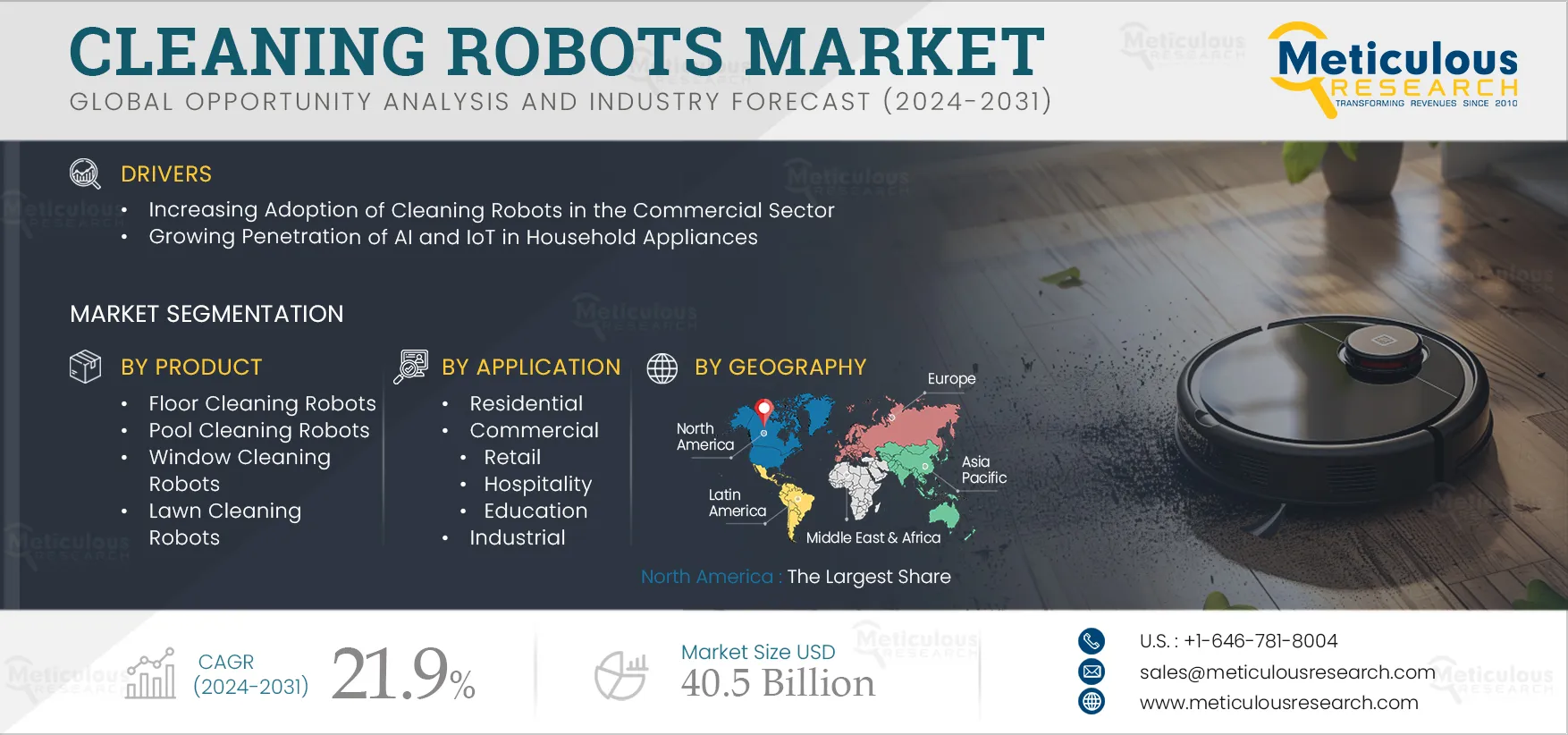
The Cleaning Robots Market is expected to reach $40.5 billion by 2032, at a CAGR of 21.9% from 2025 to 2032. The growth of the cleaning robots market is driven by their increasing adoption in the commercial sector and the growing penetration of AI and IoT in household appliances. Furthermore, the proliferation of cleaning robots in industrial applications is expected to generate growth opportunities for the players operating in this market.
The adoption of cleaning robots in commercial applications is attributed to their ability to automate routine cleaning tasks, reduce labor costs, and improve efficiency. Commercial cleaning robots are increasingly used to handle cleaning needs in various commercial environments such as offices, retail spaces, warehouses, hospitals, and hotels. Commercial cleaning robots are autonomous and can navigate and clean without human intervention. Thus, the adoption of cleaning robots in commercial applications is due to their cost-effectiveness and efficiency in cleaning tasks.
Some of the applications of commercial cleaning robots are as follows:
Thus, with the increasing adoption of cleaning robots in commercial applications, several companies are launching robots to address labor shortages and transform the cleaning sector. For instance, in July 2024, Shenzhen Pudu Technology Co., Ltd. (China) launched advanced commercial cleaning robots, PUDU CC1 and PUDU SH1. Such growing developments help to increase the demand for cleaning robots in the commercial sector.
Click here to: Get Free Sample Pages of this Report
The growing penetration of AI and IoT in household appliances is due to increasing internet penetration, technological advancements, wireless communication, and smartphone integration use in household appliances. However, cleaning robots are one of the appliances in which the integration of AI and IoT is used to automate the cleaning process for the home. The integration of IoT in cleaning robots allows users to monitor cleaning robots remotely, track their status, and control them through a web interface or mobile app. Additionally, IoT connectivity allows cleaning robots to send alerts or notifications when issues arise, such as low battery levels, maintenance needs, and obstacles in their path.
Moreover, the integration of AI in cleaning robots helps to create maps, recognize their environment, and navigate effectively. Using AI-based computer vision, cleaning robots identify objects, people, and hazards. This capability reduces the risk of collisions and enables robots to work safely in crowded or dynamic spaces. Additionally, the integration of AI helps to optimize energy usage by monitoring battery levels and scheduling recharging at optimal times to minimize downtime. Thus, several companies are launching cleaning robots with the integration of AI that provide smarter, safer, and more efficient cleaning solutions. For instance, in September 2022, SoftBank Robotics Group (Japan) launched Scrubber 50, the AI-powered Robot. Scrubber 50 is a fully automated AI-powered floor cleaning robot equipped with a large collection of sensors, including six cameras (3D/2D) and a LiDAR sensor, for fall prevention and collision detection.
In recent years, the surging need for disinfecting robots in healthcare facilities has become more apparent due to various factors such as heightened awareness of infection risks, the impact of global pandemics, and the demand for more efficient and consistent sanitation practices. Disinfecting robots use ultraviolet (UV-C) light or automated spraying of disinfectants that help to reduce the risk of Healthcare-Associated Infections (HAIs), a significant concern in healthcare settings. Additionally, the COVID-19 pandemic highlighted the need for more robust disinfection practices to reduce the spread of contagious diseases. Thus, the increasing use of disinfecting robots helps to minimize human contact and enhances sanitation in high-risk areas.
By using automated disinfection robots, the hospitals reduce the risk for healthcare workers who would otherwise be responsible for manual cleaning and disinfecting. Additionally, with the increasing government regulation for healthcare facilities regarding cleanliness and infection control, several healthcare providers are adopting disinfecting robots that help to ensure compliance with these standards. Thus, the surging need for disinfecting robots in healthcare facilities reflects the increasing demand for effective, efficient, and consistent infection control solutions. These robots play a crucial role in ensuring the safety of healthcare environments, reducing infection risks, and improving operational efficiency.
Cleaning robots are increasingly used in industrial applications for various purposes such as maintaining cleanliness in warehouses and manufacturing plants to improving safety and efficiency. There are various types of cleaning robots used in industrial applications, such as automated floor cleaners, high-pressure wash robots, robotic vacuum cleaners, and robotic window cleaners. The growing use of these robots helps industries to reduce the time and labor requirement for manual cleaning.
There are several industrial applications in which cleaning robots are used, as follows:
With the growing adoption of cleaning robots in industrial applications, several robot providers are launching products. For instance, in February 2025, Peppermint Robotics (India), a leading commercial robotics launched a new and smallest line of commercial floor cleaning robots - the SD20. This new robot is poised to set a new benchmark for excellence in small to mid-floor size cleaning automation in the industry. Such growing developments help to increase the demand for cleaning robots in industrial applications.
Based on product, the global cleaning robots market is segmented into floor cleaning robots, pool cleaning robots, window cleaning robots, lawn cleaning robots, and other cleaning robots. In 2025, the floor cleaning robots segment is expected to account for the largest share of above 44.0% of the global cleaning robots market. The segment's large market share is attributed to the growing adoption of floor cleaning robots to maintain a consistent cleaning schedule and operate without supervision, the increasing need to eliminate the need for manual vacuuming or mopping that reduces physical strain beneficial for people with mobility issues, the rising integration of advanced technology in cleaning robots to navigate rooms, avoid obstacles, and create efficient cleaning paths, and the floor cleaning robots require minimal maintenance, with straightforward processes for emptying dustbins, cleaning brushes, or changing filters.
However, the window cleaning robots segment is expected to register a higher CAGR during the forecast period. This segment's growth is attributed to the increasing adoption of window cleaning robots to minimize the risk of accidents and injuries associated with manual window cleaning, the growing need to lower the cost of window cleaning for larger properties or buildings with multiple windows, and the growing technological advancement in window cleaning robots to navigate around obstacles, detect edges, and clean windows with precision.
Based on operation mode, the global cleaning robots market is segmented into self-driven, remote-controlled, and app-controlled. In 2025, the self-driven segment is expected to account for the largest share of above 62.0% of the global cleaning robots market. The segment's large market share is attributed to the growing adoption of self-driven cleaning robots to operate autonomously, allowing users to set them up and let them do the work without direct supervision. Self-driven robots follow programmed routines or paths, ensuring consistent and regular cleaning; the increasing use of advanced sensors, cameras, and AI algorithms to detect and avoid obstacles, map out rooms, and adjust to different floor types, and the self-driven cleaning robots eliminate the need to push a vacuum cleaner or mop around, reducing the physical strain of consumer.
However, the app-controlled segment is expected to register a higher CAGR during the forecast period. The growth of this segment is attributed to the growing use of app-controlled cleaning robots to customize cleaning preferences such as cleaning modes, intensity, and specific areas to focus on; the app provides real-time updates on the robot's location, cleaning progress and battery status, allowing users to monitor the cleaning process from anywhere, the app-controlled robots send notifications for maintenance tasks like emptying the dustbin, cleaning brushes, or replacing filters, and the app-controlled cleaning robots come with mapping features that let users view and manage a digital map of their space.
Based on charging type, the global cleaning robots market is segmented into automatic charging and manual charging. In 2025, the automatic charging segment is expected to account for a larger share of above 66.0% of the global cleaning robots market. The segment's large market share is attributed to the growing use of automatic charging eliminates the need for manual recharging, making the cleaning process more seamless for users; the growing use of automatic charging in cleaning robots that users can set a cleaning schedule and let the robot manage its own power needs, and the increasing use of automatic charging stations for built-in safety features to prevent overcharging, overheating, or power surges.
Also, this segment is expected to register a higher CAGR during the forecast period.
Based on technology, the global cleaning robots market is segmented into Bluetooth, Wi-Fi, Zigbee, and other technologies. In 2025, the Wi-Fi segment is expected to account for the largest share of the global cleaning robots market. The segment's large market share is attributed to the growing use of Wi-Fi to connect with cleaning robots, allow users to control them remotely with a smartphone or tablet, the increasing use of Wi-Fi in cleaning robots for scheduling specific cleaning times, the Wi-Fi-Enabled cleaning robots provides over the air software updates for latest features, and the Wi-Fi enables cleaning robots use cloud technology for advanced mapping and navigation of robots.
Also, this segment is expected to register a higher CAGR during the forecast period.
Based on usage, the global cleaning robots market is segmented into personal cleaning robots and professional cleaning robots. In 2025, the professional cleaning robots segment is expected to account for a larger share of above 60.0% of the global cleaning robots market. The segment's large market share is attributed to the increasing adoption of cleaning robots to keep large areas like malls, department stores, and supermarkets clean; the professional cleaning robots with UV-C technology and disinfection methods to maintain hygiene in the hospitals. The rising use of professional cleaning robots to manage dust and debris in large industrial spaces, promoting a safer work environment, and the adoption of professional cleaning robots in various commercial and industrial applications for efficient, cost-saving, and consistency for cleaning.
Also, this segment is expected to register a higher CAGR during the forecast period.
Based on sales channel, the global cleaning robots market is segmented into online and offline. In 2025, the offline segment is expected to account for a larger share of above 59.0% of the global cleaning robots market. The segment's large market share is attributed to the offline sales of cleaning robots allow customers to see, touch, and experience the cleaning robots in person. Offline sales allow customers to discuss their unique requirements with experts who can recommend specific models and configurations. The cleaning robots for commercial use are large and heavy; offline sales reduce the risk of shipping damage and ensure the product arrives in perfect condition, and the offline sales of cleaning robots provide easier access to technical support, maintenance, and repair services.
Also, this segment is expected to register a higher CAGR during the forecast period.
Based on application, the global cleaning robots market is segmented into residential, commercial, industrial, and other applications. In 2025, the commercial segment is expected to account for the largest share of above 47.0% of the global cleaning robots market. The segment's large market share is attributed to the increasing adoption of cleaning robots in a commercial application to optimize labor by reallocating employees to higher-value tasks; the use of cleaning robots helps to improve cleaning performance and provides real-time performance data, and the increasing adoption of cleaning robots to clean hard-to-reach areas, reducing the need for employees to climb ladders or use other equipment that can be dangerous.
However, the residential segment is expected to register a higher CAGR during the forecast period. This segment's growth is attributed to the growing penetration of AI and IoT in household appliances. Cleaning robots provide a high level of convenience as they allow homeowners to autonomously navigate the robot's location through an app. They also offer a range of cleaning and maintenance features that enhance the quality of your indoor environment.
In 2025, North America is expected to account for the largest share of above 35.0% of the global cleaning robots market. North America’s significant market share can be attributed to the increasing adoption of cleaning robots in various industries such as healthcare, hospitality, and retail for cleaning floors, the increasing technological advancement and modernization in the field of robotics, the rise in the working population, growing number of smart homes, and growing purchasing power of cleaning robots, and the growing need of disinfection robots in this region for healthcare facilities.
However, the Asia-Pacific market is expected to register the highest CAGR of above 24.0% during the forecast period. This market's growth is attributed to the growing adoption of technologies such as home area networks and IoT in cleaning robots for residential applications, the increasing number of local manufacturers of cleaning robots, the increasing adoption of cleaning robots in the region for the commercial sector, and the growing need to lower the cost of window cleaning for larger properties or buildings with multiple windows.
The report offers a competitive analysis based on an extensive assessment of the leading players’ product portfolios, geographic presence, and key growth strategies adopted in the last 3–4 years. Some of the key players operating in the cleaning robots market iRobot Corporation (U.S.), ECOVACS Robotics Co., Ltd. (China), ILIFE Technology (China), Maytronics Limited (Israel), Milagrow HumanTech (India), Samsung Electronics America, Inc. (A Subsidiary of Samsung Electronics Co., Ltd.) (U.S.), Beijing Roborock Technology Co., Ltd. (China), Neato Robotics, Inc. (U.S.), Nilfisk Holding A/S (Denmark), SharkNinja Global SPV, Ltd. (U.S.), Pentair Plc (U.S.), Xiaomi Group (China), LG Electronics, Inc. (South Korea), CECOTEC INNOVACIONES SL (Spain), and Panasonic Holdings Corporation (Japan).
In April 2025, Avidbots Corp. (Canada) launched Kas, a fully autonomous floor scrubber for the retail, transportation, health care, and education industries. Kas allows customers to future-proof their labor strategy, realize immediate savings, and revolutionize their cleaning strategy.
In April 2024, Avidbots Corp. (Canada) launched Neo 2W, the first cleaning robot designed specifically for warehouses and manufacturing environments to improve cleaning quality, efficiency, and productivity.
|
Particulars |
Details |
|
Number of Pages |
300 |
|
Format |
|
|
Forecast Period |
2025–2032 |
|
Base Year |
2024 |
|
CAGR (Value) |
21.9% |
|
Market Size (Value) |
USD 40.5 Billion by 2032 |
|
Segments Covered |
By Product
By Operation Mode
By Charging Type
By Technology
By Usage
By Sales Channel
By Application
|
|
Countries Covered |
North America (U.S., Canada), Europe (Germany, U.K., France, Italy, Netherlands, Spain, Sweden, and Rest of Europe), Asia-Pacific (China, India, Japan, South Korea, Singapore, Australia & New Zealand, Indonesia, and Rest of Asia-Pacific), Latin America (Brazil, Mexico, and Rest of Latin America), and the Middle East & Africa (Saudi Arabia, UAE, Israel, and Rest of the Middle East & Africa) |
|
Key Companies |
iRobot Corporation (U.S.), ECOVACS Robotics Co., Ltd. (China), ILIFE Technology (China), Maytronics Limited (Israel), Milagrow HumanTech (India), Samsung Electronics America, Inc. (A Subsidiary of Samsung Electronics Co., Ltd.) (U.S.), Beijing Roborock Technology Co., Ltd. (China), Neato Robotics, Inc. (U.S.), Nilfisk Holding A/S (Denmark), SharkNinja Global SPV, Ltd. (U.S.), Pentair Plc (U.S.), Xiaomi Group (China), LG Electronics, Inc. (South Korea), CECOTEC INNOVACIONES SL (Spain), and Panasonic Holdings Corporation (Japan) |
The cleaning robots market study focuses on market assessment and opportunity analysis through the sales of cleaning robots across different regions and countries across different market segmentations. This study is also focused on competitive analysis for cleaning robots based on an extensive assessment of the leading players’ product portfolios, geographic presence, and key growth strategies.
The global cleaning robots market is projected to reach $40.5 billion by 2032, at a CAGR of 21.9% from 2025 to 2032.
In 2025, the floor cleaning robots segment is expected to account for the largest share of above 44.0% of the global cleaning robots market. The segment's large market share is attributed to the growing adoption of floor cleaning robots to maintain a consistent cleaning schedule and operate without supervision, the increasing need to eliminate the need for manual vacuuming or mopping that reduces physical strain beneficial for people with mobility issues, the rising integration of advanced technology in cleaning robots to navigate rooms, avoid obstacles, and create efficient cleaning paths.
The residential segment is expected to register a higher CAGR during the forecast period. This segment's growth is attributed to the growing penetration of AI and IoT in household appliances. Cleaning robots provide a high level of convenience as they allow homeowners to autonomously navigate the robot's location through an app. They also offer a range of cleaning and maintenance features that enhance the quality of your indoor environment.
The growth of the cleaning robots market is driven by their increasing adoption in the commercial sector and the growing penetration of AI and IoT in household appliances. Furthermore, the proliferation of cleaning robots in industrial applications is expected to generate growth opportunities for the players operating in this market.
The key players operating in the cleaning robots market iRobot Corporation (U.S.), ECOVACS Robotics Co., Ltd. (China), ILIFE Technology (China), Maytronics Limited (Israel), Milagrow HumanTech (India), Samsung Electronics America, Inc. (A Subsidiary of Samsung Electronics Co., Ltd.) (U.S.), Beijing Roborock Technology Co., Ltd. (China), Neato Robotics, Inc. (U.S.), Nilfisk Holding A/S (Denmark), SharkNinja Global SPV, Ltd. (U.S.), Pentair Plc (U.S.), Xiaomi Group (China), LG Electronics, Inc. (South Korea), CECOTEC INNOVACIONES SL (Spain), and Panasonic Holdings Corporation (Japan).
Asia-Pacific market is expected to register the highest CAGR of above 24.0% during the forecast period. The growth of this market is attributed to the growing adoption of technologies such as home area networks and IoT in cleaning robots for residential applications, the increasing number of local manufacturers of cleaning robots, the increasing adoption of cleaning robots in the region for the commercial sector, and the growing need to lower the cost of window cleaning for larger properties or buildings with multiple windows.
























Published Date: May-2025
Published Date: Nov-2024
Published Date: Jul-2024
Published Date: Jan-2025
Please enter your corporate email id here to view sample report.
Subscribe to get the latest industry updates


