Resources
About Us
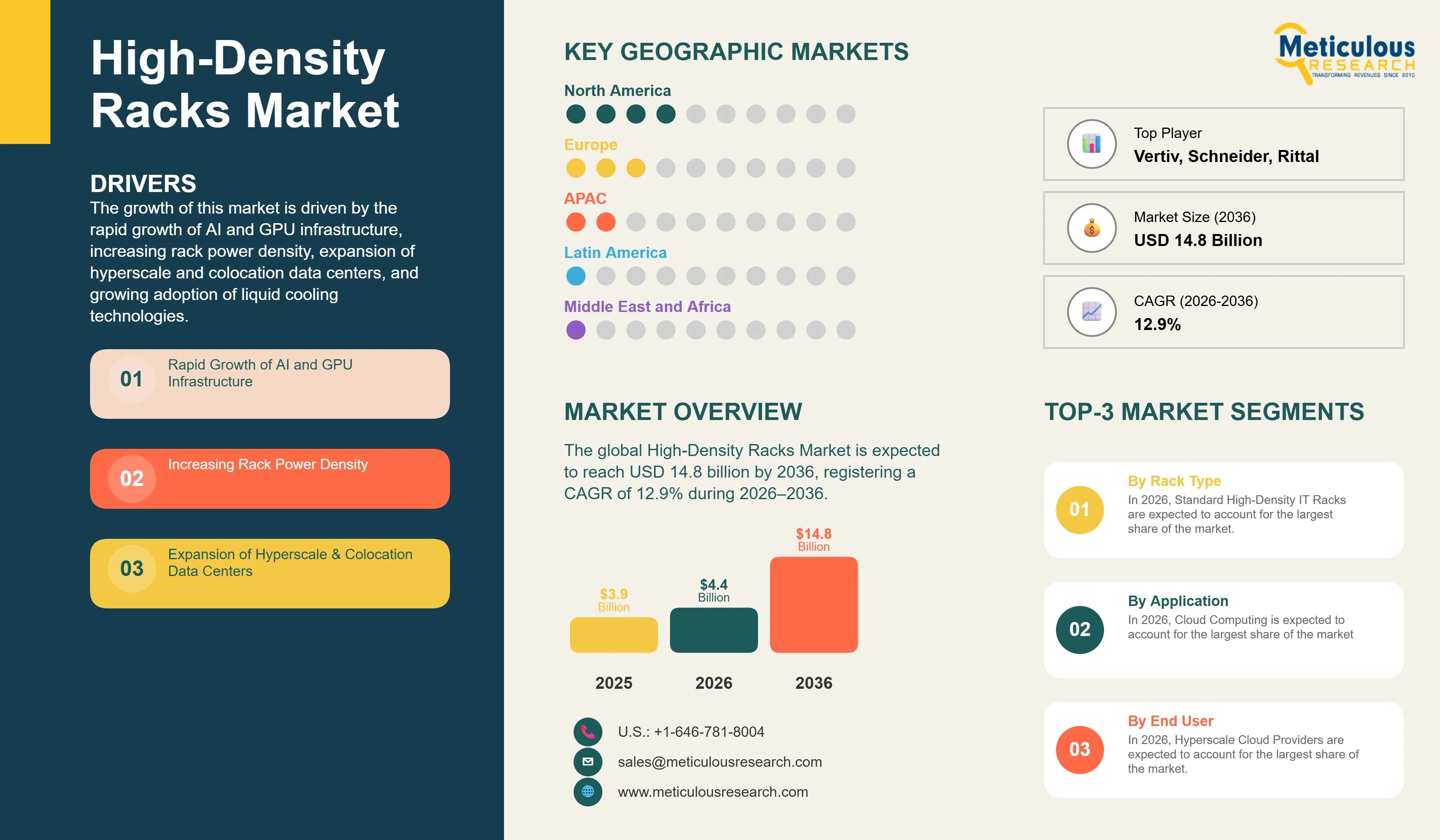
The global High-Density Racks Market is estimated to be valued at USD 3.9 billion in 2025 and is projected to reach USD 4.4 billion in 2026. The market is expected to reach USD 14.8 billion by 2036, registering a CAGR of 12.9% during the forecast period (2026–2036).
The High-Density Racks Market comprises advanced rack infrastructure designed to support high-performance servers, AI accelerators, networking equipment, and storage systems operating at significantly higher power densities than conventional data center racks. These racks integrate intelligent power distribution, advanced cable management, enhanced airflow design, liquid cooling compatibility, environmental monitoring, and rack-level management systems to support modern AI, cloud computing, and high-performance computing (HPC) environments. As organizations deploy increasingly powerful computing infrastructure, high-density racks have become a critical component of next-generation data centers.
The market is experiencing strong growth due to the rapid expansion of artificial intelligence (AI) infrastructure and hyperscale cloud computing. According to the International Data Corporation (IDC), global spending on AI-centric systems is expected to exceed USD 1.3 trillion by 2030, driving unprecedented investments in AI-ready data centers. At the same time, the deployment of GPUs and AI accelerators is significantly increasing rack power densities, creating demand for rack systems capable of supporting higher electrical loads, advanced cooling technologies, and intelligent infrastructure management.
The expansion of hyperscale and colocation data centers is further supporting market growth. According to Synergy Research Group, the number of hyperscale data centers worldwide has exceeded 1,100-1200 facilities by 2025, with continued investments by leading cloud providers including Amazon Web Services (AWS), Microsoft, Google, and Meta. These facilities require scalable rack infrastructure capable of supporting high-density computing while improving energy efficiency, cooling performance, and operational reliability. In parallel, the growing adoption of liquid cooling technologies, Open Compute Project (OCP) standards, and rack-level monitoring solutions is transforming data center infrastructure design.
Technological innovation continues to reshape the market. Manufacturers are introducing AI-optimized rack architectures, intelligent power distribution units (iPDUs), digital twin technologies, automated rack monitoring systems, and liquid cooling-compatible rack designs to improve infrastructure utilization and simplify data center operations. Looking ahead, increasing investments in AI factories, edge AI infrastructure, modular data centers, and semiconductor manufacturing are expected to create substantial growth opportunities for high-density rack manufacturers over the next decade.
Rapid Growth of AI and GPU Infrastructure
The rapid adoption of artificial intelligence is significantly increasing demand for high-density rack infrastructure. AI training and inference workloads require thousands of GPUs and AI accelerators operating within the same facility, generating substantially higher power and heat than conventional servers. According to the International Data Corporation (IDC), worldwide spending on AI-centric systems is expected to surpass USD 1.3 trillion by 2030, reflecting the continued expansion of enterprise AI adoption. To support these increasingly demanding workloads, data center operators are investing in high-density racks capable of supporting advanced cooling technologies, intelligent power distribution, and higher rack power capacities. As AI infrastructure continues to expand, demand for next-generation rack systems is expected to grow rapidly.
Expansion of Hyperscale Data Centers and Increasing Rack Power Density
The continuous expansion of hyperscale and colocation data centers is driving strong demand for high-density rack solutions. Modern AI servers and GPU clusters require significantly higher rack power densities than traditional enterprise infrastructure, creating demand for racks that can safely support higher electrical loads while maintaining efficient cooling and cable management. According to Synergy Research Group, the number of hyperscale data centers worldwide has exceeded 1,100-1,200 by 2025, and global capacity continues to grow every year. At the same time, increasing adoption of liquid cooling technologies and AI-ready infrastructure is accelerating the deployment of racks designed for power densities exceeding 30 kW, 60 kW, and even 100 kW. These developments are expected to remain a major driver of market growth throughout the forecast period.
Higher Initial Infrastructure Costs
Deploying high-density rack infrastructure requires significant investment in specialized rack systems, intelligent power distribution units, liquid cooling compatibility, environmental monitoring, and upgraded electrical infrastructure. In addition, supporting higher rack power densities often requires substantial investment in cooling systems, power management equipment, and facility upgrades. These higher capital requirements may slow adoption, particularly among small and medium-sized data center operators and enterprises with limited infrastructure budgets.
Complex Power and Cooling Requirements
As rack power densities continue to increase, maintaining reliable power delivery and efficient cooling becomes increasingly challenging. High-density AI racks require advanced thermal management, intelligent power distribution, optimized airflow, and, in many cases, liquid cooling technologies to ensure reliable operation. Integrating these systems into existing facilities can increase deployment complexity and operational costs, particularly for legacy data centers. Addressing these power and cooling challenges remains a key consideration for organizations planning next-generation data center infrastructure investments.
Expansion of AI Factories and Large-Scale AI Infrastructure
The rapid emergence of AI factories and large-scale AI infrastructure presents significant growth opportunities for the High-Density Racks Market. Technology companies and cloud service providers are investing billions of dollars in AI data centers equipped with thousands of GPUs and AI accelerators to support generative AI, large language models (LLMs), and advanced machine learning workloads. These facilities require rack infrastructure capable of supporting extremely high power densities, advanced cooling technologies, intelligent power distribution, and automated monitoring. As enterprises continue expanding AI computing capacity, demand for AI-optimized high-density racks is expected to increase substantially over the coming decade.
Growing Adoption of Modular Data Centers and Open Compute Project (OCP) Standard
The increasing adoption of modular and prefabricated data centers is creating new opportunities for high-density rack manufacturers. Organizations are deploying modular facilities to accelerate infrastructure deployment while improving scalability and reducing construction costs. At the same time, the growing adoption of Open Compute Project (OCP) standards is encouraging the development of standardized rack architectures that improve interoperability, power efficiency, and cooling performance. As enterprises modernize their data center infrastructure, demand for OCP-compatible, modular, and intelligent rack systems is expected to grow significantly across hyperscale, colocation, and enterprise environments.
Thermal Management for Ultra-High-Power Racks
Managing heat generated by ultra-high-density AI servers remains one of the biggest challenges for the market. As rack power densities exceed 100 kW, traditional air-cooling solutions become increasingly inadequate, requiring advanced liquid cooling technologies and sophisticated airflow management. Maintaining reliable operating temperatures while ensuring system availability and energy efficiency requires significant engineering expertise and infrastructure investment. Equipment manufacturers and data center operators must continuously innovate to support increasingly powerful AI workloads without compromising operational reliability.
Lack of Standardization Across Rack Architectures
The rapid evolution of AI hardware, server designs, cooling technologies, and rack configurations has resulted in varying infrastructure standards across vendors. Differences in rack dimensions, power distribution systems, cable management, cooling integration, and hardware compatibility can increase deployment complexity and limit interoperability. Although initiatives such as the Open Compute Project are promoting greater standardization, achieving broad industry adoption remains an ongoing challenge for manufacturers, system integrators, and data center operators.
Growing Adoption of Liquid Cooling-Compatible Rack Infrastructure
The increasing deployment of liquid cooling technologies is transforming high-density rack design. Modern AI servers and GPU clusters generate significantly higher heat loads than conventional computing systems, making liquid cooling an increasingly preferred solution for maintaining optimal performance. Manufacturers are introducing rack designs compatible with direct-to-chip cooling, rear-door heat exchangers, immersion cooling, and hybrid cooling systems to support next-generation AI infrastructure. As liquid cooling adoption accelerates, demand for specialized rack architectures is expected to increase significantly.
Increasing Deployment of Intelligent Rack Infrastructure
Data center operators are increasingly adopting intelligent rack infrastructure equipped with smart sensors, environmental monitoring, digital twins, intelligent power distribution units (iPDUs), and AI-enabled monitoring platforms. These technologies enable real-time visibility into power utilization, temperature, airflow, equipment health, and rack performance, allowing operators to improve infrastructure efficiency and reduce operational risks. As data centers become increasingly automated, intelligent rack infrastructure is expected to become a standard feature of modern high-density deployments.
Market Analysis by Rack Type
Based on rack type, the global High-Density Racks Market is segmented into Standard High-Density IT Racks, AI Racks, HPC Racks, Open Compute Project (OCP) Racks, and Customized High-Density Racks.
In 2026, Standard High-Density IT Racks are expected to account for the largest share of the market due to their widespread deployment across enterprise, hyperscale, and colocation data centers supporting a broad range of computing applications. However, AI Racks are projected to register the highest CAGR during the forecast period, driven by rapid investments in generative AI, GPU clusters, and AI training infrastructure requiring significantly higher rack power densities.
Market Analysis by Rack Power Density
Based on rack power density, the market is segmented into Up to 15 kW, 16–30 kW, 31–60 kW, 61–100 kW, and Above 100 kW.
In 2026, the 16–30 kW segment is expected to account for the largest market share, as it represents the most widely deployed rack configuration across enterprise and colocation data centers.However, the Above 100 kW segment is projected to witness the highest CAGR during the forecast period due to increasing deployment of AI supercomputers, GPU clusters, and next-generation AI factories.
Market Analysis by Rack Size
Based on rack size, the market is segmented into Up to 42U, 43U–48U, and Above 48U.
In 2026, the 43U–48U segment is expected to account for the largest share of the market owing to its broad adoption across hyperscale, enterprise, and colocation facilities.However, the Above 48U segment is projected to register the fastest growth due to increasing demand for higher equipment density and optimized floor space utilization in AI data centers.
Market Analysis by Component
Based on component, the market is segmented into Rack Enclosures, Rack Frames, Intelligent Power Distribution Units (iPDUs), Busbars, Cable Management Systems, Rack Monitoring Systems, Environmental Sensors, and Security & Access Control Systems.
In 2026, Rack Enclosures are expected to account for the largest market share because they form the structural foundation of every high-density rack deployment.However, Intelligent Power Distribution Units (iPDUs) are projected to witness the fastest growth as operators increasingly require intelligent power monitoring, energy optimization, and remote infrastructure management.
Market Analysis by Cooling Compatibility
Based on cooling compatibility, the market is segmented into Air-Cooled Racks, Rear Door Heat Exchanger Compatible Racks, Direct-to-Chip Cooling Compatible Racks, Immersion Cooling Compatible Racks, and Hybrid Cooling Compatible Racks.
In 2026, Air-Cooled Racks are expected to account for the largest share of the market due to their extensive installed base across conventional data centers.However, Direct-to-Chip Cooling Compatible Racks are projected to register the highest CAGR during the forecast period, supported by increasing deployment of AI servers with very high thermal loads.
Market Analysis by Application
Based on application, the market is segmented into AI Training Clusters, AI Inference Infrastructure, High-Performance Computing, Cloud Computing, Colocation Data Centers, Enterprise Data Centers, Edge Data Centers, and Scientific Research & Supercomputing.
In 2026, Cloud Computing is expected to account for the largest market share due to continued expansion of hyperscale cloud infrastructure worldwide.However, AI Training Clusters are projected to register the fastest CAGR during the forecast period as enterprises significantly increase investments in generative AI and large language model development.
Market Analysis by End User
Based on end user, the market is segmented into Hyperscale Cloud Providers, Colocation Providers, Enterprise Organizations, Telecommunications Operators, Government & Defense, Research & Academic Institutions, and Financial Services.
In 2026, Hyperscale Cloud Providers are expected to account for the largest market share due to ongoing investments in AI-ready hyperscale data centers. However, Research & Academic Institutions are projected to register the highest CAGR during the forecast period, driven by increasing investments in supercomputing facilities, scientific simulations, and AI research infrastructure.
Based on geography, the global High-Density Racks Market is segmented into North America, Europe, Asia-Pacific, Latin America, and the Middle East & Africa.
In 2026, North America is expected to account for the largest share of the global High-Density Racks Market. The region's leadership is primarily driven by large-scale investments in AI infrastructure, hyperscale cloud data centers, and high-performance computing (HPC) facilities. The United States hosts the world's largest concentration of hyperscale data centers and continues to witness significant investments from leading cloud service providers such as Amazon Web Services (AWS), Microsoft, Google, and Meta. In addition, the rapid deployment of AI training clusters, GPU-based computing infrastructure, and liquid-cooled data centers is driving demand for advanced high-density rack solutions. The strong presence of leading rack manufacturers, AI server vendors, and data center infrastructure providers further strengthens North America's position in the global market.
However, Asia-Pacific is projected to register the highest CAGR during the forecast period. Rapid digital transformation, expanding cloud infrastructure, growing AI investments, and increasing semiconductor manufacturing capacity are accelerating demand for high-density rack infrastructure across the region. Countries including China, India, Japan, South Korea, Singapore, Taiwan, Malaysia, and Australia are investing heavily in hyperscale data centers, AI computing facilities, and next-generation digital infrastructure. Government initiatives supporting semiconductor manufacturing and AI development, combined with rising adoption of edge computing and cloud services, are expected to create significant growth opportunities for high-density rack manufacturers across Asia-Pacific.
The global High-Density Racks Market is moderately consolidated, with competition among data center infrastructure providers, rack manufacturers, power management companies, and AI infrastructure solution providers. Companies compete primarily on rack scalability, structural strength, power density support, cooling compatibility, intelligent monitoring capabilities, and integration with next-generation AI and hyperscale computing environments.
Leading companies are investing heavily in AI-ready rack architectures, intelligent power distribution units (iPDUs), liquid cooling-compatible rack designs, digital infrastructure management, and Open Compute Project (OCP)-compliant solutions. Strategic partnerships with hyperscale cloud providers, expansion of manufacturing capabilities, acquisitions, and investments in advanced rack monitoring technologies remain key growth strategies adopted by market participants. As AI infrastructure continues to evolve, companies are increasingly focusing on delivering standardized, energy-efficient, and scalable rack solutions capable of supporting ultra-high-density computing environments.
The report provides a comprehensive competitive assessment of the leading companies operating in the global High-Density Racks Market. The key players profiled in the report include Vertiv Holdings Co., Schneider Electric SE, Rittal GmbH & Co. KG, Legrand SA, Eaton Corporation plc, Panduit Corp., Chatsworth Products, Inc. (CPI), Dell Technologies Inc., Hewlett Packard Enterprise (HPE), Lenovo Group Limited, Super Micro Computer, Inc., Delta Electronics, Inc., Oracle Corporation, IBM Corporation, and Fujitsu Limited.
The global High-Density Racks Market is estimated at USD 4.4 billion in 2026.
The market is projected to reach USD 14.8 billion by 2036.
The market is expected to grow at a CAGR of 12.9% during 2026–2036.
Rapid growth of AI infrastructure, increasing rack power density, expansion of hyperscale data centers, and growing adoption of liquid cooling technologies are driving market growth.
Thermal management for ultra-high-density racks and lack of standardization across rack architectures remain the primary market challenges.
AI rack architectures, Open Compute Project (OCP) racks, intelligent rack infrastructure, rack-level power distribution, digital twins, and liquid cooling integration are transforming the market.
Standard High-Density IT Racks are expected to account for the largest market share in 2026.
AI Racks are projected to register the highest CAGR during the forecast period.
The 16–30 kW segment is expected to remain the largest.
The Above 100 kW segment is projected to witness the fastest growth due to increasing deployment of AI supercomputing infrastructure.
Intelligent Power Distribution Units (iPDUs) are expected to register the highest growth due to increasing demand for intelligent power monitoring and energy optimization.
Direct-to-Chip Cooling Compatible Racks are projected to register the highest CAGR during the forecast period.
Cloud Computing is expected to account for the largest market share.
AI Training Clusters are projected to witness the highest growth due to increasing investments in generative AI infrastructure.
Hyperscale Cloud Providers are expected to remain the largest end-user segment.
North America is expected to remain the largest regional market due to significant investments in AI infrastructure, hyperscale cloud computing, and advanced data center technologies.
Asia-Pacific is expected to witness the fastest growth, supported by rapid expansion of cloud infrastructure, semiconductor manufacturing, and AI investments.
Leading companies include Vertiv Holdings, Schneider Electric, Rittal, Legrand, Eaton, Panduit, Chatsworth Products (CPI), Dell Technologies, Hewlett Packard Enterprise (HPE), Lenovo, Super Micro Computer, Delta Electronics, Oracle, IBM, and Fujitsu
1. Introduction
1.1 Market Definition
1.2 Market Ecosystem
1.3 Currency and Limitations
1.3.1 Currency
1.3.2 Limitations
1.4 Key Stakeholders
2. Research Methodology
2.1 Research Approach
2.2 Data Collection & Validation Process
2.2.1 Secondary Research
2.2.2 Primary Research & Validation
2.2.2.1 Primary Interviews with Experts
2.2.2.2 Country-/Region-Level Analysis
2.3 Market Estimation
2.3.1 Bottom-Up Approach
2.3.2 Top-Down Approach
2.3.3 Growth Forecast
2.4 Data Triangulation
2.5 Assumptions
3. Executive Summary
4. Market Overview
4.1 Introduction
4.2 Market Dynamics
4.2.1 Drivers
4.2.1.1 Rapid Growth of AI and GPU Infrastructure
4.2.1.2 Increasing Rack Power Density in Modern Data Centers
4.2.1.3 Expansion of Hyperscale and Colocation Data Centers
4.2.1.4 Growing Adoption of Liquid Cooling Technologies
4.2.2 Restraints
4.2.2.1 Higher Initial Infrastructure Costs
4.2.2.2 Retrofitting Challenges in Legacy Data Centers
4.2.2.3 Complex Power and Cooling Requirements
4.2.3 Opportunities
4.2.3.1 AI Factories and Large Language Model Infrastructure
4.2.3.2 Edge AI Data Centers
4.2.3.3 Modular and Prefabricated Data Centers
4.2.3.4 Open Compute Project (OCP) Adoption
4.2.4 Challenges
4.2.4.1 Thermal Management Above 100 kW per Rack
4.2.4.2 Standardization Across Rack Architectures
4.3 Technology Landscape
4.3.1 AI Rack Architectures
4.3.2 Open Compute Project (OCP) Racks
4.3.3 Open Rack v3 Standards
4.3.4 Intelligent Rack Infrastructure
4.3.5 Rack-Level Power Distribution
4.3.6 Rack Monitoring and Digital Twins
4.3.7 Liquid Cooling Integration
4.3.8 Rack Automation Technologies
4.4 High-Density Rack Ecosystem
4.4.1 Rack Manufacturers
4.4.2 Power Distribution Vendors
4.4.3 Cooling Solution Providers
4.4.4 Cable Management Suppliers
4.4.5 AI Server Manufacturers
4.4.6 System Integrators
4.4.7 Data Center Operators
4.5 Value Chain Analysis
4.5.1 Steel & Aluminum Suppliers
4.5.2 Component Manufacturers
4.5.3 Rack Manufacturers
4.5.4 Integrators
4.5.5 Data Center Operators
4.6 Standards & Regulatory Landscape
4.6.1 Open Compute Project (OCP)
4.6.2 EIA-310 Rack Standards
4.6.3 IEC Standards
4.6.4 ASHRAE Thermal Guidelines
4.6.5 Sustainability Standards
4.7 Porter's Five Forces Analysis
4.8 Investment & Industry Trends
4.8.1 AI Infrastructure Investments
4.8.2 Hyperscale Expansion
4.8.3 High-Power Rack Deployments
4.8.4 Liquid Cooling Investments
5. High-Density Racks Market, by Rack Type
5.1 Introduction
5.2 Standard High-Density IT Racks
5.3 AI Racks
5.4 HPC Racks
5.5 Open Compute Project (OCP) Racks
5.6 Customized High-Density Racks
6. High-Density Racks Market, by Rack Power Density
6.1 Introduction
6.2 Up to 15 kW
6.3 16–30 kW
6.4 31–60 kW
6.5 61–100 kW
6.6 Above 100 kW
7. High-Density Racks Market, by Rack Size
7.1 Introduction
7.2 Up to 42U
7.3 43U–48U
7.4 Above 48U
8. High-Density Racks Market, by Component
8.1 Introduction
8.2 Rack Enclosures
8.3 Rack Frames
8.4 Intelligent Power Distribution Units (iPDUs)
8.5 Busbars
8.6 Cable Management Systems
8.7 Rack Monitoring Systems
8.8 Environmental Sensors
8.9 Security & Access Control Systems
9. High-Density Racks Market, by Cooling Compatibility
9.1 Introduction
9.2 Air-Cooled Racks
9.3 Rear Door Heat Exchanger Compatible Racks
9.4 Direct-to-Chip Cooling Compatible Racks
9.5 Immersion Cooling Compatible Racks
9.6 Hybrid Cooling Compatible Racks
10. High-Density Racks Market, by Application
10.1 Introduction
10.2 AI Training Clusters
10.3 AI Inference Infrastructure
10.4 High-Performance Computing
10.5 Cloud Computing
10.6 Colocation Data Centers
10.7 Enterprise Data Centers
10.8 Edge Data Centers
10.9 Scientific Research & Supercomputing
11. High-Density Racks Market, by End User
11.1 Introduction
11.2 Hyperscale Cloud Providers
11.3 Colocation Providers
11.4 Enterprise Organizations
11.5 Telecommunications Operators
11.6 Government & Defense
11.7 Research & Academic Institutions
11.8 Financial Services
12. High-Density Racks Market, by Geography
12.1 Introduction
12.2 North America
12.2.1 U.S.
12.2.2 Canada
12.3 Europe
12.3.1 Germany
12.3.2 U.K.
12.3.3 France
12.3.4 Netherlands
12.3.5 Ireland
12.3.6 Sweden
12.3.7 Rest of Europe
12.4 Asia-Pacific
12.4.1 China
12.4.2 Japan
12.4.3 South Korea
12.4.4 Taiwan
12.4.5 India
12.4.6 Singapore
12.4.7 Australia
12.4.8 Malaysia
12.4.9 Rest of Asia-Pacific
12.5 Latin America
12.5.1 Brazil
12.5.2 Mexico
12.5.3 Argentina
12.5.4 Chile
12.5.5 Colombia
12.5.6 Rest of Latin America
12.6 Middle East & Africa
12.6.1 UAE
12.6.2 Saudi Arabia
12.6.3 South Africa
12.6.4 Israel
12.6.5 Rest of Middle East & Africa
13. Competitive Landscape
13.1 Overview
13.2 Key Growth Strategies
13.3 Competitive Benchmarking
13.4 Competitive Dashboard
13.4.1 Industry Leaders
13.4.2 Market Differentiators
13.4.3 Vanguards
13.4.4 Emerging Players
13.5 Market Share/Ranking Analysis, By Key Player
14. Company Profiles
(Business Overview, Financial Overview, Product Portfolio, Strategic Developments, SWOT Analysis)
14.1 Vertiv Holdings Co.
14.2 Schneider Electric SE
14.3 Rittal GmbH & Co. KG
14.4 Legrand SA
14.5 Eaton Corporation plc
14.6 Panduit Corp.
14.7 Chatsworth Products, Inc. (CPI)
14.8 Dell Technologies Inc.
14.9 Hewlett Packard Enterprise (HPE)
14.10 Lenovo Group Limited
14.11 Super Micro Computer, Inc.
14.12 Delta Electronics, Inc.
14.13 Oracle Corporation
14.14 IBM Corporation
14.15 Fujitsu Limited
15. Appendix
15.1 List of Abbreviations
15.2 Discussion Guide
15.3 Related Reports
15.4 Customization Options
























Published Date: Apr-2026
Published Date: Jun-2025
Published Date: Oct-2024
Published Date: Mar-2026
Subscribe to get the latest industry updates