Resources
About Us

Gene Transfer Technologies Market Size, Share & Trends Analysis by Technology (Viral Vectors, Non-Viral Vectors), Application (Gene Therapy, Cell Therapy, Vaccine Production, Biopharmaceutical Production, Research Applications), End User, and Geography – Global Opportunity Analysis and Industry Forecast (2026–2036)
Report ID: MRHC - 1042082 Pages: 316 Jun-2026 Formats*: PDF Category: Healthcare Delivery: 24 to 72 Hours Download Free Sample Report
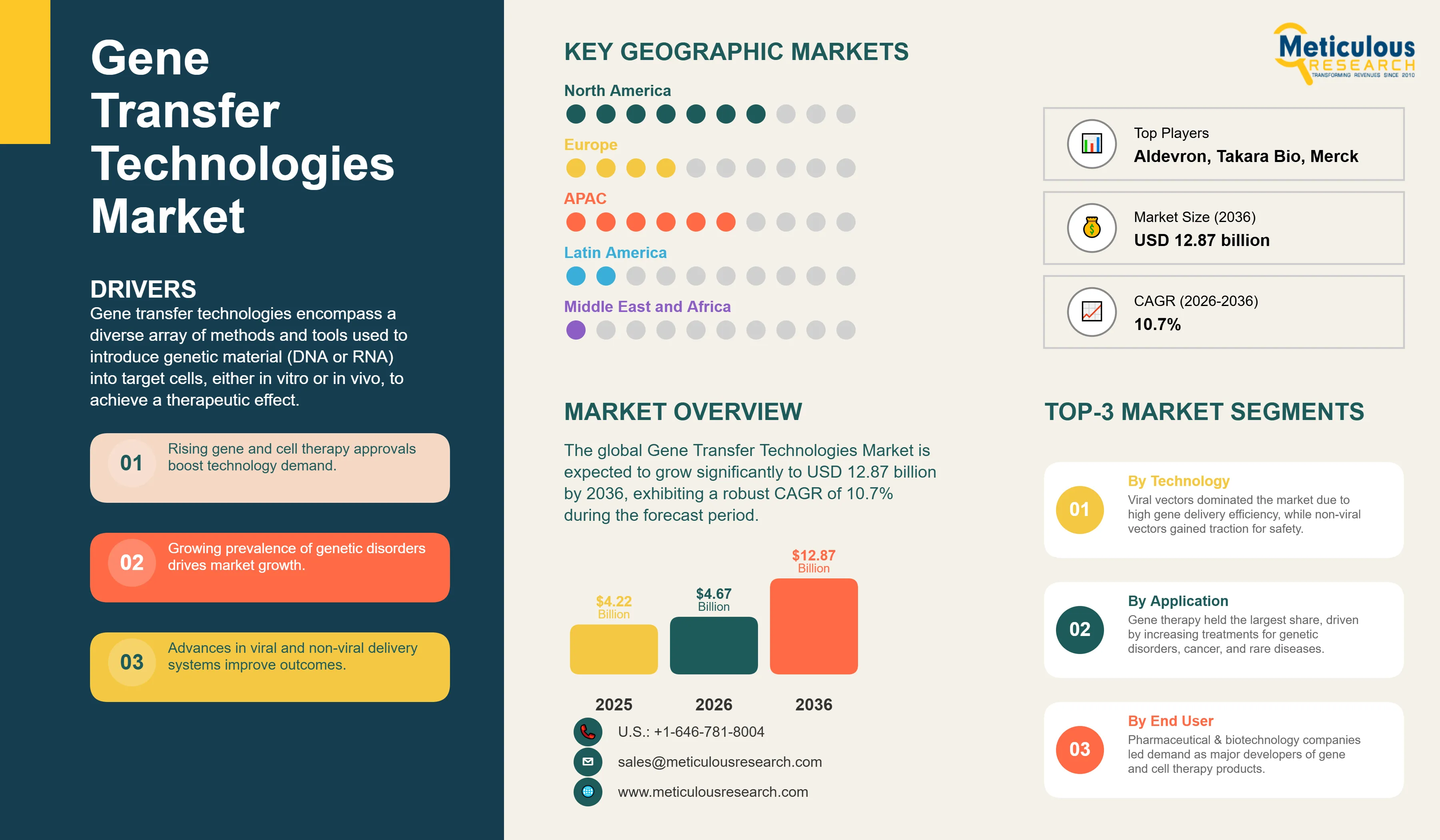
The global Gene Transfer Technologies Market is projected to reach an estimated USD 4.67 billion in 2026 and is expected to grow significantly to USD 12.87 billion by 2036, exhibiting a robust Compound Annual Growth Rate (CAGR) of 10.7% during the forecast period.
Click here to: Get Free Sample Pages of this Report
Gene transfer technologies encompass a diverse array of methods and tools used to introduce genetic material (DNA or RNA) into target cells, either in vitro or in vivo, to achieve a therapeutic effect. These technologies are fundamental to the rapidly evolving fields of gene therapy, cell therapy, and gene editing, offering the potential to treat a wide range of diseases by correcting genetic defects, introducing therapeutic genes, or modulating gene expression. The market includes both viral delivery systems, such as adeno-associated virus (AAV), lentivirus, and adenovirus vectors, and non-viral platforms including lipid nanoparticles (LNPs), electroporation, gene gun, and microinjection technologies.
The growing understanding of the genetic basis of disease, coupled with major advances in molecular biology and biotechnology, has accelerated the adoption of gene transfer technologies across research and clinical applications. According to the U.S. Food and Drug Administration (FDA), more than 40 gene therapies have been approved globally as of 2026, while the agency continues to support a rapidly expanding pipeline of cell and gene therapy products. In addition, data from the American Society of Gene & Cell Therapy (ASGCT) indicate that more than 4,000 gene, cell, and RNA therapy clinical trials are currently active worldwide, highlighting the increasing demand for efficient and scalable gene delivery platforms.
These technologies are indispensable for the development and manufacturing of advanced therapy medicinal products (ATMPs), including CAR-T cell therapies, gene-edited cells, and gene-modified stem cell therapies. The European Medicines Agency (EMA) continues to classify gene therapies, somatic cell therapies, and tissue-engineered products as key ATMP categories, reflecting growing regulatory and commercial momentum in the sector. Furthermore, the success of lipid nanoparticle-based mRNA vaccines has accelerated investment in next-generation non-viral delivery systems, while ongoing innovations in viral vector engineering are improving transduction efficiency, targeting precision, and safety profiles. As a result, gene transfer technologies are becoming a critical enabling infrastructure for the future of precision medicine and are expected to play an increasingly important role in treating previously untreatable genetic, oncological, and rare diseases.
Drivers: Catalysts for Gene Transfer Technologies Market Growth
Accelerating Research and Development in Gene and Cell Therapies: The rapid expansion of clinical trials and regulatory approvals for gene and cell therapies is a primary driver, creating immense demand for efficient and safe gene transfer technologies.
Increasing Prevalence of Genetic Disorders and Chronic Diseases: The rising global burden of genetic diseases, cancers, and other chronic conditions amenable to gene-based interventions fuels the need for advanced gene transfer solutions.
Technological Advancements in Gene Delivery Systems: Continuous innovations in both viral and non-viral vectors, including improved targeting, reduced immunogenicity, enhanced packaging capacity, and scalable manufacturing processes, are driving market growth.
Growing Investments and Funding for Gene Therapy Research: Significant public and private investments, venture capital funding, and government initiatives in gene therapy research and development are accelerating the adoption and commercialization of gene transfer technologies.
Restraints: Navigating the Hurdles to Gene Transfer Technologies Adoption
High Cost of Gene Therapy Development and Treatment: The substantial cost associated with the development, manufacturing, and administration of gene therapies, often linked to the complexity of gene transfer technologies, can limit market access and adoption.
Stringent Regulatory Requirements and Safety Concerns: The rigorous regulatory scrutiny and inherent safety concerns related to gene delivery (e.g., off-target effects, immunogenicity, insertional mutagenesis) pose significant challenges to market growth and product approval.
Complexity of Manufacturing and Scale-Up: The intricate and highly specialized manufacturing processes for gene transfer vectors, particularly viral vectors, present significant challenges in terms of scalability, consistency, and cost-effectiveness.
Ethical Considerations and Public Acceptance: Ethical debates surrounding genetic modification and potential long-term societal impacts, along with varying levels of public acceptance, can act as restraints on market expansion.
Opportunities: Unlocking New Avenues for Gene Transfer Technologies Growth
Expansion into New Therapeutic Areas: Opportunities exist for gene transfer technologies to expand their application beyond rare genetic disorders into more prevalent conditions such as cardiovascular diseases, neurodegenerative disorders, and infectious diseases.
Development of Next-Generation Gene Editing Tools: The integration of advanced gene editing technologies (e.g., CRISPR-Cas9) with efficient gene transfer methods offers opportunities for highly precise and targeted genetic modifications, opening new therapeutic avenues.
Emergence of Non-Viral Gene Delivery Platforms: Continued innovation in non-viral gene delivery systems, offering potentially safer and more scalable alternatives to viral vectors, presents significant growth opportunities.
Strategic Collaborations and Partnerships: Collaborations between academic institutions, biotechnology companies, and pharmaceutical giants are fostering innovation, accelerating product development, and expanding the reach of gene transfer technologies.
Challenges: Overcoming Obstacles in the Gene Transfer Technologies Market
Immunogenicity and Toxicity of Viral Vectors: The potential for immune responses and toxicity associated with viral vectors remains a significant challenge, necessitating ongoing research into safer and more tolerable delivery systems.
Off-Target Effects and Specificity of Gene Editing: Ensuring the precise delivery and specific action of gene editing tools without unintended off-target modifications is a critical challenge that requires continuous technological refinement.
Standardization and Harmonization of Regulatory Guidelines: The lack of globally harmonized regulatory guidelines for gene therapies and gene transfer technologies can create complexities for developers seeking international market access.
Intellectual Property (IP) Landscape and Licensing: The complex and often contentious intellectual property landscape surrounding gene transfer technologies and gene editing tools can pose barriers to innovation and commercialization.
The global Gene Transfer Technologies market is characterized by several transformative trends. A prominent trend is the continued dominance of viral vectors, particularly adeno-associated virus (AAV) and lentiviral vectors, which remain the preferred delivery platforms for many approved gene therapies and advanced clinical programs due to their high transduction efficiency and durable gene expression. According to the American Society of Gene & Cell Therapy (ASGCT), more than 4,000 active gene, cell, and RNA therapy clinical trials are underway globally, with viral vector-based approaches accounting for a substantial share of gene therapy development activities.
Another key trend is the rapid advancement of non-viral gene delivery technologies, including lipid nanoparticles (LNPs) and electroporation systems. The commercial success of mRNA vaccines demonstrated the scalability and clinical viability of LNP-based delivery, accelerating investments in next-generation non-viral platforms that offer reduced immunogenicity and simplified manufacturing compared with viral vectors. In parallel, growing adoption of targeted gene delivery systems is improving tissue specificity and therapeutic precision, helping address safety concerns related to off-target effects.
The market is also witnessing increased investment in large-scale vector manufacturing capacity as demand for gene and cell therapies expands. Industry organizations such as ASGCT report a steadily growing pipeline of late-stage gene therapy candidates, placing significant pressure on viral vector production infrastructure and driving innovation in cost-effective manufacturing technologies. Additionally, the integration of gene-editing technologies such as CRISPR-Cas9 with advanced gene transfer platforms is emerging as a major trend. According to the U.S. National Institutes of Health (NIH), the number of clinical studies evaluating gene-editing approaches has increased substantially over recent years, reinforcing the need for highly efficient and precise delivery systems capable of enabling next-generation genetic medicines.
Analysis by Technology: Viral Vectors Leading the Way
Based on technology, the viral vectors segment is expected to hold the largest share of the global Gene Transfer Technologies market. This growth of this segment is attributed to the high efficiency and robust gene expression capabilities of viral vectors, particularly AAV and lentivirus, which have been extensively utilized in successful gene therapy clinical trials and approved products. The non-viral vectors segment is anticipated to witness the fastest CAGR, driven by ongoing research to develop safer, more scalable, and less immunogenic alternatives to viral delivery, such as lipid nanoparticles and physical methods.
Analysis by Application: Gene Therapy Dominating the Market
Based on application, the gene therapy segment is projected to account for the largest share of the Gene Transfer Technologies market. This is due to the fundamental role of gene transfer technologies in delivering therapeutic genes for the treatment of various genetic disorders, cancers, and infectious diseases. The cell therapy segment is expected to grow at a significant CAGR, fueled by the increasing use of gene transfer for engineering immune cells (e.g., CAR-T cells) and stem cells for therapeutic purposes.
Analysis by End User: Pharmaceutical & Biotechnology Companies as Key Adopters
Based on end user, pharmaceutical & biotechnology companies are expected to command the largest share of the global Gene Transfer Technologies market. These companies are at the forefront of developing and commercializing gene and cell therapies, driving the demand for advanced gene transfer solutions for research, development, and manufacturing. The academic & research institutes segment is anticipated to exhibit a strong CAGR, driven by continuous basic and translational research in gene therapy and the need for various gene transfer tools for experimental studies.
North America: A Global Hub for Gene Therapy Innovation
North America is expected to hold the largest share of the global Gene Transfer Technologies market. This growth of this region is attributed to a highly developed biopharmaceutical industry, significant investments in gene therapy research and development, the presence of numerous key market players and specialized contract research organizations (CROs)/CDMOs, and a robust regulatory framework that supports advanced therapeutic development. The United States, in particular, is a major contributor due to its leading position in gene therapy approvals and a strong funding landscape for biotechnology.
Europe: Advancing Gene Therapy Research with Strong Academic and Industry Collaboration
Europe is expected to hold a significant share of the global Gene Transfer Technologies market, driven by strong academic research ecosystems, increasing government funding for gene therapy initiatives, and a growing number of clinical trials for gene-based treatments. Countries like Germany, the U.K., and France are key contributors due to their advanced research capabilities and the presence of leading biotechnology companies. The key companies operating in the European market are Lonza Group AG, Oxford Biomedica plc, and uniQure N.V.
Asia-Pacific: Rapid Growth Fueled by Expanding Biopharmaceutical Capabilities and Patient Pool
Asia-Pacific is projected to witness the fastest CAGR during the forecast period. This rapid growth is driven by increasing investments in biopharmaceutical manufacturing capabilities, a large patient pool with unmet medical needs, growing government support for biotechnology research, and the expanding presence of international gene therapy companies in countries like China, Japan, and South Korea. The key companies operating in the Asia-Pacific market are WuXi AppTec, GenScript Biotech Corporation, and Fujifilm Diosynth Biotechnologies (with regional presence).
Latin America: Emerging Opportunities in Gene Therapy Development
Latin America is anticipated to witness steady growth in the Gene Transfer Technologies market, primarily due to increasing investments in healthcare infrastructure, a rising focus on developing local biopharmaceutical industries, and growing awareness about advanced therapeutic modalities in countries like Brazil and Mexico. The modernization of medical facilities and the adoption of international guidelines for gene therapy research also contribute to the demand for gene transfer technologies. The key companies operating in the Latin American market are Thermo Fisher Scientific Inc. (with regional presence) and Merck KGaA (with regional presence).
Middle East & Africa: Gradual Expansion with Developing Biopharma Sector
The Middle East & Africa region is expected to experience gradual growth in the Gene Transfer Technologies market, driven by increasing healthcare investments, government initiatives to develop local biopharmaceutical industries, and a growing focus on adopting advanced medical technologies. Countries like UAE and Saudi Arabia are investing in biotechnology research and treatment, leading to a gradual increase in demand for gene transfer technologies. The key companies operating in the Middle East & Africa market are Thermo Fisher Scientific Inc. (with regional presence) and Merck KGaA (with regional presence).
The global Gene Transfer Technologies market is characterized by a dynamic and highly competitive landscape. It features a mix of large, diversified biotechnology and pharmaceutical companies, specialized gene therapy developers, and contract development and manufacturing organizations (CDMOs) offering gene transfer vector production services. Key players are focusing on expanding their product portfolios, investing in R&D for next-generation gene delivery systems with improved safety and efficacy, offering comprehensive manufacturing solutions, and forming strategic collaborations or acquisitions to strengthen their market positions. The competitive strategy often revolves around demonstrating technical superiority, ensuring regulatory compliance, providing robust manufacturing capabilities, and offering flexible and cost-effective solutions to clients. Companies are also investing heavily in expanding their geographic reach and increasing partnerships with academic institutions and research organizations.
The global Gene Transfer Technologies market is estimated at USD 4.67 billion in 2026 and is projected to reach USD 12.87 billion by 2036, growing at a CAGR of 10.7%.
The market is driven by accelerating R&D in gene and cell therapies, increasing prevalence of genetic disorders, technological advancements in gene delivery systems, and growing investments in gene therapy research.
Key restraints include the high cost of gene therapy development, stringent regulatory requirements and safety concerns, complexity of manufacturing and scale-up, and ethical considerations.
Opportunities include expansion into new therapeutic areas, development of next-generation gene editing tools, emergence of non-viral gene delivery platforms, and strategic collaborations.
Challenges include immunogenicity and toxicity of viral vectors, off-target effects of gene editing, standardization of regulatory guidelines, and complex intellectual property landscape.
Viral vectors hold the largest share, while non-viral vectors are anticipated to witness the fastest CAGR.
Gene therapy accounts for the largest share, and cell therapy is expected to grow at a significant CAGR.
Which end-user segment accounts for the largest share, and which is anticipated to grow the fastest?
Pharmaceutical & biotechnology companies hold the largest share, and academic & research institutes are anticipated to exhibit a strong CAGR.
North America leads the market, and Asia-Pacific is projected to witness the fastest CAGR.
Key players include Thermo Fisher Scientific Inc., Lonza Group AG, Merck KGaA, Danaher Corporation (Cytiva & Precision NanoSystems), Oxford Biomedica plc, FUJIFILM Diosynth Biotechnologies, GenScript Biotech Corporation, Takara Bio Inc., Charles River Laboratories International, Inc., and Aldevron LLC.
























Published Date: May-2026
Published Date: Oct-2013
Published Date: May-2026
Published Date: May-2023
Please enter your corporate email id here to view sample report.
Subscribe to get the latest industry updates


