
Electric Ship Market (2026-2036)
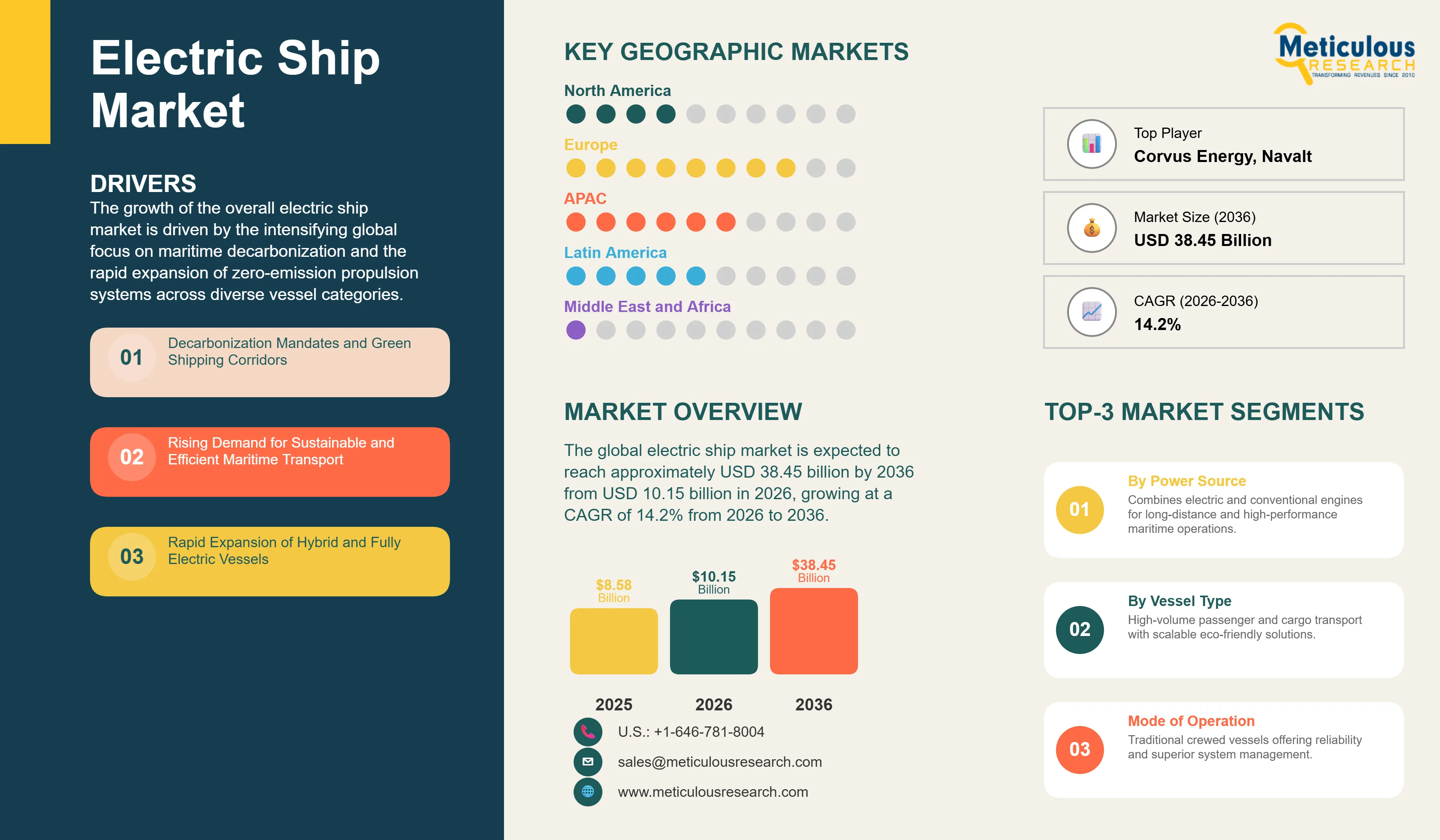
The global electric ship market was valued at USD 8.58 billion in 2025. The market is expected to reach approximately USD 38.45 billion by 2036 from USD 10.15 billion in 2026, growing at a CAGR of 14.2% from 2026 to 2036.
- Published
- Feb 2026
- Pages
- 271
- Format
- PDF + Excel
- Report ID
- MR-1759
- Base year
- 2025
- 2025 · BASELINE
- $8.58B
- 2036
- $38.45B
- CAGR 2026–2036
- 14.2%
2025 baseline · 2026–2036 forecast at 14.2% CAGR · hover a bar for the value
Key highlights
In terms of revenue, the global electric ship market is projected to reach USD 38.45 billion by 2036.
The market is expected to grow at a CAGR of 14.2% from 2026 to 2036.
Europe dominates the global electric ship market with the largest market share in 2026, driven by massive investments in green shipping corridors and the presence of leading technology innovators in Norway, Germany, and the Netherlands.
Asia-Pacific is expected to witness the fastest growth during the forecast period, supported by aggressive government initiatives for inland waterway electrification and the rapid adoption of electric ferries in China, Japan, and South Korea.
By power source, the hybrid segment holds the largest market share in 2026, particularly in supporting long-distance commercial shipping and defense operations in diverse maritime environments.
By vessel type, the commercial segment holds the largest market share in 2026, due to its proven efficacy in handling high-volume passenger and cargo movement and providing scalable, eco-friendly transport solutions.
By mode of operation, the manned segment holds the largest share of the overall market in 2026.
Report summary
| Particulars | Details |
|---|---|
| Market Size by 2036 | USD 38.45 Billion |
| Market Size in 2026 | USD 10.15 Billion |
| Market Size in 2025 | USD 8.58 Billion |
| Market Growth Rate (2026-2036) | CAGR of 14.2% |
| Format | PDF, Excel & Cloud Portal · 271 pages |
| Dominating Region | Europe |
| Fastest Growing Region | Asia-Pacific |
| Base Year | 2025 |
| Forecast Period | 2026 to 2036 |
| Segments Covered | Power Source, Vessel Type, Range, Mode of Operation, and Region |
| Regions Covered | North America, Europe, Asia-Pacific, Latin America, and Middle East & Africa |
Report overview
Segments covered: power source, vessel type, range, mode of operation.
The growth of the overall electric ship market is driven by the intensifying global focus on maritime decarbonization and the rapid expansion of zero-emission propulsion systems across diverse vessel categories. As shipping enterprises seek to integrate more intelligence into their fleet architectures and address the increasing demand for sustainable transport and operational efficiency, advanced electric propulsion platforms have become essential for maintaining structural integrity and instructional performance. The rapid expansion of battery-electric ferries and the increasing need for high-performance hybrid cargo vessels and defense ships continue to fuel significant growth of this market across all major geographic regions.
Electric ship systems represent critical maritime frameworks used to provide clean propulsion while allowing for real-time energy management and emission monitoring throughout the voyage lifecycle. These systems include specialized hardware such as high-density battery packs, electric motors, and power conversion modules, which are designed to withstand high-frequency usage and fit into diverse aquatic ecosystems. The market is defined by high-efficiency modules such as AI-driven energy optimization and smart grid integration protocols, which significantly enhance propulsion precision and system durability in complex maritime applications. These systems are indispensable for ship owners seeking to optimize their internal fleet architecture and meet aggressive decarbonization targets.
The market includes a diverse range of solutions, ranging from simple electric outboards for basic recreational craft to complex multilayer management systems for high-performance global cargo fleets and professional defense services. These systems are increasingly integrated with advanced components such as hydrogen fuel cell range extenders and AI-powered autonomous navigation to provide services such as global zero-emission connectivity and improved operational stability. The ability to provide stable, high-precision results while minimizing fuel waste has made advanced electric propulsion technology the choice for industries where environmental compliance and scalability are paramount.
The global maritime sector is pushing hard to modernize propulsion capabilities, aiming to meet zero-emission and hyper-connected intelligence targets. This drive has increased the adoption of high-density hardware platforms, with advanced data analytics techniques helping to stabilize energy yields for ultra-fine organizational architectures. At the same time, the rapid growth in the luxury yacht and professional utility markets is increasing the need for high-reliability, clinically-proven propulsion solutions.
Report infographic
Market dynamics
4 factors across 3 forcesDecarbonization Mandates and Rise of Green Shipping Corridors
A key driver of the electric ship market is the rapid movement of the global maritime industry toward data-backed, highly functional green infrastructure. Global demand for seamless zero-emission access, effective fleet support, and emission-monitoring software systems has created significant incentives for the adoption of electric ship products. The trend toward “green” shipping and the integration of sustainability into daily digital patches drive organizations toward scalable solutions that electric propulsion technology can uniquely provide. It is estimated that as ship adoption of automated routines rises and diagnostic tools become more decentralized through 2036, the need for robust, effective management platforms increases significantly; therefore, hardware modules and cloud-based delivery, with their ability to ensure high-density data delivery, are considered a crucial enabler of modern maritime design strategies.
Table of contents
11 chapters · 95 sections · 271 pages · click to expandSegmental analysis
| Segment | Largest share (2026) | Fastest growth (2026–2036) |
|---|---|---|
| By Power Source | Hybrid | — |
| By Vessel Type | Commercial | — |
| By Mode of Operation | Manned | — |
By Power Source
- The hybrid segment accounts for a significant portion of the overall electric ship market in 2026.
- This is mainly attributed to the versatile use of this technology in supporting long-distance voyages and complex remote diagnostics within extremely diverse environments, such as in open oceans and coastal waters.
- These systems offer the most comprehensive way to ensure propulsion integrity across diverse high-frequency applications.
- The commercial and defense sectors alone consume a large share of hybrid production, with major projects in Europe and Asia Pacific demonstrating the technology’s capability to handle high-density data requirements.
- However, the fully electric segment is expected to grow at a rapid CAGR during the forecast period, driven by the growing need for robust zero-emission solutions in smart cities, clinical procedures, and luxury maritime systems.
By Vessel Type
- The commercial segment holds the largest share of the overall market in 2026.
- This is primarily due to the massive volume of electric ferry projects and the rigorous performance standards required for modern transport networks.
- Current large-scale maritime hubs are increasingly specifying high-density management platforms to ensure compliance with global performance standards and passenger expectations for faster, visible results.
- The defense segment is expected to witness steady growth during the forecast period.
- The shift toward secure naval data management and the complexity of specialized research suites are pushing the requirement for advanced active systems that can handle varied data types and mechanical stresses while ensuring absolute reliability for safety-critical maritime systems.
By Mode of Operation
- The manned segment commands the largest share of the global electric ship market in 2026.
- This dominance stems from its superior vessel management capacity, data consistency, and excellent mechanical properties, making it the technology of choice for high-performance maritime systems.
- Large-scale operations in passenger transport, cargo logistics, and high-end beauty drive demand, with advanced platforms from suppliers like ABB and Wärtsilä enabling reliable performance in extreme environments.
- However, the autonomous segment is poised for steady growth through 2036, fueled by expanding applications in commercial logistics and simple delivery formulations.
- Manufacturers face mounting pressure to optimize costs for high-volume, less demanding applications, where standardized software modules provide a cost-effective alternative for basic maritime connectivity.
Geographic analysis
Europe
Largest shareEurope holds the largest share of the global electric ship market in 2026. The largest share of this region is primarily attributed to the massive investments in green shipping corridors and the presence of the world’s largest technology hubs, particularly in Norway, Germany, and the Netherlands. Norway alone accounts for a significant portion of global hardware production, with its position as a leading exporter of high-end maritime technology driving sustained growth. The presence of leading manufacturers like Kongsberg and Corvus Energy and a well-developed maritime supply chain provides a robust market for both standard and high-density software solutions.
Asia-Pacific
Asia-Pacific and Latin America together account for a substantial share of the global electric ship market. The growth of these markets is mainly driven by the need for technological modernization in the professional, luxury, and commercial maritime sectors. The demand for advanced hardware systems in Asia-Pacific is mainly due to its large-scale inland waterway projects and the presence of innovators like China State Shipbuilding Corporation and Mitsubishi Heavy Industries.
Latin America
In Latin America, the leadership in maritime engineering and the push for sustainability innovation are driving the adoption of high-reliability maritime products. Countries like Brazil, Mexico, and Chile are at the forefront, with significant focus on integrating smart software solutions into daily routines and advanced maritime treatments to ensure the highest levels of performance and reliability.
Competitive landscape
- ABB Ltd.
- Wärtsilä Corporation
- Kongsberg Gruppen
- GE Vernova
Frequently asked questions
The global electric ship market is expected to grow from USD 10.15 billion in 2026 to USD 38.45 billion by 2036.
Cite this report
Meticulous Research. (2026). Electric Ship Market - Global Opportunity Analysis and Industry Forecast (2026-2036) (Report No. MR-1759). Meticulous Market Research Pvt. Ltd. https://www.meticulousresearch.com/product/electric-ship-market-6442