Resources
About Us
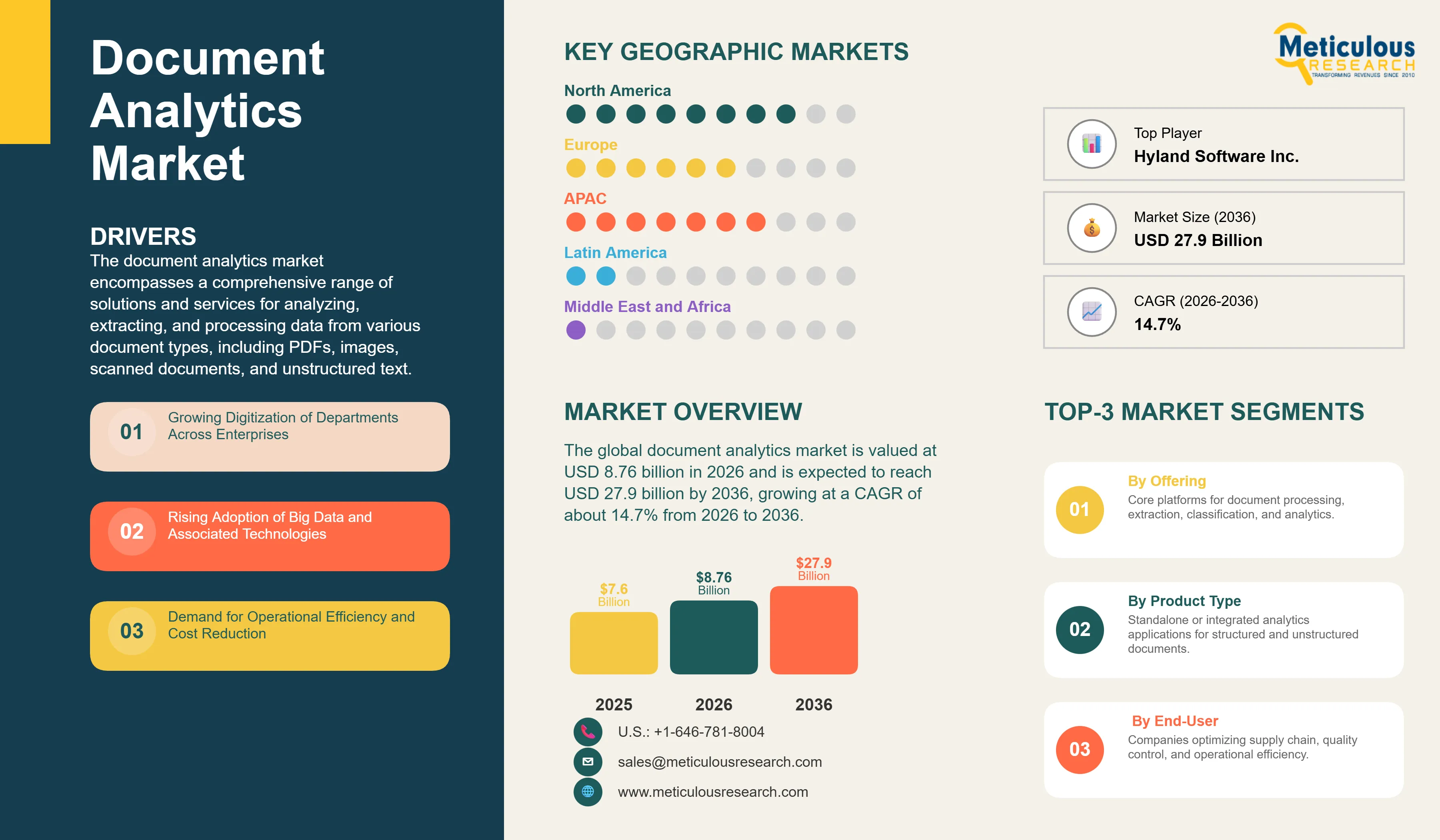
The global document analytics market is valued at USD 8.76 billion in 2026 and is expected to reach USD 27.9 billion by 2036, growing at a CAGR of about 14.7% from 2026 to 2036. The market encompasses a comprehensive range of solutions and services for analyzing, extracting, and processing data from various document types, including PDFs, images, scanned documents, and unstructured text. The growth of the document analytics market is driven by the increasing digitization of business processes, the rising adoption of cloud-based analytics solutions, and the integration of artificial intelligence and machine learning technologies. Additionally, the growing need for organizations to extract actionable insights from large volumes of unstructured data and the increasing emphasis on compliance and governance are expected to support market expansion throughout the forecast period.
 Click here to: Get Free Sample Pages of this Report
The global document analytics market includes a comprehensive suite of technologies and services designed to extract, analyze, and derive actionable insights from diverse document types, including structured forms, semi-structured data, and unstructured text. The market has experienced substantial growth in recent years, driven by the exponential increase in the volume of documents generated across organizations and the critical need to leverage this data for informed decision-making.
Document analytics solutions leverage advanced technologies such as optical character recognition (OCR), natural language processing (NLP), machine learning (ML), and artificial intelligence (AI) to automatically extract, classify, and analyze data from documents. These solutions enable organizations to streamline business processes, reduce manual data entry errors, improve operational efficiency, and enhance customer experience. The market includes a diverse range of offerings, from standalone document analytics solutions to integrated platforms that combine document processing with broader analytics and business intelligence capabilities.
The market is characterized by continuous innovation, with vendors developing increasingly sophisticated solutions that incorporate advanced AI and ML capabilities. The integration of robotic process automation (RPA) with document analytics is enabling organizations to automate end-to-end business processes, from document receipt to data extraction and downstream system integration. The growing emphasis on cloud-based solutions is also driving market growth, as organizations seek scalable, flexible, and cost-effective alternatives to on-premise deployments. The market includes established technology vendors, specialized document analytics providers, and emerging startups offering innovative solutions.
What are the Key Trends in the Document Analytics Market?
Integration of Advanced AI and Machine Learning Capabilities
A significant trend in the document analytics market is the increasing integration of advanced artificial intelligence and machine learning capabilities into document analytics solutions. Traditional document analytics solutions relied primarily on rule-based approaches and pattern matching, which had limitations in handling complex and varied document types. Modern document analytics solutions leverage deep learning models, neural networks, and advanced ML algorithms to automatically learn patterns from training data and improve accuracy over time. These AI-powered solutions can handle a wider range of document types, adapt to variations in document format and content, and continuously improve their performance through machine learning. For example, vendors such as ABBYY, Kofax, and Automation Anywhere have integrated advanced AI capabilities into their platforms to enable more sophisticated document understanding and data extraction. The development of transformer-based models and large language models (LLMs) is further advancing the capabilities of document analytics solutions, enabling them to perform more nuanced analysis and extraction tasks. This trend is driving the adoption of document analytics solutions in more complex use cases and expanding the market beyond traditional data extraction applications.
Shift Towards Cloud-Based and SaaS Document Analytics Solutions
The document analytics market is experiencing a significant shift towards cloud-based and Software-as-a-Service (SaaS) delivery models. Cloud-based solutions offer organizations greater flexibility, scalability, and cost-effectiveness compared to traditional on-premise deployments. Organizations can scale their document analytics capabilities up or down based on their needs, pay only for the resources they consume, and avoid the capital expenditure associated with on-premise infrastructure. Cloud-based solutions also enable organizations to access the latest features and updates without the need for manual upgrades and maintenance. The COVID-19 pandemic accelerated the adoption of cloud-based solutions, as organizations sought to enable remote work and reduce dependence on on-premise infrastructure. Major vendors such as Microsoft, Amazon Web Services (AWS), and Google Cloud are offering cloud-based document analytics solutions as part of their broader cloud platforms. The integration of document analytics with other cloud-based services such as data warehousing, business intelligence, and workflow automation is creating comprehensive cloud-native solutions that address the end-to-end needs of organizations. This trend is expected to continue driving the growth of the cloud-based document analytics market segment.
|
Parameters |
Details |
|
Market Size by 2036 |
USD 27.9 Billion |
|
Market Size in 2026 |
USD 8.76 Billion |
|
Revenue Growth Rate (2026-2036) |
CAGR of 14.7% |
|
Dominating Product Type |
Solutions |
|
Fastest Growing Product Type |
Services |
|
Leading Industry Vertical |
BFSI |
|
Fastest Growing Vertical |
Manufacturing |
|
Leading Geographic Region |
North America |
|
Fastest Growing Region |
Asia-Pacific |
|
Base Year |
2025 |
|
Forecast Period |
2026 to 2036 |
Drivers: Growing Digitization and Rising Adoption of Big Data Technologies
The primary drivers of the document analytics market include the growing digitization of business processes across enterprises and the rising adoption of big data and associated technologies. Organizations across all industries are undergoing digital transformation initiatives to modernize their operations, improve efficiency, and enhance customer experience. These initiatives involve the digitization of paper-based processes, the migration of data to digital systems, and the implementation of advanced analytics capabilities. As organizations accumulate vast volumes of digital documents and data, the need for sophisticated analytics solutions to extract insights from this data becomes increasingly critical. The BFSI sector, in particular, deals with enormous volumes of documents such as loan applications, invoices, contracts, and regulatory filings, making document analytics essential for operational efficiency and compliance. Additionally, the integration of big data technologies such as Hadoop and Spark with document analytics is enabling organizations to process and analyze large-scale document repositories in real-time, further driving market growth.
Opportunity: Integration of AI/ML and Improving Customer Experience
The document analytics market presents significant opportunities through the integration of advanced AI and ML capabilities and the increasing focus on improving customer experience. Organizations are recognizing that document analytics can be leveraged not only for operational efficiency but also for enhancing customer experience. For example, financial institutions can use document analytics to accelerate loan processing, reducing the time customers wait for approval. Healthcare organizations can use document analytics to improve patient experience by automating administrative processes and reducing paperwork. The development of more sophisticated AI and ML models is enabling document analytics solutions to perform increasingly complex tasks such as sentiment analysis, entity recognition, and relationship extraction. These advanced capabilities are opening new use cases and applications for document analytics across various industries. Additionally, the increasing availability of pre-trained models and transfer learning techniques is reducing the time and effort required to develop and deploy document analytics solutions, making them more accessible to organizations of all sizes.
Why Do Solutions Dominate the Market?
Solutions represent the largest product type segment for the document analytics market, driven by the critical need for organizations to extract and analyze data from documents. Document analytics solutions provide the core functionality for document processing, data extraction, classification, and analysis. These solutions are essential for organizations seeking to automate document-centric business processes and derive insights from unstructured data. The dominance of the solutions segment is driven by the fact that solutions represent the primary value proposition of document analytics vendors, and organizations are willing to invest in these solutions to achieve operational efficiency gains and cost savings. The solutions segment includes both standalone document analytics solutions and integrated platforms that combine document processing with broader analytics and business intelligence capabilities. The increasing sophistication of these solutions, driven by advances in AI and ML, is further strengthening their market position.
How Are Services Experiencing Rapid Growth?
The services segment is experiencing rapid growth in the document analytics market, driven by the increasing complexity of document analytics implementations and the growing need for specialized expertise. Document analytics services include professional services such as consulting, implementation, customization, and training, as well as managed services such as ongoing support, maintenance, and optimization. As organizations implement document analytics solutions, they require specialized expertise to design and configure solutions that meet their specific business requirements, integrate solutions with existing systems, and train employees on how to use the solutions effectively. The complexity of document analytics implementations, particularly for large enterprises with complex document processing requirements, is driving the demand for professional services. Additionally, as organizations seek to maximize the value of their document analytics investments, the demand for managed services such as ongoing optimization and support is increasing. The growing adoption of cloud-based document analytics solutions is also driving the growth of managed services, as vendors provide ongoing support and optimization services as part of their SaaS offerings.
Why Does BFSI Lead the Market?
The BFSI (Banking, Financial Services, and Insurance) vertical is expected to hold the largest market share for document analytics, driven by the sector's heavy reliance on document processing and the critical importance of accuracy and compliance. Financial institutions deal with enormous volumes of documents such as loan applications, invoices, contracts, regulatory filings, and customer correspondence. Manual processing of these documents is time-consuming, error-prone, and costly. Document analytics solutions enable BFSI organizations to automate document processing, reduce manual errors, accelerate business processes such as loan approval, and improve compliance with regulatory requirements. The sector has been early in adopting document analytics solutions, and the market penetration of these solutions in the BFSI sector is relatively high compared to other verticals. The ongoing digital transformation initiatives in the BFSI sector, coupled with the increasing regulatory requirements, are expected to continue driving the growth of document analytics in this vertical.
Which Vertical Is Experiencing Fastest Growth?
The manufacturing vertical is projected to experience the fastest growth in the document analytics market, driven by the sector's increasing focus on digitalization and the need to optimize supply chain and operational processes. Manufacturing organizations generate large volumes of documents related to production, supply chain, quality control, and regulatory compliance. Document analytics solutions enable manufacturers to automate document processing, improve supply chain visibility, optimize inventory management, and ensure compliance with quality and regulatory standards. The sector has historically been slower in adopting advanced analytics solutions compared to BFSI and healthcare, but this is changing rapidly as manufacturers recognize the potential of document analytics to drive operational efficiency and cost savings. The increasing adoption of Industry 4.0 and the Internet of Things (IoT) in manufacturing is creating new opportunities for document analytics solutions to integrate with other digital systems and provide comprehensive insights into manufacturing operations.
How Does North America Maintain Its Leadership?
North America is expected to hold the largest share of the global document analytics market, driven by the region's advanced technology infrastructure, high adoption of enterprise software solutions, and the presence of major document analytics vendors. The U.S. is the largest market in North America, with a well-established ecosystem of technology vendors, system integrators, and consulting firms specializing in document analytics. The region has a strong focus on innovation and research and development, with many document analytics vendors headquartered in North America. The early adoption of document analytics solutions by BFSI and healthcare organizations in North America has created a mature market with significant installed base. The region's regulatory environment, particularly in the financial services and healthcare sectors, has driven the adoption of document analytics solutions for compliance and risk management purposes. The key companies operating in the North American document analytics market include ABBYY, Kofax, Automation Anywhere, WorkFusion, and various other vendors and system integrators.
Which Regions Are Experiencing Rapid Growth?
Asia-Pacific is projected to experience the fastest growth in the document analytics market, driven by the region's rapid digital transformation, the increasing adoption of cloud technologies, and the growing investments in enterprise software solutions. China and India are the largest markets in Asia-Pacific, with large and growing populations of enterprises undergoing digital transformation. The region is experiencing rapid growth in the BFSI sector, with increasing numbers of digital banks and fintech companies adopting document analytics solutions. The manufacturing sector in Asia-Pacific is also increasingly adopting document analytics solutions as part of Industry 4.0 initiatives. The region's lower labor costs have historically made manual document processing economically viable, but the increasing availability of skilled workers and the rising labor costs are making automation through document analytics more attractive. The growing adoption of cloud-based document analytics solutions is also contributing to the growth of the market in Asia-Pacific, as organizations can access advanced analytics capabilities without the need for significant capital investment in on-premise infrastructure.
The key players profiled in the global document analytics market report include ABBYY, Kofax Inc., WorkFusion, Inc., Automation Anywhere, AntWorks Pte. Ltd., Hyperscience, Celaton, Extract Systems, Parascript LLC, Infrrd Inc., Hyland Software Inc., OpenText Corporation, Datamatics Global Services Ltd., HCL Technologies, and IBM Corporation.
The global document analytics market is valued at USD 8.76 billion in 2026 and is expected to reach approximately USD 27.9 billion by 2036.
The market is expected to grow at a CAGR of 14.7% from 2026 to 2036.
The key players include ABBYY, Kofax Inc., WorkFusion, Automation Anywhere, and OpenText Corporation.
The main factors include growing digitization of business processes, rising adoption of big data technologies, and integration of AI and ML capabilities.
North America is expected to maintain leadership, while Asia-Pacific is projected to experience the fastest growth during the forecast period.
1. Introduction
1.1. Market Definition
1.2. Market Ecosystem
1.3. Currency and Limitations
1.3.1. Currency
1.3.2. Limitations
1.4. Key Stakeholders
2. Research Methodology
2.1. Research Approach
2.2. Data Collection & Validation
2.2.1. Secondary Research
2.2.2. Primary Research
2.3. Market Assessment
2.3.1. Market Size Estimation
2.3.2. Bottom-Up Approach
2.3.3. Top-Down Approach
2.3.4. Growth Forecast
2.4. Assumptions for The Study
3. Executive Summary
3.1. Overview
3.2. Market Analysis, by Offering
3.3. Market Analysis, by Deployment Mode
3.4. Market Analysis, by Organization Size
3.5. Market Analysis, by Vertical
3.6. Market Analysis, by Geography
3.7. Competitive Analysis
4. Market Insights
4.1. Introduction
4.2. Drivers
4.2.1. Growing Digitization of Departments Across Enterprises
4.2.2. Rising Adoption of Big Data and Associated Technologies
4.3. Restraints
4.3.1. Legal and Data Privacy Issues
4.4. Opportunities
4.4.1. Integration of AI & ML with Document Analytics
4.4.2. Increasing Need to Improve Customer Experience
4.5. Challenges
4.5.1. High Cost of Implementation
4.6. Trends
4.6.1. Increasing Adoption of Cloud-Based Document Analytics Solutions
4.7. Impact of COVID-19 on the Document Analytics Market
5. Document Analytics Market, by Offering
5.1. Introduction
5.2. Solutions
5.3. Services
5.3.1. Professional Services
5.3.2. Managed Services
6. Document Analytics Market, by Deployment Mode
6.1. Introduction
6.2. On-Premise
6.3. Cloud-Based
7. Document Analytics Market, by Vertical
7.1. Introduction
7.2. BFSI
7.3. Healthcare and Life Sciences
7.4. Government
7.5. Retail and E-Commerce
7.6. Manufacturing
7.7. Transportation & Logistics
7.8. Other Verticals
8. Document Analytics Market, by Organization Size
8.1. Introduction
8.2. Large Enterprises
8.3. Small & Medium-Sized Enterprises
9. Document Analytics Market, by Geography
9.1. Introduction
9.2. North America
9.2.1. U.S.
9.2.2. Canada
9.3. Europe
9.3.1. Germany
9.3.2. U.K.
9.3.3. France
9.3.4. Italy
9.3.5. Spain
9.3.6. Rest of Europe
9.4. Asia-Pacific
9.4.1. Japan
9.4.2. China
9.4.3. India
9.4.4. Rest of Asia-Pacific
9.5. Latin America
9.6. Middle East & Africa
10. Competitive Landscape
10.1. Introduction
10.2. Key Growth Strategies
10.3. Competitive Benchmarking
10.4. Market Ranking by Key Players
11. Company Profiles
11.1. ABBYY
11.2. Kofax Inc.
11.3. WorkFusion, Inc.
11.4. Automation Anywhere
11.5. AntWorks Pte. Ltd.
11.6. Hyperscience
11.7. Celaton
11.8. Extract Systems
11.9. Parascript LLC
11.10. Infrrd Inc.
11.11. Hyland Software Inc.
11.12. OpenText Corporation
11.13. Datamatics Global Services Ltd.
11.14. HCL Technologies
11.15. IBM Corporation
11.16. Others
12. Appendix
12.1. Questionnaire
12.1.1. Available Customization
























Published Date: Jan-2025
Published Date: Aug-2024
Published Date: Aug-2024
Published Date: May-2024
Subscribe to get the latest industry updates