Resources
About Us
Autonomous Public Transportation Market by Vehicle Type (Buses, Rail & Metro, Shuttles & Pods), Autonomy Level, Technology, Application (Urban Mass Transit, Airport & Campus Mobility), End-User (Municipal Authorities, Public Transit Operators) - Global Forecast to 2036
Report ID: MRSE - 1041827 Pages: 310 Mar-2026 Formats*: PDF Category: Semiconductor and Electronics Delivery: 24 to 72 Hours Download Free Sample Report
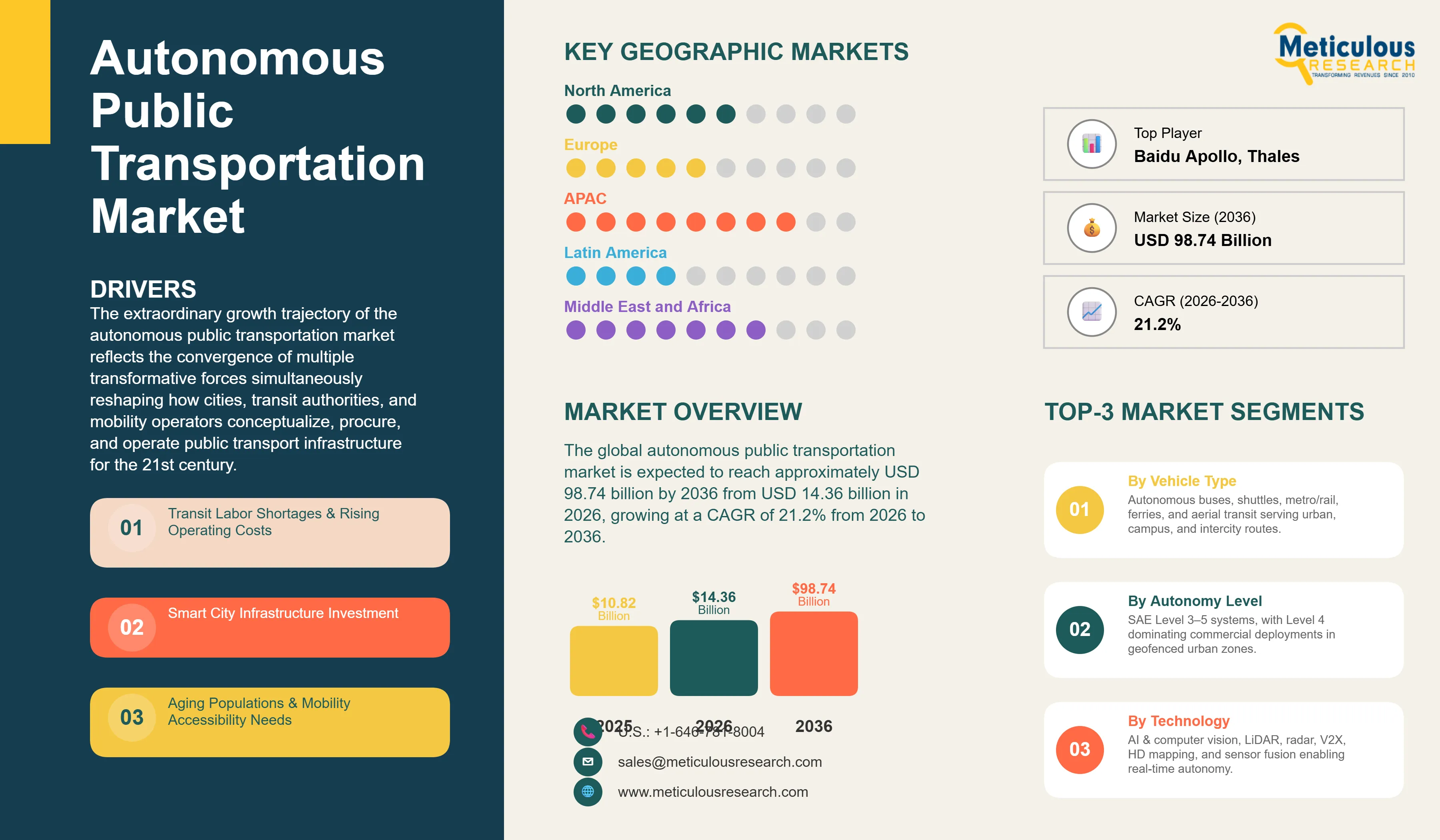
The global autonomous public transportation market was valued at USD 10.82 billion in 2025. The market is expected to reach approximately USD 98.74 billion by 2036 from USD 14.36 billion in 2026, growing at a CAGR of 21.2% from 2026 to 2036. The extraordinary growth trajectory of the autonomous public transportation market reflects the convergence of multiple transformative forces simultaneously reshaping how cities, transit authorities, and mobility operators conceptualize, procure, and operate public transport infrastructure for the 21st century. Advances in artificial intelligence, computer vision, LiDAR sensor technology, and vehicle-to-everything communication systems have reached commercial maturity thresholds enabling deployment of driverless transit vehicles in increasingly complex real-world environments, while mounting structural pressures on public transit systems — including persistent driver shortages, escalating labor costs that consume 60-75% of typical transit agency operating budgets, and demographic shifts creating demand for mobility solutions serving aging populations with reduced personal vehicle capability — are creating urgent economic and social imperatives for autonomous transit adoption. The successful commercial deployments of autonomous shuttle services, driverless metro systems, and self-driving bus pilots across Singapore, Helsinki, Las Vegas, and Shenzhen demonstrate proven operational concepts that are now scaling from pilot programs into systematic network deployment programs attracting multi-billion dollar investment from both public transit authorities and private mobility platforms recognizing autonomous public transit as a foundational urban infrastructure component for the smart city era.
 Click here to: Get Free Sample Pages of this Report
Autonomous public transportation encompasses a broad and rapidly evolving category of driverless or minimally supervised transit vehicles and systems operating across road, rail, water, and air transport modes, serving shared mobility functions that replicate or extend conventional public transit services. The market spans the full spectrum of autonomy implementation — from SAE Level 3 systems maintaining a human safety operator capable of taking control when requested, through Level 4 systems operating without human intervention within defined operational design domains, to the aspirational Level 5 full autonomy applicable across all conditions and environments. Commercial deployments have concentrated at Level 4, where geofenced urban zones, dedicated transit corridors, and controlled campus environments provide the bounded operational contexts within which current autonomous system capabilities can reliably satisfy the safety and reliability standards that public transit operations require. The technology architecture of autonomous transit vehicles integrates multiple sensor modalities — LiDAR providing three-dimensional point cloud maps of surrounding environments at ranges of 100-300 meters, millimeter-wave radar offering all-weather detection of vehicles and pedestrians, high-resolution camera systems enabling traffic signal recognition and lane marking detection, and ultrasonic sensors managing near-field object detection — processed by AI inference platforms that must achieve real-time perception, prediction, and planning within latency budgets of 50-100 milliseconds.
The autonomous public transit market is structurally differentiated across vehicle types addressing distinct operational contexts and passenger service requirements. Autonomous buses represent the most commercially advanced segment, with manufacturers including Navya (acquired by Gaussin), EasyMile, Proterra Autonomous, Yutong, and CRRC offering vehicles ranging from 12-passenger autonomous shuttles suitable for campus and last-mile applications to 40-80 passenger full-size autonomous buses designed for urban arterial routes. Autonomous rail and metro systems — the most technically mature autonomous transit category with driverless metro lines operating for decades in cities including Paris, Dubai, and Singapore — are entering a new commercial phase as retrofitting of existing metro infrastructure with autonomous operation systems and construction of new fully driverless systems expand the installed base beyond showcase projects toward systematic network autonomy. Autonomous ferry and water transit represent an emerging segment with promising deployments in Scandinavian fjords and Singapore harbor, where defined waterway corridors and the absence of complex urban intersection scenarios simplify autonomous navigation relative to road-based applications. Autonomous aerial transit — encompassing electric vertical takeoff and landing vehicles serving urban air mobility functions as fixed-route aerial shuttles — represents the most nascent but potentially most transformative segment, with commercial service launches by companies including Joby Aviation, Lilium, Archer Aviation, and EHang targeting metropolitan high-demand transit corridors from the late 2020s.
The regulatory landscape governing autonomous public transit is evolving rapidly across major markets, with jurisdictions including Singapore, China, Germany, France, and several US states having established frameworks for commercial autonomous transit operation that move beyond experimental permit structures toward routine service licensing. The EU's Automated Vehicle Framework Regulation, China's Intelligent Vehicle Road Map, and US state-level autonomous vehicle legislation collectively represent an expanding body of regulatory precedent establishing safety certification requirements, liability frameworks, operational restriction categories, and minimum performance standards that provide the regulatory certainty necessary for transit authority procurement commitments and private operator investment decisions. Insurance and liability frameworks — historically a major barrier to commercial autonomous transit scaling — are maturing through both regulatory action and market development, with specialized autonomous vehicle insurance products from Munich Re, Allianz, and dedicated insurtechs creating viable risk transfer mechanisms for autonomous transit operators.
SAE Level 4 Commercial Deployment Scaling from Pilots to Network Operations
The most significant trend reshaping the autonomous public transportation market is the graduation of Level 4 autonomous transit deployments from isolated pilot programs to systematic commercial network operations covering substantial portions of urban transit networks. Singapore's Land Transport Authority has committed to deploying autonomous buses across multiple dedicated corridors by 2027, building on successful trials in Jurong Innovation District and Sentosa Island into a comprehensive network serving tens of thousands of daily commuters. Shenzhen's autonomous bus operator AutoX has expanded from controlled campus shuttle services to mixed-traffic urban arterial operation, with city government support providing dedicated autonomous bus lanes and V2X infrastructure upgrades across key corridors. Helsinki's Helsinki Region Transport authority's multi-year autonomous bus program in the Kruunuvuori area has progressed from single-vehicle trials to multi-vehicle fleet operations integrated with conventional transit schedules, demonstrating the operational integration capability that transit authorities require for network-level deployment confidence. The critical enabler of this scaling transition has been the maturation of autonomous system performance metrics — specifically mean distance between interventions, which has improved from hundreds to thousands of kilometers across leading autonomous transit platforms — reaching thresholds that make commercial service economics viable without safety driver cost burdens that negate the labor cost savings driving transit authority adoption decisions. Fleet management software platforms enabling centralized monitoring, remote operation intervention, and predictive maintenance scheduling of autonomous transit fleets are also maturing rapidly, addressing the operational management infrastructure gap that limited early deployments to small demonstration fleets.
MaaS Integration and Multimodal Autonomous Transit Ecosystems
The integration of autonomous public transit vehicles into comprehensive Mobility as a Service platforms — enabling seamless trip planning, booking, and payment across autonomous buses, driverless metros, autonomous shuttles, and micro-mobility options through unified digital interfaces — represents a transformative market trend accelerating adoption by fundamentally changing the user experience value proposition from individual modal services to integrated urban mobility networks. Cities including Helsinki, Singapore, Dubai, and Los Angeles are developing MaaS platforms that position autonomous transit as the high-capacity backbone of urban mobility networks, complemented by on-demand autonomous shuttle services providing first-mile and last-mile connectivity that extends the effective catchment area of autonomous trunk routes well beyond walkable station access zones. The data integration dimension of MaaS-autonomous transit convergence creates powerful optimization opportunities — real-time passenger demand data from MaaS booking systems informs autonomous vehicle dispatching and routing algorithms, while autonomous vehicle sensor data contributes to city-wide traffic management and pedestrian flow analysis supporting dynamic urban management. Private MaaS platform operators including Uber, Lyft, and Grab are investing in autonomous transit integration partnerships, recognizing that deploying autonomous vehicles within public transit networks — with their established ridership, defined routes, and institutional procurement frameworks — offers a lower-risk commercialization pathway than fully open-domain autonomous ride-hailing that requires solving more complex edge cases at significantly higher technology development cost.
|
Parameter |
Details |
|
Market Size by 2036 |
USD 98.74 Billion |
|
Market Size in 2026 |
USD 14.36 Billion |
|
Market Size in 2025 |
USD 10.82 Billion |
|
Market Growth Rate (2026-2036) |
CAGR of 21.2% |
|
Dominating Region |
Asia-Pacific |
|
Fastest Growing Region |
Middle East & Africa |
|
Base Year |
2025 |
|
Forecast Period |
2026 to 2036 |
|
Segments Covered |
Vehicle Type, Autonomy Level, Technology, Application, End-User, and Region |
|
Regions Covered |
North America, Europe, Asia-Pacific, Latin America, and Middle East & Africa |
Drivers: Transit Labor Shortages and Escalating Operating Cost Pressures
The most powerful structural driver of autonomous public transportation adoption is the deepening global transit operator labor crisis — characterized by persistent driver shortages, rising wage demands, and deteriorating retention rates that collectively threaten the operational sustainability of conventional human-operated transit systems across developed economies. The American Public Transportation Association reports over 40,000 unfilled transit operator positions across US transit agencies, with transit systems reducing service frequency and canceling routes due to inability to staff operations despite aggressive wage increases. European transit operators face analogous challenges, with Germany's public transit system reporting driver vacancy rates of 15-20% in major metropolitan areas while bus driver wages have increased 25-35% over five years under collective bargaining agreements. These labor dynamics create direct and compelling economic incentives for autonomous transit adoption: autonomous buses operating without dedicated human drivers eliminate the largest single cost component of transit operations, with driver compensation including wages, benefits, overtime, and training representing 60-70% of typical bus service operating costs. The economic case for autonomous transit has strengthened significantly as autonomous system costs — historically prohibitive relative to driver wages — have declined through technology maturation and manufacturing scale to ranges where total cost of ownership comparisons favor autonomous alternatives over 5-10 year fleet lifecycle horizons in high-labor-cost markets.
Opportunity: Smart City Infrastructure Investment and Urban Mobility Transformation
The global smart city investment wave — with municipal governments and national urban development programs committing trillions in infrastructure investment to deploy connected, data-driven urban systems — creates a powerful structural opportunity for autonomous public transportation as the mobility infrastructure layer of smart city architectures. Smart city programs in Singapore, Dubai, Amsterdam, Barcelona, Songdo (South Korea), and NEOM (Saudi Arabia) explicitly position autonomous transit as foundational mobility infrastructure, with urban master plans designed around autonomous transit corridors, dedicated operational domains, and V2X communication infrastructure providing the physical and digital environment within which autonomous transit systems can operate at full capability. The greenfield nature of new smart city developments — constructing urban environments from scratch without legacy infrastructure constraints — enables optimal autonomous transit infrastructure design including segregated bus rapid transit lanes with embedded inductive charging, V2X enabled intersection control systems, high-definition mapping infrastructure, and real-time traffic management platforms that collectively create the most favorable possible operating environment for Level 4 autonomous transit. National governments including South Korea, China, Japan, and Singapore are investing substantially in autonomous transit infrastructure through smart city program capital budgets, recognizing autonomous transit as a strategic technology demonstrating national innovation leadership while addressing practical mobility challenges in aging societies and rapidly urbanizing economies.
Why Do Autonomous Buses Lead the Market?
The autonomous bus segment commands approximately 38-42% of total autonomous public transportation market revenue in 2026, reflecting the combination of greatest commercial maturity — with multiple manufacturers offering commercially available Level 4 autonomous bus products — and the largest addressable market created by buses' dominant role in global public transit networks. The commercial autonomous bus ecosystem has evolved substantially from early 12-passenger low-speed shuttles toward full-size urban transit buses operating at normal traffic speeds in mixed urban environments, with manufacturers including Yutong (China), CRRC (China), King Long, Volvo Autonomous Solutions, and Mercedes-Benz Future Bus offering or developing autonomous versions of their standard transit bus platforms. Autonomous shuttles and pods represent the second-largest vehicle type segment, occupying a distinct application niche serving campus mobility, airport ground transportation, theme parks, and controlled-environment last-mile services where their smaller passenger capacity — typically 8-15 passengers — is appropriate for demand levels and their lower maximum speeds are operationally acceptable. The autonomous rail and metro segment, while currently smaller in revenue terms, represents a strategically important and technically mature market where fully driverless metro systems have operated commercially for decades, with the current market growth driven by rapid expansion of driverless metro networks in China, Middle East, and emerging economies installing new metro infrastructure without the retrofit complexity facing existing human-operated metro systems.
How Does SAE Level 4 Dominate the Autonomous Transit Market?
SAE Level 4 autonomous systems account for approximately 58-63% of total autonomous public transportation market revenue in 2026, representing the effective commercial standard for autonomous transit deployments that can deliver genuine driverless operation within defined operational design domains — the geofenced urban zones, dedicated transit corridors, and controlled campus environments where current autonomous systems reliably satisfy safety and reliability requirements. Level 4 enables transit operators to eliminate the human driver cost — the primary economic driver of autonomous transit business cases — while operating within bounded environments where system capabilities are demonstrably adequate for safe independent operation. The transition from safety-driver-monitored Level 3 operations to genuinely unattended Level 4 deployments represents the critical commercial threshold enabling autonomous transit economics to become compelling, as Level 3 operations requiring safety drivers on board fail to deliver labor cost savings while adding autonomous system technology costs. Level 5 full autonomy — capable of operation across all environments and conditions without any operational restrictions — remains a longer-term aspiration with commercial deployment not anticipated before the early 2030s for transit applications, given the extraordinary complexity of edge cases that must be reliably managed across unrestricted operational domains. SAE Level 3 maintains relevance in highway and inter-city coach autonomy applications where highway autopilot functions can reduce driver fatigue and improve safety without full autonomous capability requirements.
How Does AI and Computer Vision Drive the Technology Landscape?
AI and computer vision technologies represent approximately 32-36% of autonomous public transportation technology market revenue in 2026, functioning as the central intelligence platform that transforms raw sensor data from LiDAR, radar, and cameras into actionable perception, prediction, and planning outputs enabling autonomous vehicle decision-making. Deep learning neural networks — particularly convolutional neural networks for object detection and classification, recurrent architectures for trajectory prediction, and transformer models for scene understanding — process visual sensor streams at framerates of 30-60 Hz, identifying and classifying pedestrians, cyclists, vehicles, traffic signs, and road markings with accuracy that in controlled environments exceeds human driver performance. LiDAR technology represents the second largest technology segment and arguably the most critical enabling sensor for autonomous transit, providing the high-resolution 3D environmental mapping that enables reliable operation in low-visibility conditions and complex urban environments where camera-only perception faces fundamental limitations. Solid-state LiDAR technology maturation — with companies including Luminar, Ouster, Innoviz, and Hesai achieving dramatic cost reductions from USD 70,000+ per unit in 2018 to USD 500-2,000 per unit in 2026 through solid-state design eliminating mechanical rotating components — has been instrumental in making autonomous transit vehicle economics viable at commercial scale. V2X communication infrastructure — enabling direct data exchange between autonomous vehicles, traffic signal controllers, road-side units, and other vehicles — is emerging as a critical technology layer for urban transit autonomy, providing cooperative perception capabilities that extend autonomous vehicle awareness beyond direct sensor range and enable traffic management integration that improves transit schedule reliability and network efficiency.
How Does Urban Mass Transit Dominate Application Segments?
The urban mass transit application accounts for approximately 45-50% of total autonomous public transportation market in 2026, encompassing the deployment of autonomous buses, driverless metro extensions, and autonomous bus rapid transit systems in city environments as primary or supplementary public transit services. Urban transit authorities represent the most strategically significant buyer segment — combining large procurement volumes, long-term service concession frameworks, and institutional credibility that accelerates technology acceptance and regulatory approval — making them the primary commercial battleground for autonomous transit technology providers. The airport and campus mobility application represents a well-established and commercially proven autonomous transit segment, with autonomous shuttle services operating at dozens of airports globally — including Charles de Gaulle, Heathrow, Frankfurt, and Singapore Changi — and autonomous people mover systems serving major corporate campuses, university grounds, and hospital complexes where defined routes, controlled access environments, and captive passenger populations create near-ideal autonomous transit operating conditions. Last-mile connectivity autonomous transit is experiencing rapid growth at approximately 24-26% CAGR, addressing the persistent challenge of extending public transit network reach to lower-density areas poorly served by fixed-route high-frequency transit, with demand-responsive autonomous shuttle services providing on-demand connections between residential neighborhoods and transit stations or activity centers that transform the effective catchment area of mass transit networks.
How is Asia-Pacific Maintaining Market Leadership?
Asia-Pacific holds approximately 40-44% of the global autonomous public transportation market in 2026, reflecting the region's combination of world-leading regulatory frameworks enabling commercial autonomous transit deployment, massive urbanization creating acute transit capacity demand, and government-directed industrial policy programs positioning autonomous transit as a strategic technology development priority. China dominates the regional market through its unique combination of centralized policy execution enabling rapid regulatory approval and infrastructure deployment, domestic autonomous vehicle technology ecosystem including Baidu Apollo, WeRide, Neolix, and Yutong developing purpose-built autonomous transit vehicles, and major city programs in Shenzhen, Guangzhou, Beijing, and Wuhan integrating autonomous transit into municipal mobility plans backed by substantial public investment. Singapore functions as the global benchmark for integrated autonomous transit system deployment, with the Land Transport Authority's autonomous vehicle testing framework, the Jurong Innovation District serving as a full-scale autonomous transit demonstration environment, and national planning frameworks that designate autonomous transit as Singapore's primary solution to space-constrained urban mobility challenges. Japan's autonomous transit investment is driven by existential demographic necessity — with rural communities facing transit deserts as conventional bus services become economically unviable due to declining ridership and driver shortages — creating strong social consensus supporting autonomous transit deployment that transcends typical regulatory and public acceptance barriers encountered elsewhere.
Which Factors Drive Middle East & Africa's Rapid Growth?
Middle East & Africa demonstrates the highest regional growth rate at approximately 25-28% CAGR, driven primarily by Gulf state megacity development projects that are architecting entirely new urban environments around autonomous transit as the foundational mobility infrastructure rather than retrofitting autonomous systems into conventional transit-dependent city designs. NEOM — Saudi Arabia's USD 500 billion linear city development project — has explicitly designed its THE LINE concept around a 170-kilometer autonomous transit backbone operating at speeds of 150 km/h within a climate-controlled environment, representing the world's most ambitious autonomous transit infrastructure commitment and a procurement program of extraordinary scale. Dubai's Roads and Transport Authority has committed to having 25% of all transit journeys conducted by autonomous vehicles by 2030, with specific programs deploying autonomous boats on Dubai Creek, autonomous pods in commercial districts, and driverless metro extensions serving new development zones. Abu Dhabi's Masdar City — designed as a zero-carbon urban development — has operated autonomous personal rapid transit since 2010, providing operational experience and public acceptance data supporting wider deployment across UAE urban developments. The African continent presents a distinct growth opportunity with several rapidly urbanizing cities in Sub-Saharan Africa and North Africa beginning to consider autonomous transit solutions for new Bus Rapid Transit infrastructure, where the absence of legacy transit infrastructure and driver base creates openness to autonomous transit as a leapfrog mobility solution avoiding the labor dependency that constrains conventional transit scaling.
The global autonomous public transportation market features technology developers, vehicle manufacturers, and system integrators across multiple transit modalities competing across autonomous transit segments. Waymo (Alphabet Inc.), Baidu Apollo, and Mobileye (Intel) lead autonomous driving technology platform development with applications spanning both personal and public transit deployments. Specialized autonomous transit vehicle manufacturers including EasyMile, Navya (Gaussin), Local Motors (acquired), and 2getthere (ZF Friedrichshafen) have pioneered commercial autonomous shuttle and pod deployments across dozens of countries. Major transit vehicle manufacturers including Yutong Bus, CRRC Corporation, King Long, Volvo Autonomous Solutions, and Mercedes-Benz are developing autonomous versions of standard transit bus platforms targeting replacement procurement cycles at transit agencies globally. Rail and metro automation specialists including Alstom (Urbalis CBTC), Siemens Mobility (Trainguard), Thales (SelTrac), and Hitachi Rail provide driverless train operation systems for metro and automated people mover applications with decades of commercial deployment experience. Autonomous ferry developers including Kongsberg Maritime, ABB Marine, and Rolls-Royce Marine (now Kongsberg) are advancing commercial autonomous waterway transit, while urban air mobility companies including Joby Aviation, Archer Aviation, Lilium, Volocopter, and EHang are developing the electric vertical takeoff and landing vehicles that represent the aerial transit segment's commercial frontier.
The global autonomous public transportation market is expected to grow from USD 14.36 billion in 2026 to USD 98.74 billion by 2036.
The global autonomous public transportation market is projected to grow at a CAGR of 21.2% from 2026 to 2036.
Autonomous buses dominate the market representing 38-42% of revenue through the greatest commercial maturity and largest addressable market among autonomous transit vehicle types. Autonomous aerial transit (UAM) demonstrates the fastest growth rate driven by electric vertical takeoff and landing vehicle commercialization from the late 2020s onward targeting high-demand urban air corridor applications.
SAE Level 4 autonomous operation within defined geofenced zones enables transit operators to eliminate human driver costs representing 60-70% of operating expenditures, creating compelling total cost of ownership advantages over 5-10 year fleet lifecycles that are driving accelerating procurement commitments from transit authorities in high-labor-cost markets facing structural driver shortages.
Asia-Pacific leads with approximately 40-44% of global market driven by China's policy-supported autonomous transit deployment programs, Singapore's world-leading regulatory sandbox, and Japan's demographic-driven transit transformation imperative. Middle East & Africa demonstrates the fastest growth at 25-28% CAGR propelled by Gulf state megacity programs designing entirely new urban environments around autonomous transit infrastructure.
The leading companies span technology platforms and vehicle segments: Waymo, Baidu Apollo, and Mobileye for autonomous driving technology; EasyMile, Navya, Yutong, CRRC, and Volvo Autonomous Solutions for transit vehicle manufacturing; Alstom, Siemens Mobility, and Thales for rail automation; and Joby Aviation, Archer Aviation, Volocopter, and EHang for urban air mobility.























Published Date: Jan-2026
Published Date: Jan-2024
Published Date: Jan-2025
Published Date: Jan-2025
Please enter your corporate email id here to view sample report.
Subscribe to get the latest industry updates


