Autonomous Naval Systems Market (2026-2036)
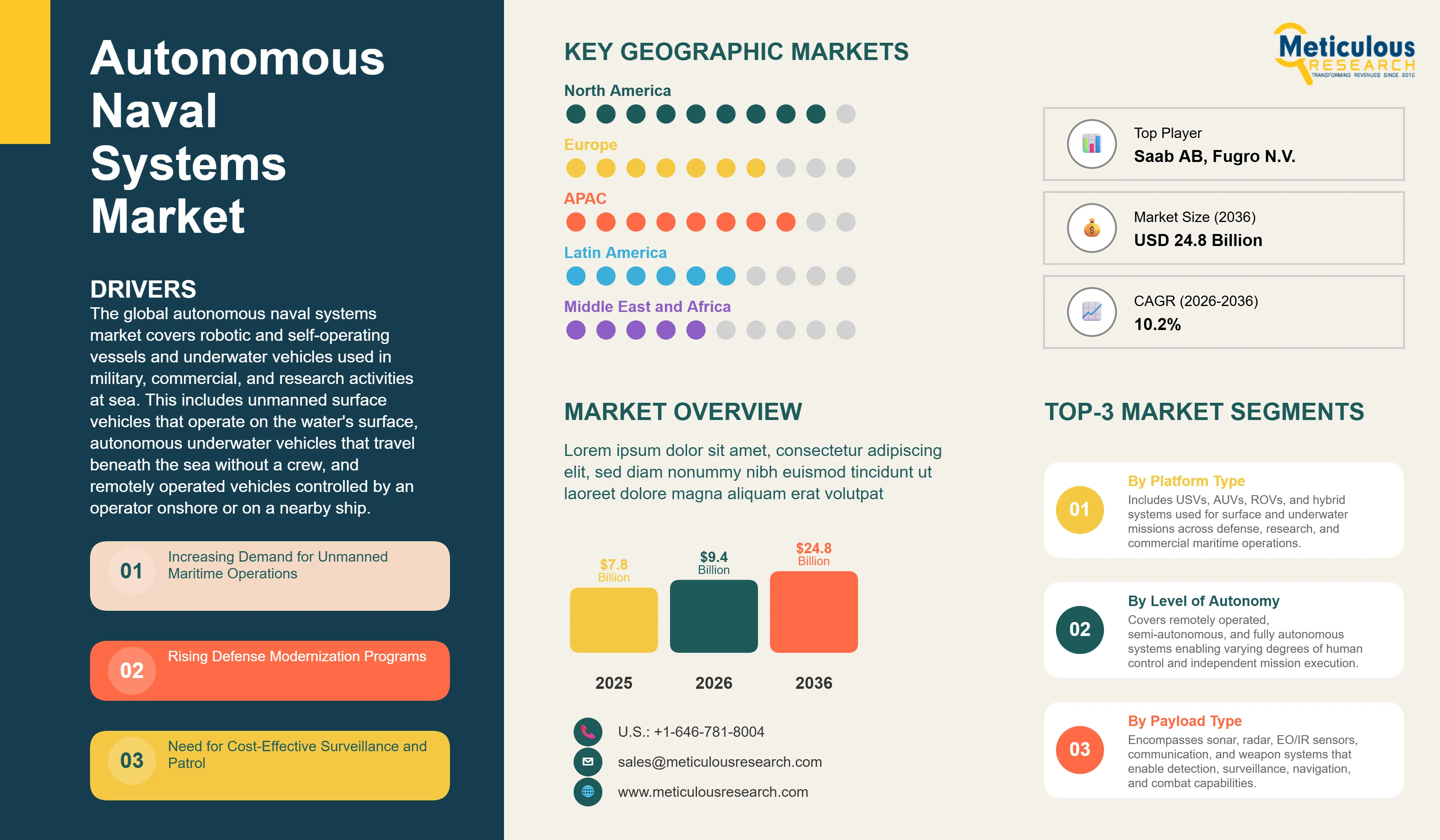
The global autonomous naval systems market was valued at USD 7.8 billion in 2025. This market is expected to reach USD 24.8 billion by 2036 from an estimated USD 9.4 billion in 2026, growing at a CAGR of 10.2% during the forecast period 2026-2036.
- Published
- Apr 2026
- Pages
- 280
- Format
- PDF + Excel
- Report ID
- MR-1909
- Base year
- 2025
- 2025 · BASELINE
- $7.80B
- 2036
- $24.80B
- CAGR 2026–2036
- 10.2%
2025 baseline · 2026–2036 forecast at 10.2% CAGR · hover a bar for the value
Key highlights
The global autonomous naval systems market is projected to reach USD 24.8 billion by 2036.
The market is expected to grow at a CAGR of 10.2% during the forecast period 2026-2036.
The global autonomous naval systems market was valued at USD 7.8 billion in 2025 and is estimated to reach USD 9.4 billion in 2026.
North America is expected to dominate the global autonomous naval systems market with the largest market share in 2026, while Asia-Pacific is projected to register the highest CAGR during the forecast period.
By platform type, the USVs segment is expected to hold the largest share of the market in 2026, while the AUVs segment is projected to register the highest CAGR during the forecast period.
By level of autonomy, the semi-autonomous systems segment is expected to hold the largest share in 2026, while the fully autonomous systems segment is projected to register the highest CAGR during the forecast period.
By payload type, the sonar systems segment is expected to hold the largest share in 2026, while the weapon systems segment is projected to register the highest CAGR during the forecast period.
By application, the ISR segment is expected to hold the largest share in 2026, while the anti-submarine warfare segment is projected to register the highest CAGR during the forecast period.
By end user, the navy segment is expected to hold the largest share in 2026, while the commercial maritime operators segment is projected to register the highest CAGR during the forecast period.
By propulsion type, the electric propulsion segment is expected to hold the largest share in 2026, while the hybrid propulsion segment is projected to register the highest CAGR during the forecast period.
Report summary
| Particulars | Details |
|---|---|
| Market Size by 2036 | USD 24.8 Billion |
| Market Size in 2026 | USD 9.4 Billion |
| Market Size in 2025 | USD 7.8 Billion |
| Revenue Growth Rate (2026-2036) | CAGR of 10.2% |
| Format | PDF, Excel & Cloud Portal · 280 pages |
| Dominating Platform Type | Unmanned Surface Vehicles (USVs) |
| Fastest Growing Platform Type | Autonomous Underwater Vehicles (AUVs) |
| Dominating Level of Autonomy | Semi-Autonomous Systems |
| Fastest Growing Level of Autonomy | Fully Autonomous Systems |
| Dominating Payload Type | Sonar Systems |
| Fastest Growing Payload Type | Weapon Systems |
| Dominating Application | ISR (Intelligence, Surveillance & Reconnaissance) |
| Fastest Growing Application | Anti-Submarine Warfare (ASW) |
| Dominating End User | Navy |
| Fastest Growing End User | Commercial Maritime Operators |
| Dominating Deployment Mode | Standalone Systems |
| Fastest Growing Deployment Mode | Fleet/Swarm-Based Systems |
| Dominating Propulsion Type | Electric Propulsion |
| Fastest Growing Propulsion Type | Hybrid Propulsion |
| Dominating Geography | North America |
| Fastest Growing Geography | Asia-Pacific |
| Base Year | 2025 |
| Forecast Period | 2026 to 2036 |
Report overview
Segments covered: platform type, application, end user.
The global autonomous naval systems market covers robotic and self-operating vessels and underwater vehicles used in military, commercial, and research activities at sea. This includes unmanned surface vehicles that operate on the water's surface, autonomous underwater vehicles that travel beneath the sea without a crew, and remotely operated vehicles controlled by an operator onshore or on a nearby ship. These systems carry sensors, cameras, sonar equipment, communication tools, and in some military cases, weapons, enabling navies and commercial operators to conduct ocean missions safely, cheaply, and without putting personnel at risk.
The market is growing primarily because navies around the world need smarter, more affordable ways to monitor large ocean areas, detect underwater threats, and secure coastlines without deploying large crewed ships. Autonomous systems can stay at sea longer, cover wider areas, and operate in dangerous conditions where sending a crewed vessel would be too risky. Defense spending on unmanned maritime systems has been rising steadily across the United States, United Kingdom, Australia, and several Asian countries as governments recognize that autonomous vessels offer a cost-effective way to extend naval reach, particularly in large ocean territories where continuous human-crewed patrol is not practical.
Two significant opportunities are shaping the market going forward. The growing use of AI-based navigation and decision-making software is making autonomous vessels smarter and more capable, allowing them to complete complex missions with minimal human input. This is opening new possibilities in areas like underwater mine detection, submarine tracking, and long-range ocean surveys. In addition, the commercial sector is increasingly adopting autonomous vessels for offshore oil and gas inspection, environmental monitoring, and underwater infrastructure surveys, creating a fast-growing non-military customer base that is expanding the market well beyond its traditional defense roots.
Report infographic
Market dynamics
7 factors across 3 forcesIncreasing Demand for Unmanned Maritime Operations
The clearest driver of this market is a simple need: navies and maritime agencies want to monitor vast ocean areas and conduct dangerous missions without putting sailors at risk or spending the full cost of a crewed warship. The world's oceans are enormous, and no country can afford to keep crewed ships everywhere they need a maritime presence. Autonomous surface and underwater vehicles solve this problem by operating for days or weeks without a crew, covering large areas at low cost. The U.S. Navy alone manages millions of square kilometers of ocean territory and has been one of the most active buyers of autonomous naval systems for this reason. Coast guards in Southeast Asia, the Middle East, and Europe face similar challenges in protecting long coastlines and exclusive economic zones, and autonomous patrol vessels are increasingly seen as a cost-effective solution. As these programs demonstrate success, more countries are following suit, creating a steadily expanding global customer base.
Need for Cost-Effective Surveillance and Patrol
Operating a crewed naval vessel costs tens of thousands of dollars per day when crew salaries, fuel, maintenance, and logistics are included. An autonomous vessel performing the same patrol mission can cost a fraction of that amount. For countries with limited defense budgets but large maritime responsibilities, this cost difference is a compelling reason to invest in autonomous systems. The economic argument is especially strong for coast guards and smaller navies in Southeast Asia, Latin America, and Africa that need to protect fisheries, monitor illegal immigration, and guard coastline infrastructure but cannot afford to maintain large crewed ship fleets. As the cost of autonomous vessel platforms continues to fall with improving technology and rising production volumes, the economic case for autonomous maritime patrol is becoming convincing for a wider range of potential customers globally.
Table of contents
15 chapters · 175 sections · 280 pages · click to expandSegmental analysis
| Segment | Largest share (2026) | Fastest growth (2026–2036) |
|---|---|---|
| By Platform Type | USVs | AUV |
| By Level of Autonomy | Semi-Autonomous Systems | Fully autonomous systems |
| By Payload Type | Sonar Systems | Weapon systems |
| By Application | ISR | Anti-submarine warfare (ASW) |
| By End User | Navy | Commercial maritime operators |
| By Deployment Mode | Standalone Systems | Fleet and swarm-based systems |
By Platform Type
- USVs to Dominate
- The USV segment is expected to account for the largest share of the global autonomous naval systems market.
- USVs are the most visible and commercially established autonomous naval platform category.
- They can be seen and tracked easily, are relatively straightforward to deploy and recover, and are versatile enough to carry sensors, cameras, and communication equipment for a wide range of missions including coastal patrol, mine detection support, intelligence gathering, and maritime security.
- Several navies including the U.S. Navy, Royal Navy, and Israeli Navy have already bought and deployed USVs operationally, creating a solid commercial foundation that makes USVs the current revenue leader in this market.
- However, the AUV segment is poised to register the highest CAGR during the forecast period.
- AUVs travel underwater without being connected to a surface ship by a cable, making them ideal for covert military missions and for deep-water commercial surveys that surface vessels cannot conduct.
- The rapid growth of undersea cable inspection, offshore energy surveys, and anti-submarine warfare programs is creating strong demand for AUVs across both military and commercial customers.
- Advances in battery technology are extending AUV endurance from days to weeks, opening up longer-range mission possibilities that are attracting growing investment from navies and commercial operators alike.
By Level of Autonomy
- Semi-Autonomous Systems to Hold the Largest Share
- The semi-autonomous systems segment is expected to account for the largest share of the global autonomous naval systems market.
- Most operational autonomous naval vessels today sit in the semi-autonomous category.
- They can handle routine navigation, collision avoidance, and basic mission tasks on their own, but a human operator remains in the loop for key decisions such as engaging a potential threat or changing the mission plan in response to a new situation.
- This balance of automation and human oversight is preferred by most military customers, who want the efficiency benefits of autonomous operation without fully removing humans from decision-making, particularly in situations where the consequences of a mistake could be serious.
- However, the fully autonomous systems segment is projected to register the highest CAGR during the forecast period.
- As AI navigation and decision-making software matures, and as navies build trust in autonomous systems through operational experience, the market is gradually shifting toward platforms that can complete entire missions without human intervention.
- Fully autonomous systems are particularly attractive for long-endurance underwater missions where maintaining a communication link to a human operator is not practical, and for swarm operations where dozens of vehicles must coordinate with each other faster than any human team could manage.
By Payload Type
- Sonar Systems to Hold the Largest Share
- The sonar systems segment is expected to account for the largest share of the global autonomous naval systems market.
- Sonar is the most commonly carried payload on autonomous naval systems because it is essential for nearly every underwater mission.
- AUVs and ROVs use sonar to map the seafloor, detect mines, find undersea cables and pipelines, and track submarines.
- USVs tow sonar arrays for anti-submarine patrol and mine countermeasure missions.
- The very broad applicability of sonar across both military and commercial missions makes it the dominant payload category by revenue.
- However, the weapon systems segment is projected to register the highest CAGR during the forecast period.
- Several major navies are actively developing and testing autonomous vessels capable of carrying and deploying weapons, including torpedo tubes on AUVs and small missile or gun systems on large USVs.
- The U.S. Navy's Large Unmanned Surface Vehicle program and similar programs in Israel and the UK include weapon system options.
- As these programs move from development into procurement, the weapon systems payload segment will grow rapidly, driven by the high per-unit value of armed autonomous naval systems compared with sensor-only platforms.
By Application
- ISR to Hold the Largest Share
- The ISR segment is expected to account for the largest share of the global autonomous naval systems market.
- ISR is the most widely practiced application for autonomous naval systems today.
- Navies use autonomous vessels to gather information about what is happening in their territorial waters and in areas of strategic interest, tracking ship movements, monitoring for suspicious activity, and collecting intelligence data that is transmitted back to shore-based command centers.
- Because ISR missions are continuous and cover large geographic areas, they are ideal for autonomous vehicles that can operate without crew rotation.
- However, the anti-submarine warfare (ASW) segment is projected to register the highest CAGR during the forecast period.
- Finding and tracking submarines is one of the most technically demanding and strategically important naval missions, and it is also one of the most expensive when conducted using crewed ships.
- Autonomous underwater gliders and AUVs equipped with advanced sonar can cover large ocean areas hunting for submarine signatures at a much lower cost than crewed ASW frigates or maritime patrol aircraft.
- The growing submarine fleets of China, Russia, North Korea, and Iran are creating urgency across NATO and Indo-Pacific allied navies to invest more in ASW capability, and autonomous systems are seen as an affordable way to extend ASW coverage without proportional increases in crewed ship and aircraft numbers.
By End User
- Navy to Hold the Largest Share
- The navy segment is expected to account for the largest share of the global autonomous naval systems market.
- National navies are the largest buyers of autonomous naval systems because their missions are the most complex, their budgets are the largest, and their need for unmanned capability is most pressing.
- The U.S. Navy, Royal Navy, Australian Navy, and Israeli Navy are among the most active early adopters, with ongoing procurement programs for USVs, AUVs, and unmanned underwater systems that collectively represent the majority of total market revenue.
- Other navies including India, France, Germany, South Korea, and Japan are also investing in autonomous naval capability as part of their broader force modernization plans.
- However, the commercial maritime operators segment is projected to register the highest CAGR during the forecast period.
- Companies providing ocean surveys, cable inspection, port management, and offshore infrastructure services are increasingly replacing expensive crewed survey ships with fleets of autonomous vessels that can complete the same work at lower cost.
- As autonomous vessel technology matures and becomes more reliable, more commercial applications are becoming financially attractive, creating a rapidly expanding commercial customer base for autonomous naval system manufacturers and operators.
By Deployment Mode
- Standalone Systems to Hold the Largest Share
- The standalone systems segment is expected to account for the largest share of the global autonomous naval systems market.
- The majority of current autonomous naval deployments involve a single vessel completing a defined mission independently, which is the simplest and most operationally proven deployment model.
- Standalone autonomous vessels require simpler control infrastructure and can be procured and operated without the complex coordination systems needed for multi-vessel swarms.
- However, the fleet and swarm-based systems segment is projected to register the highest CAGR during the forecast period.
- Operating multiple autonomous vessels together as a coordinated team multiplies the area covered, speed of mission completion, and resilience compared with a single vessel, making swarm approaches highly attractive for large-scale ocean surveys, coordinated mine clearing, and distributed surveillance.
- U.S. DARPA programs and commercial ocean survey companies are actively developing swarm coordination capabilities, and as this technology matures it will unlock a significant expansion of what autonomous naval systems can accomplish.
Geographic analysis
North America
Largest shareIn 2026, North America is expected to account for the largest share of the global autonomous naval systems market. The United States is the world's largest buyer of autonomous naval systems by a significant margin, driven by the U.S. Navy's active programs to develop and buy unmanned surface vessels and underwater vehicles as part of its strategic plan to operate larger numbers of ships with a reduced total crew size and budget. The U.S. Navy's Ghost Fleet Overlord program for large unmanned surface ships, the Extra Large Unmanned Underwater Vehicle program for long-range submarine-like AUVs, and a wide range of smaller USV and AUV procurement programs represent billions of dollars in annual spending that make North America the world's dominant autonomous naval systems market. The U.S. defense industrial base, which includes companies like L3Harris, Textron, General Dynamics, Huntington Ingalls Industries, and Teledyne Technologies, is home to many of the world's leading autonomous naval system developers. Canada's growing investment in Arctic maritime surveillance using autonomous systems adds further demand to the North American market.
Asia-Pacific
Fastest growthHowever, the Asia-Pacific autonomous naval systems market is expected to grow at the fastest CAGR during the forecast period. The rapid build-up of Chinese naval power and the rising tensions in the South China Sea and Taiwan Strait are compelling Japan, South Korea, Australia, India, and several Southeast Asian nations to invest urgently in autonomous maritime capabilities that can provide a surveillance and deterrence presence without requiring additional crewed warships. Australia has been one of the most aggressive investors in autonomous naval systems in the region, running the Ghost Shark and Bluezone autonomous underwater programs. Japan's Maritime Self-Defense Force is testing autonomous patrol vessels. South Korea is investing in unmanned naval systems as part of its broader defense technology modernization. India's growing maritime security focus is generating new interest in autonomous coastal patrol systems. China is also a major developer and buyer of autonomous naval systems for its own navy, making Asia-Pacific the most dynamic and fastest-growing regional market in the world.
Europe
Europe is a well-developed autonomous naval systems market with strong technology capabilities and growing government investment. Norway's Kongsberg Gruppen is a world leader in autonomous ship technology, and the company's HUGIN AUV series is used by navies and commercial operators on every continent. The UK's Royal Navy has been an early adopter of USVs including the autonomous mine-hunting systems. France, Germany, Italy, and Sweden are all running military autonomous naval programs. The strong commercial maritime and offshore energy sectors in the North Sea provide important commercial demand alongside the military procurement programs.
Middle East & Africa
The Middle East is a growing market, particularly in Israel, which has one of the world's most advanced autonomous naval industries through Elbit Systems and IAI, and in the Gulf states investing in autonomous coastal security for their long and strategically important coastlines.
Competitive landscape
- Kongsberg Gruppen ASA · Norway
- L3Harris Technologies Inc. (U.S.)
- Huntington Ingalls Industries Inc. (U.S.)
- Saab AB · Sweden
- Textron Inc. (U.S.)
- Thales Group · France
- Leonardo S.p.A · Italy
- BAE Systems plc (UK)
- General Dynamics Corporation (U.S.)
- Elbit Systems Ltd. · Israel
- Israel Aerospace Industries · Israel
- Ocean Infinity Ltd. (UK)
- Teledyne Technologies Incorporated (U.S.)
- Fugro N.V. · Netherlands
- ECA Group · France
Frequently asked questions
The global autonomous naval systems market is expected to reach USD 24.8 billion by 2036 from an estimated USD 9.4 billion in 2026, at a CAGR of 10.2% during the forecast period 2026-2036.
Cite this report
Meticulous Research. (2026). Autonomous Naval Systems Market - Global Opportunity Analysis and Industry Forecast (2026-2036) (Report No. MR-1909). Meticulous Market Research Pvt. Ltd. https://www.meticulousresearch.com/product/autonomous-naval-systems-market-6592