NEXT-Generation Military Radar Systems Market (2025-2035)
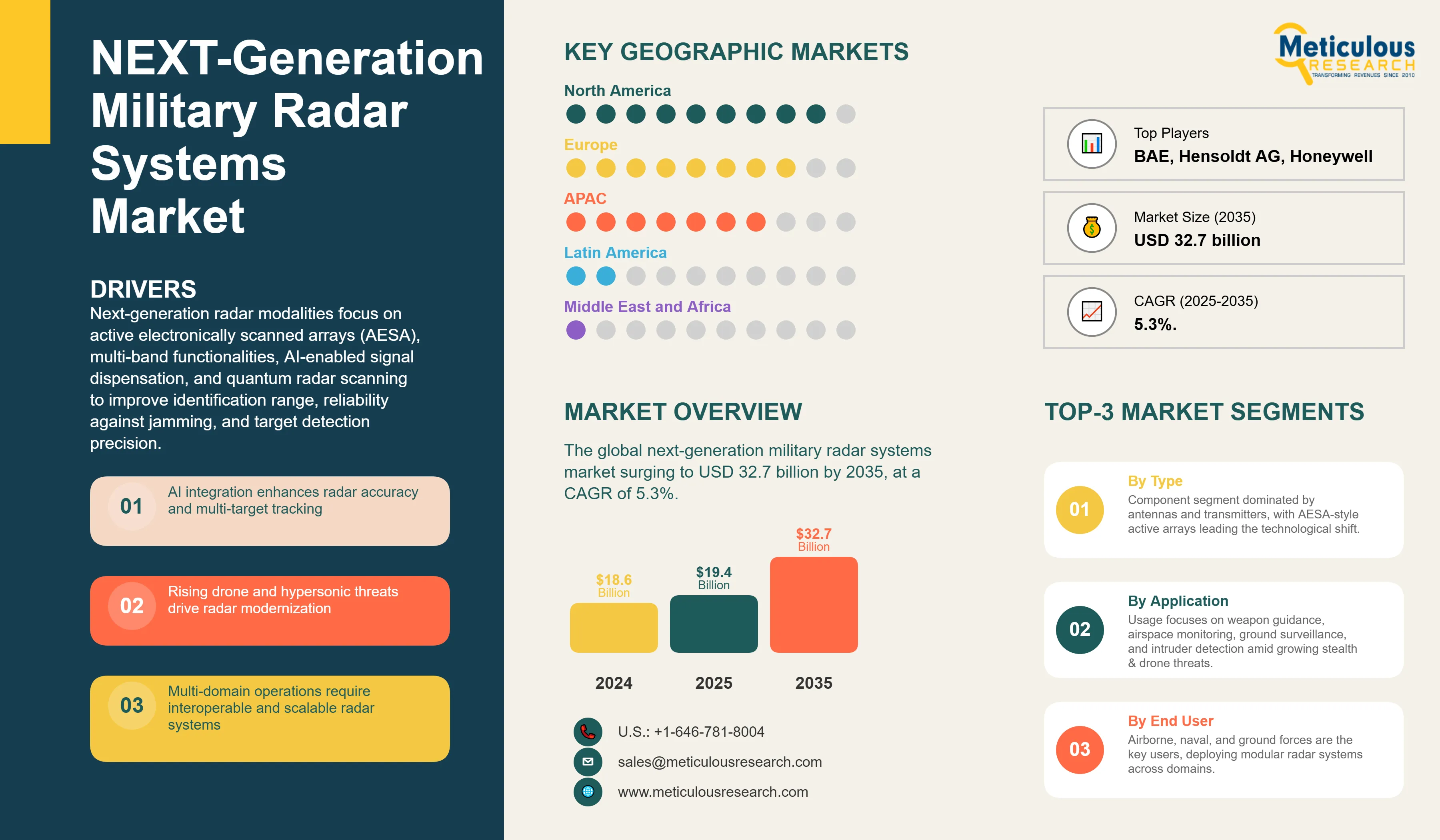
The global next-generation military radar systems market was valued at USD 18.6 billion in 2024 and is projected to reach USD 19.4 billion in 2025, surging to USD 32.7 billion by 2035, at a CAGR of 5.3%.
- Published
- Sep 2025
- Pages
- 204
- Format
- PDF + Excel
- Report ID
- MR-1588
- Base year
- 2024
- 2024 · BASELINE
- $18.60B
- 2035
- $32.70B
- CAGR 2025–2035
- 5.3%
2024 baseline · 2025–2035 forecast at 5.3% CAGR · hover a bar for the value
Key highlights
Antenna Segment Dominates While Transmitter Leads in Growth
Long-Range Segment Dominates While Medium-Range Leads in Growth
North America is the Largest Next-generation Military Radar Systems Market, Driven by Advanced Programs and Export Leadership
Asia Pacific is the Fastest-Growing Market for Next-generation Military Radar Systems with Strategic Modernization Programs
Report summary
| Particulars | Details |
|---|---|
| Market size (2025) | USD 19.4 billion |
| Revenue forecast in 2035 | USD 32.7 billion |
| CAGR (2025-2035) | 5.3% |
| Format | PDF, Excel & Cloud Portal · 204 pages |
| Base Year | 2024 |
| Forecast period | 2025 – 2035 |
| Report coverage | Market size and forecast, competitive landscape and benchmarking, country/regional level analysis, key trends, growth drivers and restraints |
| Segments covered | By Component (Transmitter, Antenna, Receiver, Duplexer, and Others), By Frequency (HF-Band, C-Band, S-Band, X-Band, L-Band, UHF/VHF, Ku/K/Ka-Band, and Multi Band Systems), By Range (Long, Medium, Short, and Very Short), By Platform (Airborne Radar, Land Radar, Naval Radar, and Space Radar), By Application (Weapon Guidance, Airspace Monitoring & Traffic Management, Airborne Mapping, Ground Surveillance & Intruder Detection, Navigation, and Others), Geography |
| Regional scope | North America, Europe, Asia-Pacific, Latin America, and Middle East & Africa |
| Key companies profiled | BAE Systems plc., Hanwha Systems Co. Ltd., Hensoldt AG, Honeywell International Inc., Israel Aerospace Industries Ltd., L3Harris Technologies, Inc., Leonardo S.p.A, Lockheed Martin Corporation, Northrop Grumman Corporation, Raytheon Technologies Corporation, Saab AB |
| Customization | Comprehensive report customization with purchase. Addition or modification to country, regional & segment scope available |
| Pricing Details | Access customized purchase options to meet your specific research requirements. Explore flexible pricing models |
Report overview
Segments covered: platform, frequency band, component, application.
This robust expansion is propelled by the evolving intricacies of new threats, comprising stealth fighters, hypersonic missiles, drones, and unconventional electronic warfare mechanisms.
Next-generation radar modalities focus on active electronically scanned arrays (AESA), multi-band functionalities, AI-enabled signal dispensation, and quantum radar scanning to improve identification range, reliability against jamming, and target detection precision. Need is surging for a radar platform that facilitates multi-province manoeuvres, with applications covering missile detection, border surveillance, and naval situational awareness. The market is shifting from conventional phased-array platforms to software-enabled, modular infrastructures capable of real-time threat detection.
Report infographic
Base CAGR: 5.3%
|
Category |
Key Factor |
Short-Term Impact (2025–2028) |
Long-Term Impact (2029–2035) |
Estimated CAGR Impact |
|||||||||
|
Drivers |
1. AI integration enhances radar accuracy and multi-target tracking |
Accelerated procurement of AESA, multi-band radars, and AI upgrades |
Institutionalized integration into layered air/missile defense networks |
▲ +2.2% |
|||||||||
|
|
2. Rising drone and hypersonic threats drive radar modernization |
Multi-role adoption across services; reduced need for multiple legacy systems |
Lifecycle cost savings and rapid adaptability via software upgrades |
▲ +1.5% |
|||||||||
|
Restraints |
1. High development and procurement costs |
Limits adoption for smaller defense forces |
Slows modernization cycles |
▼ −1.7% |
|||||||||
|
|
▼ −1.4% Market dynamics7 factors across 4 forces01 AI integration enhances radar accuracy and multi-target trackingNewly developed and deployed military radar systems feature AI-based signal processing, improving multi-target tracking and threat prioritization. Artificial intelligence algorithms facilitate the real-time classification of radar returns, thereby decreasing false positives and improving response times. In July 2025, the US Air Force held a four-day exercise called "Experiment 3" at Nellis Air Force Base. During this exercise, AI software provided real-time recommendations to dynamic targeting teams, allowing side-by-side comparisons of AI-suggested and operator-derived courses of action. 02 Rising drone and hypersonic threats drive radar modernizationThe increased threat from drones and hypersonic missiles has had a significant impact on the development of next-generation military radar systems. In 2024, the Federal Aviation Administration (FAA) reported that there were over 1.1 million drones registered in the United States, with more than 100 drone-related reports filed monthly, indicating a significant increase in drone activity. Simultaneously, Russia's deployment of the "Oreshnik" hypersonic missile, capable of reaching speeds of Mach 10, has highlighted the limitations of traditional radar systems in detecting high-speed, low-altitude threats. 03 Multi-domain operations require interoperable and scalable radar systemsIn 2022, radar systems were integrated across land, sea, and air platforms in over 40% of joint military exercises across Europe, according to the European Defence Agency. Modular radar systems are capable of accommodating mission-specific configurations, and interoperability and scalability are currently essential procurement criteria. The AN/SPY-6 by Raytheon and the Ground Master series by Thales are two examples of scalable platforms that have been deployed across multiple domains. This trend underscores the necessity of a coordinated threat response and unified situational awareness. Table of contents14 chapters · 164 sections · 204 pages · click to expandReview the full research scope before you buy. Chapters can also be purchased individually. 1.1Market Definition 1.2Market Ecosystem 1.3Currency 1.4Key Stakeholders Segmental analysis
01 Other segments
02 By Range
Geographic analysis01 North AmericaLargest shareNorth America dominates the global next-generation military radar systems market, with a large market share, anchored by the United States’ massive defense budget and extensive modernization programs. In 2024, North America was responsible for the maximum of global radar system upgrades, as reported by the U.S. Government Accountability Office (GAO). The U.S. Department of Defense is responsible for 18 active radar modernization programs. The AN/SPY-6 radar was deployed across naval platforms, and the Army's LTAMDS system entered final testing for integrated air and missile defense. In addition to this, in 2024, the United States expanded radar integration across multiple platforms, including the Army's LTAMDS, Navy's AN/SPY-6, and Air Force's Three-Dimensional Expeditionary Long-Range Radar (3DELRR), according to the U.S. Department of Defense. During joint exercises, the LTAMDS system successfully tracked cruise missiles and unmanned aerial vehicles. These systems are intended to facilitate JADC2 and integrated deterrence strategies. Canada enhanced its early warning capabilities by expanding its NORAD radar coverage in the Arctic with new long-range systems. The region is characterized by robust public-private partnerships, with companies such as Raytheon, Northrop Grumman, and L3Harris spearheading innovation. Interoperability among services and allies continues to be a strategic priority. Moreover, the region also leads in radar export capacity, supplying advanced systems to NATO allies and Indo-Pacific partners, strengthening interoperability in coalition operations. North America is the Largest Next-generation Military Radar Systems Market, Driven by Advanced Programs and Export Leadership 02 Asia-PacificFastest growthThe next-generation military radar systems market in the Asia-Pacific region is projected to grow at the fastest CAGR through 2035, driven by rising defense budgets and the urgent need to counter stealth aircraft, missile proliferation, and maritime security challenges. Japan implemented new AESA radar systems as part of its F-X fighter program, while India's DRDO conducted border monitoring tests for long-range surveillance radars. Australia collaborated with the United States to upgrade its JORN over-the-horizon radar network, thereby improving its coverage of the Indo-Pacific region. Similarly, China integrated multi-band systems for naval and air surveillance in the South China Sea, thereby expanding its radar footprint. To mitigate their dependence on foreign systems, regional governments are emphasizing the development of indigenous radar capabilities, thereby driving the market growth. China’s military radar systems market is growing rapidly due to significant local research and development and the strategic integration of radar networks into its anti-access/area-denial (A2/AD) defense strategy. In 2023, China deployed new long-range radar systems across South China Sea installations to improve maritime surveillance and airspace control, overseen by the China Electronics Technology Group Corporation (CETC). These radars use advanced AESA technology and connect directly to naval command centers, allowing for real-time threat monitoring and response. Chinese defense contractors work closely with state research institutions to create radar systems with long-range detection, high-resolution imaging, and strong electronic counter-countermeasures. Notable innovations include AI-powered airborne radars that maintain over 99% tracking accuracy even under intense electronic jamming, marking significant progress in electronic warfare resilience. The 14th Five-Year Plan and ongoing defense modernization efforts focus on increasing funding for radar research, particularly in hypersonic tracking and stealth target detection. Plans also include the development of quantum radar and silent radar technologies that improve detection while keeping the radar’s presence hidden. These developments support China’s strategic goals of achieving regional military dominance and strategic independence, strengthening its leading position in the next-generation military radar systems market, with continuous investments expected throughout the forecast period. Asia Pacific is the Fastest-Growing Market for Next-generation Military Radar Systems with Strategic Modernization Programs Expanding Indigenous Capabilities for Counter-Stealth and Maritime Surveillance Propels Next-Generation Military Radar Systems Growth in China 03 EuropeFrance has a significant share of the European market for next-generation military radar systems. This is driven by strategic investments related to NATO commitments and broader European security efforts. The country’s defense industry focuses on developing multifunctional radar systems that integrate Active Electronically Scanned Array (AESA) technology. It benefits from strong aerospace capabilities, led by industry leaders such as Thales Group. Modernization programs and larger defense budgets are fueling the growth of France’s radar sector. Recent investments include a major €50 million upgrade of the Nostradamus over-the-horizon radar, which improves the detection accuracy of ballistic and hypersonic threats over thousands of kilometers. This radar is a key part of France’s extended air defense strategy, using both monostatic and bistatic modes to provide continuous coverage from ground level to near-space altitudes. In addition, France is developing space-based radar platforms and incorporating artificial intelligence into existing radars like the Ground Master 400 and GM200. This aims to improve the detection of complex and stealthy aerial targets in near-space. These efforts back France’s strategic goal of having autonomous, integrated defense capabilities that offer better early warning and situational awareness. With a strong export market and innovative projects such as the Stratobus high-altitude airship and BalMan maneuverable balloon, France is in a good position to maintain and grow its leadership in next-generation military radar systems, both in Europe and worldwide. The focus on near-space operations and new sensor fusion techniques highlights France’s commitment to addressing emerging aerial and missile threats. France Invests in Advanced Technology Integration and Strategic Partnerships Competitive landscapeThe next-generation military radar systems market is highly competitive, with leading defense contractors, electronics specialists, and niche sensor technology firms all competing for large-scale modernization contracts. The global next-generation military radar systems market is dominated by Lockheed Martin, Northrop Grumman, Raytheon Technologies (RTX), Thales Group, Leonardo S.p.A., and Saab AB, which have extensive portfolios of airborne, naval, and ground-based radar platforms. To provide adaptable systems for a variety of mission profiles, these companies are utilizing active electronically scanned array (AESA) technology, multi-band capabilities, and open-architecture frameworks. Recent developments
Companies profiled (11)
Frequently asked questionsThe Next-Generation Military Radar Systems Market is estimated to be USD 19.4 billion in 2025 and grow at a CAGR of 5.3% to reach USD 32.7 billion by 2035. Cite this reportMeticulous Research. (2025). NEXT-Generation Military Radar Systems Market - Global Opportunity Analysis And Industry Forecast (2025-2035) (Report No. MR-1588). Meticulous Market Research Pvt. Ltd. https://www.meticulousresearch.com/product/next-generation-military-radar-systems-market-6271 Search Market IntelligenceSearch across reports, blogs, press releases, and industries |