AI in Defense & Aerospace Market (2026-2036)
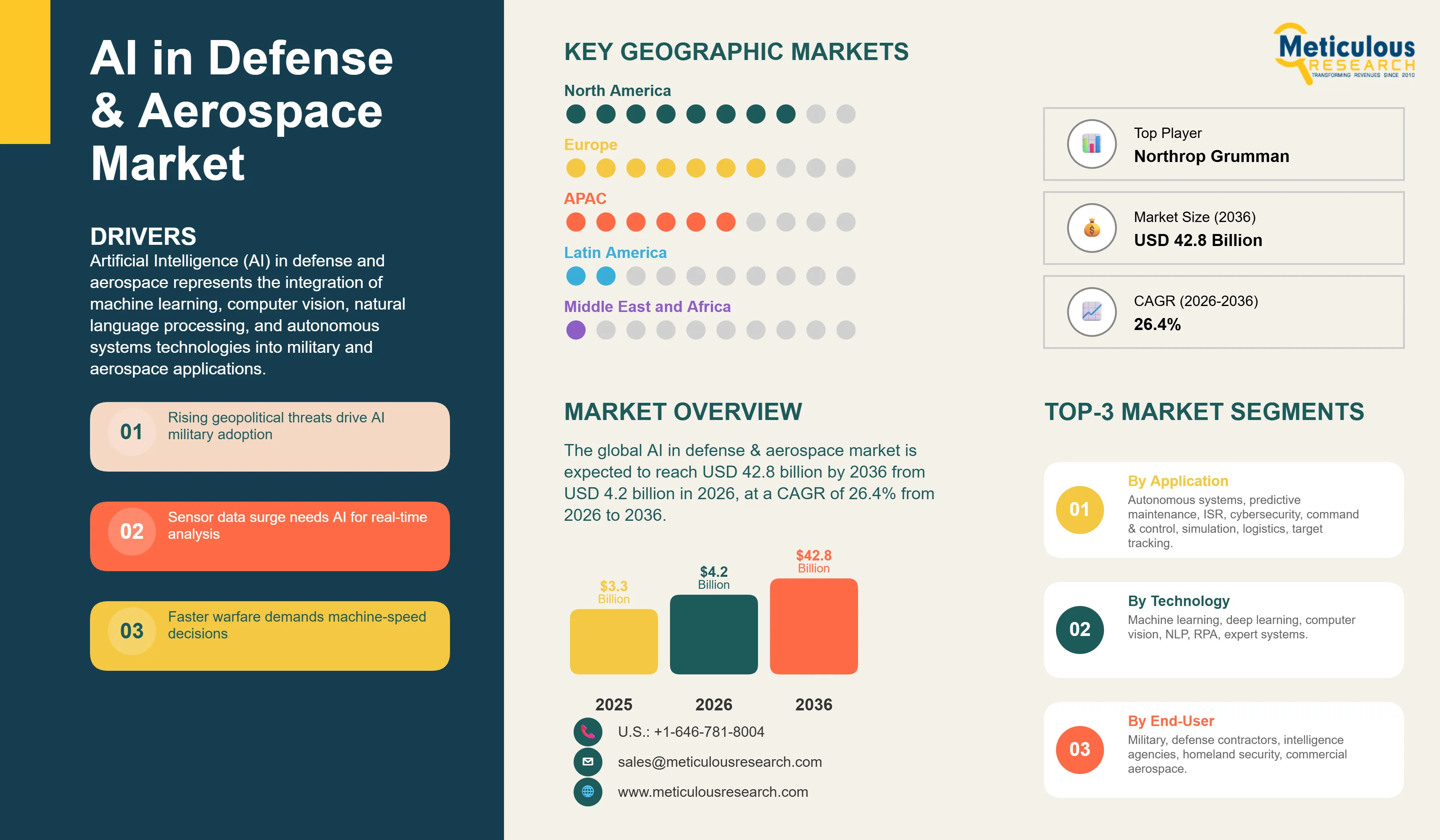
The global AI in defense & aerospace market is expected to reach USD 42.8 billion by 2036 from USD 4.2 billion in 2026, at a CAGR of 26.4% from 2026 to 2036.
- Published
- Jan 2026
- Pages
- 296
- Format
- PDF + Excel
- Report ID
- MR-1696
- Base year
- 2025
- 2026 · ESTIMATED
- $4.20B
- 2036
- $42.80B
- CAGR 2026–2036
- 26.4%
2025 baseline · 2026–2036 forecast at 26.4% CAGR · hover a bar for the value
Key highlights
1. In 2026, North America is estimated to account for the largest share of the global AI in defense & aerospace market, driven by massive defense budgets, presence of leading AI defense contractors including Lockheed Martin, Northrop Grumman, and Palantir, extensive military AI research programs, and early adoption of autonomous systems across all military branches.
2. Asia-Pacific is projected to register the highest CAGR during the forecast period, fueled by rapidly increasing defense budgets in China, India, and Japan, military modernization initiatives, development of domestic AI defense capabilities, territorial security concerns, and government investments in autonomous weapons systems.
3. Based on application, the autonomous systems segment is estimated to hold the largest share of the market in 2026, driven by widespread deployment of military drones, development of autonomous combat vehicles, swarm technology demonstrations, and strategic focus on unmanned capabilities reducing human casualties.
4. Based on deployment type, the cloud-based segment is expected to witness the highest growth during the forecast period, driven by secure military cloud infrastructure development, need for distributed AI training and updates, multi-domain integration requirements, and classified cloud computing initiatives.
5. Based on technology, the machine learning and deep learning segment dominates the market in 2026, representing the most mature and widely deployed AI technology for military applications including image recognition, predictive analytics, and autonomous navigation systems.
6. The intelligence, surveillance, and reconnaissance (ISR) segment is expected to grow at a significant CAGR during the forecast period, driven by massive volumes of satellite and drone imagery requiring AI analysis, real-time threat detection needs, and fusion of multi-source intelligence data.
7. The military aviation segment accounts for the largest platform share, driven by autonomous fighter jet development programs, AI-enhanced pilot systems, unmanned combat aerial vehicles (UCAVs), and next-generation air combat training systems.
8. The U.S. AI in defense & aerospace market is projected to grow at a CAGR of around 24% during the forecast period 2026 to 2036, driven by Department of Defense AI strategy, JAIC (Joint AI Center) initiatives, Silicon Valley defense partnerships, and extensive military AI procurement programs.
9. China is expected to lead the Asia-Pacific AI in defense & aerospace market, driven by aggressive military AI development targets, civil-military fusion strategy, domestic AI technology advancement, large-scale autonomous drone programs, and strategic focus on AI military superiority.
10. In 2026, the U.K. is projected to account for significant share of the European AI in defense & aerospace market, driven by Defence AI Centre establishment, Tempest sixth-generation fighter AI integration, NATO AI cooperation leadership, and BAE Systems AI development programs.
Report summary
| Particulars | Details |
|---|---|
| Market Size Value in 2026 | USD 4.2 Billion |
| Revenue Forecast in 2036 | USD 42.8 Billion |
| Growth Rate | CAGR of 26.4% from 2026 to 2036 |
| Format | PDF, Excel & Cloud Portal · 296 pages |
| Base Year for Estimation | 2025 |
| Historical Data | 2020-2024 |
| Forecast Period | 2026-2036 |
| Report Coverage | Revenue forecast, company share, competitive landscape, growth factors, and trends |
| Segments Covered | Application, Deployment Type, Technology, Platform, End-User, Geography |
| Regional Scope | North America, Europe, Asia-Pacific, Latin America, Middle East & Africa |
| Key Companies Profiled | Lockheed Martin, Northrop Grumman, Raytheon Technologies, Boeing, BAE Systems, Palantir Technologies, Anduril Industries, Shield AI, General Dynamics, L3Harris Technologies, Thales Group, Leonardo S.p.A., CACI International, Booz Allen Hamilton, and others |
Report overview
Segments covered: application, deployment type, technology, platform, end-user.
Artificial Intelligence (AI) in defense and aerospace represents the integration of machine learning, computer vision, natural language processing, and autonomous systems technologies into military and aerospace applications. These systems leverage advanced algorithms to process vast amounts of sensor data, enable autonomous decision-making, predict equipment failures, analyze intelligence information, optimize mission planning, and enhance situational awareness. Key applications include autonomous unmanned aerial vehicles (UAVs) and ground vehicles capable of navigation and target recognition, predictive maintenance systems that analyze equipment telemetry to prevent failures and optimize logistics, AI-powered intelligence analysis platforms that process satellite imagery, signals intelligence, and open-source data, command and control systems that integrate multi-domain data for rapid decision support, cybersecurity solutions detecting and responding to threats in real-time, and simulation and training platforms providing adaptive learning environments. The technology employs various AI approaches including deep learning neural networks for image and pattern recognition, reinforcement learning for autonomous navigation and decision-making, natural language processing for intelligence analysis and communication systems, edge AI computing enabling real-time processing on deployed platforms, and federated learning allowing model training across distributed systems while maintaining security. These AI systems offer critical advantages including enhanced speed of decision-making in time-sensitive military operations, improved accuracy in target identification and threat assessment reducing civilian casualties, force multiplication allowing smaller units to achieve greater effectiveness, reduced human exposure to dangerous situations through autonomous systems, optimized resource allocation and logistics, and continuous learning and adaptation to evolving threats and environments.
AI in Defense & Aerospace represents a transformative shift in military capabilities and aerospace operations, fundamentally changing how armed forces conduct operations, make decisions, and maintain technological superiority. Unlike traditional defense systems that rely on pre-programmed responses and human decision-making at every step, AI-enabled systems can process vast amounts of data in real-time, identify patterns humans might miss, make autonomous decisions within defined parameters, and continuously learn and adapt from experience. These systems offer significant strategic advantages, including decision speed measured in milliseconds rather than minutes enabling rapid response to threats, processing capability handling petabytes of sensor and intelligence data impossible for human analysts alone, 24/7 operational availability without fatigue or human limitations affecting performance, and cost-effectiveness allowing force multiplication with fewer personnel. As global military competition intensifies and emerging threats including hypersonic weapons, cyber warfare, and great power competition require faster decision-making and more sophisticated responses, defense establishments worldwide are investing heavily in AI to maintain strategic advantages. This creates substantial market opportunities for AI defense contractors, technology companies entering the defense sector, and nations seeking to develop indigenous AI military capabilities.
Several key trends are reshaping the AI in defense and aerospace market. These include the shift from pilot projects to operational deployment with AI systems moving beyond testing to active military use, development of multi-domain integration connecting AI across air, land, sea, space, and cyber domains for coordinated operations, emphasis on ethical AI and human oversight ensuring autonomous weapons comply with international law and maintain meaningful human control, edge AI deployment enabling processing on deployed platforms without constant connectivity, adversarial AI development both for offensive cyber capabilities and defending against AI-powered threats, and commercial-military technology transfer with defense forces leveraging Silicon Valley innovations while maintaining security requirements. The convergence of increasing global security threats creating demand for advanced capabilities, maturation of AI technologies proving military applicability and reliability, substantial government funding with the U.S. alone investing billions annually, and strategic competition between major powers driving AI military innovation has elevated AI from experimental technology to a core component of defense strategy. This transformation has attracted major technology companies into defense contracts, stimulated startup formation focused on military AI applications, and prompted billions in international defense AI investments.
Report infographic
Market dynamics
10 factors across 4 forcesData Volume Overwhelming Human Processing Capacity
Modern military sensors generate massive data volumes. A single Reaper drone produces 1,000 hours of video footage daily. Satellite constellations image entire continents every day. Signals intelligence systems monitor billions of communications. Human analysts cannot process this information volume, creating critical intelligence gaps. AI systems can analyze imagery at rates 100,000 times faster than humans, identify patterns across disparate data sources, and provide alerts on significant events in real-time. This capability transforms raw data into actionable intelligence, making AI essential for effective military operations.
Speed of Modern Warfare Requiring Automated Decisions: Hypersonic missiles traveling at Mach 5+ provide only minutes of warning time. Electronic warfare and cyber attacks operate at milliseconds. Adversary autonomous systems make decisions at machine speed. Human decision-making speeds are insufficient for these threats. AI systems can detect, analyze, and respond to threats orders of magnitude faster than human operators while providing decision support for complex scenarios. This speed advantage is critical for missile defense, electronic warfare, and air combat, driving adoption across all military domains.
Table of contents
15 chapters · 139 sections · 296 pages · click to expandGeographic analysis
North America
Largest shareIn 2026, North America is estimated to account for the largest share of the global AI in defense & aerospace market, driven by massive defense budgets, presence of leading AI defense contractors including Lockheed Martin, Northrop Grumman, and Palantir, extensive military AI research programs, and early adoption of autonomous systems across all military branches. 2.
Asia-Pacific
Fastest growthAsia-Pacific is projected to register the highest CAGR during the forecast period, fueled by rapidly increasing defense budgets in China, India, and Japan, military modernization initiatives, development of domestic AI defense capabilities, territorial security concerns, and government investments in autonomous weapons systems.
Competitive landscape
- Lockheed Martin
- Northrop Grumman
- Raytheon Technologies
- Boeing
- BAE Systems
- Palantir Technologies
- Anduril Industries
- Shield AI
- General Dynamics
- L3Harris Technologies
- Thales Group
- Leonardo S.p.A
- CACI International
- Booz Allen Hamilton
Frequently asked questions
The AI in defense & aerospace market is expected to grow from USD 4.2 billion in 2026 to USD 42.8 billion by 2036.
Cite this report
Meticulous Research. (2026). AI in Defense & Aerospace Market - Global Opportunity Analysis and Industry Forecast (2026-2036) (Report No. MR-1696). Meticulous Market Research Pvt. Ltd. https://www.meticulousresearch.com/product/ai-in-defense-and-aerospace-market-6379