
AI-Powered Machine Vision Market (2026-2036)
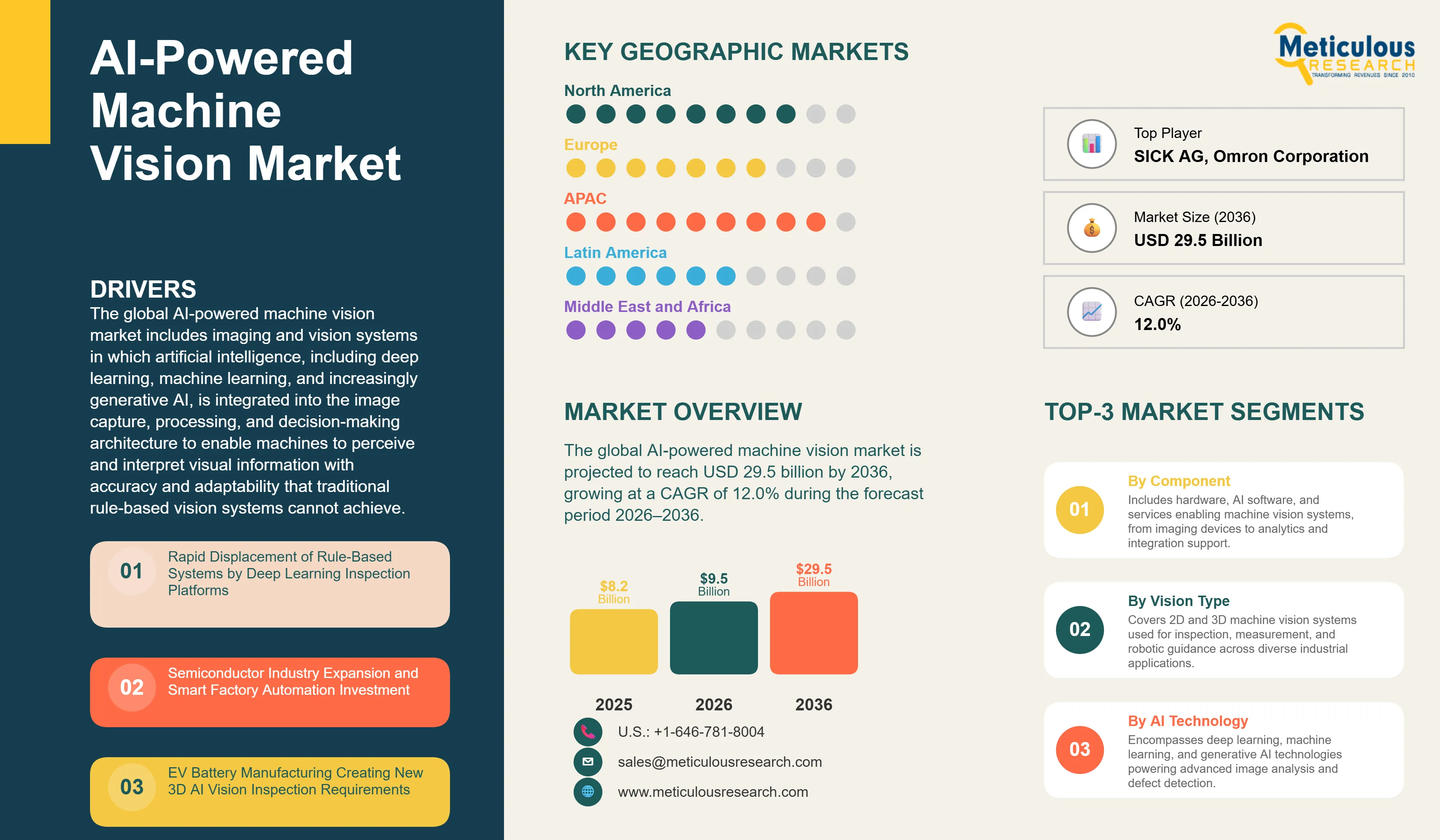
The global AI-powered machine vision market was valued at USD 8.2 billion in 2025. The market is projected to reach USD 29.5 billion by 2036 from an estimated USD 9.5 billion in 2026, growing at a CAGR of 12.0% during the forecast period 2026–2036.
- Published
- Apr 2026
- Pages
- 290
- Format
- PDF + Excel
- Report ID
- MR-1928
- Base year
- 2025
- 2025 · BASELINE
- $8.20B
- 2036
- $29.50B
- CAGR 2026–2036
- 12.0%
2025 baseline · 2026–2036 forecast at 12.0% CAGR · hover a bar for the value
Key highlights
The global AI-powered machine vision market is projected to reach USD 29.5 billion by 2036.
The market is expected to grow at a CAGR of 12.0% during the forecast period 2026–2036.
The global AI-powered machine vision market was valued at USD 8.2 billion in 2025 and is estimated to reach USD 9.5 billion in 2026.
Asia Pacific is expected to dominate the global AI-powered machine vision market in 2026, accounting for around 35-40% of the global revenue. The region’s leadership reflects its position as the world’s largest electronics, semiconductor, and automotive manufacturing base, where demand for high-speed, high-accuracy AI vision inspection systems is the most intense globally.
China, Japan, South Korea, and Taiwan are the primary national markets within Asia Pacific region.
Advanced semiconductor wafer fabs increasingly incorporate full automation for wafer inspection, lithography alignment, etch monitoring, and package quality control, with SEMI forecasting 69% capacity growth for leading-edge nodes through 2028, each requiring sophisticated AI-powered machine vision systems.
Asia Pacific AI-powered machine vision market is also expected to grow at the fastest CAGR during the forecast period. The growth of this market is mainly driven by the increasing investment in advanced manufacturing, semiconductor production capacity expansion, and smart factory initiatives across China, Japan, South Korea, Taiwan, and India.
North America holds a significant market share, driven by strong demand across the semiconductor, automotive, pharmaceutical, and logistics sectors. The North American machine vision market is expected to grow at a CAGR of over 10% from 2026 to 2036, primarily led by continuous investment in 3D machine vision technology.
The U.S. is home to Cognex Corporation, the global market leader in industrial machine vision, and Teledyne Technologies, a leading provider of imaging and vision systems for industrial and scientific applications. In January 2025, Cognex launched the DataMan 290 and 390 barcode readers, extending its AI-integrated product portfolio.
By component, hardware is expected to hold the largest market share in 2026, reflecting the dominant cost contribution of industrial cameras, sensors, lighting, frame grabbers, and AI-capable edge processing modules in AI-powered machine vision deployments. However, AI software market is expected to grow at the fastest CAGR through 2036.
By vision type, 2D machine vision is expected to hold the largest market share in 2026, indicating its dominance across the range of industrial inspection, identification, and guidance applications. However, 3D machine vision is expected to register the fastest CAGR during the forecast period, driven by the growing demand for dimensional measurement, surface topology analysis, and robot guidance in environments where 2D imaging cannot adequately capture depth information.
By end-use industry, electronics and semiconductor manufacturing is expected to hold the largest market share in 2026, mainly due to the growing inspection precision demands of semiconductor wafer fabrication, PCB assembly, and consumer electronics production.
Pharmaceuticals and healthcare is expected to register the fastest CAGR, driven by stringent regulatory compliance requirements, growing adoption of AI vision for drug label verification, packaging integrity inspection, and medical imaging-guided diagnostic systems.
By application, quality assurance and inspection is expected to hold the largest market share in 2026 at approximately 35-45% of revenue, driven by universal manufacturing demand for defect detection, dimensional measurement, and surface analysis automation.
Report summary
| Particulars | Details |
|---|---|
| Market Size by 2036 | USD 29.5 Billion |
| Market Size in 2026 | USD 9.5 Billion |
| Market Size in 2025 | USD 8.2 Billion |
| Revenue Growth Rate (2026–2036) | CAGR of 12.0% |
| Format | PDF, Excel & Cloud Portal · 290 pages |
| Dominating Component | Hardware (Cameras, Sensors, Processors) |
| Fastest Growing Component | AI Software (Deep Learning & Analytics Platforms) |
| Dominating Vision Type | 2D Machine Vision |
| Fastest Growing Vision Type | 3D Machine Vision |
| Dominating AI Technology | Deep Learning / Convolutional Neural Networks (CNNs) |
| Fastest Growing AI Technology | Generative AI for Synthetic Data Augmentation |
| Dominating Application | Quality Assurance & Inspection |
| Fastest Growing Application | Autonomous Vehicles & Robotics Guidance |
| Dominating Deployment Mode | On-Premise / Edge |
| Fastest Growing Deployment Mode | Cloud-Based / Hybrid |
| Dominating End-Use Industry | Electronics & Semiconductor Manufacturing |
| Fastest Growing End-Use Industry | Pharmaceuticals & Healthcare |
| Dominating Geography | Asia Pacific |
| Fastest Growing Geography | Asia Pacific |
| Base Year | 2025 |
| Forecast Period | 2026 to 2036 |
Report overview
Segments covered: component, vision type, ai technology, application, deployment mode, end-use industry.
The global AI-powered machine vision market includes imaging and vision systems in which artificial intelligence, including deep learning, convolutional neural networks, machine learning, and increasingly generative AI, is integrated into the image capture, processing, and decision-making architecture to enable machines to perceive and interpret visual information with accuracy and adaptability that traditional rule-based vision systems cannot achieve. This integration elevates machine vision from static, pre-programmed pattern matching into dynamic, adaptive inspection and guidance systems that improve performance over time and generalize to new defect types and environmental conditions without explicit reprogramming.
AI integration is the most important technology transformation occurring in the machine vision market. AI integration represents the dominant technology transformation in machine vision, with manufacturer adoption exceeding 50% and defect detection accuracy surpassing 99%, more than 15 points above traditional rule-based systems. CNN architectures excel at complex surface anomalies and variable lighting conditions, driving demand across electronics, automotive, and pharmaceutical quality control applications.
Report infographic
Market dynamics
2 factors across 1 forceDeep Learning and CNN-Based Inspection Systems Displacing Rule-Based Machine Vision Across Industrial Manufacturing
The key trend transforming the global AI-powered machine vision market is the displacement of traditional rule-based machine vision systems by deep learning and CNN-based inspection platforms that learn from data rather than relying on hand-crafted algorithms. This transition is driving the competitive landscape, the economics of machine vision deployment, and the range of inspection tasks that automation can address effectively. Rule-based systems, which require expert programmers to define explicit feature detection algorithms for each inspection scenario, have inherent limitations in handling complex, variable, or unpredictable defect types that naturally occur in real manufacturing environments.
Deep learning–based systems fundamentally transform this paradigm. Convolutional neural network (CNN) architectures automatically learn to identify relevant features from labeled training images, allowing them to generalize to new defect types, adapt to variable lighting conditions, and continuously improve as more data becomes available. As a result, AI-driven machine vision systems now achieve defect recognition rates exceeding 99%, outperforming traditional approaches. Solutions such as Cognex ViDi (98–99% accuracy), KEYENCE’s VS Series (up to 99.7% detection accuracy in pharmaceutical applications), and AI-native platforms like Landing AI, Neurala, and Overview.ai are driving this shift. Notably, KEYENCE’s 2025 VS Series delivers 15–25% accuracy improvements for complex inspection tasks, while ISRA Vision’s RTVision.3D enables high-precision 3D analysis down to 0.1 mm. Additionally, Cognex ViDi integration has been shown to reduce false positives by approximately 28%.
The democratization of AI vision through no-code platforms showcased at Automate 2025 enables manufacturing engineers to deploy effective inspection models without data science expertise. Customers report up to 60% inspection cost reductions and 50% faster cycles. PMC-validated CNN architectures (99%+ accuracy) excel at surface anomaly detection with continuous learning capabilities across manufacturing sectors.
3D Machine Vision Expansion Driven by Robotics, EV Battery Inspection, and Semiconductor Precision Requirements
3D machine vision is the fastest-growing vision type in the AI-powered machine vision market, driven by three key demand vectors: the expansion of vision-guided robotics requiring depth perception for accurate manipulation, the new quality inspection requirements of electric vehicle battery manufacturing, and the growing precision demands of advanced semiconductor fabrication. While 2D machine vision remains the dominant vision type by installed base and revenue, 3D systems are growing at a meaningfully higher CAGR driven by the unique depth, topography, and dimensional measurement capabilities that 2D imaging cannot provide.
In robotics, the integration of 3D machine vision is critical for enabling robots to perform pick-and-place, assembly, and manipulation tasks in dynamic environments where part orientation and positioning are variable. The fusion of LiDAR and stereo camera data for enhanced obstacle recognition in autonomous warehouse robots, and the use of high-speed 3D vision scanners for automated dimensional measurement in aerospace component fabrication, are among the most commercially active 3D application areas. Over 50% of advanced manufacturers now deploy 3D imaging in machine vision systems, with multi-camera synchronization expanding inspection coverage by up to 33%. LMI Technologies' 2024 Gocator 3500 smart sensor delivers 40% faster scanning for consumer electronics. KEYENCE's 2025 LJ-X8000 3D laser profiler achieves 35% precision gains, driving electronics manufacturing adoption.
Electric vehicle battery manufacturing is creating a new high-growth application for 3D machine vision. The precise inspection of battery cell electrodes, anode and cathode coating uniformity, separator integrity, and cell-to-pack assembly verification requires the depth resolution and surface topography measurement capabilities unique to 3D vision systems. As global EV production scales rapidly with battery gigafactory capacity under construction across the United States, Europe, and Asia, AI-powered 3D machine vision is being embedded into EV battery manufacturing lines as a standard quality assurance component. Increasing investments in EV production are cited as a key driver of advanced vision technology demand in North America, Europe, and China.
Table of contents
14 chapters · 172 sections · 290 pages · click to expandSegmental analysis
| Segment | Largest share (2026) | Fastest growth (2026–2036) |
|---|---|---|
| By Component | Hardware | — |
| By Vision Type | 2D Machine Vision | 3D machine vision |
| By AI Technology | Deep Learning / CNNs | Generative AI |
| By Application | Quality Assurance & Inspection | Robotic guidance and autonomous vehicles |
| By End-Use Industry | Electronics & Semiconductor Manufacturing | Pharmaceuticals and healthcare |
By Component
- Hardware to Dominate the Global AI-Powered Machine Vision Market
- Hardware is expected to account for the largest share of the global AI-powered machine vision market.
- This segment covers industrial cameras, sensors and lighting, frame grabbers, processors and GPUs, and edge AI computing modules that form the physical foundation of machine vision systems.
- In 2D and 3D machine vision, hardware typically constitutes 60-70% of total system cost, indicating the dominance of this segment.
- Teledyne DALSA’s Linea HS2 TDI line scan camera, offering 16k resolution, 1 MHz line rates, and 16 Gigapixels per second throughput, represents the leading edge of high-performance machine vision camera hardware for semiconductor inspection.
- Sony Group, Canon, and Basler AG are also major suppliers of high-performance industrial camera sensors for AI machine vision applications.
- AI software market is expected to grow at the fastest CAGR during the forecast period.
- The AI software layer, including deep learning and CNN-based inspection platforms, vision analytics tools, and simulation and synthetic data generation systems, is the primary value-creation dimension of AI-powered machine vision and is growing at a significantly higher rate than hardware as manufacturers shift from hardware-defined to software-defined inspection capabilities.
By Vision Type
- 2D Machine Vision to Hold the Largest Share
- 2D machine vision is expected to account for the largest share of the global AI-powered machine vision market.
- The installed base of 2D camera systems is substantially larger than that of 3D systems, and AI integration into existing 2D imaging infrastructure is delivering significant performance improvements at lower incremental cost than system replacement.
- PC-based 2D machine vision systems currently hold approximately 55-60% of the total machine vision market by system type.
- 3D machine vision is expected to register the fastest CAGR during the forecast period, driven by the growing penetration of 3D vision in robotic guidance, EV battery inspection, semiconductor metrology, and aerospace structural inspection.
- Key 3D technology variants including structured light, time-of-flight, stereo vision, and laser triangulation each serve distinct application requirements in terms of working distance, speed, and resolution.
By AI Technology
- Deep Learning / CNNs to Hold the Largest Share
- Deep learning and CNN-based vision systems are expected to account for the largest share of the AI technology segment, indicating their established commercial dominance in industrial inspection applications.
- CNNs are the primary architecture for object detection, image classification, anomaly detection, and surface defect identification in production machine vision deployments.
- These architectures have demonstrated consistent outperformance of classical machine learning approaches in complex vision tasks, particularly for detecting subtle, variable defects in semiconductor, electronics, and automotive manufacturing.
- Generative AI is expected to register the fastest CAGR during the forecast period, driven by its unique ability to resolve the training data scarcity challenge that has historically constrained AI machine vision adoption.
- Generative models produce realistic synthetic defect training images, enabling manufacturers to train effective inspection models without requiring years of defect data accumulation.
- This capability is opening AI machine vision deployment to a significantly broader range of manufacturers and applications, particularly in pharmaceutical production, agricultural inspection, and medical imaging, where real defect examples are rare or difficult to ethically collect at scale.
By Application
- Quality Assurance & Inspection to Hold the Largest Share
- Quality assurance and inspection is expected to account for the largest share of the global AI-powered machine vision market.
- This application dominance indicates the universal manufacturing requirement for automated defect detection, dimensional measurement, and surface analysis.
- Approximately 65% of total machine vision demand comes from industrial automation, and quality inspection applications specifically account for approximately 45-50% of machine vision revenue growth.
- The integration of AI into inspection systems has transformed the category from binary pass/fail rule-checking into probabilistic, learning-based quality assessment that improves progressively with accumulated production data.
- Robotic guidance and autonomous vehicles applications are expected to register the fastest CAGR during the forecast period.
- The integration of AI machine vision into collaborative robots, industrial manipulators, and autonomous mobile robots is a primary driver of demand for both 2D and 3D vision systems.
- Vision-guided cobots require real-time depth and position information to safely and accurately grasp, position, and assemble variable parts.
- Autonomous warehouse robots require fused LiDAR and camera vision to navigate dynamic environments.
- Advanced Driver Assistance Systems (ADAS) and autonomous vehicle platforms require multi-sensor vision systems with AI processing capable of reliably detecting objects, pedestrians, and obstacles in diverse environmental conditions.
By End-Use Industry
- Electronics & Semiconductor Manufacturing to Hold the Largest Share
- Electronics and semiconductor manufacturing is expected to account for the largest share of the global AI-powered machine vision market.
- Over 60% of new wafer fabs globally are designed for fully automated operation requiring continuous machine vision monitoring, and the expansion of global semiconductor capacity under the CHIPS Act, European Chips Act, and parallel Asian investments is generating multi-year demand growth for semiconductor machine vision systems.
- Pharmaceuticals and healthcare is expected to register the fastest CAGR during the forecast period, driven by the dual imperatives of stringent regulatory compliance and operational quality control.
- AI-powered machine vision is transforming pharmaceutical manufacturing through automated drug label verification, packaging integrity inspection, tablet inspection for defects and coatings, and vial content verification.
- Hyperspectral imaging systems with AI analysis enable chemical composition verification.
- In healthcare, AI vision systems are advancing medical imaging diagnostics, surgical guidance, and pathology image analysis.
- The implementation of explainable AI techniques in medical vision applications is particularly important for regulatory acceptance, enabling clinical-grade decisions with transparent and auditable reasoning.
Geographic analysis
Asia-Pacific
Largest shareIn 2026, Asia Pacific is expected to account for the largest share of the global AI-powered machine vision market, at around 35-45% of the revenue. The region is the world’s largest manufacturer of electronics, semiconductors, and automobiles, and has the highest rate of smart factory investment globally. China’s massive electronics and EV manufacturing base, Japan’s precision manufacturing leadership, South Korea and Taiwan’s semiconductor fabrication dominance, and India’s rapidly expanding electronics manufacturing sector collectively drive the machine vision demand in the region.
North America
North America holds the second-largest regional share of the global AI-powered machine vision market, driven by its strong semiconductor, pharmaceutical, automotive, logistics, and defense manufacturing sectors. The U.S. is home to the two dominant global machine vision software and systems companies — Cognex Corporation and Teledyne Technologies — and benefits from significant government-backed semiconductor manufacturing investment under the CHIPS and Science Act, which is generating new machine vision demand in domestic wafer fabrication facilities.
Europe
Europe holds a meaningful market share, driven by Germany, France, and the United Kingdom as the primary national markets. Germany’s strong automotive and machine tool manufacturing base, combined with Basler AG and SICK AG as leading European machine vision suppliers, positions the country as the largest machine vision market in this region. The European market is characterized by strong adoption in automotive assembly, pharmaceutical production, and food processing, driven by local R&D efforts in energy-efficient and compact vision solutions. The EU’s circular economy initiatives are also expanding machine vision into recycling and waste management applications. Focoos AI, an Italian spin-off of Politecnico di Torino incubated by I3P and the ESA BIC Turin program, closed a seed investment round in February 2025 focused on AI vision technology for industrial inspection.
Latin America
Latin America and the Middle East & Africa are emerging markets with growing AI machine vision adoption driven by manufacturing sector development, food processing automation, and agricultural inspection applications. Brazil, Mexico, and Argentina lead Latin American machine vision adoption.
Middle East & Africa
In the Middle East, smart factory investments in Saudi Arabia, the UAE, and Israel are creating growing demand for industrial vision systems.
Competitive landscape
- Cognex Corporation (U.S.)
- KEYENCE Corporation · Japan
- Teledyne Technologies / Teledyne DALSA (U.S./Canada)
- Basler AG · Germany
- SICK AG · Germany
- Omron Corporation · Japan
- National Instruments (NI, U.S.)
- MVTec Software GmbH · Germany
- ISRA Vision AG · Germany/Hexagon
- LMI Technologies (Canada/TKH Group)
- Sony Group Corporation · Japan
- Canon Inc. · Japan
- Texas Instruments Incorporated (U.S.)
- Allied Vision Technologies GmbH · Germany
- JAI A/S · Denmark
- Landing AI (U.S.)
- Neurala Inc. (U.S.)
- Focoos AI · Italy
- Datalogic S.p.A · Italy
Frequently asked questions
The global AI-powered machine vision market is expected to reach USD 29.5 billion by 2036 from an estimated USD 9.5 billion in 2026, at a CAGR of 12.0% during the forecast period 2026–2036.
Cite this report
Meticulous Research. (2026). AI-Powered Machine Vision Market - Global Opportunity Analysis And Industry Forecasts (2026-2036) (Report No. MR-1928). Meticulous Market Research Pvt. Ltd. https://www.meticulousresearch.com/product/ai-powered-machine-vision-market-6611