Resources
About Us
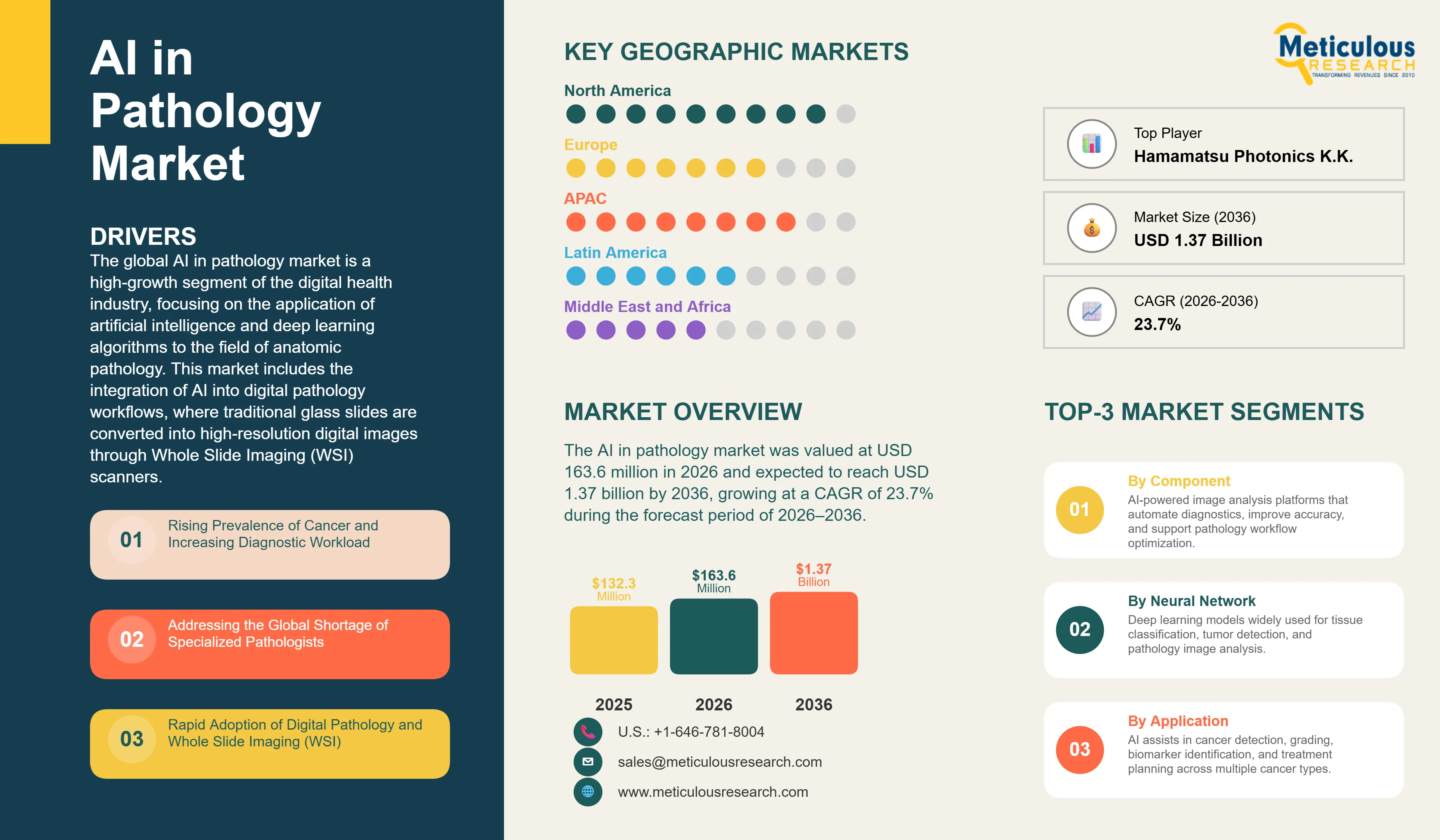
The global AI in pathology market was valued at USD 163.6 million in 2026. This market is expected to reach USD 1.37 billion by 2036, growing at a CAGR of 23.7% during the forecast period of 2026–2036.
 Click here to: Get Free Sample Pages of this Report
The global AI in pathology market is a high-growth segment of the digital health industry, focusing on the application of artificial intelligence and deep learning algorithms to the field of anatomic pathology. This market includes the integration of AI into digital pathology workflows, where traditional glass slides are converted into high-resolution digital images through Whole Slide Imaging (WSI) scanners. AI algorithms are then used to assist pathologists in tasks such as automated cell counting, tissue segmentation, and the detection of subtle clinical findings that may be difficult to identify through traditional microscopy. The adoption of AI in pathology is driven by the need to manage the increasing diagnostic workload, address the global shortage of specialized pathologists, and improve the precision of disease diagnosis, particularly in oncology.
The transition from analog to digital pathology is a fundamental driver for the AI market. As of 2025, digital pathology adoption is estimated at approximately 20-25% in the U.S. and Europe, providing a growing foundation for the implementation of AI-enabled diagnostic tools. Regulatory bodies are increasingly authorizing AI-based pathology software, with a surge in clearances for tools focused on breast, prostate, and lung cancer. As of March 2026, the FDA has authorized 1,451 AI-enabled medical devices, and while radiology currently holds the dominant share of AI authorizations, pathology is recognized as a rapidly growing emerging specialty for AI. AI algorithms have demonstrated high sensitivity, with studies showing 96% sensitivity for detecting metastatic prostate cancer findings in lymph nodes and pan-cancer AI achieving 100% conditional sensitivity, highlighting their potential to serve as a reliable second opinion for clinicians.
Despite the significant potential, the AI in pathology market faces restraints, including high initial implementation costs and cultural resistance to changing long-standing diagnostic workflows. The investment required for high-speed scanners, robust IT infrastructure, and specialized software licenses can be a barrier for smaller diagnostic laboratories. Furthermore, managing the large file sizes generated by WSI scanners poses a long-term data management challenge. However, the emergence of AI-driven drug discovery and companion diagnostics (CDx) presents substantial growth opportunities. Pharmaceutical companies are increasingly using AI to analyze pathology slides in clinical trials to identify biomarkers and predict patient response to targeted therapies, driving the integration of AI into the drug development lifecycle.
Geographically, North America is expected to dominate the global AI in pathology market in 2026, driven by a mature regulatory environment and high adoption of digital pathology in large academic medical centers. Meanwhile, Asia-Pacific AI in pathology market is projected to witness the fastest growth through 2036, driven by government-led digital health initiatives and the increasing prevalence of cancer in the region. The competitive landscape is characterized by a mix of established diagnostic imaging giants like Leica Biosystems and Roche, and specialized AI software providers such as Paige AI and PathAI. As the industry moves toward 2036, the focus is expected to shift toward multi-modal AI and the integration of real-world evidence to further personalize diagnostic pathways.
The primary driver for the AI in pathology market is the increasing prevalence of cancer and other chronic diseases globally. As the number of biopsy procedures increases, the workload for pathologists has reached unprecedented levels. AI algorithms assist by automating routine tasks such as cell counting and IHC scoring, allowing pathologists to focus on more complex diagnostic decisions. The Digital Pathology Association (DPA) has highlighted that AI is essential for maintaining diagnostic quality and addressing the global shortage of specialized pathologists.
Another key driver is the technological advancement in Whole Slide Imaging (WSI) and high-speed data transfer. Improvements in scanner speed and image quality have made digital pathology a viable alternative to traditional microscopy. The integration of deep learning, particularly convolutional neural networks (CNNs), has enabled the development of highly accurate algorithms for tissue segmentation and feature classification. This technological foundation is driving the rapid expansion of AI-based diagnostic tools in clinical and research settings.
A major restraint is the high initial cost of implementing digital pathology and AI systems. The transition requires a significant capital investment in scanners, high-performance computing hardware, and software licenses. Furthermore, the cultural and workflow challenges associated with moving away from traditional microscopy can lead to resistance among experienced pathologists. The lack of standardized data formats and interoperability between different scanner and software manufacturers also poses a challenge for widespread adoption in multi-vendor environments.
The integration of AI into drug discovery and development offers a significant growth opportunity. Pharmaceutical companies are increasingly using AI to analyze pathology slides in clinical trials to identify biomarkers and predict patient response to targeted therapies. This can lead to more efficient trial designs and the development of personalized treatment plans. Furthermore, the expansion of healthcare digitalization in emerging markets provides a massive opportunity for AI tools that can provide high-quality diagnostic support in areas with limited access to specialized pathology services.
Managing the large file sizes generated by digital pathology scanners remains a critical challenge. A single whole slide image can be several gigabytes in size, requiring robust storage solutions and high-speed network infrastructure. Additionally, ensuring the generalizability and lack of bias in AI algorithms is essential for maintaining clinical trust. AI models must be validated across diverse patient populations and imaging equipment to ensure consistent performance. The evolving regulatory landscape for adaptive and learning algorithms also poses a long-term challenge for the industry.
There is a growing trend toward the development of AI-based companion diagnostics, where AI algorithms are used to identify patients who are most likely to benefit from a specific targeted therapy. These tools analyze pathology slides to provide precise measurements of biomarker expression, such as PD-L1 or HER2. This trend is driving the integration of AI into personalized medicine and is being fueled by collaborations between AI software providers and pharmaceutical companies.
The integration of multi-modal AI, combining pathology image data with genomic, proteomic, and clinical information, is an emerging trend. These 'multi-omic' approaches provide a more comprehensive view of a patient's disease, leading to more accurate diagnosis and prognosis. AI algorithms are uniquely suited for integrating these diverse datasets and identifying complex patterns that are not visible through the analysis of a single data type.
Based on component, the overall AI in pathology market is segmented into Software, Scanners, and Services. In 2026, the software segment is expected to hold the largest share of the market. This dominance is due to the high value of AI algorithms for image analysis and the recurring revenue models associated with software-as-a-service (SaaS). AI software is the primary driver of innovation in the field, providing the analytical capabilities that transform digital images into actionable clinical insights.
The Services segment is projected to register the highest CAGR during the forecast period. This growth is driven by the increasing need for professional services, including implementation, training, and maintenance of complex digital pathology and AI systems. As more laboratories transition to digital workflows, the demand for specialized IT and clinical support services is expected to rise significantly.
North America is expected to dominate the global AI in pathology market in 2026, primarily due to its advanced healthcare infrastructure and high adoption of digital pathology. The U.S. is the leading hub for AI innovation in pathology, with a robust ecosystem of startups and significant investment from major diagnostic imaging firms. The presence of the FDA's Digital Health Center of Excellence and a supportive regulatory environment for digital health are key drivers. The key companies operating in the North American market are Leica Biosystems, Roche, Indica Labs, Paige AI, and PathAI.
The Asia-Pacific AI in pathology market is projected to witness the fastest growth during the forecast period. This is driven by rapid digitalization in healthcare, increasing investments in medical technology in China and India, and government initiatives to address the pathologist shortage. The region's large population and the increasing prevalence of cancer are driving the demand for scalable AI-based diagnostic solutions. The key companies operating in the Asia-Pacific market are Hamamatsu Photonics, Fujifilm Holdings, Olympus, and various emerging digital health specialists in the region.
The global AI in pathology market is characterized by intense competition and a high degree of innovation. The competitive landscape is shaped by a mix of established diagnostic imaging equipment manufacturers and specialized AI software developers. Major incumbents like Leica Biosystems (Danaher), Roche (Ventana), and Hamamatsu Photonics are increasingly integrating AI capabilities into their scanner and software platforms through internal development and strategic partnerships. These companies leverage their extensive installed bases and deep clinical relationships to drive the adoption of AI-enabled diagnostic tools.
In addition to the large incumbents, the market features a vibrant ecosystem of specialized AI software providers such as Paige AI, PathAI, and Ibex Medical Analytics. These companies focus on developing high-performance algorithms for specific clinical use cases, such as the detection of prostate or breast cancer. The market is also seeing a trend toward platform-based approaches, where 'AI marketplaces' allow laboratories to access multiple AI applications from different vendors through a single interface. Key players in the global AI in pathology market include Leica Biosystems, Roche Holding AG, Hamamatsu Photonics K.K., Fujifilm Holdings Corporation, Indica Labs, Inc., Proscia Inc., PathAI, Inc., and Paige AI, Inc.
The market is projected to reach USD 1.37 billion by 2036, growing at a CAGR of 23.7% from 2026 to 2036.
The software segment is expected to hold the largest share in 2026 due to the high value of image analysis algorithms.
The increasing prevalence of cancer and the global shortage of pathologists are the primary drivers.
Asia-Pacific is projected to witness the highest CAGR due to rapid digital transformation and increasing cancer incidence.
AI automates routine detection tasks and provides high-sensitivity second opinions, particularly for identifying metastatic findings.
Challenges include high initial implementation costs and cultural resistance to changing diagnostic workflows.
AI analyzes pathology slides in clinical trials to identify biomarkers and predict patient response to targeted therapies.
WSI scanners convert glass slides into digital images, providing the essential data foundation for AI analysis.
Regulators are focusing on the clinical validation of algorithms across diverse patient populations and scanner types.
Leading companies include Leica Biosystems, Roche, Hamamatsu Photonics, Fujifilm, Paige AI, and PathAI.
1. Introduction
1.1. Market Definition
1.2. Market Scope
1.3. Currency and Pricing
2. Research Methodology
2.1. Research Process
2.2. Data Collection & Sources
2.2.1. Primary Research
2.2.2. Secondary Research
2.3. Market Sizing & Forecasting
2.3.1. Bottom-up Approach
2.3.2. Top-down Approach
2.4. Data Triangulation & Validation
2.5. Assumptions & Limitations
3. Executive Summary
3.1. Market Overview
3.2. Segmental Analysis
3.3. Geographic Outlook
3.4. Competitive Insights
4. Market Insights
4.1. Introduction
4.2. Market Dynamics
4.2.1. Drivers
4.2.1.1. Rising Prevalence of Cancer and Increasing Diagnostic Workload
4.2.1.2. Addressing the Global Shortage of Specialized Pathologists
4.2.2. Restraints
4.2.2.1. High Initial Implementation Costs for Digital Pathology Infrastructure
4.2.2.2. Cultural and Workflow Resistance to Transitioning from Microscopy
4.2.3. Opportunities
4.2.3.1. Integration of AI into Drug Discovery and Clinical Biomarker Identification
4.2.3.2. Expansion of AI-Based Companion Diagnostics (CDx) for Personalized Medicine
4.2.4. Challenges
4.2.4.1. Managing Massive Data Storage and Network Requirements for WSI
4.2.4.2. Ensuring Interoperability Between Diverse Scanner and Software Platforms
4.3. Porter’s Five Forces Analysis
4.4. Regulatory Landscape
4.5. Value Chain Analysis
5. AI in Pathology Market Assessment, by Component
5.1. Introduction
5.2. Software
5.3. Scanners
5.4. Services
6. AI in Pathology Market Assessment, by Neural Network
6.1. Introduction
6.2. Convolutional Neural Networks (CNNs)
6.3. Generative Adversarial Networks (GANs)
6.4. Others
7. AI in Pathology Market Assessment, by Application
7.1. Introduction
7.2. Oncology
7.3. Cardiovascular Diseases
7.4. Infectious Diseases
7.5. Others
8. AI in Pathology Market Assessment, by End User
8.1. Introduction
8.2. Hospitals & Diagnostic Laboratories
8.3. Pharmaceutical & Biotechnology Companies
8.4. Academic & Research Institutions
9. AI in Pathology Market Assessment, by Geography
9.1. Introduction
9.2. North America
9.2.1. U.S.
9.2.2. Canada
9.3. Europe
9.3.1. Germany
9.3.2. UK
9.3.3. France
9.3.4. Italy
9.3.5. Spain
9.3.6. Rest of Europe
9.4. Asia-Pacific
9.4.1. China
9.4.2. India
9.4.3. Japan
9.4.4. Singapore
9.4.5. Australia
9.4.6. South Korea
9.4.7. Rest of Asia-Pacific
9.5. Latin America
9.5.1. Brazil
9.5.2. Mexico
9.5.3. Rest of Latin America
9.6. Middle East & Africa
9.6.1. UAE
9.6.2. Saudi Arabia
9.6.3. South Africa
9.6.4. Rest of MEA
10. Competitive Landscape
10.1. Introduction
10.2. Market Share Analysis
10.3. Competitive Benchmarking
10.4. Strategic Developments
10.4.1. Product Launches & Enhancements
10.4.2. Partnerships & Collaborations
10.4.3. Mergers & Acquisitions
11. Company Profiles
11.1. Leica Biosystems (Danaher Corporation)
11.2. Roche Holding AG
11.3. Hamamatsu Photonics K.K.
11.4. Fujifilm Holdings Corporation
11.5. Agilent Technologies, Inc.
11.6. Indica Labs, Inc.
11.7. Proscia Inc.
11.8. Ibex Medical Analytics Ltd.
11.9. Paige AI, Inc.
11.10. Visiopharm A/S
11.11. PathAI, Inc.
11.12. Aiforia Technologies Plc
11.13. DeepBio Inc.
11.14. Mindpeak GmbH
11.15. Akoya Biosciences, Inc.
11.16. Owkin
11.17. Nucleai
11.18. Lunit Inc.
11.19. Inspirata, Inc.
11.20. Others
12. Appendix
























Published Date: Jun-2026
Published Date: Apr-2026
Published Date: Feb-2026
Published Date: Feb-2026
Subscribe to get the latest industry updates