
AI in Blood Pressure Monitoring Market (2026-2036)
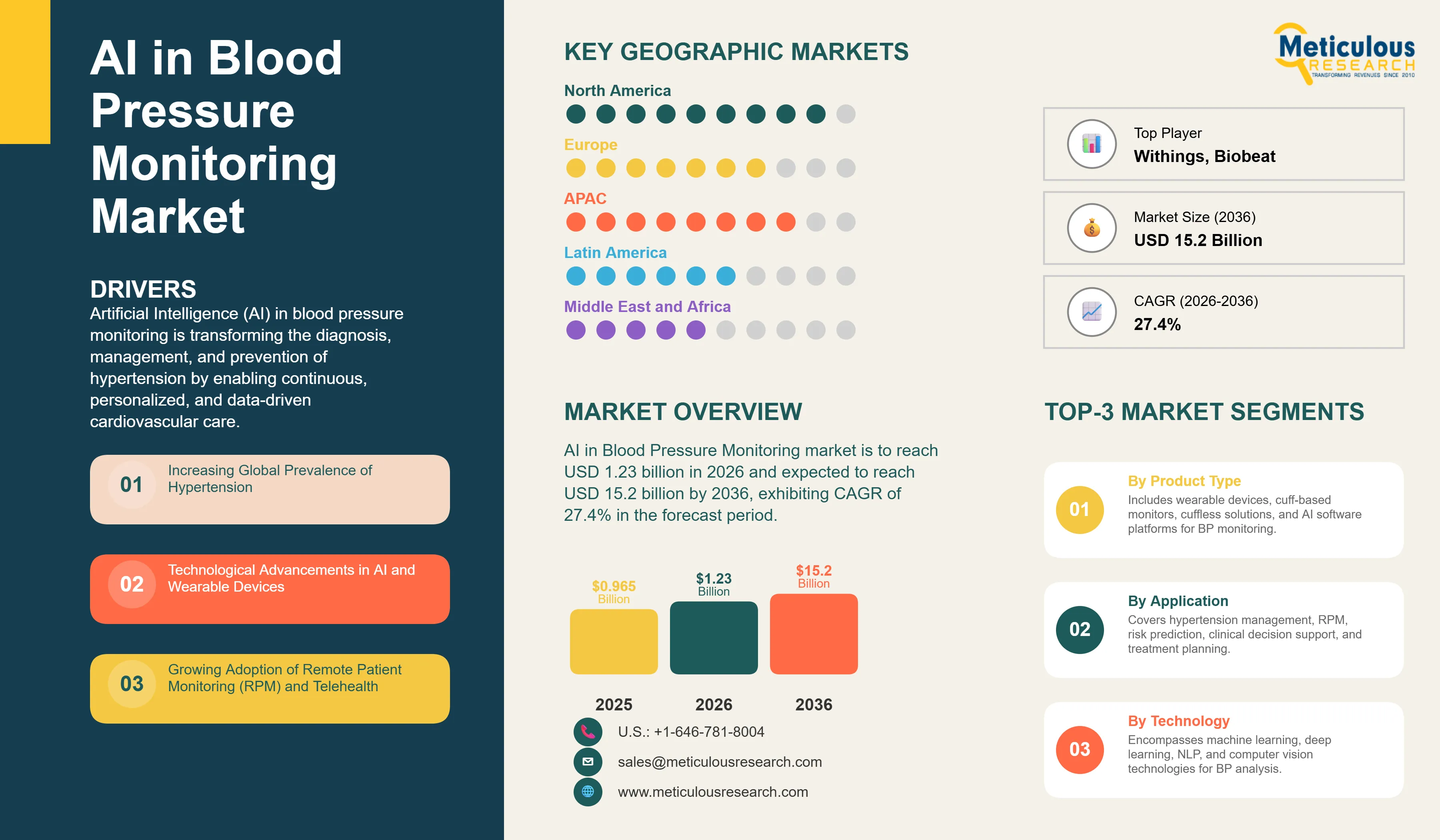
The global AI in Blood Pressure Monitoring market is projected to reach an estimated USD 1.23 billion in 2026 and is expected to grow significantly to USD 15.2 billion by 2036, exhibiting a robust Compound Annual Growth Rate (CAGR) of 27.4% during the forecast period.
- Published
- Jun 2026
- Pages
- 294
- Format
- PDF + Excel
- Report ID
- MRHC - 1042084
- Base year
- 2025
- 2026 · ESTIMATED
- $1.23B
- 2036
- $15.20B
- CAGR 2026–2036
- 27.4%
2025 baseline · 2026–2036 forecast at 27.4% CAGR · hover a bar for the value
Key highlights
The global AI in Blood Pressure Monitoring market is projected to reach USD 15.2 billion by 2036, growing at a CAGR of 27.4% during the forecast period 2026–2036.
North America is expected to dominate the global market in 2026, driven by its advanced healthcare infrastructure, strong adoption of digital health technologies, favorable reimbursement policies for remote patient monitoring, and the presence of leading technology and medical device companies.
Asia-Pacific is projected to witness the fastest growth, fueled by the rising prevalence of hypertension, expanding healthcare infrastructure, increasing digital health adoption, and supportive government initiatives in countries such as China and India.
By product type, the wearable devices segment is expected to hold the largest share in 2026, supported by growing consumer adoption of smartwatches and fitness trackers integrated with AI-enabled blood pressure monitoring capabilities.
By application, the hypertension management segment is expected to account for the largest share in 2026, owing to the increasing need for continuous monitoring and personalized treatment of patients with hypertension.
By technology, the machine learning algorithms segment is expected to hold the largest share in 2026, as machine learning forms the foundation of most AI-powered blood pressure monitoring and predictive analytics platforms.
By end user, the hospitals & clinics segment is expected to hold the largest share in 2026, driven by the widespread adoption of AI-enabled monitoring solutions to support clinical decision-making and chronic disease management.
Key players operating in the global market include Omron Healthcare, Withings, Biobeat, Aktiia, and Valencell.
Report summary
| Particulars | Details |
|---|---|
| Base Year | 2025 |
| Estimated Year | 2026 |
| Forecast Period | 2026–2036 |
| Market Size (2026) | USD 1.23 billion |
| Market Size (2036) | USD 15.20 billion |
| CAGR (2026–2036) | 27.4% |
| Format | PDF, Excel & Cloud Portal · 294 pages |
| Segments Covered | By Product Type: Wearable Devices, Cuff-Based Devices, Cuffless Solutions, Software & Platforms · By Application · By Technology · By End User |
Report overview
Segments covered: product type, application, technology, end user.
Artificial Intelligence (AI) in blood pressure monitoring is transforming the diagnosis, management, and prevention of hypertension by enabling continuous, personalized, and data-driven cardiovascular care. Unlike traditional intermittent cuff-based measurements, AI-powered solutions leverage advanced algorithms to analyze data from wearable devices, smart cuffs, cuffless sensors, and remote monitoring platforms, providing real-time insights, predictive risk assessments, and personalized treatment recommendations. This shift enables earlier detection of abnormalities and more proactive disease management.
The growing global burden of hypertension remains the primary driver of market growth. According to the World Health Organization (WHO), approximately 1.28 billion adults aged 30–79 years worldwide live with hypertension, yet only about 21% have their condition adequately controlled. Hypertension is also one of the leading risk factors for cardiovascular disease, which accounts for more than 20 million deaths annually worldwide, according to the World Heart Federation. These statistics highlight the urgent need for innovative monitoring solutions that can improve disease detection, patient engagement, and long-term blood pressure control.
The increasing adoption of remote patient monitoring, coupled with advancements in AI algorithms, wearable technologies, and cuffless blood pressure monitoring, is further accelerating market expansion. As healthcare systems increasingly prioritize preventive care and personalized medicine, AI-powered blood pressure monitoring solutions are emerging as critical tools for improving patient outcomes and reducing the burden of cardiovascular disease.
Report infographic
Market dynamics
20 factors across 5 forcesIncreasing Global Prevalence of Hypertension
The rising incidence of hypertension worldwide, driven by lifestyle changes, aging populations, and comorbidities, creates an urgent demand for more effective and accessible monitoring solutions. AI-powered systems offer the potential for widespread screening, early diagnosis, and continuous management, addressing a significant public health challenge.
Technological Advancements in AI and Wearable Devices
Continuous innovation in AI algorithms, machine learning, and deep learning, coupled with the proliferation of sophisticated wearable sensors and cuffless blood pressure monitoring devices, is enabling more accurate, non-invasive, and user-friendly solutions. These advancements are expanding the capabilities and accessibility of AI in blood pressure monitoring.
Growing Adoption of Remote Patient Monitoring (RPM) and Telehealth
The shift towards remote healthcare delivery, accelerated by global health events, has fueled the demand for RPM solutions. AI in blood pressure monitoring seamlessly integrates with telehealth platforms, allowing healthcare providers to remotely track patient data, receive alerts for critical changes, and provide timely interventions, thereby improving patient outcomes and reducing healthcare costs.
Demand for Personalized Healthcare and Predictive Analytics
AI's ability to analyze individual patient data, identify subtle patterns, and predict future health risks enables highly personalized hypertension management strategies. This caters to the growing patient and provider preference for tailored interventions that go beyond one-size-fits-all approaches.
Table of contents
12 chapters · 138 sections · 294 pages · click to expandSegmental analysis
| Segment | Largest share (2026) | Fastest growth (2026–2036) |
|---|---|---|
| By Product Type | Wearable devices | Cuffless solutions |
| By Application | Hypertension management | Predictive analytics and risk stratification |
| By Technology | Machine learning algorithms | Deep learning |
| By End User | Hospitals and clinics | Homecare settings |
By Product Type
- Analysis by Product Type: Devices and Software Driving Innovation
- The wearable devices segment is expected to hold the largest share of the global AI in blood pressure monitoring market.
- This dominance is attributed to the increasing consumer adoption of smartwatches and fitness trackers, coupled with continuous advancements in sensor technology and AI integration for non-invasive, continuous blood pressure measurement.
- The cuffless solutions segment is anticipated to witness the fastest CAGR, driven by the growing demand for more convenient and discreet monitoring methods, and breakthroughs in AI algorithms that enable accurate blood pressure estimation without traditional cuffs.
By Application
- Analysis by Application: From Hypertension Management to Predictive Health
- The hypertension management segment is projected to account for the largest share of the AI in blood pressure monitoring market.
- This is primarily due to the widespread prevalence of hypertension and the critical need for continuous, accurate monitoring to guide treatment decisions and improve patient outcomes.
- The predictive analytics and risk stratification segment is expected to grow at the fastest CAGR, propelled by AI's ability to identify individuals at high risk of developing hypertension and to forecast cardiovascular events, enabling proactive and preventive healthcare interventions.
By Technology
- Analysis by Technology: Machine Learning and Beyond
- The machine learning algorithms segment is expected to command the largest share of the global AI in blood pressure monitoring market.
- Machine learning forms the core of most AI-driven BP monitoring solutions, enabling pattern recognition, data analysis, and predictive modeling from complex physiological signals.
- The deep learning segment is anticipated to exhibit the fastest CAGR, driven by its superior capability in processing vast amounts of raw data from continuous monitoring devices and its potential for developing highly accurate and robust predictive models for blood pressure trends.
By End User
- Analysis by End User: Empowering Patients and Clinicians Across Settings
- The hospitals and clinics segment is expected to command the largest share of the global AI in blood pressure monitoring market.
- These settings are primary points of care for hypertension diagnosis and management, and the integration of AI solutions supports clinical decision-making, remote monitoring of inpatients, and management of chronic conditions.
- The homecare settings segment is anticipated to exhibit the fastest CAGR, driven by the increasing preference for remote monitoring, the rise of telehealth, and the growing availability of user-friendly AI-powered devices that empower patients to manage their blood pressure effectively at home.
Geographic analysis
North America
Largest shareNorth America is expected to hold the largest share of the global AI in Blood Pressure Monitoring market. This dominance is attributed to several factors, including a high prevalence of hypertension, advanced healthcare infrastructure, significant investments in digital health technologies, favorable reimbursement policies for remote monitoring, and the strong presence of key technology and medical device companies. The United States, in particular, is a major contributor due to its large patient population, robust R&D activities, and a proactive approach to integrating AI into clinical practice. North America: A Leader in AI Healthcare Innovation
Asia-Pacific
Fastest growthAsia-Pacific is projected to witness the fastest CAGR during the forecast period. This rapid growth is driven by the increasing prevalence of hypertension in populous countries like China and India, improving healthcare infrastructure, rising healthcare expenditure, growing adoption of digital health solutions, and a large tech-savvy population. Government initiatives supporting digital health and the emergence of local AI innovators also contribute to the region's market expansion. Asia-Pacific: Rapid Growth Fueled by Digital Transformation
Europe
Europe is expected to hold a significant share of the global AI in Blood Pressure Monitoring market, driven by a high burden of cardiovascular diseases, well-developed healthcare systems, and increasing regulatory support for digital health innovations. Countries like Germany, the U.K., and France are key contributors due to their focus on health technology assessment, favorable data protection regulations (e.g., GDPR), and strong research collaborations between academic institutions and industry. The key companies operating in the European market are Omron Healthcare, Withings, and Biobeat. Europe: Advancing AI in Healthcare with Strong Regulatory Support
Latin America
Latin America is anticipated to witness steady growth in the AI in Blood Pressure Monitoring market, primarily due to improving healthcare infrastructure, rising awareness about hypertension management, and increasing investments in digital health technologies in countries like Brazil and Mexico. The growing prevalence of chronic diseases in the region also contributes to the demand for AI-powered monitoring solutions. The key companies operating in the Latin American market are Omron Healthcare and Withings. Latin America: Growing Adoption Amidst Healthcare Modernization
Middle East & Africa
The Middle East & Africa region is expected to experience gradual growth in the AI in Blood Pressure Monitoring market, driven by increasing healthcare investments, government initiatives to modernize healthcare systems, and a growing focus on preventive medicine. Countries like UAE and Saudi Arabia are leading the adoption of advanced medical technologies and digital health solutions in the region. The key companies operating in the Middle East & Africa market are Omron Healthcare and Biobeat. Middle East & Africa: Emerging Opportunities in Digital Health
Competitive landscape
The global AI in Blood Pressure Monitoring market is characterized by a dynamic and evolving competitive landscape. It features a mix of established medical device manufacturers, technology giants, and innovative startups. Key players are focusing on product innovation, strategic partnerships, mergers and acquisitions, and geographic expansion to strengthen their market positions. The competitive strategy often revolves around developing highly accurate, user-friendly, and seamlessly integrated AI solutions that address the diverse needs of patients and healthcare providers. Companies are also investing heavily in clinical validation and regulatory approvals to gain a competitive edge.
Frequently asked questions
The global AI in Blood Pressure Monitoring market is estimated at USD 1.23 billion in 2026 and is projected to reach USD 15.2 billion by 2036, growing at a CAGR of 27.4%.
Cite this report
Meticulous Research. (2026). AI in Blood Pressure Monitoring Market - Global Opportunity Analysis and Industry Forecast (2026-2036) (Report No. MRHC - 1042084). Meticulous Market Research Pvt. Ltd. https://www.meticulousresearch.com/product/ai-in-blood-pressure-monitoring-market-6767