AI in Biotechnology Market (2026-2036)
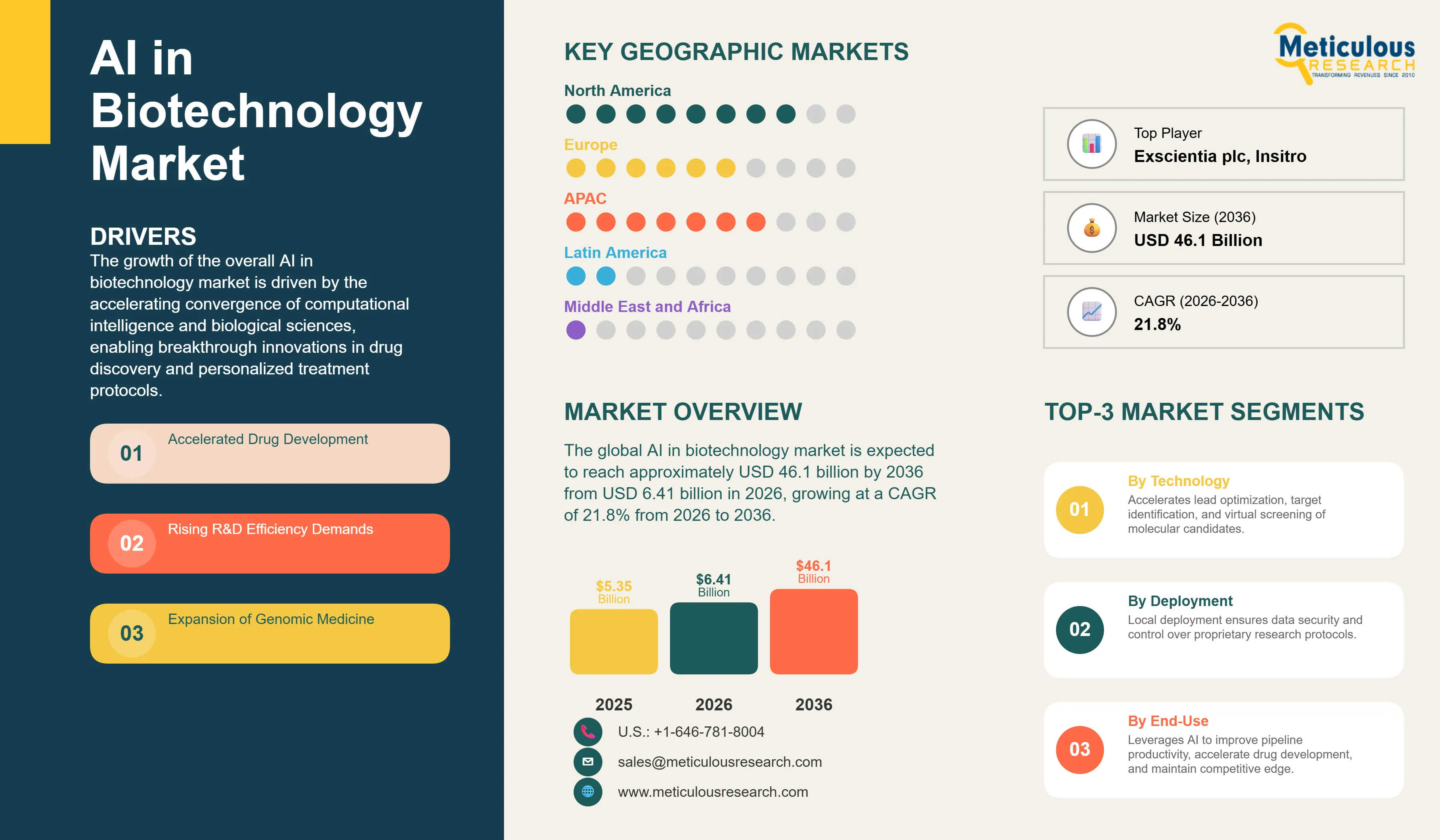
The global AI in biotechnology market was valued at USD 5.35 billion in 2025. The market is expected to reach approximately USD 46.1 billion by 2036 from USD 6.41 billion in 2026, growing at a CAGR of 21.8% from 2026 to 2036.
- Published
- Feb 2026
- Pages
- 277
- Format
- PDF + Excel
- Report ID
- MR-1787
- Base year
- 2025
- 2025 · BASELINE
- $5.35B
- 2036
- $46.10B
- CAGR 2026–2036
- 21.8%
2025 baseline · 2026–2036 forecast at 21.8% CAGR · hover a bar for the value
Key highlights
In terms of revenue, the global AI in biotechnology market is projected to reach USD 46.1 billion by 2036.
The market is expected to grow at a CAGR of 21.8% from 2026 to 2036.
North America dominates the global AI in biotechnology market with the largest market share in 2026, driven by substantial investments in computational biology infrastructure and the concentration of leading pharmaceutical innovators in the U.S. and Canada.
Asia-Pacific is expected to witness the fastest growth during the forecast period, supported by expanding biotech research capabilities and government initiatives promoting AI-driven healthcare innovation in China, India, and Singapore.
By technology, the drug discovery & development segment holds the largest market share in 2026, particularly in supporting small molecule design, target identification, and accelerated clinical candidate optimization.
By deployment, the cloud-based segment holds the largest market share in 2026, due to its scalability and ability to handle massive biological datasets with collaborative research workflows.
By end-use, the pharmaceutical companies segment holds the largest share of the overall market in 2026.
Report summary
| Particulars | Details |
|---|---|
| Market Size by 2036 | USD 46.1 Billion |
| Market Size in 2026 | USD 6.41 Billion |
| Market Size in 2025 | USD 5.35 Billion |
| Market Growth Rate (2026-2036) | CAGR of 21.8% |
| Format | PDF, Excel & Cloud Portal · 277 pages |
| Dominating Region | North America |
| Fastest Growing Region | Asia-Pacific |
| Base Year | 2025 |
| Forecast Period | 2026 to 2036 |
| Segments Covered | Technology, Deployment, End-use, and Region |
| Regions Covered | North America, Europe, Asia-Pacific, Latin America, and Middle East & Africa |
Report overview
Segments covered: technology, deployment, end-use.
The growth of the overall AI in biotechnology market is driven by the accelerating convergence of computational intelligence and biological sciences, enabling breakthrough innovations in drug discovery and personalized treatment protocols. As pharmaceutical organizations seek to compress development timelines and enhance the precision of therapeutic interventions, AI-powered platforms have become essential for maintaining competitive advantage in biological research and clinical translation. The rapid expansion of genomic datasets and the increasing need for high-throughput screening in complex disease environments continue to fuel significant growth of this market across all major geographic regions.
AI in biotechnology represents the integration of machine learning algorithms, deep neural networks, and advanced computational frameworks to accelerate biological discovery and optimize therapeutic development across the entire research lifecycle. These systems include sophisticated pattern recognition engines, predictive modeling platforms, and automated analysis tools designed to extract meaningful insights from complex biological datasets and enhance decision-making precision in research environments. The market is defined by transformative technologies such as generative AI for molecular design and transformer-based models for protein structure prediction, which significantly enhance discovery speed and resource efficiency in high-stakes pharmaceutical development. These systems are indispensable for research organizations seeking to optimize their discovery pipelines and meet ambitious timelines for bringing novel therapies to patients.
The market includes a diverse range of solutions, ranging from specialized algorithms for target identification to comprehensive AI-driven platforms that manage entire drug development workflows. These systems are increasingly integrated with advanced capabilities such as multi-omics data fusion and real-time laboratory automation to provide services such as predictive toxicology analysis and patient stratification for clinical studies. The ability to provide accurate, high-confidence predictions while minimizing experimental waste has made AI technology the choice for institutions where research productivity and therapeutic success are paramount.
The global biotechnology sector is pushing hard to modernize discovery capabilities, aiming to meet precision medicine goals and address unmet medical needs more efficiently. This drive has increased the adoption of intelligent automation solutions, with advanced AI platforms helping to accelerate compound optimization and streamline regulatory submission processes. At the same time, the rapid growth in genomic sequencing capabilities and digital health integration is increasing the need for sophisticated, scalable computational solutions.
Report infographic
Market dynamics
4 factors across 3 forcesAccelerated Drug Development and Rising R&D Efficiency Demands
A key driver of the AI in biotechnology market is the pharmaceutical industry's urgent need to reduce development timelines and improve success rates in clinical translation. Global pressure to address complex diseases, emerging pathogens, and aging population healthcare needs has created significant incentives for the adoption of AI-powered research infrastructure. The trend toward data-driven decision-making and the integration of computational tools into laboratory workflows drive pharmaceutical organizations toward scalable solutions that AI can uniquely provide. It is estimated that as precision medicine adoption expands and regulatory frameworks evolve to accommodate algorithmic evidence through 2036, the need for validated, transparent AI platforms increases significantly; therefore, advanced machine learning systems and integrated discovery platforms, with their ability to ensure high-confidence predictions and reproducible outcomes, are considered a crucial enabler of modern therapeutic development strategies.
Table of contents
10 chapters · 106 sections · 277 pages · click to expandSegmental analysis
| Segment | Largest share (2026) | Fastest growth (2026–2036) |
|---|---|---|
| By Technology | Drug Discovery & Development | — |
| By Deployment | Cloud-based | — |
| By End-use | Pharmaceutical Companies | Biotechnology companies |
By Technology
- The drug discovery & development segment accounts for a significant portion of the overall AI in biotechnology market in 2026.
- This is mainly attributed to the technology's transformative impact on accelerating lead optimization, reducing preclinical attrition, and enabling virtual screening of millions of molecular candidates within modern pharmaceutical workflows.
- These platforms offer the most comprehensive approach to address productivity challenges across diverse therapeutic areas.
- The pharmaceutical sector alone invests heavily in AI-powered discovery platforms, with major programs at companies like Pfizer, Roche, and Novartis demonstrating the technology's capability to identify clinical candidates faster than traditional methods.
- However, the genomics & gene editing segment is expected to grow at a rapid CAGR during the forecast period, driven by the expanding applications of CRISPR technologies, increasing demand for therapeutic gene modifications, and the critical need for AI-assisted design of precise genetic interventions in complex hereditary diseases.
By Deployment
- The cloud-based segment holds the largest share of the overall market in 2026.
- This is primarily due to the massive computational requirements of biological data analysis and the collaborative nature of modern biotechnology research requiring accessible, scalable infrastructure.
- Current large-scale discovery programs are increasingly leveraging distributed computing platforms to ensure rapid iteration cycles and seamless integration with laboratory information management systems.
- The on-premise segment maintains relevance for organizations with stringent data security requirements and proprietary research protocols.
- The need for complete control over sensitive intellectual property and patient information in regulated environments ensures continued adoption of locally deployed AI systems, particularly among established pharmaceutical corporations managing confidential early-stage programs.
By End-use
- The pharmaceutical companies segment commands the largest share of the global AI in biotechnology market in 2026.
- This dominance stems from its substantial R&D budgets, urgent need to improve pipeline productivity, and strategic focus on leveraging computational technologies to maintain competitive positioning in therapeutic innovation.
- Large-scale drug development programs, from target identification through clinical trial optimization, drive demand, with advanced platforms from providers like IBM Watson Health and NVIDIA enabling accelerated discovery timelines and improved success probabilities.
- However, the biotechnology companies segment is poised for rapid growth through 2036, fueled by the emergence of AI-native startups and the increasing adoption of algorithmic approaches in specialized therapeutic areas.
- These organizations face unique opportunities to build discovery platforms around AI capabilities from inception, where computational tools provide strategic advantages in addressing niche disease areas and developing innovative treatment modalities with limited traditional research infrastructure.
Geographic analysis
North America
Largest shareNorth America holds the largest share of the global AI in biotechnology market in 2026. The largest share of this region is primarily attributed to the concentration of leading pharmaceutical and technology companies, substantial venture capital investment in computational biology, and the presence of world-class research institutions, particularly in the United States. The U.S. alone accounts for a significant portion of global AI biotechnology investment, with its position as a leader in both pharmaceutical innovation and artificial intelligence research driving sustained market growth. The presence of pioneering companies like Recursion Pharmaceuticals, Insitro, and Atomwise, combined with a well-established ecosystem connecting academic research with commercial applications, provides a robust foundation for both foundational research and clinical translation.
Asia-Pacific
Fastest growthAsia-Pacific is expected to witness the fastest growth during the forecast period, driven by expanding biotechnology infrastructure, government-led initiatives promoting AI adoption in healthcare, and the rapid digitalization of clinical research in countries like China, India, and Singapore. China's substantial investments in genomics research and AI development, combined with India's growing bioinformatics capabilities and Singapore's focus on precision medicine, create significant opportunities for market expansion. The region benefits from large patient populations enabling extensive clinical data generation and increasingly sophisticated research capabilities at leading institutions.
Europe
Europe maintains a substantial market presence, with leadership in regulatory science and strong emphasis on responsible AI deployment in healthcare settings. Countries like the United Kingdom, Germany, and Switzerland are at the forefront, with significant academic-industry collaboration through initiatives focused on integrating computational approaches into drug discovery workflows and establishing frameworks for algorithmic validation in medical applications.
Competitive landscape
- IBM Watson Health (IBM Corporation)
- Google DeepMind (Alphabet Inc.)
- Microsoft Corporation
- NVIDIA Corporation
Frequently asked questions
The global AI in biotechnology market is expected to grow from USD 6.41 billion in 2026 to USD 46.1 billion by 2036.
Cite this report
Meticulous Research. (2026). AI in Biotechnology Market - Global Opportunity Analysis and Industry Forecast (2026-2036) (Report No. MR-1787). Meticulous Market Research Pvt. Ltd. https://www.meticulousresearch.com/product/ai-in-biotechnology-market-6470