Resources
About Us
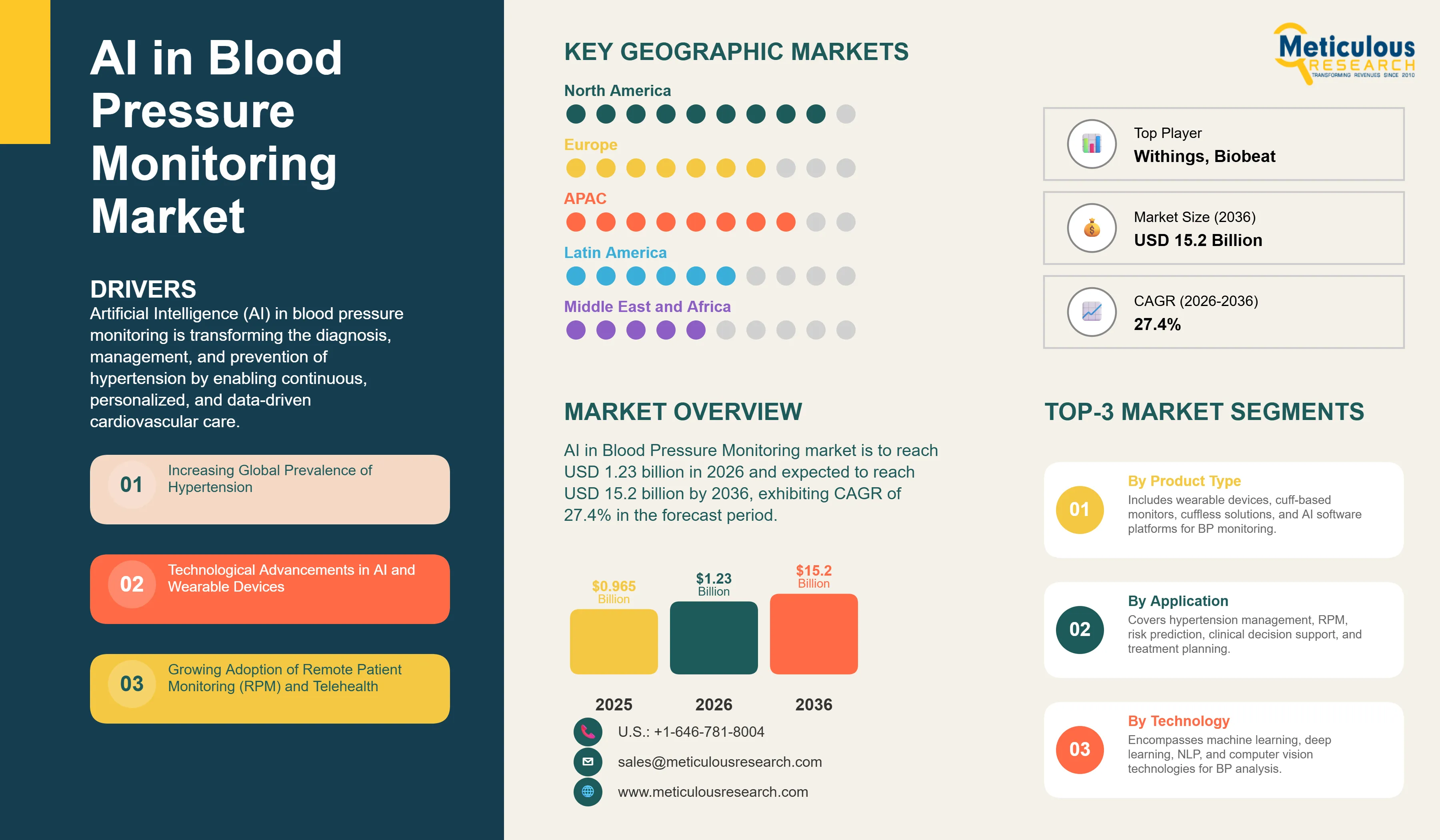
The global AI in Blood Pressure Monitoring market is projected to reach an estimated USD 1.23 billion in 2026 and is expected to grow significantly to USD 15.2 billion by 2036, exhibiting a robust Compound Annual Growth Rate (CAGR) of 27.4% during the forecast period.
Click here to: Get Free Sample Pages of this Report
Artificial Intelligence (AI) in blood pressure monitoring is transforming the diagnosis, management, and prevention of hypertension by enabling continuous, personalized, and data-driven cardiovascular care. Unlike traditional intermittent cuff-based measurements, AI-powered solutions leverage advanced algorithms to analyze data from wearable devices, smart cuffs, cuffless sensors, and remote monitoring platforms, providing real-time insights, predictive risk assessments, and personalized treatment recommendations. This shift enables earlier detection of abnormalities and more proactive disease management.
The growing global burden of hypertension remains the primary driver of market growth. According to the World Health Organization (WHO), approximately 1.28 billion adults aged 30–79 years worldwide live with hypertension, yet only about 21% have their condition adequately controlled. Hypertension is also one of the leading risk factors for cardiovascular disease, which accounts for more than 20 million deaths annually worldwide, according to the World Heart Federation. These statistics highlight the urgent need for innovative monitoring solutions that can improve disease detection, patient engagement, and long-term blood pressure control.
The increasing adoption of remote patient monitoring, coupled with advancements in AI algorithms, wearable technologies, and cuffless blood pressure monitoring, is further accelerating market expansion. As healthcare systems increasingly prioritize preventive care and personalized medicine, AI-powered blood pressure monitoring solutions are emerging as critical tools for improving patient outcomes and reducing the burden of cardiovascular disease.
Drivers: Catalysts for AI in Blood Pressure Monitoring Market Growth
Increasing Global Prevalence of Hypertension: The rising incidence of hypertension worldwide, driven by lifestyle changes, aging populations, and comorbidities, creates an urgent demand for more effective and accessible monitoring solutions. AI-powered systems offer the potential for widespread screening, early diagnosis, and continuous management, addressing a significant public health challenge.
Technological Advancements in AI and Wearable Devices: Continuous innovation in AI algorithms, machine learning, and deep learning, coupled with the proliferation of sophisticated wearable sensors and cuffless blood pressure monitoring devices, is enabling more accurate, non-invasive, and user-friendly solutions. These advancements are expanding the capabilities and accessibility of AI in blood pressure monitoring.
Growing Adoption of Remote Patient Monitoring (RPM) and Telehealth: The shift towards remote healthcare delivery, accelerated by global health events, has fueled the demand for RPM solutions. AI in blood pressure monitoring seamlessly integrates with telehealth platforms, allowing healthcare providers to remotely track patient data, receive alerts for critical changes, and provide timely interventions, thereby improving patient outcomes and reducing healthcare costs.
Demand for Personalized Healthcare and Predictive Analytics: AI's ability to analyze individual patient data, identify subtle patterns, and predict future health risks enables highly personalized hypertension management strategies. This caters to the growing patient and provider preference for tailored interventions that go beyond one-size-fits-all approaches.
Restraints: Navigating the Hurdles to AI in Blood Pressure Monitoring Adoption
Data Privacy and Security Concerns: The collection and analysis of sensitive health data by AI-powered devices raise significant concerns regarding data privacy, cybersecurity, and regulatory compliance. Ensuring robust data protection measures and building patient trust are critical challenges.
Regulatory Complexities and Lack of Standardization: The rapid evolution of AI in medical devices often outpaces regulatory frameworks, leading to complexities in obtaining approvals and establishing clear guidelines for clinical validation. A lack of standardized protocols for AI algorithm development and deployment can hinder market growth.
High Cost of Advanced AI Solutions: The initial investment required for developing, implementing, and maintaining sophisticated AI-powered blood pressure monitoring systems can be substantial. This high cost may limit adoption, particularly in resource-constrained healthcare settings or developing economies.
Accuracy and Validation Challenges in Diverse Populations: Ensuring the accuracy and reliability of AI algorithms across diverse patient demographics, ethnicities, and physiological conditions remains a challenge. Extensive clinical validation is required to build confidence in these technologies.
Opportunities: Unlocking New Avenues for AI in Blood Pressure Monitoring Growth
Integration with Broader Digital Health Ecosystems: The opportunity to integrate AI blood pressure monitoring solutions with electronic health records (EHRs), other digital health apps, and wellness platforms can create a comprehensive and seamless patient management experience, enhancing value proposition and market reach.
Expansion into Preventive Care and Early Detection: AI's predictive capabilities offer significant potential for shifting from reactive treatment to proactive preventive care. Identifying individuals at high risk of developing hypertension before onset can open new market segments focused on early intervention and lifestyle modification.
Development of Novel Cuffless and Continuous Monitoring Technologies: The ongoing research and development in cuffless and continuous blood pressure monitoring devices, powered by AI, represents a major opportunity. These less intrusive and more convenient solutions can significantly improve patient adherence and data collection.
Emerging Markets and Underserved Populations: Developing economies with rapidly growing healthcare infrastructure and a high burden of hypertension present substantial untapped market potential. AI-powered solutions can offer scalable and cost-effective ways to address healthcare disparities in these regions.
Challenges: Overcoming Obstacles in the AI in Blood Pressure Monitoring Market
Physician Acceptance and Training: Gaining widespread acceptance among healthcare professionals and providing adequate training on the effective use and interpretation of AI-driven insights are crucial. Overcoming skepticism and integrating these tools into clinical workflows require significant educational efforts.
Interoperability Issues: Ensuring seamless data exchange and interoperability between different AI devices, platforms, and existing healthcare IT systems is a complex challenge. Lack of interoperability can create data silos and hinder the holistic management of patient health.
Ethical Considerations and Bias in AI Algorithms: Addressing ethical concerns related to AI decision-making, potential algorithmic bias, and ensuring equitable access to these technologies are critical for responsible development and deployment. Bias in algorithms could lead to health disparities.
Patient Adherence and Engagement: While AI offers advanced monitoring, patient adherence to using devices and engaging with health recommendations remains a challenge. Designing user-friendly interfaces and incorporating motivational strategies are essential for long-term success.
Key Trends in the Global AI in Blood Pressure Monitoring Market
The AI in blood pressure monitoring market is being shaped by the rapid advancement of cuffless and continuous monitoring technologies. Manufacturers are increasingly integrating AI into smartwatches, smart rings, and camera-based monitoring platforms to enable non-invasive blood pressure assessment and real-time health tracking. This trend is gaining importance as the World Health Organization (WHO) estimates that approximately 1.28 billion adults worldwide live with hypertension, while only about 21% achieve adequate blood pressure control, highlighting the need for more frequent and accessible monitoring solutions.
Another major trend is the growing adoption of predictive analytics and personalized hypertension management. AI algorithms are increasingly being used to identify hypertension risk, predict cardiovascular events, and support individualized treatment decisions. This is particularly significant given that cardiovascular diseases cause more than 20 million deaths annually worldwide, according to the World Heart Federation, creating strong demand for technologies that enable earlier intervention and risk reduction.
The integration of AI-powered blood pressure monitoring with remote patient monitoring (RPM), telehealth platforms, and broader digital health ecosystems is also accelerating. According to the U.S. Centers for Disease Control and Prevention (CDC), nearly half of U.S. adults have hypertension or take medication for hypertension, driving demand for scalable remote monitoring solutions that can improve disease management outside traditional healthcare settings.
In parallel, manufacturers are increasing investments in clinical validation and regulatory approvals to strengthen confidence in AI-driven medical devices. Growing regulatory attention to software as a medical device (SaMD), combined with the emergence of AI-enabled preventive care solutions, is supporting the development of tools capable of identifying at-risk individuals earlier and delivering proactive lifestyle and treatment recommendations.
Analysis by Product Type: Devices and Software Driving Innovation
Based on product type, the wearable devices segment is expected to hold the largest share of the global AI in blood pressure monitoring market. This dominance is attributed to the increasing consumer adoption of smartwatches and fitness trackers, coupled with continuous advancements in sensor technology and AI integration for non-invasive, continuous blood pressure measurement. The cuffless solutions segment is anticipated to witness the fastest CAGR, driven by the growing demand for more convenient and discreet monitoring methods, and breakthroughs in AI algorithms that enable accurate blood pressure estimation without traditional cuffs.
Analysis by Application: From Hypertension Management to Predictive Health
The hypertension management segment is projected to account for the largest share of the AI in blood pressure monitoring market. This is primarily due to the widespread prevalence of hypertension and the critical need for continuous, accurate monitoring to guide treatment decisions and improve patient outcomes. The predictive analytics and risk stratification segment is expected to grow at the fastest CAGR, propelled by AI's ability to identify individuals at high risk of developing hypertension and to forecast cardiovascular events, enabling proactive and preventive healthcare interventions.
Analysis by Technology: Machine Learning and Beyond
Based on technology, the machine learning algorithms segment is expected to command the largest share of the global AI in blood pressure monitoring market. Machine learning forms the core of most AI-driven BP monitoring solutions, enabling pattern recognition, data analysis, and predictive modeling from complex physiological signals. The deep learning segment is anticipated to exhibit the fastest CAGR, driven by its superior capability in processing vast amounts of raw data from continuous monitoring devices and its potential for developing highly accurate and robust predictive models for blood pressure trends.
Analysis by End User: Empowering Patients and Clinicians Across Settings
The hospitals and clinics segment is expected to command the largest share of the global AI in blood pressure monitoring market. These settings are primary points of care for hypertension diagnosis and management, and the integration of AI solutions supports clinical decision-making, remote monitoring of inpatients, and management of chronic conditions. The homecare settings segment is anticipated to exhibit the fastest CAGR, driven by the increasing preference for remote monitoring, the rise of telehealth, and the growing availability of user-friendly AI-powered devices that empower patients to manage their blood pressure effectively at home.
Geographic Analysis: Regional Dynamics in AI Blood Pressure Monitoring Adoption
North America: A Leader in AI Healthcare Innovation
North America is expected to hold the largest share of the global AI in Blood Pressure Monitoring market. This dominance is attributed to several factors, including a high prevalence of hypertension, advanced healthcare infrastructure, significant investments in digital health technologies, favorable reimbursement policies for remote monitoring, and the strong presence of key technology and medical device companies. The United States, in particular, is a major contributor due to its large patient population, robust R&D activities, and a proactive approach to integrating AI into clinical practice.
Asia-Pacific: Rapid Growth Fueled by Digital Transformation
Asia-Pacific is projected to witness the fastest CAGR during the forecast period. This rapid growth is driven by the increasing prevalence of hypertension in populous countries like China and India, improving healthcare infrastructure, rising healthcare expenditure, growing adoption of digital health solutions, and a large tech-savvy population. Government initiatives supporting digital health and the emergence of local AI innovators also contribute to the region's market expansion.
Europe: Advancing AI in Healthcare with Strong Regulatory Support
Europe is expected to hold a significant share of the global AI in Blood Pressure Monitoring market, driven by a high burden of cardiovascular diseases, well-developed healthcare systems, and increasing regulatory support for digital health innovations. Countries like Germany, the U.K., and France are key contributors due to their focus on health technology assessment, favorable data protection regulations (e.g., GDPR), and strong research collaborations between academic institutions and industry. The key companies operating in the European market are Omron Healthcare, Withings, and Biobeat.
Latin America: Growing Adoption Amidst Healthcare Modernization
Latin America is anticipated to witness steady growth in the AI in Blood Pressure Monitoring market, primarily due to improving healthcare infrastructure, rising awareness about hypertension management, and increasing investments in digital health technologies in countries like Brazil and Mexico. The growing prevalence of chronic diseases in the region also contributes to the demand for AI-powered monitoring solutions. The key companies operating in the Latin American market are Omron Healthcare and Withings.
Middle East & Africa: Emerging Opportunities in Digital Health
The Middle East & Africa region is expected to experience gradual growth in the AI in Blood Pressure Monitoring market, driven by increasing healthcare investments, government initiatives to modernize healthcare systems, and a growing focus on preventive medicine. Countries like UAE and Saudi Arabia are leading the adoption of advanced medical technologies and digital health solutions in the region. The key companies operating in the Middle East & Africa market are Omron Healthcare and Biobeat.
The global AI in Blood Pressure Monitoring market is characterized by a dynamic and evolving competitive landscape. It features a mix of established medical device manufacturers, technology giants, and innovative startups. Key players are focusing on product innovation, strategic partnerships, mergers and acquisitions, and geographic expansion to strengthen their market positions. The competitive strategy often revolves around developing highly accurate, user-friendly, and seamlessly integrated AI solutions that address the diverse needs of patients and healthcare providers. Companies are also investing heavily in clinical validation and regulatory approvals to gain a competitive edge.
The global AI in Blood Pressure Monitoring market is estimated at USD 1.23 billion in 2026 and is projected to reach USD 15.2 billion by 2036, growing at a CAGR of 27.4%.
The market is driven by the increasing global prevalence of hypertension, technological advancements in AI and wearable devices, growing adoption of remote patient monitoring, and demand for personalized healthcare.
Key restraints include data privacy and security concerns, regulatory complexities, high cost of advanced AI solutions, and accuracy/validation challenges in diverse populations.
Opportunities include integration with broader digital health ecosystems, expansion into preventive care, development of novel cuffless technologies, and growth in emerging markets.
Challenges include physician acceptance and training, interoperability issues, ethical considerations and bias in AI algorithms, and patient adherence/engagement.
Wearable devices hold the largest share, while cuffless solutions are expected to grow the fastest.
Hypertension management dominates the market, and predictive analytics and risk stratification are projected to have the highest CAGR.
Machine learning algorithms hold the largest share, and deep learning is anticipated to grow the fastest.
Which end-user segment accounts for the largest share, and which is anticipated to grow the fastest?
Hospitals and clinics hold the largest share, and homecare settings are expected to grow the fastest.
North America leads the market, and Asia-Pacific is projected to exhibit the fastest growth.
1. Introduction
1.1. Market Definition & Scope
1.2. Market Ecosystem
1.3. Currency Considered
1.4. Key Stakeholders
2. Research Methodology
2.1. Research Approach
2.2. Data Collection and Validation
2.2.1. Secondary Research
2.2.2. Primary Research/KOL Interviews
2.3. Market Sizing and Forecast
2.3.1. Market Size Estimation Approach
2.3.1.1. Bottom-Up Approach
2.3.1.2. Top-Down Approach
2.3.2. Growth Forecast Approach
2.3.3. Assumptions for the Study
3. Executive Summary
3.1. Overview
3.2. Segmental Analysis
3.2.1. Market Analysis, by Product Type
3.2.2. Market Analysis, by Application
3.2.3. Market Analysis, by Technology
3.2.4. Market Analysis, by End User
3.2.5. Market Analysis, by Geography
3.3. Competitive Analysis
4. Market Insights
4.1. Overview
4.2. Factors Affecting Market Growth
4.2.1. Drivers
4.2.1.1. Increasing Global Prevalence of Hypertension
4.2.1.2. Technological Advancements in AI and Wearable Devices
4.2.1.3. Growing Adoption of Remote Patient Monitoring (RPM) and Telehealth
4.2.1.4. Demand for Personalized Healthcare and Predictive Analytics
4.2.2. Restraints
4.2.2.1. Data Privacy and Security Concerns
4.2.2.2. Regulatory Complexities and Lack of Standardization
4.2.2.3. High Cost of Advanced AI Solutions
4.2.2.4. Accuracy and Validation Challenges in Diverse Populations
4.2.3. Opportunities
4.2.3.1. Integration with Broader Digital Health Ecosystems
4.2.3.2. Expansion into Preventive Care and Early Detection
4.2.3.3. Development of Novel Cuffless and Continuous Monitoring Technologies
4.2.3.4. Emerging Markets and Underserved Populations
4.2.4. Challenges
4.2.4.1. Physician Acceptance and Training
4.2.4.2. Interoperability Issues
4.2.4.3. Ethical Considerations and Bias in AI Algorithms
4.2.4.4. Patient Adherence and Engagement
4.2.5. Key Trends
4.3. Porter’s Five Forces Analysis
4.4. Regulatory Landscape
4.5. Value Chain Analysis
5. Global AI in Blood Pressure Monitoring Market, by Product Type
5.1. Overview
5.2. Wearable Devices
5.2.1. Smartwatches
5.2.2. Smart Rings
5.2.3. Patches
5.3. Cuff-based Devices
5.3.1. Smart Cuffs
5.3.2. Connected Monitors
5.4. Cuffless Solutions
5.4.1. Camera-based Monitoring
5.4.2. PPG-based Monitoring
5.4.3. Radar-based Monitoring
5.5. Software & Platforms
5.5.1. AI Algorithms
5.5.2. Data Analytics Platforms
5.5.3. Cloud Solutions
6. Global AI in Blood Pressure Monitoring Market, by Application
6.1. Overview
6.2. Hypertension Management
6.3. Hypotension Management
6.4. Cardiovascular Disease Prediction & Risk Stratification
6.5. Remote Patient Monitoring
6.6. Clinical Decision Support
6.7. Personalized Treatment Recommendations
7. Global AI in Blood Pressure Monitoring Market, by Technology
7.1. Overview
7.2. Machine Learning
7.2.1. Supervised Learning
7.2.2. Unsupervised Learning
7.2.3. Reinforcement Learning
7.3. Deep Learning
7.3.1. Convolutional Neural Networks (CNNs)
7.3.2. Recurrent Neural Networks (RNNs)
7.4. Natural Language Processing (NLP)
7.5. Computer Vision
8. Global AI in Blood Pressure Monitoring Market, by End User
8.1. Overview
8.2. Hospitals & Clinics
8.3. Homecare Settings
8.4. Ambulatory Surgical Centers
8.5. Diagnostic Centers
8.6. Research & Academic Institutions
9. Global AI in Blood Pressure Monitoring Market, by Geography
9.1. Overview
9.2. North America
9.2.1. U.S.
9.2.2. Canada
9.3. Europe
9.3.1. Germany
9.3.2. U.K.
9.3.3. France
9.3.4. Italy
9.3.5. Spain
9.3.6. Rest of Europe
9.4. Asia-Pacific
9.4.1. China
9.4.2. Japan
9.4.3. India
9.4.4. Rest of Asia-Pacific
9.5. Latin America
9.5.1. Brazil
9.5.2. Mexico
9.5.3. Rest of Latin America
9.6. Middle East & Africa
9.6.1. UAE
9.6.2. Saudi Arabia
9.6.3. Rest of Middle East & Africa
10. Competitive Landscape
10.1. Overview
10.2. Key Growth Strategies
10.3. Competitive Benchmarking
10.4. Market Share Analysis
11. Company Profiles
11.1. Omron Healthcare
11.2. Withings
11.3. Biobeat
11.4. Aktiia
11.5. Valencell
11.6. Apple Inc.
11.7. Samsung Electronics Co., Ltd.
11.8. Huawei Technologies Co., Ltd.
11.9. Garmin Ltd.
11.10. Fitbit (Google LLC)
11.11. Masimo Corporation
11.12. Caretaker Medical
11.13. Binah.ai
11.14. Shen.ai
11.15. TytoCare
11.16. AliveCor, Inc.
11.17. Eko Health
11.18. Medtronic plc
11.19. Philips Healthcare
11.20. GE HealthCare Technologies Inc.
12. Appendix
12.1. Abbreviations
12.2. Bibliography
12.3. Disclaimer
























Published Date: Apr-2026
Published Date: Feb-2026
Published Date: Jan-2023
Subscribe to get the latest industry updates