Resources
About Us

Intracranial Pressure Monitoring Market Size, Share & Trends Analysis by Product Type, Application, End User, and Geography - Global Opportunity Analysis and Industry Forecast (2026-2036)
Report ID: MRHC - 1042075 Pages: 288 Jun-2026 Formats*: PDF Category: Healthcare Delivery: 24 to 72 Hours Download Free Sample Report
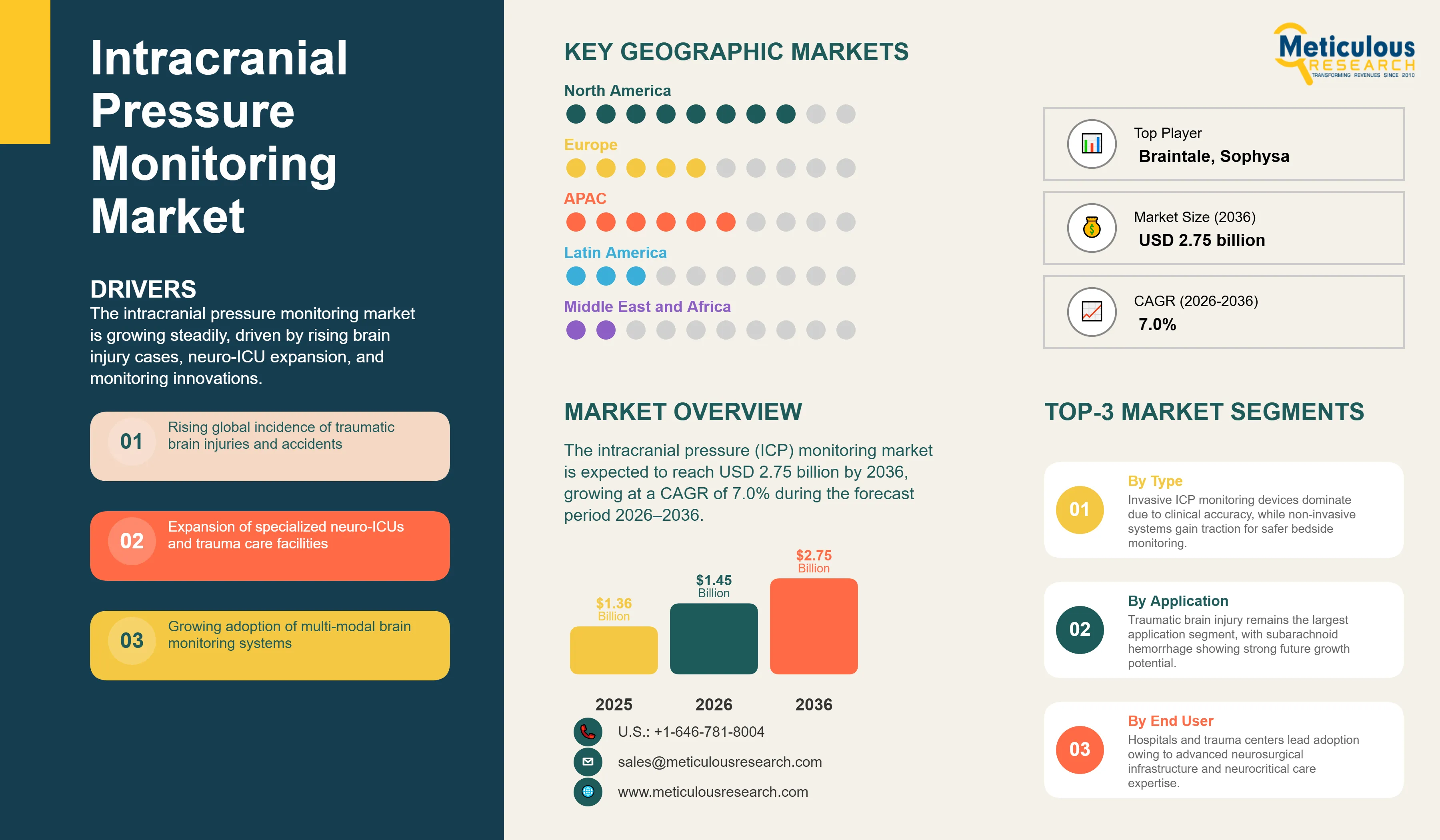
The global intracranial pressure (ICP) monitoring market is estimated to be USD 1.45 billion in 2026. This market is expected to reach USD 2.75 billion by 2036, growing at a CAGR of 7.0% during the forecast period 2026–2036.
 Click here to: Get Free Sample Pages of this Report
The global intracranial pressure (ICP) monitoring market is undergoing a significant evolution, driven by the increasing clinical emphasis on preventing secondary brain injury in patients with acute neurological trauma. As the 'gold standard' for neurocritical care, ICP monitoring provides real-time diagnostic data that is essential for managing intracranial hypertension and optimizing cerebral perfusion. The market is primarily characterized by the dominance of invasive monitoring technologies, such as ventriculostomy and intraparenchymal sensors, which offer unparalleled precision in high-acuity settings. However, there is a rising trend toward the adoption of non-invasive monitoring solutions, which aim to reduce the risks of infection and hemorrhage while providing bedside diagnostic utility. Clinical guidelines from the Neurocritical Care Society (NCS) and the American Association of Neurological Surgeons (AANS) continue to underscore the importance of standardized ICP monitoring in improving patient outcomes for traumatic brain injury (TBI) and subarachnoid hemorrhage (SAH). The integration of multi-modal monitoring systems and advanced data analytics is further enhancing the ability of neuro-ICU teams to personalize treatment protocols. As the industry focuses on developing portable, wireless, and more durable monitoring systems, the market is expected to witness sustained growth, particularly in emerging economies where neurosurgical infrastructure is rapidly expanding, ensuring consistent market expansion through 2036.
The growth of the global intracranial pressure monitoring market is primarily driven by the increasing prevalence of neurological trauma and the global expansion of specialized neurocritical care facilities.
Increasing Global Burden of Traumatic Brain Injuries and Road Traffic Accidents
A major driver for the market is the rising global incidence of traumatic brain injuries (TBI) resulting from road traffic accidents, falls, and sports-related injuries. According to the World Health Organization, road traffic injuries cause approximately 1.19 million deaths annually worldwide and injure an estimated 20–50 million people each year, making them a major contributor to traumatic brain injuries. Furthermore, global epidemiological studies published in The Lancet Neurology estimate that approximately 27–69 million people sustain a traumatic brain injury annually worldwide, highlighting the substantial burden of neurological trauma. As one of the leading causes of death and disability, particularly among children and young adults, TBI necessitates immediate and precise intracranial pressure (ICP) management to prevent secondary brain damage. The high volume of TBI cases presenting to emergency departments and trauma centers ensures a consistent demand for both invasive and non-invasive ICP monitoring systems. Additionally, governments worldwide are investing in trauma care infrastructure and emergency response systems, while increasing awareness of the long-term neurological consequences of brain injuries is driving the adoption of advanced neuro-monitoring technologies in critical care settings.
Rapid Expansion of Specialized Neuro-Intensive Care Units and Multi-Modal Monitoring Protocols
The market is significantly driven by the rapid expansion of specialized neuro-intensive care units (neuro-ICUs) and the adoption of multi-modal monitoring protocols. These specialized facilities provide the multidisciplinary expertise and advanced technological infrastructure required for continuous brain monitoring. The increasing clinical evidence supporting the benefits of multi-modal monitoring—combining ICP with brain tissue oxygenation and cerebral microdialysis—is driving the demand for integrated monitoring platforms. This shift toward more comprehensive neuro-monitoring is encouraging hospitals to invest in high-end monitoring systems that can provide a holistic view of cerebral health, thereby driving market growth.
Restraints: Risks Associated with Invasive Monitoring and the High Cost of Advanced Neuro-Monitoring Systems
Despite its clinical necessity, the intracranial pressure monitoring market faces challenges related to the potential complications of invasive procedures and the financial burden of advanced monitoring technologies.
Inherent Risks of Infection and Hemorrhage Associated with Invasive ICP Monitoring Procedures
A major restraint for the market is the risk of complications associated with invasive ICP monitoring, such as bacterial meningitis, ventriculitis, and intracranial hemorrhage. These risks, although manageable in specialized settings, can influence clinical decision-making, particularly in patients where the benefit of monitoring must be carefully weighed against potential procedural harm. The need for specialized neurosurgical expertise for the insertion of invasive monitors also limits their use in facilities without 24/7 neurosurgical coverage. This procedural complexity and the associated risk profile can restrain the broader adoption of invasive monitoring in certain clinical scenarios.
High Cost of Advanced Monitoring Consumables and the Financial Burden on Healthcare Systems
The market is also impacted by the high cost of advanced ICP monitoring systems and the ongoing expense of single-use sensors and consumables. The financial burden of implementing a comprehensive neuro-monitoring program, including the initial capital investment and the cost of specialized clinical training, can be significant for healthcare providers. In regions with limited healthcare budgets or unfavorable reimbursement policies, the high cost of these systems can restrain market expansion. Furthermore, the economic pressure on hospitals to reduce length-of-stay and procedural costs can impact the procurement of premium monitoring technologies, particularly when lower-cost alternatives are available.
Future growth opportunities in the intracranial pressure monitoring market are centered on the development of non-invasive diagnostic tools and the expansion of neurosurgical care in developing regions.
Technological Advancements in Non-invasive Diagnostic Tools for Rapid Intracranial Pressure Assessment
There is a significant opportunity for market growth driven by the development of more accurate and reliable non-invasive ICP monitoring technologies. Innovations in optic nerve sheath diameter (ONSD) ultrasound, transcranial Doppler (TCD), and automated pupillometry are providing clinicians with rapid, bedside tools for assessing intracranial hypertension. These non-invasive methods represent a high-growth opportunity, particularly for initial patient screening in emergency departments and for monitoring patients where invasive procedures are contraindicated. Manufacturers that can provide clinical validation for the diagnostic accuracy of their non-invasive systems are well-positioned to capitalize on this emerging market segment.
Expansion of Neurosurgical Infrastructure and Neurocritical Care Services in Emerging Economies
The expansion of neurosurgical infrastructure and specialized neurocritical care services in emerging economies represents a major opportunity. Countries like China, India, and Brazil are making significant investments in trauma care and specialized neurological centers to address the rising burden of brain injuries. Government initiatives to improve healthcare access and the growing middle class with higher disposable income are accelerating the demand for advanced neuro-monitoring technologies. Manufacturers that can provide cost-effective yet high-precision monitoring solutions tailored for these markets are likely to lead the next phase of global market expansion.
Increasing Shift Toward Multi-Modal Brain Monitoring and Integrated Neuro-ICU Data Platforms
A prominent trend in 2026 is the increasing shift toward multi-modal brain monitoring, where ICP is integrated with other physiological parameters like brain tissue oxygenation (PbtO2) and cerebral blood flow. This comprehensive approach provides a more holistic view of cerebral health, allowing for more precise management of neurocritical patients. This trend is driven by the development of integrated data platforms that can synchronize multiple monitoring streams into a single user interface. Manufacturers are increasingly focusing on providing modular monitoring systems that can be easily expanded to include additional sensors, aligning with the growing clinical preference for multi-modal diagnostic insights.
Rising Integration of Artificial Intelligence for Predictive Neurological Analytics and Automated Alerts
The market is witnessing an increasing trend toward the integration of artificial intelligence (AI) and machine learning for predictive neurological analytics. AI algorithms are being developed to analyze ICP waveforms in real-time to predict episodes of intracranial hypertension before they occur. This predictive capability allows neuro-ICU teams to intervene earlier, potentially improving patient outcomes. The development of automated alert systems and decision-support tools is further enhancing the ability of clinicians to manage complex neurological data. This integration of AI is marking a significant step toward the digitalization of neurocritical care, driving further demand for advanced monitoring systems with integrated data processing capabilities.
Analysis by Product Type
Based on product type, the invasive ICP monitoring devices segment is expected to hold the largest share of the global intracranial pressure monitoring market in 2026. This leadership is substantiated by its status as the 'gold standard' for clinical precision, with ventriculostomy and intraparenchymal sensors providing the most reliable data for managing life-threatening intracranial hypertension. However, the non-invasive ICP monitoring devices segment is projected to register the highest CAGR during the forecast period. The rising demand for safer, bedside monitoring solutions that eliminate the risks of infection and hemorrhage associated with invasive procedures is driving its rapid and sustained growth.
Analysis by Application
By application, the traumatic brain injury (TBI) segment is expected to hold the largest share in 2026, due to the high global prevalence of neurological trauma resulting from accidents and falls. However, the subarachnoid hemorrhage (SAH) segment is projected to register the highest CAGR during the forecast period. The increasing prevalence of cerebral aneurysms and the growing emphasis on multi-modal monitoring in neuro-ICUs for SAH patients are significantly accelerating adoption in this segment.
Analysis by End User
By end user, the hospitals & trauma centers segment is expected to hold the largest share in 2026, as these facilities possess the specialized neurosurgical infrastructure and specialized neuro-ICU teams required for ICP monitoring procedures. However, the specialty clinics & neurological centers segment is projected to register the highest CAGR during the forecast period. The ongoing shift toward decentralized specialized care and the increasing adoption of portable and non-invasive monitoring technologies for long-term patient follow-up are facilitating growth in this segment.
Largest Share: North America
North America is expected to dominate the global intracranial pressure monitoring market in 2026. This leading position is attributed to its advanced neurocritical care infrastructure, high healthcare spending, and strict adherence to clinical guidelines for brain injury management. The region has a high adoption rate of innovative multi-modal monitoring systems. According to the American Association of Neurological Surgeons (AANS), the standardized use of ICP monitoring in Level 1 trauma centers is a major factor driving the high market valuation in the U.S. and Canada.
Fastest Growing: Asia-Pacific
The Asia-Pacific region is projected to witness the fastest growth in the global intracranial pressure monitoring market, with a CAGR of 8-10% during the forecast period. This rapid expansion is driven by the rising incidence of road traffic accidents in developing economies, increasing healthcare investments, and the expansion of specialized neuro-ICUs. Government initiatives to improve emergency response systems and the growing adoption of western clinical protocols are accelerating the demand for ICP monitoring technologies. Data from the World Health Organization (WHO) highlights the high burden of neurological injuries in the APAC region, which is directly translating into increased procurement of neuro-monitoring equipment.
The global intracranial pressure monitoring market is characterized by intense competition between established medical technology giants and specialized neuro-monitoring firms. Competition is primarily focused on enhancing the precision and clinical safety of sensors and improving the integration of monitoring data into hospital-wide digital platforms. Key players are investing heavily in R&D to develop multi-modal monitoring platforms and non-invasive diagnostic tools to capture the growing specialized and emergency care markets. Strategic developments often involve acquisitions of innovative neuro-monitoring firms and partnerships with leading neurological centers to validate new monitoring protocols. Furthermore, there is a growing focus on providing integrated neurocritical care solutions that combine ICP monitors with brain tissue oxygenation and cerebral microdialysis sensors. Manufacturers are also increasingly focusing on comprehensive clinical training programs and robust long-term technical support to ensure the successful implementation and consistent performance of their monitoring systems in high-acuity healthcare settings, which is critical for maintaining market leadership in this rapidly evolving neuro-monitoring field.
Integra LifeSciences Corporation, Natus Medical Incorporated, Medtronic plc, Raumedic AG, Spiegelberg GmbH & Co. KG, Codman, Sophysa, Vittamed, Orsan Medical Technologies, NovaSignal, Gaeltec Devices Ltd., Nison Instrument (Shanghai) Co., Ltd., HeadSense Medical, Branchpoint Technologies, Third Eye Diagnostics, Braintale, Lucid Robotic, Natus Neuro, DePuy Synthes, Boston Neurosciences
The global market is estimated at USD 1.45 billion in 2026, with a projected growth to USD 2.85 billion by 2036, at a CAGR of 7.0%.
Primary drivers include the rising incidence of traumatic brain injuries and the expansion of specialized neuro-intensive care units.
Major restraints include the risks of infection and hemorrhage associated with invasive procedures and the high cost of advanced systems.
Opportunities lie in the advancements in non-invasive monitoring technologies and the growth of neuro-monitoring in emerging markets.
Invasive ICP monitoring devices are expected to hold the largest share as they remain the gold standard for clinical precision.
Non-invasive ICP monitoring devices are projected to grow at the fastest CAGR, driven by the demand for safer bedside solutions.
Hospitals & trauma centers are expected to hold the largest share, as they possess the specialized neurosurgical infrastructure.
North America is expected to dominate the market due to its advanced neurocritical care infrastructure and high healthcare spending.
Asia-Pacific is projected to witness the fastest growth, fueled by the rising incidence of road accidents and increasing healthcare investments.
Key trends include the shift toward multi-modal brain monitoring and the integration of AI for predictive neurological analytics.
























Published Date: Jun-2026
Published Date: Aug-2024
Please enter your corporate email id here to view sample report.
Subscribe to get the latest industry updates


