
AI Data Center Market (2026-2036)
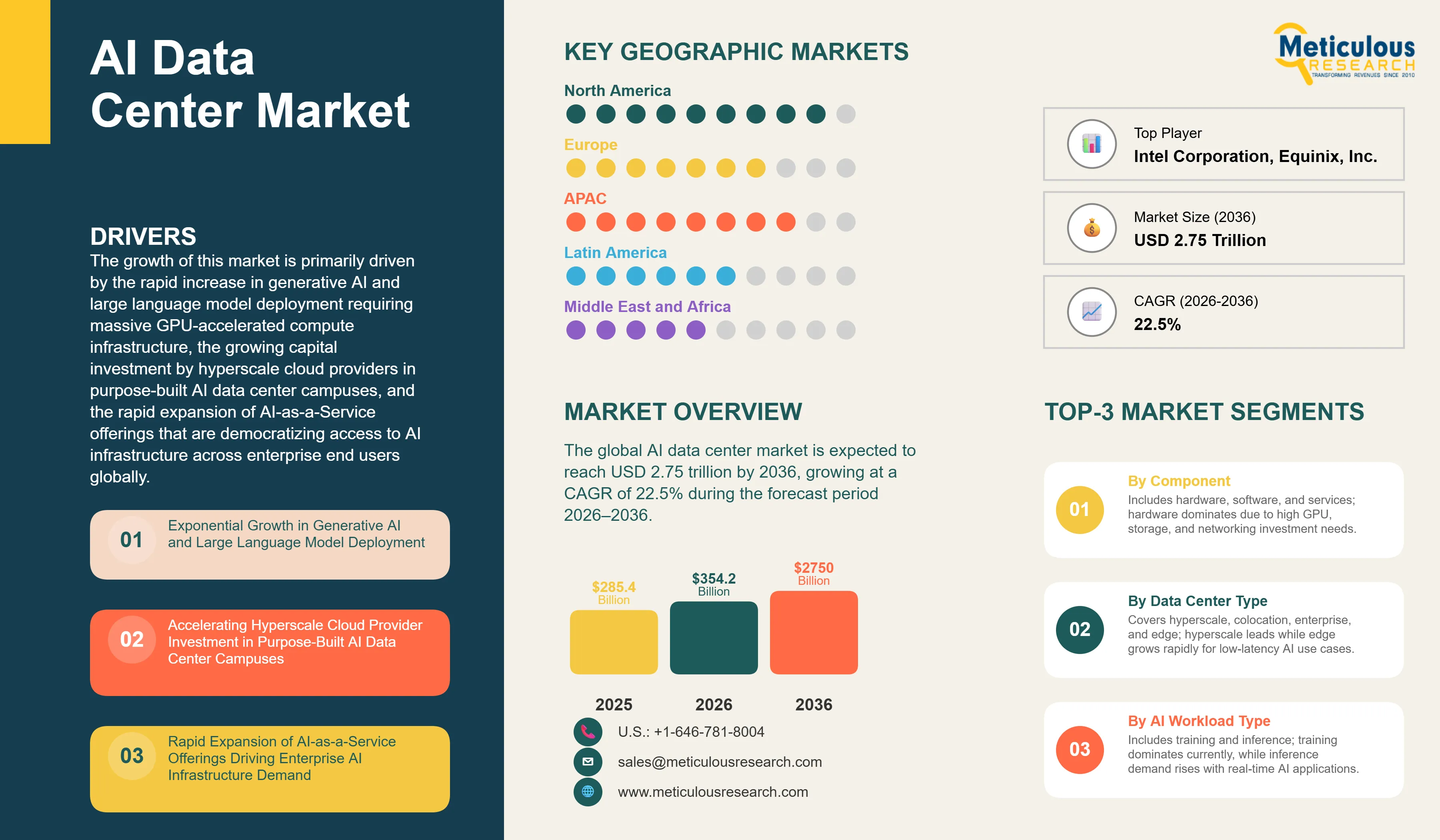
The global AI data center market was valued at USD 285.4 billion in 2025. This market is expected to reach USD 2.75 trillion by 2036 from an estimated USD 354.2 billion in 2026, growing at a CAGR of 22.5% during the forecast period 2026–2036.
- Published
- Apr 2026
- Pages
- 290
- Format
- PDF + Excel
- Report ID
- MR-1856
- Base year
- 2025
- 2025 · BASELINE
- $285.4B
- 2036
- $2.75T
- CAGR 2026–2036
- 22.5%
2025 baseline · 2026–2036 forecast at 22.5% CAGR · hover a bar for the value
Key highlights
The global AI data center market is projected to reach USD 2.75 trillion by 2036.
The market is expected to grow at a CAGR of 22.5% during the forecast period 2026–2036.
The global AI data center market was valued at USD 285.4 billion in 2025 and is estimated to reach USD 354.2 billion in 2026.
North America is expected to dominate the global AI data center market with the largest market share in 2026, driven by the concentration of leading hyperscale cloud providers, the highest global density of GPU-accelerated AI training infrastructure, and the most advanced ecosystem of AI hardware manufacturers, software platforms, and data center operators in the U.S.
Asia Pacific is projected to witness the fastest growth during the forecast period, driven by massive government-led AI infrastructure investment programs in China, India, Japan, and Southeast Asia, the rapid expansion of regional cloud giants, and the accelerating adoption of AI across manufacturing, financial services, and healthcare sectors.
By component, the hardware segment is expected to account for the largest share of the global AI data center market in 2026.
By component, the services segment is projected to register the highest CAGR during the forecast period, driven by the increasing complexity of AI data center operations and the growing preference of enterprise customers for managed AI infrastructure models.
By data center type, the hyperscale AI data centers segment is expected to account for the largest share of the market in 2026, reflecting the concentration of AI model training workloads at major cloud providers and frontier AI research institutions.
By data center type, the edge AI data centers segment is projected to register the highest CAGR, driven by growing requirements for low-latency AI inference at the network edge for autonomous vehicles, industrial AI, and 5G-enabled AI applications.
By AI workload type, the training segment is expected to account for the largest share in 2026, while the generative AI segment is projected to register the highest CAGR during the forecast period.
By geography, North America is expected to dominate the market in 2026, while Asia Pacific is expected to witness the fastest growth during the forecast period.
Report summary
| Particulars | Details |
|---|---|
| Market Size by 2036 | USD 2.75 Trillion |
| Market Size in 2026 | USD 354.2 Billion |
| Market Size in 2025 | USD 285.4 Billion |
| Revenue Growth Rate (2026–2036) | CAGR of 22.5% |
| Format | PDF, Excel & Cloud Portal · 290 pages |
| Dominating Component | Hardware |
| Fastest Growing Component | Services |
| Dominating Data Center Type | Hyperscale AI Data Centers |
| Fastest Growing Data Center Type | Edge AI Data Centers |
| Dominating AI Workload Type | Training |
| Fastest Growing AI Workload Type | Generative AI |
| Dominating Deployment Mode | Cloud-Based |
| Fastest Growing Deployment Mode | On-Premises |
| Dominating End Use | Technology & Cloud Service Providers |
| Fastest Growing End Use | Government & Defense |
| Dominating Geography | North America |
| Fastest Growing Geography | Asia Pacific |
| Base Year | 2025 |
| Forecast Period | 2026 to 2036 |
Report overview
Segments covered: component, data center type, ai workload, deployment mode, end use.
The growth of this market is primarily driven by the rapid increase in generative AI and large language model deployment requiring massive GPU-accelerated compute infrastructure, the growing capital investment by hyperscale cloud providers in purpose-built AI data center campuses, and the rapid expansion of AI-as-a-Service offerings that are democratizing access to AI infrastructure across enterprise end users globally.
However, severe power grid constraints, high capital costs of AI-optimized infrastructure, and the shortage of skilled professionals for designing and operating high-density AI data center environments restrain the growth of this market.
The growing shift from AI training to AI inference as the dominant workload driver, anticipated to represent half of all data center capacity by 2030, and the increasing adoption of sovereign AI cloud and on-premises AI infrastructure by government and enterprise end users are expected to generate significant market growth opportunities for stakeholders operating in this market.
Furthermore, the emergence of modular, prefabricated AI data center deployments and the rapid advancement of liquid cooling technologies enabling ever-higher rack power densities are the major trends shaping this market.
The global AI data center market includes physical and digital infrastructure specifically designed, configured, and operated to support artificial intelligence workloads, including compute-intensive GPU and AI accelerator server clusters, high-bandwidth storage systems, ultra-low-latency AI networking fabrics, AI platform software, and the managed services required to plan, deploy, and operate these environments at scale.
Unlike general-purpose data centers, AI data centers are purpose-optimized for the unique power, cooling, networking, and compute density requirements imposed by training and inference of large-scale AI models, making them a distinct and high-growth segment of the broader data center market.
The AI data center market has transitioned from a nascent, research-dominated segment to a mainstream and rapidly scaling commercial infrastructure category. The catalyst has been the commercialization of generative AI, a technology wave that requires orders of magnitude more compute per workload than the cloud computing and big data applications that defined the previous decade of data center growth.
A single large language model training run, such as those used for frontier AI models, can consume tens of thousands of high-end GPUs running continuously for months, creating infrastructure requirements that are compressing years of capital investment into months.
The scale of commitment from the world’s largest technology companies is unprecedented: Microsoft, Google, Amazon, Meta, and others have collectively announced hundreds of billions of dollars in AI data center capital expenditure commitments through 2028.
The infrastructure composition of AI data centers differs from conventional hyperscale facilities. GPU and AI accelerator servers, such as NVIDIA’s HGX H100, H200, and Blackwell B200 systems, form the core compute layer, drawing 700 watts to over 1,000 watts per GPU in dense configurations that push rack power densities to around 60–120 kW per rack, versus 10–15 kW in conventional servers. This power intensity requires liquid cooling, either direct‑to‑chip cold‑plate cooling or full‑immersion cooling, rather than traditional air‑based cooling, creating large, co‑dependent markets in AI‑optimized thermal and cooling infrastructure.
Networking requirements are equally distinctive: AI training workloads demand near‑all‑to‑all communication between thousands of GPUs with ultra‑low latency, driving the adoption of InfiniBand and 400 GbE/800 GbE fabrics and prompting the deployment of switch architectures that are radically different from those used in general‑purpose cloud environments.
Training workloads are among the most compute-intensive in the data center industry, consuming tens of thousands of high-end GPUs for months at a time per training run.
Report infographic
Market dynamics
3 factors across 1 forceSovereign AI Cloud and National AI Infrastructure Programs
Governments worldwide are moving aggressively to establish domestic AI computing infrastructure, driven by concerns about strategic dependence on foreign AI providers, the economic significance of AI leadership, and the data sovereignty requirements of sensitive government and healthcare applications.
The European Union's AI Gigafactory initiative, India's IndiaAI Mission targeting 10,000+ GPU public cloud infrastructure, Saudi Arabia's HUMAIN AI company backed by USD 100 billion in capital, and Japan's USD 740 billion digital and AI infrastructure strategy represent a new category of sovereign AI demand that is geographically diversifying AI data center investment beyond the traditional U.S.-dominated concentration.
This trend is favorable for market growth as it creates demand in regions that previously had limited AI infrastructure, effectively driving the global addressable market.
Transition to Gigawatt-Scale AI Campus Development
The scale of individual AI data center developments has escalated significantly, with leading hyperscalers and infrastructure partners planning and constructing gigawatt-scale AI campus developments—contiguous, multi-site facilities in the 500 MW to 1+ GW range, often co-located with dedicated power generation capacity.
Initiatives such as Microsoft Corporation’s Project Stargate collaboration with OpenAI, involving a multi–tens of billions USD infrastructure commitment across multiple phases, and Meta Platforms, Inc.’s ~2 GW-scale Louisiana data center campus drive this shift toward campus-scale AI infrastructure.
These gigawatt‑scale developments represent a structural change in how AI data center capacity is procured, planned, and financed, moving from incremental, building‑level capacity additions to decade‑scale, master‑planned campuses anchored by long‑term power agreements that may include nuclear, natural gas, and large‑scale renewable‑energy installations.
Liquid Cooling as Standard for High-Density AI Racks
The widespread adoption of liquid cooling has shifted from a premium option to a technical requirement for AI data centers deploying current‑generation and next‑generation GPU clusters. NVIDIA’s Blackwell architecture, deployed at scale from 2025 onward, requires liquid cooling for full‑performance operation in multi‑GPU NVL72 rack configurations, where rack power densities can exceed 100–140 kW.
Major data center operators, including Equinix, Digital Realty, and NTT, have established liquid‑ready infrastructure as a standard specification for new AI‑optimized deployments. The global direct‑to‑chip liquid cooling market is expected to grow at a high double‑digit CAGR (around 20–22% from 2025 to 2030), with immersion cooling emerging as the preferred solution for the highest‑density AI rack configurations.
Table of contents
13 chapters · 132 sections · 290 pages · click to expandSegmental analysis
| Segment | Largest share (2026) | Fastest growth (2026–2036) |
|---|---|---|
| By Component | Hardware | Services |
| Other segments | Large market share of this | — |
| By AI Workload Type | Training | Generative AI |
| By Deployment Mode | Cloud-based | — |
By Component
- The global AI data center market is segmented into hardware, software, and services.
- The hardware segment is expected to account for the largest share of around 65–70% of the global AI data center market.
- A single NVIDIA GB200 NVL72 rack system, combining 72 Blackwell GPUs with NVLink interconnects, liquid cooling, and integrated networking, represents approximately USD 3 million in hardware value, with actual quotes typically ranging from about USD 2.8 million to USD 3.4 million depending on configuration and vendor.
- At the scale of hyperscale AI deployments, hardware procurement drives tens of billions of dollars in market value annually.
- Within hardware, compute infrastructure accounts for the largest sub-segment share, driven by GPU server procurement for AI training clusters and the growing deployment of AI inference servers across colocation and enterprise data centers.
- However, the services segment is projected to register the highest CAGR during the forecast period.
- The complexity of AI data center design, commissioning, and ongoing operations, mainly for liquid-cooled, high-density environments, is driving strong demand for design consulting, systems integration, and managed AI infrastructure services.
- The managed services segment is particularly high-growth as enterprise customers increasingly prefer to consume AI infrastructure as a managed service rather than building in-house operational expertise.
- The AI cloud services market, estimated at around USD 65 billion in 2025, is growing at an average annual rate in the mid‑30% range, with each dollar of AI cloud revenue supported by roughly USD 3–4 of underlying infrastructure investment when averaged across current GPU‑heavy AI‑cloud deployments.
- The AI cloud services market, estimated at around USD 65 billion in 2025, is growing at an average annual rate in the mid‑30% range, with each dollar of AI cloud revenue supported by roughly USD 3–4 of underlying infrastructure investment when averaged across current GPU‑heavy AI‑cloud deployments.
Other segments
- The large market share of this segment is attributed to the capital-intensive nature of AI compute infrastructure: GPU and AI accelerator servers, high-bandwidth networking equipment, and AI-optimized storage systems represent the majority of total AI data center investment by value.
By AI Workload Type
- The global AI data center market is segmented into training and inference.
- The training segment is expected to account for the largest share of the global AI data center market, reflecting the massive GPU cluster investments being made by frontier AI labs and hyperscale cloud providers to train successive generations of foundation models.
By Deployment Mode
- The global AI data center market is segmented into cloud-based, on-premises, and hybrid.
- The cloud-based segment is expected to account for the largest share of the global AI data center market, driven by the dominance of AWS, Azure, and Google Cloud in providing AI compute capacity to enterprise and developer customers.
Geographic analysis
North America
Largest sharen 2026, North America is expected to account for the largest share of around 45–50% of the global AI data center market. North America's dominant position is attributed to the concentration of hyperscale cloud providers, GPU manufacturers, AI research institutions, and AI software companies in the U.S. The U.S. is home to NVIDIA, the dominant AI compute hardware provider; Amazon, Microsoft, Google, and Meta, the four largest AI data center operators globally; and the world's deepest capital markets for AI infrastructure financing.
Asia-Pacific
Fastest growthHowever, the Asia Pacific is expected to register the highest growth rate in the AI data center market through 2036. This growth is primarily driven by the rapid expansion of China’s domestic AI data center ecosystem, which—despite export control constraints—continues to scale through initiatives such as Huawei Technologies Co., Ltd.’s Ascend AI cluster deployments and strong government mandates for sovereign AI compute capacity. India is also emerging as a key growth engine, driven by the IndiaAI Mission with approximately USD 1.25 billion in public AI-compute funding, while Japan is advancing a multi-hundred-billion-dollar digital and AI infrastructure roadmap. In parallel, countries such as Singapore and South Korea are witnessing rapid expansion in AI infrastructure investments. Overall, the region’s combination of large-scale government-led AI investment programs, accelerating AI application adoption, and expanding domestic AI chip manufacturing capacity positions Asia Pacific as the fastest-growing AI data center market through 2036.
Competitive landscape
- NVIDIA Corporation
- Cisco Systems, Inc.
- Intel Corporation
- Dell Technologies Inc.
- Equinix, Inc.
- Digital Realty Trust, Inc.
- Schneider Electric SE
- Vertiv Holdings Co.
- Huawei Technologies Co., Ltd.
- Arista Networks, Inc.
- Super Micro Computer, Inc.
- Hewlett Packard Enterprise Company
- Pure Storage, Inc.
- Iron Mountain Incorporated
- Wiwynn Corporation
Frequently asked questions
The global AI data center market is expected to reach USD 2.75 trillion by 2036 from an estimated USD 354.2 billion in 2026, at a CAGR of 22.5% during the forecast period 2026–2036.
Cite this report
Meticulous Research. (2026). AI Data Center Market - Global Opportunity Analysis and Industry Forecast (2026-2036) (Report No. MR-1856). Meticulous Market Research Pvt. Ltd. https://www.meticulousresearch.com/product/ai-data-center-market-6539