Adult Incontinence Products Market (2026-2036)
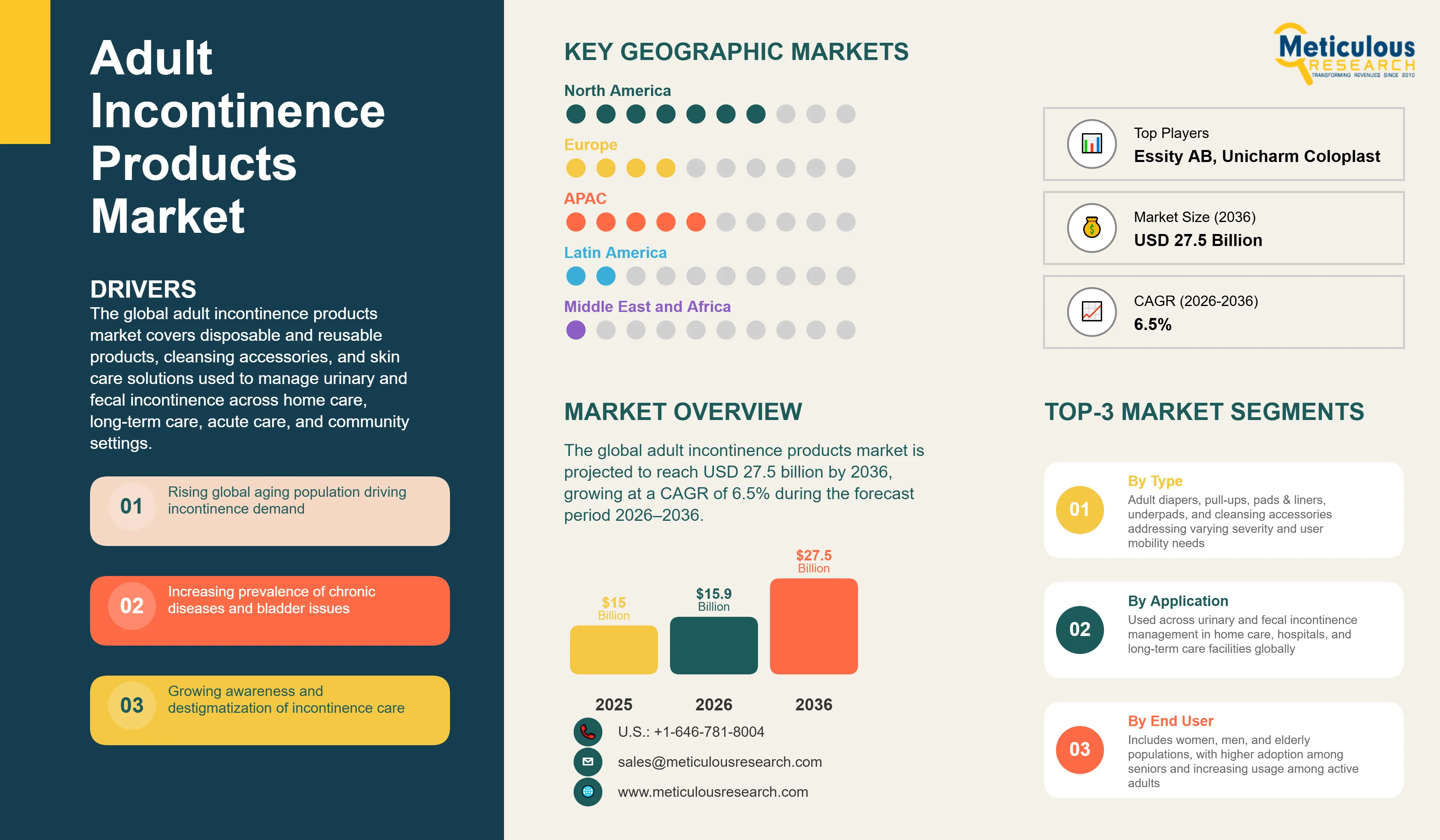
The global adult incontinence products market was valued at USD 15.0 billion in 2025. The market is projected to reach USD 27.5 billion by 2036 from an estimated USD 15.9 billion in 2026, growing at a CAGR of 6.5% during the forecast period 2026–2036.
- Published
- Apr 2026
- Pages
- 265
- Format
- PDF + Excel
- Report ID
- MR-1927
- Base year
- 2025
- 2025 · BASELINE
- $15.00B
- 2036
- $27.50B
- CAGR 2026–2036
- 6.5%
2025 baseline · 2026–2036 forecast at 6.5% CAGR · hover a bar for the value
Key highlights
The global adult incontinence products market is projected to reach USD 27.5 billion by 2036.
The market is expected to grow at a CAGR of 6.5% during the forecast period 2026–2036.
The global adult incontinence products market was valued at USD 15.0 billion in 2025 and is estimated to reach USD 15.9 billion in 2026.
North America is expected to dominate the global adult incontinence products market in 2026, accounting for approximately 35-40% of the global revenue. The region's leadership is driven by one of the world's largest and fastest-growing elderly populations, with 61 million Americans aged 65+ as of 2025 (U.S. Census Bureau), projected to reach 80 million by 2040. Urinary incontinence affects 25-33% of U.S. adults (~60-80 million total), with prevalence rising sharply among the elderly, creating a significant addressable market.
The growth of the North America adult incontinence products market is further driven by the substantial ongoing investment from leading manufacturers. Kimberly-Clark announced a USD 2 billion U.S. manufacturing investment plan spanning 2025 to 2030, described as the company’s largest domestic expansion in 30 years, to enhance production capacity for Depend and related incontinence product lines. In May 2025, First Quality Enterprises also announced an expansion of its South Carolina manufacturing facility, increasing production capacity for its Prevail brand premium incontinence products.
Asia Pacific adult incontinence products market is expected to grow at the fastest CAGR from 2026 to 2036. The high growth in this region indicates the world’s largest and fastest-growing elderly population base, with Japan, China, South Korea, and India all experiencing significant demographic aging.
China and India are the most significant volume growth opportunities within Asia Pacific. In China, over 90 million adults are affected by incontinence, according to available population data, while awareness and product accessibility continue to improve.
In India, Tulips entered the adult hygiene category in September 2025 with the launch of TULIPS Adult Diaper Pants, showing rising demand for discreet, comfortable incontinence products across the country’s rapidly aging population.
Europe holds the second-largest share of the global adult incontinence products market, driven by well-established healthcare reimbursement frameworks, high consumer awareness, and the presence of leading manufacturers including Essity (Sweden/TENA), Ontex Group (Belgium/iD), Paul Hartmann AG (Germany/MoliCare), and Abena Holding A/S (Denmark). European consumers are among the world’s most environmentally conscious, driving a more rapid shift toward sustainable product formats including biodegradable disposables and reusable washable underwear compared to other regions.
By product type, adult diapers and briefs are expected to hold the largest market share in 2026, accounting for around 45-50% of the global revenue. This segment serves the highest-severity incontinence needs, including moderate-to-heavy urinary and fecal incontinence common in long-term care settings, hospital patients, and seniors with neurological conditions including Alzheimer’s disease. According to the Alzheimer's Association, approximately 7.2 million Americans aged 65 and older are living with Alzheimer's as of 2025, with 74% of them aged 75 or older, a demographic cohort exhibiting high rates of incontinence prevalence (50-70% among late-stage patients) rather than near-universal dependence.
Protective underwear and pull-ups market is expected to grow at the fastest CAGR during the forecast period, driven by consumer preference for products that mimic regular underwear in appearance, fit, and ease of use, supporting dignity and independent living. Industry leaders like Essity report pull-up incontinence products growing at 20%+ annually among ambulatory seniors, reflecting strong consumer preference for designs supporting independent living and dignity.
By category, disposable products are expected to hold the dominant market share at around 90% of the global revenue in 2026, driven by their superior convenience, hygiene, and institutional compatibility. However, reusable and washable products are expected to grow at the fastest CAGR, led by the rapidly growing leakproof apparel segment. Essity estimates the leakproof apparel category is growing at more than 20% annually (based on Essity-compiled market data, excluding Asia), driven by Essity’s own TENA Washable Absorbent Underwear and its acquisitions of Knix Wear (Canada) and Modibodi (Australia), as well as Kimberly-Clark’s majority acquisition of Thinx.
By distribution channel, pharmacies and drug stores are expected to hold the largest market share in 2026, showing the importance of healthcare professional guidance in product selection for moderate-to-severe incontinence management.
Online and e-commerce channels are expected to register the fastest CAGR during the forecast period, driven by the growing consumer preference for discreet home delivery, subscription-based purchasing, and expanding direct-to-consumer brands including NorthShore Care Supply, which expanded its U.S. manufacturing capacity in May 2025 to support growing online demand.
Report summary
| Particulars | Details |
|---|---|
| Market Size by 2036 | USD 27.5 Billion |
| Market Size in 2026 | USD 15.9 Billion |
| Market Size in 2025 | USD 15.0 Billion |
| Revenue Growth Rate (2026–2036) | CAGR of 6.5% |
| Format | PDF, Excel & Cloud Portal · 265 pages |
| Dominating Product Type | Adult Diapers / Briefs |
| Fastest Growing Product Type | Protective Underwear / Pull-Ups |
| Dominating Absorbency Level | Moderate / Heavy |
| Fastest Growing Absorbency Level | Light (Stress & Urgency Leakage) |
| Dominating Category | Disposable |
| Fastest Growing Category | Reusable / Washable |
| Dominating End User | Women |
| Fastest Growing End User | Women (Light Incontinence Segment) |
| Dominating Age Group | Seniors (65+) |
| Fastest Growing Age Group | Adults (18–64) |
| Dominating End Use | Home Care |
| Fastest Growing End Use | Home Care / OTC Retail |
| Dominating Geography | North America |
| Fastest Growing Geography | Asia Pacific |
| Base Year | 2025 |
| Forecast Period | 2026 to 2036 |
Report overview
Segments covered: product type, absorbency level, category, end user, age group, end use, distribution channel.
The global adult incontinence products market covers disposable and reusable products, cleansing accessories, and skin care solutions used to manage urinary and fecal incontinence across home care, long-term care, acute care, and community settings. Core product categories include adult diapers and briefs, protective pull-up underwear, pads and liners for lighter incontinence, underpads and bed protection, and associated skincare and cleansing products. The market is characterized by strong structural demand rooted in global demographic aging, rising chronic disease prevalence, and growing consumer awareness and destigmatization of incontinence as a common and manageable health condition.
The key driver in the market is the increasing growth of the global elderly population. According to the United Nations World Population Prospects 2022, the proportion of people aged 65 and older is growing faster than any other age group globally, with 761 million people aged 65 and above as of 2025 (up from 703 million in 2023). Around 25-33% of individuals in this age group experience some form of incontinence, creating growing demand for absorbent hygiene products. The WHO's Integrated Care for Older People (ICOPE) guidelines document urinary incontinence prevalence ranging from 9% to 39% across different patient populations. In the U.S., 61 million Americans aged 65+ as of 2025 (U.S. Census Bureau) face incontinence affecting 25-33% of adults overall (~60-80 million total), representing expanding addressable market.
Beyond demographics, rising prevalence of chronic conditions that contribute to or exacerbate incontinence is driving the addressable market into younger age groups. Diabetes, obesity, neurological disorders including Parkinson's disease and multiple sclerosis, prostate-related issues in men, and the long-term effects of childbirth and menopause in women are all driving incontinence among the 40-64 age cohort at rates that justify dedicated product development and marketing toward this segment. The Alzheimer's Association reported approximately 7.2 million Americans aged 65 and older living with Alzheimer's disease as of 2025, a population with high incontinence prevalence (50-70% in late stages).
Report infographic
Market dynamics
2 factors across 1 forceAging Demographics Driving Structural and Sustained Demand Growth Across All Geographies
The key trend shaping the global adult incontinence products market is the accelerating demographic aging of the global population, which is creating a multi-decade demand for the category. The United Nations World Population Prospects 2022 confirmed that the proportion of people aged 65 and older is growing faster than any other demographic globally, with this group reaching 761 million people as of 2025. The relationship between aging and incontinence is direct and physiologically well-established: weakening pelvic floor muscles, reduced bladder capacity, hormonal changes, and increasing prevalence of neurological conditions all contribute to rising incontinence rates with age.
Japan provides the most advanced illustration of this demographic dynamic, having reached a stage of demographic aging that other major markets are now approaching. Adult diapers have outsold baby diapers in Japan every year since 2011, showing the country's super-aged society in which over 36.2 million individuals are aged 65 and above as of 2023. Over 65% of nursing home residents in Japan use adult diapers regularly, representing a structurally captive institutional market. Institutional purchase volumes remain substantial globally, with healthcare facilities representing ~60% of total incontinence product end-user demand worldwide.
China is the most significant emerging volume growth market. With over 90 million adults affected by incontinence and a rapidly aging urban population, China’s incontinence product market is expected to grow at one of the highest CAGRs among major national markets globally. The combination of improving awareness, rising disposable income, expanding organized retail and e-commerce penetration, and international brands introducing affordable, innovative product options is rapidly increasing market participation. India is similarly positioned, with Tulips’ September 2025 entry into the adult diaper pants category indicating the growing commercialization of what was previously a highly underpenetrated market.
In the U.S., the aging of the Baby Boomer generation is creating a strong demand surge. With 59.3 million Americans aged 65 and older as of 2023, a number expected to reach 80 million by 2040, the demographic foundation of the U.S. market is expanding. Kimberly-Clark's USD 2 billion domestic manufacturing investment from 2025 to 2030, described as the company's largest expansion in 30+ years, indicates their confidence in this long-term demand trajectory. Institutional demand remains substantial, as evidenced by major healthcare systems and VA facilities serving millions of incontinence patients annually.
Premiumization and Destigmatization Expanding the Market Beyond the Traditional Institutional Segment
Another defining commercial trend driving the competitive landscape is the concurrent shift toward product premiumization and consumer destigmatization of incontinence, which is expanding the addressable market significantly beyond the traditional high-severity institutional segment into the broader active adult, younger consumer, and light-incontinence categories. This shift is transforming the category from a medically-oriented, often embarrassment-associated product area into a mainstream personal care segment accessible to a broader range of consumer demographics.
The leakproof apparel sub-segment is the most commercially dynamic expression of this trend. Essity estimates that leakproof apparel, products that look and feel like regular underwear while providing incontinence protection, is growing at more than 20% annually (based on Essity's market data, excluding Asia). Essity's acquisitions of Knix Wear and Modibodi extended the TENA brand ecosystem into premium, discreet washable underwear, while Kimberly-Clark's majority acquisition of Thinx and the associated Speax by Thinx incontinence underwear brand directly positions Kimberly-Clark in the intersection of menstrual and light incontinence care. AARP's 2024 Home and Community Preferences Survey confirms 75% of adults aged 50+ prefer aging in place, validating the commercial logic behind pull-up and underwear-format product innovation.
The destigmatization trend is also being actively driven by manufacturers through consumer-facing communication campaigns. Essity’s TENA SmartCare platform, its fully relaunched TENA Men brand, and its TENA Washable Absorbent Underwear launch under a ‘barrier to well-being’ communications strategy are all designed to shift consumer perception of incontinence from a source of embarrassment into a manageable, product-supported health condition. According to Essity, 77% of women with bladder weakness report discomfort, and the company’s product development pipeline is specifically oriented toward addressing skin irritation and comfort as primary consumer pain points. This consumer-centric, wellness-oriented approach is directly driving the expansion of the market into new consumer segments and age groups.
Table of contents
15 chapters · 153 sections · 265 pages · click to expandSegmental analysis
| Segment | Largest share (2026) | Fastest growth (2026–2036) |
|---|---|---|
| By Product Type | Adult Diapers / Briefs | — |
| By Absorbency Level | Moderate / Heavy | Light absorbency segment for stress and urgency leakage |
| By Category | Disposable | Reusable and washable products |
| By End User | Women | — |
| By Age Group | Seniors (65+) | — |
By Product Type
- Adult Diapers / Briefs to Dominate the Global Adult Incontinence Products Market
- Adult diapers and briefs are expected to account for the largest share of the global adult incontinence products market.
- This segment serves the highest-severity incontinence needs across institutional care settings, nursing homes, hospitals, and assisted living facilities, where tab-style brief products are the standard of care for non-ambulatory or cognitively impaired patients.
- The product’s superior absorbency capacity, ease of application by caregivers without requiring the patient to stand, and compatibility with institutional waste management protocols underpin its market dominance.
- However, protective underwear and pull-ups market is expected to grow at the fastest CAGR during the forecast period.
- The pull-up format’s resemblance to regular underwear, ease of self-application for ambulatory users, and contribution to user dignity and confidence are driving its adoption among active adults managing moderate incontinence.
By Absorbency Level
- Moderate / Heavy to Hold the Largest Share
- The moderate-to-heavy absorbency segment is expected to account for the largest share of the global adult incontinence products market, at around 40-45% of revenue.
- This segment serves the core institutional and home care demand, including patients with established moderate-to-severe urinary or fecal incontinence who require products capable of reliable overnight protection and extended wear periods.
- Hospital patients, nursing home residents, and homebound elderly users represent the primary demand base for this segment.
- However, the light absorbency segment for stress and urgency leakage is expected to register the fastest CAGR during the forecast period, driven by the growing population of active adults managing occasional or mild incontinence.
- Light incontinence is significantly more prevalent than severe cases but has historically been under-served by products specifically designed for this need.
By Category
- Disposable to Hold the Largest Share
- Disposable products are expected to account for around 90% of the global adult incontinence product revenue, reflecting their dominance across institutional and home care settings.
- Disposable products’ superior performance in absorbency, odor control, and infection prevention, combined with the convenience of single-use application for both independent users and caregivers, underpins their strong commercial dominance.
- Reusable and washable products market is expected to grow at the fastest CAGR during the forecast period, consistent with the leakproof apparel growth trend.
- Essity’s estimate of 20%+ annual growth for the leakproof apparel sub-segment, Kimberly-Clark’s Thinx acquisition, and the growing availability of washable pull-up style products from both established brands and direct-to-consumer entrants are collectively establishing reusables as the most dynamic growth sub-segment in the category.
- The TENA Stylish™ Washable Absorbent Underwear, launched as a consumer-facing product explicitly designed to look and feel like everyday lingerie, represents the premium end of this opportunity.
By End User
- Women to Hold the Largest Share
- Women are expected to account for the largest share of the global adult incontinence products market, at around 55% to 60% of revenue.
- Women experience incontinence at approximately twice the rate of men due to physiological factors including pregnancy, childbirth, and menopause, all of which weaken pelvic floor muscles and reduce bladder control.
- The National Association for Continence notes that women make up approximately 75% of incontinence sufferers in the U.S., indicating the gender-disproportionate prevalence of this condition.
- The male incontinence segment is also growing, driven primarily by the rising awareness of prostate-related incontinence among aging men.
- Essity fully relaunched its TENA Men brand with product innovation, new packaging design, and a distinctive new visual identity, reflecting the commercial opportunity in a segment that was historically underserved by product design and consumer communication.
- A study conducted by Essity for TENA Men found that the percentage of male shoppers buying TENA Men themselves increased by 8%, indicating growing male consumer engagement with the category.
By Age Group
- Seniors (65+) to Hold the Largest Share
- Seniors aged 65 and above are expected to account for around 70% of the global adult incontinence products market revenue, showing the dominant role of age-related physiological decline in driving product adoption.
- In the U.S., 61 million people are aged 65 and older as of 2025, with this population expected to expand to 80 million by 2040.
- The high prevalence of Alzheimer's disease, which affects approximately 7.2 million Americans aged 65 and older as of 2025, further increases incontinence product dependence in this age cohort.
- The adult 18–64 segment is expected to grow at a faster CAGR during the forecast period, driven by rising awareness and product adoption among postpartum women, adults with obesity and diabetes-related incontinence, and younger adults managing overactive bladder conditions.
- The development of discreet, lifestyle-compatible products, including ultra-thin pads, leakproof underwear, and active-fit pull-ups, is specifically designed to capture this segment, which has historically been reluctant to adopt traditional incontinence products associated with severe disability or advanced old age.
Geographic analysis
North America
Largest shareIn 2026, North America is expected to account for the largest share of the global adult incontinence products market. The U.S. dominates the regional market at approximately 90% of North American revenue, driven by a large and rapidly aging population, advanced healthcare infrastructure, high consumer awareness of incontinence management, and a culture increasingly accepting of adult hygiene products for active living. Kimberly-Clark’s USD 2 billion manufacturing investment plan (2025–2030), First Quality Enterprises’ South Carolina expansion in May 2025, and NorthShore Care Supply’s manufacturing expansion in May 2025 all reflect the industry’s confidence in strong U.S. demand growth. – U.S. North America – Canada
Europe
Europe holds the second-largest regional share of the global adult incontinence products market. Germany, France, the U.K., and the Nordic countries are the largest national markets for adult incontinence products within Europe. European consumers are characterized by high awareness of incontinence management, strong healthcare reimbursement for institutional products, and growing demand for sustainable product formats. Essity (TENA), headquartered in Sweden, Ontex Group (Belgium/iD, Serenity), Paul Hartmann AG (Germany/MoliCare), and Abena (Denmark) are the dominant European brands, collectively shaping product innovation toward sustainability, skin health, and digital care management solutions. The regulatory environment for single-use plastics and strong ESG preferences in Europe are driving the shift toward biodegradable and reusable product formats ahead of other global markets. – U.K. – Germany – France – Sweden – Italy – Spain – Rest of Europe
Asia-Pacific
Fastest growthAsia Pacific adult incontinence products market is expected to grow at the fastest CAGR during the forecast period, led by the demographic transformation across multiple major markets simultaneously. Japan’s adult diaper market and its institutional eldercare sector is among the most sophisticated globally in incontinence management. China, with over 90 million incontinence-affected adults and a rapidly aging urban population, represents the largest single volume growth opportunity in the region. Essity launched TENA ProSkin Pants Plus across multiple Asia-Pacific markets in January 2025, indicating the company’s strategic commitment to this region. In India, Tulips’ September 2025 entry into the adult diaper pants category marks an inflection point in a market that has historically been severely underpenetrated due to social stigma and limited product availability. – Japan – China – India – South Korea – Australia – Rest of Asia Pacific
Latin America
Latin America and the Middle East & Africa are smaller but growing markets. In Latin America, Brazil and Mexico are the largest national markets, with rising incontinence awareness, improving organized retail infrastructure, and a growing middle-class elderly population driving growing adoption. – Brazil – Mexico – Rest of Latin America
Middle East & Africa
The Middle East & Africa market is characterized by strong healthcare spending in Gulf Cooperation Council countries, expanding elderly care infrastructure, and increasing import demand for international incontinence product brands. By Geography (Revenue, USD Billion, 2026–2036) Middle East & Africa – UAE – Saudi Arabia – South Africa – Rest of Middle East & Africa
Competitive landscape
- Essity AB · Sweden
- Kimberly-Clark Corporation (U.S.)
- Procter & Gamble Company (U.S.)
- Unicharm Corporation · Japan
- Paul Hartmann AG · Germany
- Ontex Group NV · Belgium
- First Quality Enterprises, Inc. (U.S.)
- Abena Holding A/S · Denmark
- Medline Industries LP (U.S.)
- Cardinal Health, Inc. (U.S.)
- Hollister Incorporated (U.S.)
- Hengan International Group · China
- Coloplast A/S · Denmark
- NorthShore Care Supply (U.S.)
- Nobel Hygiene Pvt. Ltd. · India
- Principle Business Enterprises, Inc. (U.S.)
Frequently asked questions
The global adult incontinence products market is expected to reach USD 27.5 billion by 2036 from an estimated USD 15.9 billion in 2026, at a CAGR of 6.5% during the forecast period 2026–2036.
Cite this report
Meticulous Research. (2026). Adult Incontinence Products Market - Global Opportunity Analysis And Industry Forecasts (2026-2036) (Report No. MR-1927). Meticulous Market Research Pvt. Ltd. https://www.meticulousresearch.com/product/adult-incontinence-products-market-6610