Resources
About Us
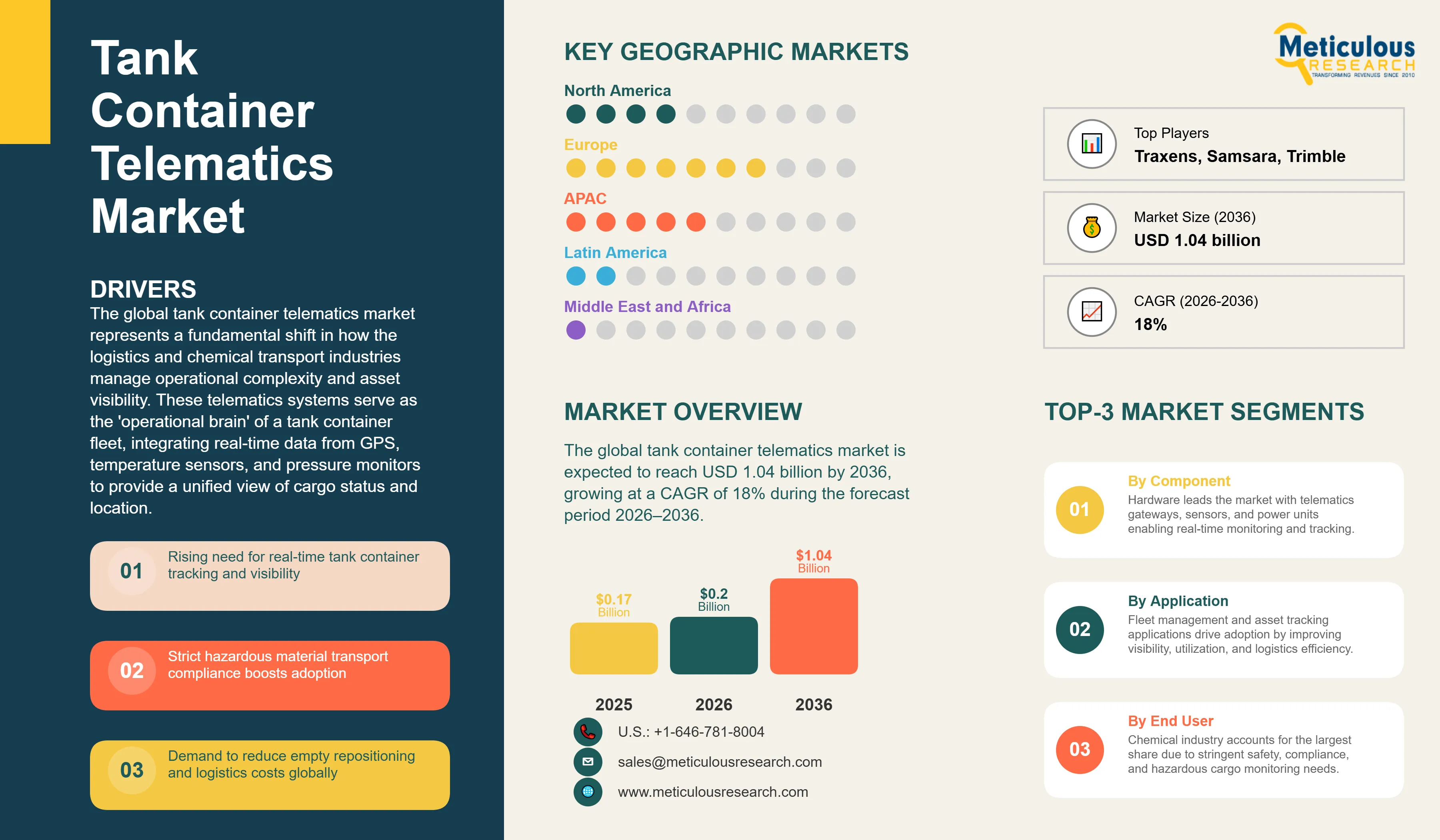
The global tank container telematics market is estimated to be USD 0.20 billion in 2026. This market is expected to reach USD 1.04 billion by 2036, growing at a Compound Annual Growth Rate (CAGR) of 18% during the forecast period 2026–2036.
Click here to: Get Free Sample Pages of this Report
The global tank container telematics market represents a fundamental shift in how the logistics and chemical transport industries manage operational complexity and asset visibility. These telematics systems serve as the 'operational brain' of a tank container fleet, integrating real-time data from GPS, temperature sensors, and pressure monitors to provide a unified view of cargo status and location. According to the International Tank Container Organisation (ITCO) 2026 Fleet Survey, the global tank container fleet reached 899,044 units, reflecting a steady growth that necessitates advanced tracking solutions. This increasing fleet size, coupled with the rising complexity of global supply chains, necessitates the move beyond reactive tracking toward proactive, data-driven asset orchestration enabled by telematics. The market's expansion is intrinsically linked to the broader digitalization of supply chains and the increasing emphasis on sustainability and risk management in global trade.
Drivers: Addressing the Global Logistics Efficiency Crisis
The growth of the overall market is being driven by the critical need to optimize asset utilization and the rising use of predictive analytics to manage fleet operations. Recent industry data indicate that logistics providers are facing unprecedented pressure to reduce costs and improve turnaround times. The US Census Bureau's Manufacturing and Trade Inventories and Sales report highlights the ongoing need for efficient inventory management, with inventory-to-sales ratios underscoring the importance of precise supply chain timing. Tank container telematics have shown measurable impact, with reported reductions in empty repositioning costs and significant decreases in asset allocation delays, allowing operators to maximize the revenue-generating potential of each unit.
Escalating Demand for Real-time Asset Visibility and Fleet Optimization
The global tank container fleet, which reached 899,044 units as of January 1, 2026, as reported by ITCO, demands sophisticated solutions for real-time tracking and management. This escalating demand is driven by the need for enhanced operational efficiency, enabling operators to precisely locate assets, optimize routing, and reduce transit times. The ability to monitor the movement of tank containers across complex intermodal networks significantly reduces the potential for delays and improves overall supply chain predictability. This optimization directly translates into cost savings and improved customer service, making real-time visibility a paramount driver for telematics adoption.
Stringent Regulatory Compliance for Hazardous Materials (HazMat)
The transport of hazardous materials (HazMat) in tank containers is subject to increasingly stringent international and regional regulations. Bodies like Cefic (European Chemical Industry Council) and the EU's ADR (European Agreement concerning the International Carriage of Dangerous Goods by Road) mandate verifiable monitoring of cargo conditions, including pressure and temperature. Telematics solutions provide the necessary data integrity and audit trails to ensure compliance, mitigate risks associated with spills or accidents, and enhance safety across the chemical supply chain. The need to avoid penalties and ensure responsible transport practices is a significant driver for telematics adoption.
Proliferation of IoT and Low-Power Connectivity (LTE-M/NB-IoT)
The rapid advancements in Internet of Things (IoT) technology and low-power wide-area networks (LPWAN) such as LTE-M and NB-IoT are making telematics solutions more accessible and cost-effective. These technologies enable extended battery life for devices (often 10+ years) and reduce hardware costs, lowering the barrier to entry for operators. The ability to maintain 'always-on' connectivity, even in remote areas, ensures continuous data flow, which is crucial for monitoring critical parameters and making timely operational decisions. This technological evolution is expanding the addressable market for tank container telematics.
Focus on Reducing 'Empty Repositioning' and Operational Costs
Empty repositioning of tank containers represents a significant operational cost for logistics providers. Telematics data provides insights into asset location and availability, enabling operators to optimize backhauls and minimize unproductive movements. According to the ITCO Journal, effective utilization of telematics can lead to a reduction of up to 15% in operational costs by streamlining logistics and improving asset turnover. This direct financial benefit is a powerful incentive for the adoption of telematics solutions, particularly in a cost-sensitive industry.
Restraints: Capital Expenditure and Integration Barriers
Despite clear operational benefits, market growth is constrained by high capital requirements and the significant organizational change management needed for fleet-wide deployment. Equipping a large fleet with telematics requires substantial investments in hardware, software subscriptions, and dedicated IT staff for system integration. At the same time, the ITCO 2026 report noted a slowdown in fleet growth to 1.93%, down from historical averages, reflecting broader economic uncertainties and geopolitical tensions that can cause operators to delay capital-intensive technology upgrades. Furthermore, integrating diverse telematics data streams with legacy Enterprise Resource Planning (ERP) systems remains a persistent technical challenge.
High Initial Capital Expenditure (CAPEX) for Hardware and Integration
The upfront investment required to equip an entire tank container fleet with telematics hardware and integrate these systems into existing operational frameworks can be substantial. For large operators, fleet-wide deployment costs can run into the low single-digit millions of dollars. While the long-term return on investment (ROI) is compelling, the initial CAPEX can be a significant barrier, particularly for smaller and medium-sized enterprises (SMEs) with limited capital budgets. This financial hurdle often delays or limits the scale of telematics adoption.
Data Interoperability and Legacy System Integration Challenges
Integrating diverse telematics data streams with a multitude of proprietary truck GPS systems, Enterprise Resource Planning (ERP) software, and Transport Management Systems (TMS) presents significant technical and operational complexities. Many logistics companies operate with legacy IT infrastructure, making seamless data interoperability a challenge. The lack of standardized data formats and communication protocols can lead to data silos, requiring extensive customization and development efforts, which further increases implementation costs and time. Initiatives by organizations like BIC (Bureau International des Containers) aim to standardize data exchange, but widespread adoption is still evolving.
Geopolitical Tensions and Slowdown in Global Fleet Growth
The global economic environment, marked by geopolitical tensions, trade disputes, and high energy costs, has impacted the growth trajectory of the tank container fleet. The ITCO 2026 report indicated a slowdown in fleet growth to 1.93% in 2025/2026, a notable decrease from historical averages of 8%. This moderation in fleet expansion directly affects the addressable market for new telematics installations. Economic uncertainties can lead operators to defer non-essential investments, including technology upgrades, thereby restraining market growth.
Opportunities: Scaling Cryogenic Monitoring and Predictive Maintenance
Emerging opportunities in cryogenic transport and predictive maintenance are creating new growth avenues. By 2026, advanced sensors are enabling operators to monitor the pressure and temperature of liquified natural gas (LNG) and liquid hydrogen with extreme precision, preventing dangerous 'boil-off' events. The expansion of AI-driven analytics allows fleet managers to predict valve failures or heating system malfunctions before they occur, preserving cargo integrity and reducing maintenance downtime. This trend is particularly strong in regions heavily investing in new energy infrastructure, where the safe transport of specialized gases is paramount.
Scaling Specialized Monitoring for Cryogenic and LNG Transport
The increasing global demand for cleaner energy sources, particularly Liquified Natural Gas (LNG) and the nascent market for liquid hydrogen, presents a significant opportunity for specialized tank container telematics. These cryogenic gases require precise temperature and pressure monitoring (e.g., LNG at -162°C) to prevent 'boil-off' and ensure safe transport. Telematics solutions capable of providing ultra-accurate, real-time data for these sensitive cargoes are in high demand, enabling operators to expand into these high-value segments and meet stringent safety requirements.
Integration of AI and Machine Learning for Predictive Maintenance
The integration of Artificial Intelligence (AI) and Machine Learning (ML) algorithms with telematics data is transforming maintenance practices from reactive to predictive. By analyzing historical and real-time sensor data, AI models can forecast potential equipment failures, such as valve malfunctions or heating system breakdowns, before they occur. This enables proactive maintenance scheduling, minimizing unscheduled downtime, extending asset lifespan, and significantly reducing operational costs. The development of 'digital twins' for tank containers, as explored by ITCO Work Groups, further enhances these predictive capabilities.
Expansion of 'Hospital-at-Home' Logistics Models for Medical Gases
While primarily associated with healthcare, the 'hospital-at-home' model has an analogous application in logistics, particularly for the distribution of medical gases like liquid oxygen. As healthcare systems increasingly decentralize care, the demand for efficient and precisely monitored transport of medical gases in tank containers will rise. Telematics solutions can ensure the integrity and timely delivery of these critical supplies, mirroring the patient flow optimization seen in hospital command centers and creating a niche but high-growth opportunity.
Development of 'Digital Twin' for Tank Containers
The concept of a 'digital twin' for tank containers, actively being developed by ITCO Work Groups, represents a significant opportunity. A digital twin is a virtual replica of a physical asset, continuously updated with real-time telematics data. This allows for comprehensive lifecycle management, enhanced predictive analytics, and seamless data exchange during critical processes like hand-overs between different logistics partners. This innovation promises to further optimize asset utilization, improve safety, and streamline complex intermodal operations.
Transition to Autonomous and Predictive Fleet Logistics
A defining trend in 2026 is the evolution of telematics from simple tracking tools into autonomous orchestration hubs. Advanced platforms are increasingly capable of 'self-healing' operational logistics, where AI engines automatically trigger maintenance requests or adjust routing based on real-time sensor data and historical patterns. This automation reduces the cognitive load on fleet managers, allowing them to focus on strategic planning rather than manual tracking. The integration of machine learning is further accelerating this trend by optimizing empty container repositioning, ensuring that assets are deployed where they are most needed.
Ambient Sensor Intelligence for Cargo Safety
The convergence of ambient intelligence and advanced sensor technology is revolutionizing the scope of tank container monitoring. By integrating data from multi-parameter sensors, telematics platforms can monitor cargo safety milestones—such as temperature stability, pressure integrity, and impact events—without manual inspections. This capability is becoming a standard feature in high-end smart containers, particularly for the transport of hazardous chemicals and pharmaceuticals. The ability to provide 24/7 situational awareness over high-risk cargo significantly reduces spoilage and improves overall supply chain reliability.
Cloud-Native and Edge Computing in Telematics Gateways
The shift towards cloud-native architectures and edge computing is a critical trend in tank container telematics. Cloud platforms offer scalability and robust data analytics capabilities, while edge computing allows for real-time processing of sensor data directly at the asset level. This distributed intelligence reduces latency, enhances data security, and enables faster decision-making, particularly for critical alerts. The combination of cloud and edge computing ensures efficient data management and maximizes the responsiveness of telematics systems.
Analysis by Component
Based on component, the hardware segment is expected to hold the largest share in 2026. This dominance is driven by the fundamental necessity of physical devices such as telematics gateways, various sensors (temperature, pressure, level, impact), and power management units to capture data from the physical asset. These components form the backbone of any telematics system, providing the raw data necessary for monitoring and analysis. However, the software/platform segment is projected to register the highest CAGR during the forecast period. This growth is fueled by the expansion of cloud-based analytics, predictive maintenance modules, and fleet management dashboards, which transform raw sensor data into actionable operational insights, thereby increasing the overall value of the telematics investment.
Analysis by Technology
By technology, satellite tracking remains crucial for global intermodal transport, ensuring uninterrupted connectivity even in remote oceanic or terrestrial areas where cellular networks are unavailable. This technology provides the foundational layer for global asset visibility. However, cellular technologies, particularly low-power wide-area networks (LPWAN) such as LTE-M and NB-IoT, are gaining significant traction and are expected to grow at the fastest CAGR for regional and coastal tracking. Their cost-effectiveness, lower power consumption, and ability to penetrate challenging environments make them ideal for efficient data transmission and real-time communication with smart tank containers in more localized operations. Emerging technologies like Bluetooth Low Energy (BLE)and RFID/NFC are also playing increasingly vital roles for short-range communication and digital identification, often integrated into hybrid connectivity solutions that seamlessly switch between different communication protocols to maximize coverage and cost-efficiency.
Analysis by End User
By end user, the chemical industry segment is expected to hold the largest share in 2026. The transport of hazardous and non-hazardous bulk liquids requires strict adherence to safety regulations and continuous monitoring to prevent incidents, making telematics indispensable. The energy & petrochemical industry is also projected to register significant growth, as the global trade of liquified gases like LNG and specialized fuels demands highly specialized and reliable monitoring solutions to maintain extreme temperature and pressure conditions during transit. Other key end-user industries include food & beverage, pharmaceuticals, and mining & industrial materials, all of which benefit from enhanced cargo integrity and supply chain visibility. Furthermore, tank container operators & lessors represent a crucial end-user category, as they are the primary adopters of telematics to optimize asset utilization, reduce operational costs, and provide value-added services to their clients.
North America
North America is expected to dominate the global tank container telematics market in 2026. The region's dominance is supported by a mature logistics IT landscape and the widespread adoption of centralized operational models by large chemical manufacturers and transport operators. Stringent safety regulations from bodies like the Federal Motor Carrier Safety Administration (FMCSA) and the Department of Transportation (DOT) necessitate robust tracking and monitoring capabilities. The region's vast geographical span makes satellite-based tracking a necessity for intermodal movements between major ports and inland industrial hubs, particularly for the chemical and energy sectors. The key companies operating in the North America market are Orbcomm Inc., Verizon Connect, Samsara, and Geotab.
Europe
Europe is expected to hold a significant share of the global tank container telematics market in 2026. The region's mature logistics infrastructure and stringent regulatory environment, including the EU Single-Use Plastics Directive and the European Green Deal, drive the need for advanced telematics solutions. According to Eurostat and industry guidelines from Cefic, there is a strong push towards resilient, smart, and sustainable chemical mobility in the EU. The presence of leading telematics vendors and significant investment in digital supply chain infrastructure continue to drive the market in countries like Germany, the UK, and the Netherlands. The key companies operating in the Europe market are Intermodal Telematics (IMT), Nexxiot AG, Savvy Telematic Systems, and Trifleet Leasing.
Asia Pacific
The Asia Pacific region is projected to witness the fastest growth during the forecast period. This is driven by rapid industrial infrastructure expansion and digital logistics initiatives across China, India, and South Korea. For example, major chemical producers in the region are standardizing on telematics models to manage large export volumes across multi-modal networks. The increasing adoption of cloud-based platforms and the digital transformation of regional supply chains are creating substantial opportunities for market expansion. The key companies operating in the Asia Pacific market are Orbcomm Inc., Traxens, and various regional integrators.
Latin America
Latin America is anticipated to experience steady growth, supported by expanding agricultural and mining exports that utilize tank containers. The inclusion of Mexico in this region further bolsters its market potential due to its significant manufacturing and export activities. Investments in modernizing port and rail infrastructure are facilitating the integration of telematics. The key companies operating in the Latin America market are Orbcomm Inc. and regional providers.
Middle East & Africa
The Middle East & Africa region will see gradual adoption, primarily driven by the petrochemical industry's need for secure and efficient transport of bulk liquids. The key companies operating in the Middle East & Africa market are Nexxiot AG and regional providers.
Competitive Landscape
The global tank container telematics market is highly competitive, characterized by the presence of specialized technology providers and large industrial IoT companies. Key players are focusing on continuous innovation, strategic partnerships, and geographic expansion to strengthen their market position. The integration of AI and advanced analytics into telematics platforms is a major focus area for leading vendors aiming to provide comprehensive fleet orchestration solutions. Strategic collaborations between telematics providers and tank container lessors, such as Trifleet Leasing and Eurotainer, are becoming increasingly common to standardize telematics hardware and offer integrated solutions to clients. This collaborative approach is accelerating market penetration and driving the evolution of smart tank containers.
Intermodal Telematics (IMT), Orbcomm Inc., Traxens, Globe Tracker, Nexxiot AG, Savvy Telematic Systems, Geotab, Verizon Connect, Samsara, Trimble, Trifleet Leasing, Eurotainer, Seaco, Exsif Worldwide, Hoyer Group, Bertschi AG, Stolt-Nielsen, Chemical Express, VTG AG, Den Hartogh Logistics.
The global Tank Container Telematics market is estimated to be approximately USD 0.20 billion in 2026, with a projected growth to USD 1.04 billion by 2036, at a CAGR of 18%.
Key drivers include the escalating demand for real-time asset visibility and fleet optimization, stringent regulatory compliance for hazardous materials, proliferation of IoT and low-power connectivity, and the focus on reducing empty repositioning and operational costs.
Restraints include high initial capital expenditure for hardware and integration, data interoperability and legacy system integration challenges, and geopolitical tensions impacting global fleet growth.
Opportunities lie in scaling specialized monitoring for cryogenic and LNG transport, integration of AI and Machine Learning for predictive maintenance, expansion of 'hospital-at-home' logistics models for medical gases, and the development of 'digital twin' for tank containers.
The hardware segment is expected to hold the largest share due to the fundamental need for physical sensors and communication devices, while the software/platform segment is projected for the fastest growth.
Cellular technologies (LTE-M/NB-IoT) are expected to grow at the fastest CAGR for regional and coastal tracking, while satellite tracking remains crucial for global coverage.
The chemical industry is expected to hold the largest share due to the critical need for safety and regulatory compliance in transporting hazardous materials.
North America is expected to dominate the market due to its mature logistics IT landscape, stringent safety regulations, and widespread adoption of centralized operational models.
Asia Pacific is projected to witness the fastest growth, fueled by rapid industrial infrastructure expansion, digital logistics initiatives, and increasing chemical manufacturing capabilities.
Key trends include the transition to autonomous and predictive fleet logistics, ambient sensor intelligence for cargo safety, and the adoption of cloud-native and edge computing in telematics gateways.
1. Introduction
2. Research Methodology
3. Executive Summary
4. Market Overview
4.1. Market Definition and Scope
4.2. Market Dynamics
4.2.1. Drivers
4.2.1.1. Escalating Demand for Real-time Asset Visibility and Fleet Optimization
4.2.1.2. Stringent Regulatory Compliance for Hazardous Materials (HazMat)
4.2.1.3. Proliferation of IoT and Low-Power Connectivity (LTE-M/NB-IoT)
4.2.1.4. Focus on Reducing 'Empty Repositioning' and Operational Costs
4.2.2. Restraints
4.2.2.1. High Initial Capital Expenditure (CAPEX) for Hardware and Integration
4.2.2.2. Data Interoperability and Legacy System Integration Challenges
4.2.2.3. Geopolitical Tensions and Slowdown in Global Fleet Growth
4.2.3. Opportunities
4.2.3.1. Scaling Specialized Monitoring for Cryogenic and LNG Transport
4.2.3.2. Integration of AI and Machine Learning for Predictive Maintenance
4.2.3.3. Expansion of 'Hospital-at-Home' Logistics Models for Medical Gases
4.2.3.4. Development of 'Digital Twin' for Tank Containers
4.2.4. Trends
4.2.4.1. Transition to Autonomous and Predictive Fleet Logistics
4.2.4.2. Ambient Sensor Intelligence for Cargo Safety
4.2.4.3. Cloud-Native and Edge Computing in Telematics Gateways
4.3. Porter's Five Forces Analysis
4.4. Regulatory Landscape
4.5. Value Chain Analysis
5. Global Tank Container Telematics Market, by Component
5.1. Hardware
5.1.1. Telematics Gateways/Control Units
5.1.2. Sensors
5.1.2.1. Temperature Sensors
5.1.2.2. Pressure Sensors
5.1.2.3. Level/Full-Empty Sensors
5.1.2.4. Heating Sensors
5.1.2.5. Impact & Door Sensors
5.1.3. Solar Panels & Power Management
5.2. Software/Platform
5.2.1. Fleet Management Dashboards
5.2.2. Predictive Analytics & AI Modules
5.2.3. Mobile Applications
5.2.4. API & Integration Services
6. Global Tank Container Telematics Market, by Technology
6.1. Satellite Tracking
6.2. Cellular (LTE-M/NB-IoT)
6.3. Bluetooth Low Energy (BLE)
6.4. RFID & NFC
6.5. Hybrid Connectivity
7. Global Tank Container Telematics Market, by End User
7.1. Chemical Industry
7.2. Food & Beverage Industry
7.3. Energy & Petrochemical Industry
7.4. Pharmaceutical Industry
7.5. Mining & Industrial Materials
7.6. Tank Container Operators & Lessors
8. Global Tank Container Telematics Market, by Geography
8.1. North America
8.1.1. U.S.
8.1.2. Canada
8.2. Europe
8.2.1. Germany
8.2.2. U.K.
8.2.3. France
8.2.4. Italy
8.2.5. Spain
8.2.6. Rest of Europe
8.3. Asia Pacific
8.3.1. China
8.3.2. Japan
8.3.3. India
8.3.4. South Korea
8.3.5. Rest of Asia Pacific
8.4. Latin America
8.4.1. Brazil
8.4.2. Argentina
8.4.3. Mexico
8.4.4. Rest of Latin America
8.5. Middle East & Africa
8.5.1. UAE
8.5.2. Saudi Arabia
8.5.3. Rest of Middle East & Africa
9. Competitive Landscape
9.1. Overview
9.2. Key Growth Strategies
9.3. Competitive Benchmarking
9.4. Competitive Dashboard
9.4.1. Industry Leaders
9.4.2. Market Differentiators
9.4.3. Vanguards
9.4.4. Emerging Companies
9.5. Market Share/Ranking Analysis
10. Company Profiles
10.1. Intermodal Telematics (IMT)
10.2. Orbcomm Inc.
10.3. Traxens
10.4. Globe Tracker
10.5. Nexxiot AG
10.6. Savvy Telematic Systems
10.7. Geotab
10.8. Verizon Connect
10.9. Samsara
10.10. Trimble
10.11. Trifleet Leasing
10.12. Eurotainer
10.13. Seaco
10.14. Exsif Worldwide
10.15. Hoyer Group
10.16. Bertschi AG
10.17. Stolt-Nielsen
10.18. Chemical Express
10.19. VTG AG
10.20. Den Hartogh Logistics
11. Appendix
11.1. References
11.2. Disclaimer























Published Date: Jun-2026
Published Date: Jun-2026
Published Date: Nov-2024
Published Date: Feb-2024
Subscribe to get the latest industry updates