Resources
About Us
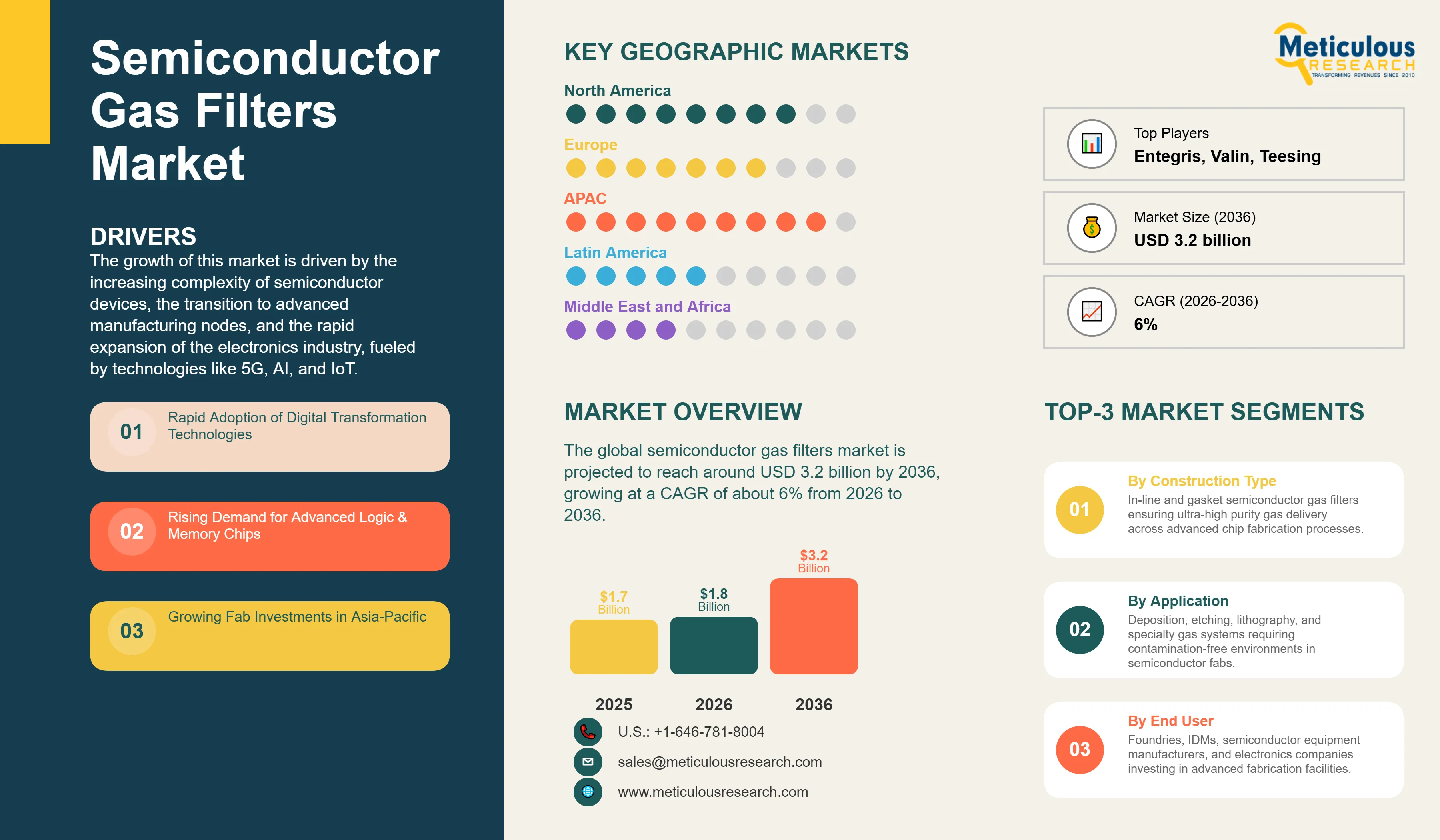
The global semiconductor gas filters market is estimated at USD 1.8 billion in 2026 and is projected to reach around USD 3.2 billion by 2036, growing at a CAGR of about 6% from 2026 to 2036. The growth of this market is driven by the increasing complexity of semiconductor devices, the transition to advanced manufacturing nodes, and the rapid expansion of the electronics industry, fueled by technologies like 5G, AI, and IoT.
Click here to: Get Free Sample Pages of this Report
The semiconductor gas filters are critical components in the manufacturing process, ensuring the purity of gases used in deposition, etching, and other fabrication steps. The presence of even minute particulate or gaseous contaminants can lead to device defects, reducing yield and reliability. Key manufacturers in this space, such as Entegris, Inc., Pall Corporation (a part of Danaher), and Donaldson Company, Inc., provide highly specialized filtration solutions to meet the stringent purity requirements of semiconductor fabs.
The growth of semiconductor gas filters market is propelled by the relentless drive towards smaller and more complex semiconductor devices. As transistor dimensions shrink to the single-digit nanometer scale, the sensitivity to contamination increases exponentially. According to SEMI, the global semiconductor manufacturing equipment market is projected to exceed $100 billion, reflecting the massive investments in new and upgraded fabrication facilities. This expansion directly fuels the demand for high-purity gas filters. For instance, Entegris offers its Torrento X series of filters designed for sub-10nm manufacturing nodes, highlighting the industry's need for advanced filtration technologies. The rise of new applications in AI, 5G, and automotive electronics further accelerates this demand, as these sectors require high-performance, reliable semiconductor components.
Adoption of Advanced Materials for Enhanced Filtration Performance
A key trend in the market is the development and adoption of advanced filter materials to meet the ever-increasing purity requirements of next-generation semiconductor manufacturing. Traditional stainless steel filters are being supplemented and, in some cases, replaced by filters made from advanced alloys like Hastelloy or nickel, which offer superior corrosion resistance to specialty gases. Furthermore, manufacturers are developing proprietary membrane technologies to improve particle capture efficiency and reduce outgassing. For example, Porvair Filtration Group's GasPro filters utilize a proprietary sintered metal powder media to provide high-efficiency filtration. This trend is driven by the need to eliminate killer defects caused by metallic and other contaminants in advanced logic and memory devices.
|
Parameters |
Details |
|
Market Size by 2036 |
USD 3.2 Billion |
|
Market Size in 2026 |
USD 1.8 Billion |
|
Revenue Growth Rate (2026-2036) |
CAGR of 6% |
|
Dominant Filter Element |
Metallic Filters |
|
Leading Geographic Region |
Asia-Pacific |
Drivers: Growing Demand for Advanced Semiconductor Devices
The primary driver for the semiconductor gas filters market is the insatiable global demand for more powerful and efficient semiconductor devices. The proliferation of data centers, the rollout of 5G networks, and the integration of AI into a vast array of applications are creating unprecedented demand for advanced logic, memory, and storage chips. According to a PwC report, the semiconductor market is projected to grow to over $1 trillion by 2030, driven by these megatrends. This growth necessitates the construction of new, state-of-the-art fabrication plants and the upgrading of existing ones, all of which require extensive gas delivery systems equipped with high-performance filters.
How Does Asia-Pacific Maintain Its Leadership in the Global Market?
Asia-Pacific is the undisputed leader in the semiconductor gas filters market, a position it is expected to maintain and strengthen throughout the forecast period. The region is home to the world's largest semiconductor foundries and memory manufacturers, including TSMC, Samsung, and SK Hynix. Massive government and private sector investments in countries like China, Taiwan, and South Korea continue to expand the region's manufacturing capacity. For example, the CHIPS and Science Act in the U.S. and similar initiatives in Europe are aimed at boosting domestic production, but the sheer scale of manufacturing in Asia-Pacific ensures its market dominance. The key companies operating in the Asia-Pacific semiconductor gas filters market are Entegris, Inc., Pall Corporation, and Donaldson Company, Inc., all of which have a significant presence in the region to serve their major customers.
The key players profiled in the global semiconductor gas filters market report include Entegris, Inc. (U.S.), Pall Corporation (U.S.), Donaldson Company, Inc. (U.S.), Porvair Filtration Group (U.K.), Mott Corporation (U.S.), Parker Hannifin Corporation (U.S.), Nippon Seisen Co., Ltd. (Japan), Valin Corporation (U.S.), Ewald Associates, Inc. (U.S.), WITT-Gasetechnik GmbH & Co KG (Germany), Mycropore Corporation (Taiwan), and Teesing B.V. (Netherlands).
The global semiconductor gas filters market is valued at USD 1.8 billion in 2026 and is expected to reach USD 3.2 billion by 2036, growing at a CAGR of 6%.
The main drivers include the growing demand for advanced semiconductor devices, the transition to smaller manufacturing nodes, and the expansion of the electronics industry fueled by 5G and AI.
The key players include Entegris, Inc., Pall Corporation, Donaldson Company, Inc., Porvair Filtration Group, Mott Corporation, and Parker Hannifin Corporation, among others.
Asia-Pacific is expected to lead the global semiconductor gas filters market during the forecast period 2026 to 2036.
1. Introduction
1.1 Market Definition
1.2 Market Ecosystem
1.3 Currency & Limitations
1.3.1 Currency
1.3.2 Limitations
1.4 Key Stakeholders
2. Research Methodology
2.1 Research Approach
2.2 Data Collection & Validation
2.2.1 Secondary Research
2.2.2 Primary Research
2.3 Market Assessment
2.3.1 Market Size Estimation
2.3.2 Bottom-Up Approach
2.3.3 Top-Down Approach
2.3.4 Growth Forecast
2.4 Assumptions for the Study
3. Executive Summary
3.1 Market Overview
3.2 Market Analysis, by Construction
3.3 Market Analysis, by Filter Element
3.4 Market Analysis, by Geography
3.5 Competitive Analysis
4. Market Insights
4.1 Introduction
4.2 Market Dynamics
4.2.1 Drivers
4.2.1.1 Rapid Adoption of Digital Transformation Technologies
4.2.1.2 Rising Demand for Advanced Logic & Memory Chips
4.2.1.3 Growing Fab Investments in Asia-Pacific
4.2.1.4 Increasing Stringency of Gas Purity Standards
4.2.2 Restraints
4.2.2.1 Cyclical Nature of Semiconductor Capital Expenditure
4.2.2.2 High Qualification and Validation Time for New Components
4.2.3 Opportunities
4.2.3.1 Development of AI and High-Performance Computing Hardware
4.2.3.2 Expansion of EUV and Advanced Deposition Processes
4.2.3.3 Growth in Specialty Gas Applications
4.2.4 Challenges
4.2.4.1 Supply Chain Concentration
4.2.4.2 Material Compatibility with Reactive Process Gases
4.3 Trends
4.3.1 Shift Toward Metal Sintered High-Purity Filters
4.3.2 Integration of Smart Monitoring in Gas Delivery Systems
4.3.3 Localization of Semiconductor Supply Chains
5. Semiconductor Gas Filters Market, by Construction
5.1 Introduction
5.2 In-line Filters
5.3 Gasket Filters
6. Semiconductor Gas Filters Market, by Filter Element
6.1 Introduction
6.2 Metallic Filter Elements
6.3 Non-Metallic Filter Elements
7. Semiconductor Gas Filters Market, by Geography
7.1 Introduction
7.2 North America
7.2.1 U.S.
7.2.2 Canada
7.3 Europe
7.3.1 Germany
7.3.2 U.K.
7.3.3 France
7.3.4 Italy
7.3.5 Spain
7.3.6 Netherlands
7.3.7 Rest of Europe
7.4 Asia-Pacific
7.4.1 China
7.4.2 Japan
7.4.3 South Korea
7.4.4 Taiwan
7.4.5 Singapore
7.4.6 Rest of Asia-Pacific
7.5 Latin America
7.5.1 Brazil
7.5.2 Mexico
7.5.3 Argentina
7.5.4 Rest of LATAM
7.6 Middle East & Africa
8. Competitive Landscape
8.1 Introduction
8.2 Key Growth Strategies
8.3 Competitive Benchmarking
8.4 Market Share Analysis
9. Company Profiles
9.1 Entegris, Inc.
9.2 Pall Corporation
9.3 Donaldson Company, Inc.
9.4 Porvair Filtration Group
9.5 Mott Corporation
9.6 Parker Hannifin Corporation
9.7 Nippon Seisen Co., Ltd.
9.8 Valin Corporation
9.9 Ewald Associates, Inc.
9.10 WITT-Gasetechnik GmbH & Co. KG
9.11 Mycropore Corporation
9.12 Teesing B.V.
9.13 Others
10. Appendix
10.1 Questionnaire
10.2 Available Customization
























Published Date: May-2026
Published Date: Feb-2026
Published Date: Nov-2024
Published Date: Oct-2024
Subscribe to get the latest industry updates