
Advanced Semiconductors Market (2026-2036)
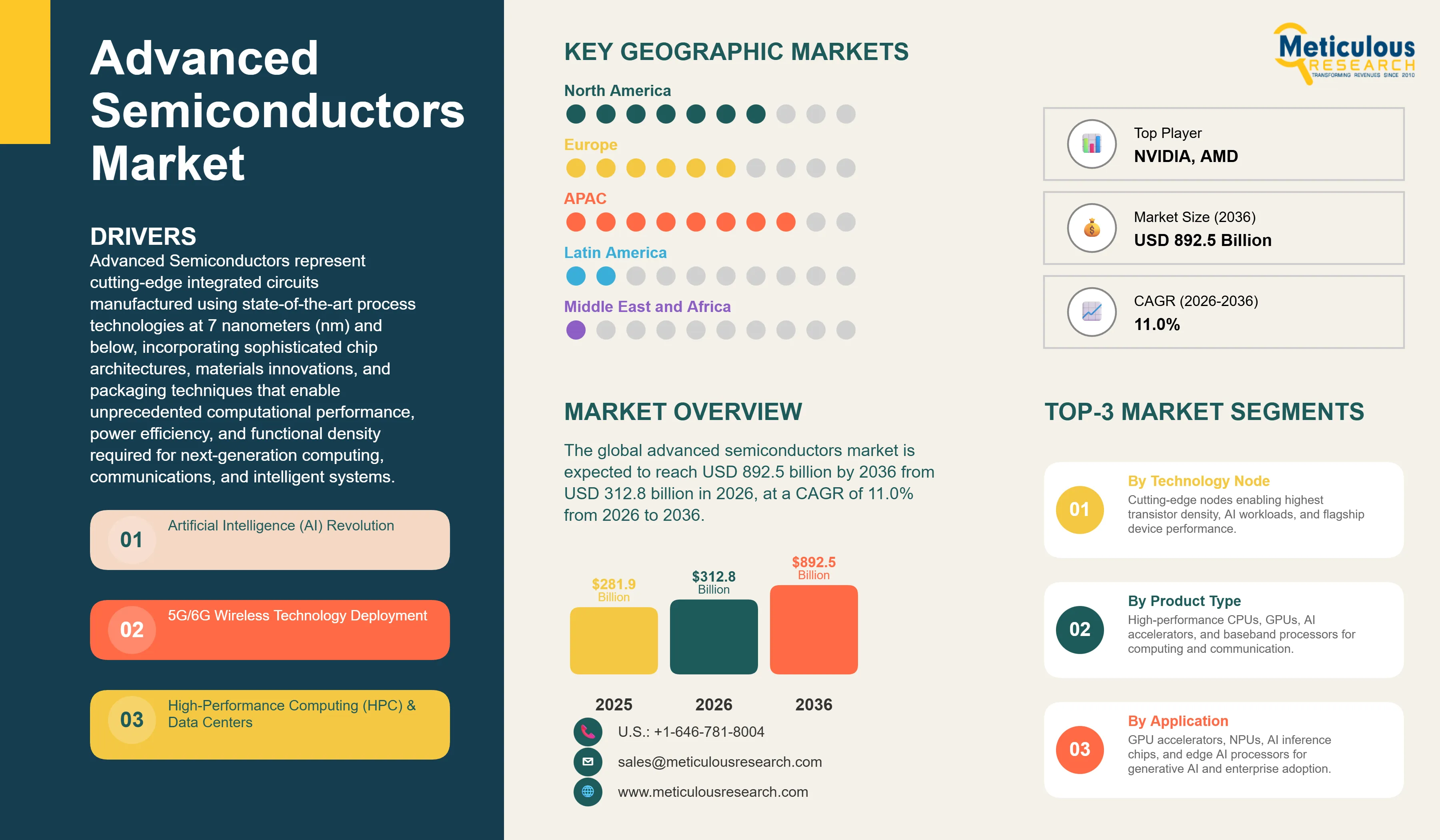
The global advanced semiconductors market is expected to reach USD 892.5 billion by 2036 from USD 312.8 billion in 2026, at a CAGR of 11.0% from 2026 to 2036.
- Published
- Feb 2026
- Pages
- 278
- Format
- PDF + Excel
- Report ID
- MR-1715
- Base year
- 2025
- 2026 · ESTIMATED
- $312.8B
- 2036
- $892.5B
- CAGR 2026–2036
- 11.0%
2025 baseline · 2026–2036 forecast at 11.0% CAGR · hover a bar for the value
Key highlights
In 2026, Asia-Pacific is estimated to account for the largest share of the global advanced semiconductors market, driven by Taiwan's TSMC and South Korea's Samsung leading-edge fabrication dominance, China's massive semiconductor investments and domestic demand, and regional concentration of electronics manufacturing and technology companies.
North America is projected to register significant growth during the forecast period, fueled by CHIPS Act investments driving domestic fab construction, leadership in fabless chip design (NVIDIA, AMD, Qualcomm, Apple), AI semiconductor innovation, and government strategic initiatives reshoring critical semiconductor manufacturing.
Based on technology node, the 3nm-5nm segment is estimated to hold the largest share of the market in 2026, driven by widespread adoption in flagship smartphones, high-performance computing processors, AI accelerators, and optimal balance between performance, power efficiency, and manufacturing maturity.
Based on product type, the logic chips segment is expected to witness the highest growth during the forecast period, driven by AI processor demand, data center CPU/GPU requirements, 5G baseband processors, and automotive computing platforms requiring advanced process nodes.
Based on application, the AI/ML segment dominates rapid growth in 2026, representing GPU accelerators, neural processing units (NPUs), AI inference chips, and edge AI processors benefiting from generative AI explosion and enterprise AI adoption.
The 2nm technology node segment is expected to grow at the highest CAGR during the forecast period, driven by next-generation flagship smartphones launching 2026-2027, Apple and Qualcomm processor roadmaps, AI workload performance requirements, and TSMC/Samsung pilot production ramp.
The advanced packaging segment is experiencing rapid growth, driven by chiplet architectures enabling modular chip design, 2.5D/3D stacking technologies achieving higher bandwidth and integration, heterogeneous integration combining different process nodes, and overcoming Moore's Law scaling limitations.
The U.S. advanced semiconductors market is projected to grow at a CAGR of around 12% during the forecast period 2026 to 2036, driven by CHIPS and Science Act $52.7 billion funding, Intel and TSMC Arizona fab construction, fabless design leadership, AI semiconductor innovation hubs, and national security considerations.
Taiwan is expected to maintain leadership in the Asia-Pacific advanced semiconductors market, driven by TSMC's 70%+ leading-edge foundry market share, 2nm/3nm production leadership, advanced packaging capabilities, and ecosystem supporting fabless customers including Apple, NVIDIA, AMD, and Qualcomm.
In 2026, the automotive semiconductor segment is projected to account for significant growth share, driven by electric vehicle compute platforms, autonomous driving AI processors, advanced driver assistance systems (ADAS), vehicle electrification requiring power management ICs, and automotive-grade advanced node adoption.
Report summary
| Particulars | Details |
|---|---|
| Base Year | 2025 |
| Estimated Year | 2026 |
| Forecast Period | 2026–2036 |
| Market Size (2026) | USD 312.80 billion |
| Market Size (2036) | USD 892.50 billion |
| CAGR (2026–2036) | 11.0% |
| Format | PDF, Excel & Cloud Portal · 278 pages |
| Segments Covered | By Technology Node: 2nm, 3nm, 5nm, 7nm · By Product Type: Logic Chips, Memory Chips, Analog ICs, Processors · By Application: AI/ML, 5G/6G, HPC, Automotive · By End-Use Industry · By Packaging Technology |
Report overview
Segments covered: technology node, product type, application, end-use industry, packaging technology.
Advanced Semiconductors represent cutting-edge integrated circuits manufactured using state-of-the-art process technologies at 7 nanometers (nm) and below, incorporating sophisticated chip architectures, materials innovations, and packaging techniques that enable unprecedented computational performance, power efficiency, and functional density required for next-generation computing, communications, and intelligent systems. These semiconductor devices employ extreme ultraviolet (EUV) lithography enabling feature sizes approaching atomic scales, utilize novel materials including high-k metal gates, FinFET (fin field-effect transistor) and gate-all-around (GAA) transistor structures maximizing electrostatic control, integrate 3D stacking technologies and advanced packaging methods (chiplets, 2.5D/3D packaging) combining multiple dies for enhanced performance, implement specialized architectures optimized for artificial intelligence workloads (neural processing units, tensor cores), 5G/6G communications (RF transceivers, millimeter-wave components), and high-performance computing (multi-core processors, GPU accelerators), and achieve transistor densities exceeding 100-300 million transistors per square millimeter enabling complex system-on-chip (SoC) designs integrating CPU, GPU, memory, and specialized accelerators on single silicon die. By pushing the physical limits of semiconductor manufacturing through innovations in lithography, materials science, device physics, and chip architecture, advanced semiconductors enable transformative technologies including artificial intelligence capable of processing trillions of operations per second, 5G networks delivering multi-gigabit wireless speeds, autonomous vehicles processing sensor data in real-time, and hyperscale data centers supporting cloud computing and digital services, addressing the fundamental challenge that conventional semiconductor scaling approaches are reaching fundamental physical and economic limits requiring disruptive innovations in manufacturing processes, chip design methodologies, and system architectures.
Advanced Semiconductors represent the technological frontier of the global electronics industry, enabling the computing power, energy efficiency, and functional capabilities required for artificial intelligence, 5G/6G communications, autonomous systems, and hyperscale cloud computing that define the digital economy. The semiconductor industry has followed Moore's Law—the observation that transistor density doubles approximately every two years—for over five decades, but advanced nodes below 7nm represent a fundamental inflection point where continued scaling requires revolutionary rather than evolutionary innovations in manufacturing processes, materials science, and chip architectures. The transition from planar transistors to FinFET structures at 22nm/16nm nodes, the adoption of extreme ultraviolet (EUV) lithography for 7nm and below, the development of gate-all-around (GAA) transistors for 3nm/2nm processes, and the integration of high-k metal gate materials demonstrate continuous innovation maintaining semiconductor performance improvements despite approaching atomic-scale dimensions where quantum effects, power consumption, and manufacturing complexity create formidable challenges.
Several transformative trends are reshaping the advanced semiconductors market, including the explosion of artificial intelligence driving unprecedented demand for specialized AI processors with massive parallel computing capabilities and high memory bandwidth, the proliferation of 5G networks requiring advanced RF transceivers and baseband processors handling gigabit data rates, the electrification and autonomization of automotive industry creating automotive-grade advanced semiconductor requirements, the geopolitical semiconductor competition with United States, China, European Union, Japan, and South Korea investing hundreds of billions in domestic semiconductor capabilities, the emergence of chiplet architectures and advanced packaging enabling continued performance scaling through heterogeneous integration when traditional process node shrinking faces diminishing returns, and the sustainability imperative driving power-efficient chip designs reducing data center energy consumption and extending mobile device battery life. The convergence of AI revolution—with ChatGPT demonstrating transformative potential and enterprises racing to deploy AI capabilities—mobile computing evolution toward 6G and edge intelligence, automotive transformation requiring processing power orders of magnitude beyond current vehicles, and geopolitical technology sovereignty concerns has elevated advanced semiconductors from enabling technology to strategic asset commanding hundreds of billions in government investments and representing critical economic and national security infrastructure.
Report infographic
Market dynamics
11 factors across 3 forcesThe artificial intelligence revolution is the
primary market driver creating explosive demand for advanced semiconductors capable of training and running sophisticated AI models. The emergence of large language models (LLMs) including GPT-4, Claude, and Google's Gemini requiring thousands of GPUs for training, generative AI applications transforming content creation and software development, enterprise AI adoption for automation and analytics, and edge AI deployment for real-time inference in smartphones, IoT devices, and autonomous systems collectively drive unprecedented semiconductor demand. AI training workloads require massive parallel processing, high-bandwidth memory, and power-efficient architectures only achievable with leading-edge process technologies—NVIDIA's H100 Tensor Core GPU manufactured on TSMC 4nm delivers up to 4 petaFLOPS AI performance while consuming 700W, with next-generation B100 on 3nm targeting even higher performance density. The AI infrastructure buildout is massive: hyperscale cloud providers are projected to purchase 2-3 million AI accelerators annually 2024-2027 representing $100-150+ billion semiconductor spending, while enterprises deploying on-premises AI systems and edge AI devices create additional demand. The AI semiconductor market extends beyond training: inference acceleration for deploying AI models at scale, edge AI processors enabling on-device intelligence for privacy and latency, and specialized AI chips optimized for specific workloads (computer vision, natural language processing, recommendation systems) create diverse advanced semiconductor requirements across performance and power envelopes.
5G/6G wireless technology deployment is driving
advanced RF and baseband semiconductor demand globally. 5G networks require fundamentally more sophisticated semiconductors than 4G LTE—supporting wider bandwidth (up to 100+ MHz channel widths versus 20MHz for LTE), higher frequencies including millimeter-wave bands (24-47 GHz) with different RF characteristics, massive MIMO antenna arrays requiring complex signal processing, and ultra-low latency for mission-critical applications—creating requirements only advanced process nodes can satisfy. Qualcomm's Snapdragon X75 5G modem manufactured on 4nm process, MediaTek's Dimensity 9300 integrating 5G in flagship SoC on 4nm, and Apple's custom 5G modems demonstrate smartphone 5G semiconductor complexity. The 5G infrastructure side drives demand for advanced baseband processors, RF front-end components, and network processors handling increased data throughput. Looking forward, 6G research targeting 2030 deployment anticipates even more demanding requirements including terahertz frequencies, AI-native network architectures, and integrated sensing and communication requiring next-generation advanced semiconductors. The wireless semiconductor market is global: 5G smartphone shipments exceeding 1 billion units annually create massive volume demand, while network infrastructure spanning base stations, small cells, and core network equipment drives additional advanced semiconductor consumption across diverse applications from smartphones to satellite communications.
High-performance computing (HPC) and data center
infrastructure expansion is driving sustained advanced semiconductor demand. Modern data centers supporting cloud computing, streaming services, online gaming, social media, e-commerce, and enterprise applications require ever-increasing processing capacity—global data center IP traffic projected to grow from 20 zettabytes in 2023 to 50+ zettabytes by 2028 according to Cisco. This drives adoption of advanced server processors: AMD's EPYC using chiplet architecture on 5nm/4nm nodes capturing data center market share, Intel's Xeon Scalable processors transitioning to advanced nodes, and ARM-based server chips from Amazon (Graviton), Ampere, and others providing power-efficient alternatives. Data centers increasingly deploy specialized accelerators beyond CPUs—GPUs for graphics and AI, DPUs (data processing units) for networking and storage offload, FPGA accelerators for specific workloads, and custom ASICs including Google's TPUs—diversifying advanced semiconductor demand. The sustainability imperative amplifies advanced node importance: data centers consume 1-2% of global electricity with projections suggesting 8%+ by 2030 absent efficiency improvements. Advanced semiconductor nodes deliver 20-40% power reduction per generation enabling performance scaling while containing energy consumption and operational costs, making power efficiency critical data center procurement criterion driving adoption of latest process technologies for maximum performance-per-watt.
Geopolitical competition and technology sovereignty concerns
are driving massive government investments in domestic advanced semiconductor capabilities. The United States CHIPS and Science Act allocates $52.7 billion for semiconductor manufacturing, R&D, and workforce development including $39 billion in manufacturing incentives driving Intel's $100+ billion U.S. fab expansion, TSMC's Arizona facilities targeting $65 billion investment with 3nm/2nm production planned, and Samsung's Texas expansion. The European Chips Act targets €43 billion investment doubling Europe's global semiconductor market share to 20% by 2030, supporting Intel's €30+ billion German fab complex and other European semiconductor projects. China's semiconductor self-sufficiency drive includes hundreds of billions in subsidies for domestic companies including SMIC, despite U.S. export restrictions limiting access to advanced manufacturing equipment. Japan and South Korea maintain semiconductor leadership through government-industry partnerships—Japan supporting Rapidus 2nm foundry development and Taiwan collaboration, South Korea providing tax incentives and infrastructure support for Samsung and SK Hynix expansions. These geopolitical dynamics recognize semiconductors as critical infrastructure underlying economic competitiveness, military capabilities, and technological leadership, creating unprecedented government support for advanced semiconductor development accelerating global capacity expansion and potentially reshaping geographic industry concentration from Asia-Pacific toward more distributed manufacturing footprint.
Table of contents
13 chapters · 157 sections · 278 pages · click to expandSegmental analysis
| Segment | Largest share (2026) | Fastest growth (2026–2036) |
|---|---|---|
| Other segments | 3nm–5nm | — |
| By Product Type | — | Logic chips |
| By Application | AI/ML | AI/ML |
Other segments
- The 3nm–5nm segment is expected to dominate the advanced semiconductor market in 2026 because it represents the most commercially viable leading-edge technology.
- These nodes deliver superior performance, higher transistor density, and lower power consumption compared to older generations, making them ideal for high-end applications.
- Major smartphone brands such as Apple, Samsung, and Google are adopting these nodes for flagship processors, while hyperscale cloud providers rely on them for AI accelerators and data center chips.
- Compared to 2nm and below, 3nm–5nm processes also offer better manufacturing yield and cost efficiency, making them more attractive for large-scale production.
- As a result, these nodes are likely to remain the industry workhorse for advanced computing, AI, and 5G infrastructure over the near term.
By Product Type
- Logic chips are expected to be the fastest-growing product category in the advanced semiconductor market due to surging demand from multiple high-growth industries.
- The rapid adoption of artificial intelligence is driving massive demand for GPUs, AI accelerators, and specialized processors used in training and deploying machine learning models.
- Data centers are scaling up investments in high-performance CPUs and custom silicon to handle increasing cloud workloads.
- Additionally, the global rollout of 5G networks is increasing demand for advanced baseband processors and networking chips.
- In the automotive sector, the transition toward electric vehicles and software-defined cars is creating new demand for powerful computing platforms that rely on advanced logic chips.
- Together, these trends are accelerating the shift toward smaller process nodes and higher-performance logic devices.
By Application
- The AI/ML segment is expected to dominate and experience the most rapid growth in 2026, driven by the global surge in artificial intelligence adoption across industries.
- This growth is largely powered by demand for high-performance computing components such as GPU accelerators, neural processing units (NPUs), specialized AI inference chips, and edge AI processors.
- The explosive rise of generative AI applications—such as large language models, image generation, and automated content creation—has significantly increased the need for advanced semiconductor solutions capable of handling massive data processing workloads.
- Enterprises across sectors including healthcare, finance, automotive, retail, and manufacturing are increasingly integrating AI into their operations for automation, predictive analytics, and decision-making, further boosting chip demand.
- Additionally, the shift toward edge AI—where data is processed locally on devices rather than in centralized cloud servers—is driving adoption of power-efficient, advanced-node processors for smartphones, IoT devices, robotics, and smart infrastructure.
- Together, these trends position AI/ML as the most influential application area shaping the advanced semiconductor market in 2026.
Geographic analysis
Asia-Pacific
Largest shareIn 2026, Asia-Pacific is estimated to account for the largest share of the global advanced semiconductor market due to its overwhelming manufacturing leadership and integrated electronics ecosystem. Taiwan’s TSMC remains the world’s most advanced foundry, producing chips at 3nm and below for major global tech companies, making it a critical pillar of the semiconductor supply chain. South Korea’s Samsung is another key leader in advanced logic and memory manufacturing, strengthening regional technological dominance. Meanwhile, China continues to invest massively in domestic semiconductor production to reduce dependency on foreign suppliers, supported by government subsidies, industrial policies, and strong end-market demand from consumer electronics, telecommunications, and electric vehicles. The region also hosts a dense network of semiconductor equipment suppliers, packaging firms, and electronics manufacturers, creating a highly concentrated and efficient value chain that reinforces Asia-Pacific’s leadership.
North America
North America is projected to register significant growth in advanced semiconductors, primarily driven by the U.S. CHIPS and Science Act, which is stimulating large-scale investments in domestic chip fabrication plants by companies such as Intel, TSMC (Arizona), and Samsung (Texas). This policy shift aims to strengthen supply chain resilience, reduce geopolitical risks, and bring critical manufacturing back to the U.S. In parallel, North America maintains global leadership in fabless semiconductor design, with companies such as NVIDIA, AMD, Qualcomm, and Apple driving innovation in AI chips, data center processors, and mobile SoCs. The rapid expansion of cloud computing, artificial intelligence, autonomous vehicles, and defense electronics is further boosting demand for advanced nodes. Government strategic initiatives, public-private collaborations, and research funding in next-generation semiconductor technologies are expected to sustain long-term market momentum.
Frequently asked questions
The advanced semiconductors market is expected to grow from USD 312.8 billion in 2026 to USD 892.5 billion by 2036.
Cite this report
Meticulous Research. (2026). Advanced Semiconductors Market - Global Opportunity Analysis and Industry Forecast (2026-2036) (Report No. MR-1715). Meticulous Market Research Pvt. Ltd. https://www.meticulousresearch.com/product/advanced-semiconductors-market-6398