Sample Preparation Market (2026-2036)
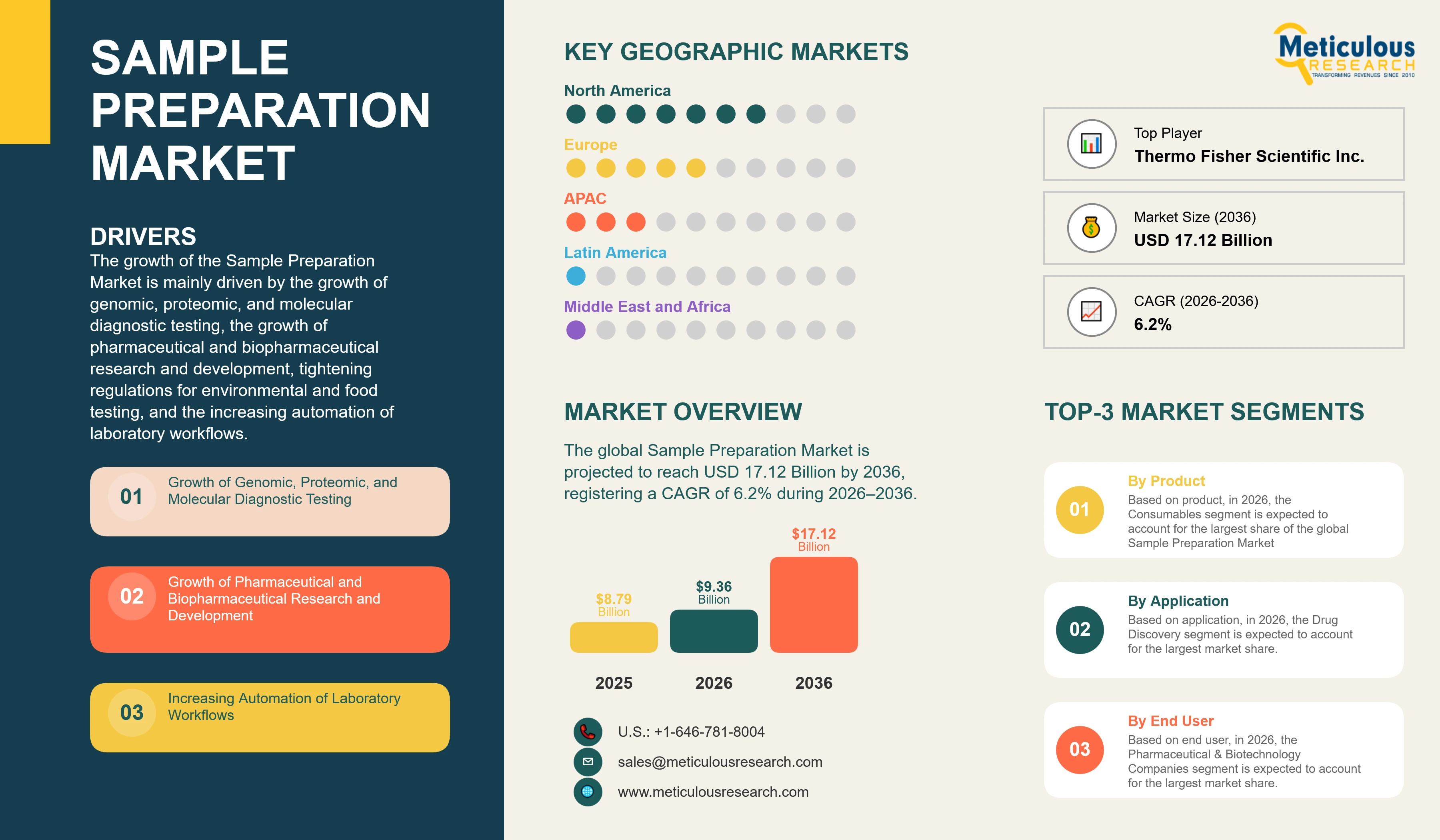
The global Sample Preparation Market was valued at USD 8.79 billion in 2025. This market is expected to reach USD 17.12 billion by 2036 from an estimated USD 9.36 billion in 2026, registering a CAGR of 6.2% during the forecast period (2026-2036).
- Published
- Oct 2026
- Pages
- 412
- Format
- PDF + Excel
- Report ID
- MRHC - 104844
- Base year
- 2025
- 2025 · BASELINE
- $8.79B
- 2036
- $17.12B
- CAGR 2026–2036
- 6.2%
2025 baseline · 2026–2036 forecast at 6.2% CAGR · hover a bar for the value
Key highlights
The global Sample Preparation Market is projected to reach USD 17.12 billion by 2036, driven by genomic and proteomic research, molecular diagnostics, biopharmaceutical development, environmental and food testing, and laboratory automation.
Laboratory demand is recovering, led by consumables and life sciences. In the third quarter of fiscal year 2026, Agilent Technologies, Inc. reported revenue of USD 1.88 billion, up 8.1% year over year, with its Life Sciences and Diagnostics Markets segment growing 11% to USD 746 million, its CrossLab consumables and services segment growing 6% to USD 786 million, and its Applied Markets segment growing 7% to USD 346 million, and raised its fiscal 2026 revenue guidance to USD 7.49-7.51 billion.
Automated sample preparation is growing faster than manual methods. In the second quarter of 2026, QIAGEN N.V. reported Sample technologies sales of USD 182 million, up 9% at constant exchange rates, with automated consumables growing at a high-teens rate, while rolling out its next-generation QIAsymphony Connect platform and receiving first orders for QIAsprint Connect.
North America is expected to account for the largest market share in 2026, supported by large pharmaceutical, biotechnology, and diagnostic industries, environmental testing regulations, and the presence of leading manufacturers, while Asia-Pacific is projected to register the fastest growth during the forecast period.
By application, Drug Discovery is expected to account for the largest market share in 2026, whereas Proteomic Studies are projected to witness the fastest growth through 2036, as high-sensitivity mass spectrometry and affinity-based proteomics expand in research, biomarker discovery, and population studies.
Report summary
| Particulars | Details |
|---|---|
| Forecast Period | 2026-2036 |
| Base Year | 2025 |
| Estimated Year | 2026 |
| CAGR (Value) | 6.2% |
| Format | PDF, Excel & Cloud Portal · 412 pages |
| Market Size (Value) in 2026 | USD 9.36 Billion |
| Market Size (Value) in 2036 | USD 17.12 Billion |
| Segments Covered | By Product: Consumables (Sample Preparation Kits & Reagents [Isolation Kits & Reagents, Extraction Kits & Reagents, Purification Kits & Reagents, each for DNA, RNA, and Protein; Other Reagents], Filters, Tubes, Plates, Other Consumables), Instruments (Liquid Handling Systems [Automated Liquid Handling Systems, Manual Pipettes, Reagent Dispensers, Microplate Washers, Other Liquid Handling Systems], Centrifuges, Filtration Systems, Extraction Systems, Purification Systems, Other Sample Preparation Systems), Workstations, Software. By Technique: Solid Phase Extraction, Liquid Phase Extraction, Filtration, Dilution, Precipitation, Other Techniques. By Application: Drug Discovery, Diagnostics, Genomic Studies, Proteomic Studies, Analytical Testing, Other Applications. By End User: Pharmaceutical & Biotechnology Companies, Contract Research Organizations, Academic & Research Institutes, Hospital & Diagnostic Laboratories, Food & Beverage Companies, Environmental Testing Laboratories, Other End Users. |
| Countries Covered | North America: U.S., Canada. Europe: Germany, France, Italy, U.K., Spain, Rest of Europe. Asia-Pacific: China, Japan, India, South Korea, Australia, Rest of Asia-Pacific. Latin America: Brazil, Mexico, Rest of Latin America. Middle East & Africa: Saudi Arabia, UAE, Rest of Middle East & Africa. |
| Key Companies | Thermo Fisher Scientific Inc., Agilent Technologies, Inc., Danaher Corporation, Merck KGaA, QIAGEN N.V., F. Hoffmann-La Roche Ltd, Bio-Rad Laboratories, Inc., Revvity, Inc., Illumina, Inc., Promega Corporation, Waters Corporation, Tecan Group Ltd., and Hamilton Company. |
Report overview
Segments covered: product, technique, application, end user.
The growth of this market is mainly driven by the growth of genomic, proteomic, and molecular diagnostic testing, which require reproducible preparation of nucleic acids, proteins, and cells; the growth of pharmaceutical and biopharmaceutical research and development, including bioanalysis for biologics, cell and gene therapies, and novel modalities; tightening regulations for environmental and food testing, including testing for per- and polyfluoroalkyl substances (PFAS), pesticides, and contaminants; and the increasing automation of laboratory workflows to address throughput demands and staff shortages. In addition, the adoption of high-sensitivity mass spectrometry and sequencing that place greater demands on sample quality, the development of integrated sample preparation workstations, the growth of liquid biopsy and single-cell analysis, and the expansion of laboratory capacity in Asia-Pacific are further supporting the growth of this market.
The Sample Preparation Market, also referred to as the laboratory sample preparation market, sample processing market, or analytical sample preparation market, comprises the consumables, instruments, workstations, and software used to isolate, extract, purify, concentrate, dilute, filter, and otherwise prepare biological, chemical, food, and environmental samples for analysis by sequencing, PCR, mass spectrometry, chromatography, immunoassays, and other analytical methods. The market includes kits and reagents for the isolation, extraction, and purification of DNA, RNA, and proteins; buffers, solvents, filtration media, and immunomagnetic reagents; filters, tubes, plates, columns, tips, and cartridges; liquid handling systems, including automated liquid handlers, pipettes, dispensers, and microplate washers; centrifuges, filtration systems, extraction and purification systems, homogenizers, shakers, and microwave digestion systems; integrated sample preparation workstations; and software for workflow control and data management. The market covers techniques including solid phase extraction (SPE), liquid phase extraction (LPE), filtration, dilution, and precipitation. The market ecosystem extends from manufacturers of consumables, reagents, and instruments to pharmaceutical and biotechnology companies, contract research organizations (CROs), academic and research institutes, hospitals and diagnostic laboratories, food and beverage companies, and environmental testing laboratories.
Sample preparation is often the most time-consuming and error-prone part of laboratory analysis. The quality of sample preparation determines the accuracy, sensitivity, and reproducibility of results, and poorly prepared samples can cause failed runs, false results, and instrument downtime. As analytical instruments such as high-resolution mass spectrometers and high-throughput sequencers become more sensitive and productive, sample preparation increasingly becomes the bottleneck, and laboratories are investing in better consumables, automation, and integrated workflows.
Life sciences and pharmaceutical research are the largest sources of demand. Genomic studies require extraction and library preparation of nucleic acids, proteomic studies require protein extraction, digestion, and enrichment, and drug discovery and development require preparation of samples for screening, bioanalysis, and quality control. In the third quarter of fiscal year 2026, Agilent Technologies, Inc. reported revenue of USD 1.88 billion, up 8.1% year over year, with its Life Sciences and Diagnostics Markets segment growing 11% to USD 746 million, its CrossLab consumables and services segment growing 6% to USD 786 million, and its Applied Markets segment growing 7% to USD 346 million, and raised its fiscal 2026 revenue guidance to USD 7.49-7.51 billion. The growth of biologics, antibody-drug conjugates, cell and gene therapies, and oligonucleotide drugs is increasing the complexity of bioanalytical sample preparation.
Molecular diagnostics and genomics continue to drive demand for nucleic acid sample preparation. In the second quarter of 2026, QIAGEN N.V. reported Sample technologies sales of USD 182 million, up 9% at constant exchange rates, with automated consumables growing at a high-teens rate, while rolling out its next-generation QIAsymphony Connect platform and receiving first orders for QIAsprint Connect. The growth of oncology testing, liquid biopsy, infectious disease testing, and genetic testing requires automated and reproducible extraction from blood, plasma, tissue, and other samples, and the growth of sequencing volumes increases demand for library preparation and cleanup.
Environmental and food testing are important and regulation-driven applications. In the U.S., the Environmental Protection Agency (EPA) limits of 4.0 parts per trillion for PFOA and PFOS in drinking water remain in force, with public water systems required to disclose PFAS levels from 2027, and compliance testing relies on EPA Methods 533 and 537.1, which use solid phase extraction followed by liquid chromatography-tandem mass spectrometry (LC-MS/MS), while EPA Method 1633A extends PFAS analysis to wastewater, surface water, groundwater, soils, biosolids, and tissue. Laboratories testing water, soil, food, and consumer products for PFAS, pesticides, mycotoxins, veterinary drug residues, and other contaminants use SPE, QuEChERS, filtration, and digestion methods, and tightening limits require greater sensitivity and cleaner samples.
Automation is reshaping laboratory sample preparation. Laboratories face rising sample volumes, shortages of skilled staff, and requirements for traceability and reproducibility, and they are adopting automated liquid handlers, extraction systems, and integrated workstations. In the first half of 2026, Tecan Group Ltd. reported sales of CHF 427.5 million, up 3.4% in local currencies, with its Life Sciences Business growing 3.1% on growth in biopharma and diagnostics, a recovery in liquid handling instrument revenue in the second quarter, and recurring revenues reaching 64.4% of segment sales, while academic and government demand declined. Manufacturers are also adding software, analytics, and AI capabilities to automation platforms to improve productivity.
The market includes leading life science and analytical companies such as Thermo Fisher Scientific, Agilent Technologies, Danaher, Merck KGaA, QIAGEN, Roche, Bio-Rad Laboratories, Revvity, Illumina, Promega, and Waters, and laboratory automation companies such as Tecan and Hamilton. These companies compete on the performance and reproducibility of consumables, the breadth of portfolios across sample types and techniques, the throughput and flexibility of automation, integration with analytical instruments, regulatory compliance, cost per sample, and global distribution and service.
At the same time, the market faces challenges, including variability in research funding, particularly in academic and government laboratories, the high cost of automated systems for smaller laboratories, the complexity of preparing samples from diverse and difficult matrices, the need for method validation, price competition in standard consumables, and the environmental impact of plastic consumables and solvents. As a result, companies that combine high-performance consumables, flexible and scalable automation, integration with downstream analysis, validated application workflows, and sustainable products are expected to capture the largest share of growth over the forecast period.
Report infographic
Market dynamics
15 factors across 5 forcesGrowth of Genomic, Proteomic, and Molecular Diagnostic Testing
The growth of genomic, proteomic, and molecular diagnostic testing is a major factor driving the Sample Preparation Market, as every sequencing run, PCR test, and mass spectrometry analysis begins with sample preparation. Sequencing volumes continue to grow with population genomics, clinical genome sequencing, and single-cell research, and molecular diagnostics continue to expand in oncology, infectious diseases, and genetic testing. In the second quarter of 2026, QIAGEN N.V. reported Sample technologies sales of USD 182 million, up 9% at constant exchange rates, with automated consumables growing at a high-teens rate, while rolling out its next-generation QIAsymphony Connect platform and receiving first orders for QIAsprint Connect.
Proteomics is also expanding rapidly, driven by improvements in mass spectrometry sensitivity and throughput and by affinity-based proteomic platforms used in biomarker discovery and population studies. Mass spectrometry-based proteomics requires extraction, digestion, cleanup, and enrichment of proteins and peptides, and these steps are increasingly automated to handle large studies, creating demand for specialized consumables and workstations.
Growth of Pharmaceutical and Biopharmaceutical Research and Development
The growth of pharmaceutical and biopharmaceutical research and development is significantly driving market growth. Drug discovery, preclinical and clinical bioanalysis, and manufacturing quality control require extensive sample preparation, and the growth of biologics, antibody-drug conjugates, cell and gene therapies, peptides, and oligonucleotides is increasing the complexity of bioanalytical methods. In the third quarter of fiscal year 2026, Agilent Technologies, Inc. reported revenue of USD 1.88 billion, up 8.1% year over year, with its Life Sciences and Diagnostics Markets segment growing 11% to USD 746 million, its CrossLab consumables and services segment growing 6% to USD 786 million, and its Applied Markets segment growing 7% to USD 346 million, and raised its fiscal 2026 revenue guidance to USD 7.49-7.51 billion. Tecan reported growth in its biopharma business in the first half of 2026, reflecting demand for automation in pharmaceutical research.
Tightening Regulations for Environmental and Food Testing
Tightening regulations for environmental and food testing are an important driver of demand. In the U.S., the Environmental Protection Agency (EPA) limits of 4.0 parts per trillion for PFOA and PFOS in drinking water remain in force, with public water systems required to disclose PFAS levels from 2027, and compliance testing relies on EPA Methods 533 and 537.1, which use solid phase extraction followed by liquid chromatography-tandem mass spectrometry (LC-MS/MS), while EPA Method 1633A extends PFAS analysis to wastewater, surface water, groundwater, soils, biosolids, and tissue. Regulations on pesticide residues, mycotoxins, heavy metals, veterinary drug residues, and emerging contaminants in food and the environment in the U.S., Europe, and Asia-Pacific require sensitive analysis, and sample preparation by SPE, QuEChERS, filtration, and digestion is essential to achieving required detection limits.
As detection limits fall to parts-per-trillion levels for contaminants such as PFAS, sample preparation becomes more demanding, requiring cleaner extraction, contamination control, and automated workflows to process large numbers of samples. This creates sustained demand for SPE cartridges, filtration products, and automated extraction systems from environmental and food testing laboratories.
Increasing Automation of Laboratory Workflows
The increasing automation of laboratory workflows supports market growth. Laboratories are automating sample preparation to increase throughput, reduce manual errors and hands-on time, improve reproducibility and traceability, and address shortages of skilled staff. In the first half of 2026, Tecan Group Ltd. reported sales of CHF 427.5 million, up 3.4% in local currencies, with its Life Sciences Business growing 3.1% on growth in biopharma and diagnostics, a recovery in liquid handling instrument revenue in the second quarter, and recurring revenues reaching 64.4% of segment sales, while academic and government demand declined. QIAGEN reported high-teens growth in automated consumables in the second quarter of 2026, outpacing its overall Sample technologies growth.
Table of contents
12 chapters · 169 sections · 412 pages · click to expandSegmental analysis
| Segment | Largest share (2026) | Fastest growth (2026–2036) |
|---|---|---|
| By Product | Consumables | Workstations |
| By Technique | Solid Phase Extraction | Solid Phase Extraction |
| By Application | Drug Discovery | Proteomic Studies |
| By End User | Pharmaceutical & Biotechnology Companies | Environmental Testing Laboratories |
By Product
- Sample Preparation Market Analysis by Product
- Consumables are further segmented into Sample Preparation Kits & Reagents, Filters, Tubes, Plates, and Other Consumables; Sample Preparation Kits & Reagents are further segmented into Isolation Kits & Reagents, Extraction Kits & Reagents, Purification Kits & Reagents, each covering DNA, RNA, and protein, and Other Reagents.
- Instruments are further segmented into Liquid Handling Systems, including Automated Liquid Handling Systems, Manual Pipettes, Reagent Dispensers, Microplate Washers, and Other Liquid Handling Systems, Centrifuges, Filtration Systems, Extraction Systems, Purification Systems, and Other Sample Preparation Systems.
- The Consumables segment is expected to account for the largest share of the global Sample Preparation Market.
- The large share of this segment is mainly due to the recurring use of kits, reagents, filters, tubes, plates, and tips for every sample, the large installed base of instruments that use platform-specific consumables, and the growth of testing volumes across genomics, proteomics, diagnostics, and applied testing.
- Agilent reported 6% growth in its CrossLab consumables and services segment in the third quarter of fiscal 2026.
- However, the Workstations segment is projected to register the highest CAGR during the forecast period.
- The rapid growth of this segment is attributed to the shift toward end-to-end automated workflows, the need to increase throughput and reproducibility, shortages of skilled laboratory staff, and the integration of sample preparation with analytical instruments in genomics, proteomics, bioanalysis, and environmental testing.
By Technique
- Sample Preparation Market Analysis by Technique
- Other Techniques include stir bar sorptive extraction, microwave-assisted extraction, flow injection analysis, Soxhlet extraction, ultrasonic extraction, supercritical fluid extraction, and headspace extraction.
- The Solid Phase Extraction segment is expected to account for the largest share of the market and is also projected to register the highest CAGR during the forecast period.
- This is mainly due to the widespread use of SPE in bioanalysis, environmental testing, food testing, and clinical mass spectrometry, its suitability for automation, its role in regulated methods such as EPA Methods 533 and 537.1 for PFAS in drinking water, and the use of silica- and magnetic bead-based solid phase methods in nucleic acid extraction.
- The Filtration segment is expected to record strong growth, supported by the use of filtration in sample clarification, biologics and cell and gene therapy analysis, and environmental testing, while Liquid Phase Extraction remains important in food, environmental, and chemical analysis.
By Application
- Sample Preparation Market Analysis by Application
- Other Applications include microbiology, cell culture, and cell biology.
- The Drug Discovery segment is expected to account for the largest share of the market.
- The large share of this segment is mainly due to the extensive use of sample preparation in screening, bioanalysis, and quality control by pharmaceutical and biotechnology companies, the growth of biologics and novel modalities requiring complex bioanalytical methods, and the significant research and development budgets of the pharmaceutical industry.
- However, the Proteomic Studies segment is projected to register the highest CAGR during the forecast period.
- The rapid growth of this segment is attributed to improvements in the sensitivity and throughput of mass spectrometry, the growth of affinity-based proteomic platforms, the use of proteomics in biomarker discovery and large population studies, such as the proteomic data planned for 150,000 UK Biobank participants, and the automation of protein extraction, digestion, and cleanup.
By End User
- Sample Preparation Market Analysis by End User
- Other End Users include forensic laboratories, agricultural organizations, and blood banks.
- The Pharmaceutical & Biotechnology Companies segment is expected to account for the largest share of the market.
- The large share of this segment is mainly due to the extensive use of sample preparation in drug discovery, development, and manufacturing quality control, investment in laboratory automation, and the growth of biologics and advanced therapies.
- However, the Environmental Testing Laboratories segment is projected to register the highest CAGR during the forecast period.
- The rapid growth of this segment is attributed to tightening regulations for PFAS and other contaminants in drinking water, wastewater, soil, and consumer products, the requirement for public water systems in the U.S. to disclose PFAS levels from 2027, the increasing number of samples requiring trace-level analysis, and the adoption of automated SPE and extraction systems.
Geographic analysis
North America
Largest shareIn 2026, North America is expected to account for the largest share of the global Sample Preparation Market. The large share of this region is mainly attributed to large pharmaceutical, biotechnology, and diagnostic industries, substantial research funding, regulations for environmental and food testing, including PFAS limits for drinking water, and the presence of leading manufacturers such as Thermo Fisher Scientific, Agilent Technologies, Danaher, Bio-Rad Laboratories, Revvity, Illumina, Promega, Waters, and Hamilton. In the U.S., the Environmental Protection Agency (EPA) limits of 4.0 parts per trillion for PFOA and PFOS in drinking water remain in force, with public water systems required to disclose PFAS levels from 2027, and compliance testing relies on EPA Methods 533 and 537.1, which use solid phase extraction followed by liquid chromatography-tandem mass spectrometry (LC-MS/MS), while EPA Method 1633A extends PFAS analysis to wastewater, surface water, groundwater, soils, biosolids, and tissue.
Europe
Europe is expected to account for a significant share of the market, supported by strong pharmaceutical and research sectors, strict food and environmental regulations, including restrictions on PFAS, and the presence of companies such as Merck KGaA, QIAGEN, Roche, and Tecan. In the first half of 2026, Tecan Group Ltd. reported sales of CHF 427.5 million, up 3.4% in local currencies, with its Life Sciences Business growing 3.1% on growth in biopharma and diagnostics, a recovery in liquid handling instrument revenue in the second quarter, and recurring revenues reaching 64.4% of segment sales, while academic and government demand declined.
Asia-Pacific
Fastest growthAsia-Pacific is projected to register the highest CAGR during the forecast period. The growth of this region is driven by the expansion of pharmaceutical research, CROs, and contract manufacturing in China and India, growing investment in genomics and diagnostics, tightening food and environmental regulations, and the expansion of laboratory capacity in Japan, South Korea, and Southeast Asia. Tecan opened direct operations in India in May 2026, reflecting the growing importance of the region.
Latin America
Latin America and the Middle East & Africa are expected to account for smaller shares of the market. In Latin America, pharmaceutical, food, and agricultural testing in Brazil and Mexico are expected to support demand, while in the Middle East & Africa, investment in healthcare, research, and environmental testing in Gulf countries is expected to support growth.
Competitive landscape
The global Sample Preparation Market is moderately consolidated, with a group of large life science and analytical companies holding significant shares through broad portfolios of consumables and instruments, alongside laboratory automation specialists and specialized consumable suppliers. Market participants compete primarily on the performance and reproducibility of consumables, portfolio breadth across sample types and techniques, the throughput and flexibility of automation, integration with analytical instruments, regulatory compliance, cost per sample, and global service.
Leading companies are launching next-generation automated platforms and workstations, expanding application-specific kits and consumables, integrating software and AI, forming automation partnerships, and pursuing acquisitions. Recent examples include the rollout of QIAsymphony Connect by QIAGEN in 2026, the integration of agentic AI into the Tecan Introspect platform in June 2026, the opening of direct operations by Tecan in India in May 2026, and the acquisition of Parse Biosciences by QIAGEN.
The report provides a comprehensive competitive assessment of the leading companies operating in the global Sample Preparation Market. The key players profiled in the report include Thermo Fisher Scientific Inc. (U.S.), Agilent Technologies, Inc. (U.S.), Danaher Corporation (U.S.), Merck KGaA (Germany), QIAGEN N.V. (Netherlands), F. Hoffmann-La Roche Ltd (Switzerland), Bio-Rad Laboratories, Inc. (U.S.), Revvity, Inc. (U.S.), Illumina, Inc. (U.S.), Promega Corporation (U.S.), Waters Corporation (U.S.), Tecan Group Ltd. (Switzerland), and Hamilton Company (U.S.).
- Thermo Fisher Scientific Inc.
- Agilent Technologies, Inc.
- Danaher Corporation
- Merck KGaA
- QIAGEN N.V.
- F. Hoffmann-La Roche Ltd
- Bio-Rad Laboratories, Inc.
- Revvity, Inc.
- Illumina, Inc.
- Promega Corporation
- Waters Corporation
- Tecan Group Ltd.
- Hamilton Company
Expert perspectives
The Sample Preparation Market is benefiting from a recovery in laboratory spending and a structural shift toward automation. With Agilent reporting 8.1% revenue growth in the third quarter of fiscal 2026, QIAGEN reporting high-teens growth in automated consumables, and Tecan reporting recovering liquid handling demand, laboratories are investing to remove the sample preparation bottleneck that limits the productivity of increasingly powerful analytical instruments. The binding constraint is shifting from analytical capacity to the speed, reproducibility, and automation of sample preparation.
Three structural changes are expected to shape competitive positions through 2036. First, end-to-end automated workflows and workstations are expected to replace manual and step-wise preparation in high-throughput laboratories, favoring companies with integrated platforms. Second, proteomics, liquid biopsy, single-cell analysis, and advanced bioanalysis are expected to drive demand for specialized, high-value consumables. Third, regulation-driven testing, particularly for PFAS and other contaminants, is expected to sustain strong demand from environmental and food laboratories.
For companies planning entry or expansion, the most defensible positions over the forecast period are likely to be found in integrated workstations for genomics, proteomics, and bioanalysis, automated SPE for environmental and food testing, proteomics sample preparation, liquid biopsy and single-cell preparation, and sustainable consumables. For established providers, the principal priorities are growing recurring consumable revenue from installed bases, integrating software and AI, and expanding in Asia-Pacific.
Overall, the market is expected to grow steadily, with consumables, solid phase extraction, drug discovery, pharmaceutical and biotechnology companies, and North America providing the core of demand and workstations, proteomic studies, environmental testing laboratories, and Asia-Pacific providing the fastest growth.
Customer perspectives
Insights gathered during primary interviews with pharmaceutical bioanalysis leaders, environmental laboratory managers, and genomics core facility directors operating in this market highlight where procurement priorities are shifting. The following perspectives reflect recurring themes raised across these discussions.
“This reflects sample preparation as the bottleneck in analysis.”
“This indicates regulation-driven demand for specialized sample preparation.”
“This points to automation as a priority in genomics laboratories.”
Frequently asked questions
The global Sample Preparation Market is estimated at USD 9.36 billion in 2026.
Cite this report
Meticulous Research. (2026). Sample Preparation Market - Global Opportunity Analysis and Industry Forecast (2026-2036) (Report No. MRHC - 104844). Meticulous Market Research Pvt. Ltd. https://www.meticulousresearch.com/product/sample-preparation-market-5527