Quantum Communication Market (2026-2036)
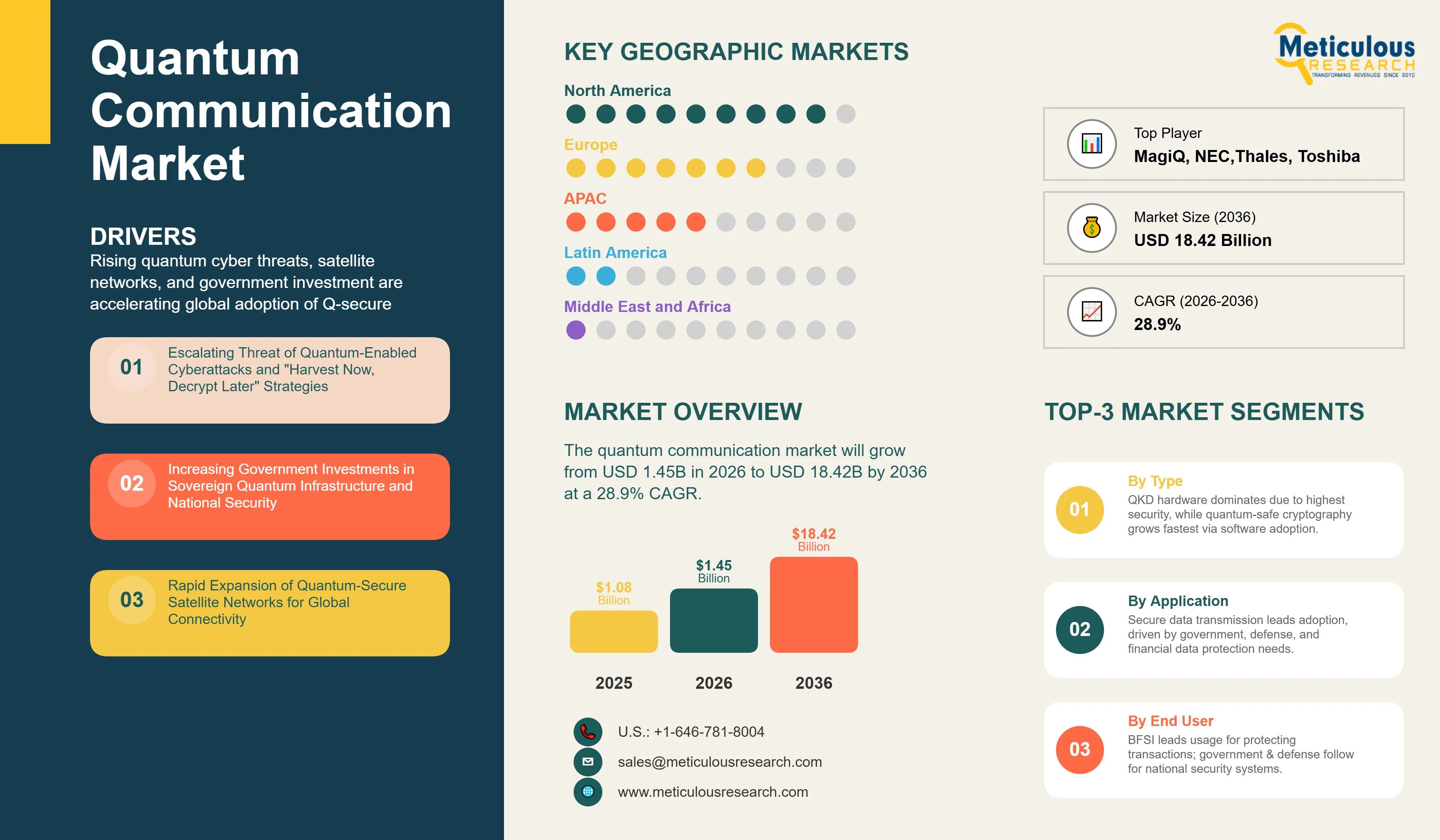
The global quantum communication market was valued at USD 1.08 billion in 2025. The market is expected to reach approximately USD 18.42 billion by 2036 from USD 1.45 billion in 2026, growing at a CAGR of 28.9% from 2026 to 2036.
- Published
- Feb 2026
- Pages
- 278
- Format
- PDF + Excel
- Report ID
- MR-1702
- Base year
- 2025
- 2025 · BASELINE
- $1.08B
- 2036
- $18.42B
- CAGR 2026–2036
- 28.9%
2025 baseline · 2026–2036 forecast at 28.9% CAGR · hover a bar for the value
Key highlights
In terms of revenue, the global quantum communication market is projected to reach USD 18.42 billion by 2036.
The market is expected to grow at a CAGR of 28.9% from 2026 to 2036.
North America dominates the global quantum communication market with the largest market share in 2026, driven by advanced R&D initiatives, high adoption of cutting-edge cybersecurity technologies, and significant federal funding for quantum-secure networks.
Europe is expected to witness the fastest growth during the forecast period, supported by the EuroQCI initiative and the rapid deployment of cross-border quantum communication infrastructure among EU member states.
By offering, the solutions segment (including QKD hardware and QRNG chips) holds the largest market share in 2026, as enterprises prioritize the physical deployment of quantum-secure hardware.
By technology, the Quantum Key Distribution (QKD) segment currently leads the market, but Quantum-Safe Cryptography (QSC) is expected to witness the fastest CAGR as software-based post-quantum solutions become easier to integrate into existing IT ecosystems.
By vertical, the BFSI segment holds the largest share of the overall market in 2026, reflecting the urgent need for financial institutions to safeguard high-frequency transactions and sensitive customer data against future quantum threats.
Report summary
| Particulars | Details |
|---|---|
| Market Size by 2036 | USD 18.42 Billion |
| Market Size in 2026 | USD 1.45 Billion |
| Market Size in 2025 | USD 1.08 Billion |
| Market Growth Rate (2026-2036) | CAGR of 28.9% |
| Format | PDF, Excel & Cloud Portal · 278 pages |
| Dominating Region | North America |
| Fastest Growing Region | Europe |
| Base Year | 2025 |
| Forecast Period | 2026 to 2036 |
| Segments Covered | Offering, Technology, Transmission Medium, Vertical, and Region |
| Regions Covered | North America, Europe, Asia-Pacific, Latin America, and Middle East & Africa |
Report overview
Segments covered: offering, technology, transmission medium, vertical.
The growth of the overall quantum communication market is driven by the escalating threat of quantum-enabled cyberattacks on traditional encryption standards, the rapid expansion of quantum-secure satellite networks, and the increasing government investments in sovereign quantum infrastructure. As organizations transition toward “quantum-resistant” architectures to protect high-value data from “harvest now, decrypt later” strategies, quantum communication has evolved from a theoretical research domain into a critical pillar of national and corporate security. The proliferation of fiber-based quantum networks in urban centers, coupled with the development of long-distance satellite-to-ground quantum links, continues to fuel significant growth of this market across all major geographic regions.
Quantum communication represents a revolutionary paradigm in information security that leverages the fundamental principles of quantum mechanics—such as superposition and entanglement—to enable ultra-secure data transmission. Unlike classical communication, which relies on mathematical complexity for security, quantum communication provides “information-theoretic security,” where any attempt to intercept or measure the quantum state of a transmitted key inherently disturbs the system, alerting the legitimate users to the presence of an eavesdropper. The market is defined by the convergence of advanced photonics, cryogenic engineering, and cryptographic software, creating a high-stakes sector focused on building the “Quantum Internet” of the future.
The market includes a diverse range of systems, from high-speed fiber-based QKD systems for metropolitan area networks (MANs) to sophisticated satellite payloads designed for global quantum key distribution. These systems are increasingly integrated with existing telecommunications infrastructure, allowing for a hybrid approach where quantum-secured keys are used to encrypt classical data streams. The ability to provide tamper-proof communication channels has made quantum communication the technology of choice for government agencies, financial institutions, and critical infrastructure operators looking to future-proof their data against the eventual arrival of cryptographically relevant quantum computers (CRQCs).
The global cybersecurity landscape is undergoing a fundamental shift, moving away from traditional public-key infrastructure (PKI) toward quantum-resilient solutions. This drive is supported by the rapid advancement of single-photon detectors and quantum repeaters, which are extending the range and reliability of quantum links. At the same time, the growing focus on “sovereign quantum capability” is encouraging nations to develop their own quantum communication standards and hardware, further expanding the market for specialized components and professional integration services.
Report infographic
Market dynamics
4 factors across 3 forcesEscalating Threat of Quantum-Enabled Cyberattacks
A primary driver of the quantum communication market is the growing recognition of the “harvest now, decrypt later” threat, where malicious actors collect encrypted data today with the intent of decrypting it once powerful quantum computers become available. This has created an urgent demand for quantum-secure solutions among organizations that handle data with long-term value, such as national security secrets, medical records, and intellectual property. The transition toward quantum-resistant standards is no longer seen as a future luxury but as a present-day necessity for maintaining data integrity and national sovereignty.
Table of contents
12 chapters · 123 sections · 278 pages · click to expandSegmental analysis
| Segment | Largest share (2026) | Fastest growth (2026–2036) |
|---|---|---|
| By Offering | Quantum Solutions | — |
| By Technology | Quantum Key Distribution (QKD) | Quantum-Safe Cryptography (QSC) |
| By Vertical | BFSI | — |
By Offering
- The solutions segment, comprising QKD hardware, QRNG chips, and quantum-secure routers, accounts for around 70-75% of the overall quantum communication market in 2026.
- This dominance is attributed to the high capital expenditure required for the initial physical deployment of quantum-secure infrastructure.
- Hardware-based solutions like QKD provide the highest level of security by utilizing the laws of physics, making them the preferred choice for mission-critical applications in government and finance.
- The increasing miniaturization of quantum components, such as chip-scale QRNGs for mobile devices, is further expanding the reach of these solutions into the consumer electronics market.
- However, the services segment (including professional consulting, managed security services, and integration) is expected to grow at a significant CAGR as organizations seek expert guidance on navigating the complex transition to quantum-secure architectures.
- The ability to provide “Quantum-Security-as-a-Service” (QSaaS) is becoming a key differentiator for leading cybersecurity firms.
By Technology
- The Quantum Key Distribution (QKD) segment holds the largest share of the overall market in 2026, accounting for around 60-65% of the overall market.
- QKD is the most mature quantum communication technology, with numerous commercial deployments already active in metropolitan networks and data center interconnects.
- Its ability to provide provably secure key exchange makes it the gold standard for high-security communication.
- The Quantum-Safe Cryptography (QSC) segment is expected to grow at the fastest CAGR during the forecast period.
- Unlike QKD, which requires specialized hardware, QSC is a software-based approach that can be implemented on existing classical hardware.
- This makes it highly scalable and cost-effective for protecting large-scale enterprise networks and internet-facing applications.
- The finalization of post-quantum cryptographic standards is a major catalyst for the rapid adoption of QSC solutions.
By Vertical
- The BFSI segment holds the largest share of the overall market in 2026, accounting for around 35-40% of the overall market.
- Financial institutions are prime targets for cyberattacks, and the potential compromise of high-frequency trading data or customer financial records by quantum computers poses an existential threat to the global economy.
- As a result, banks and insurance companies are early adopters of QKD and quantum-secure data center links to protect their core infrastructure.
- The government & defense segment is also a major contributor, driven by the need for secure diplomatic communication and military command-and-control systems.
- The healthcare segment is witnessing increasing interest as providers look to protect sensitive genomic data and patient records from long-term decryption threats.
Geographic analysis
North America
Largest shareNorth America holds the largest share of the global quantum communication market in 2026. The largest share of this region is primarily attributed to the massive federal investments in quantum research, a robust ecosystem of technology giants and specialized startups, and the early adoption of quantum-secure standards by the U.S. government. The presence of leading players like IBM, Microsoft, and specialized firms like Quantinuum and IonQ, along with a strong focus on national security, has made North America the primary driver of quantum communication innovation.
Europe
Fastest growthEurope is expected to witness the fastest growth, driven by the EuroQCI initiative, which aims to build a secure quantum communication infrastructure across the entire European Union. Countries like Germany, France, and the Netherlands are leading the way in developing quantum repeaters and metropolitan quantum networks.
Asia-Pacific
In Asia-Pacific, market growth is supported by ambitious national quantum programs in China, Japan, and South Korea. China, in particular, has deployed the world’s longest terrestrial QKD network and is a leader in space-based quantum communication, driving significant demand for quantum hardware in the region.
Competitive landscape
- Toshiba Corporation
- Thales Group
- ID Quantique (SK Telecom)
- NEC Corporation
Frequently asked questions
The global quantum communication market is projected to reach a valuation of USD 18.42 billion by 2036, expanding from USD 1.45 billion in 2026. This significant growth trajectory is underpinned by a robust Compound Annual Growth Rate (CAGR) of 28.9% over the forecast period, reflecting the urgent transition toward quantum-secure architectures.
Cite this report
Meticulous Research. (2026). Quantum Communication Market - Global Opportunity Analysis and Industry Forecast (2026-2036) (Report No. MR-1702). Meticulous Market Research Pvt. Ltd. https://www.meticulousresearch.com/product/quantum-communication-market-6385