
Military Microgrids Market (2026-2036)
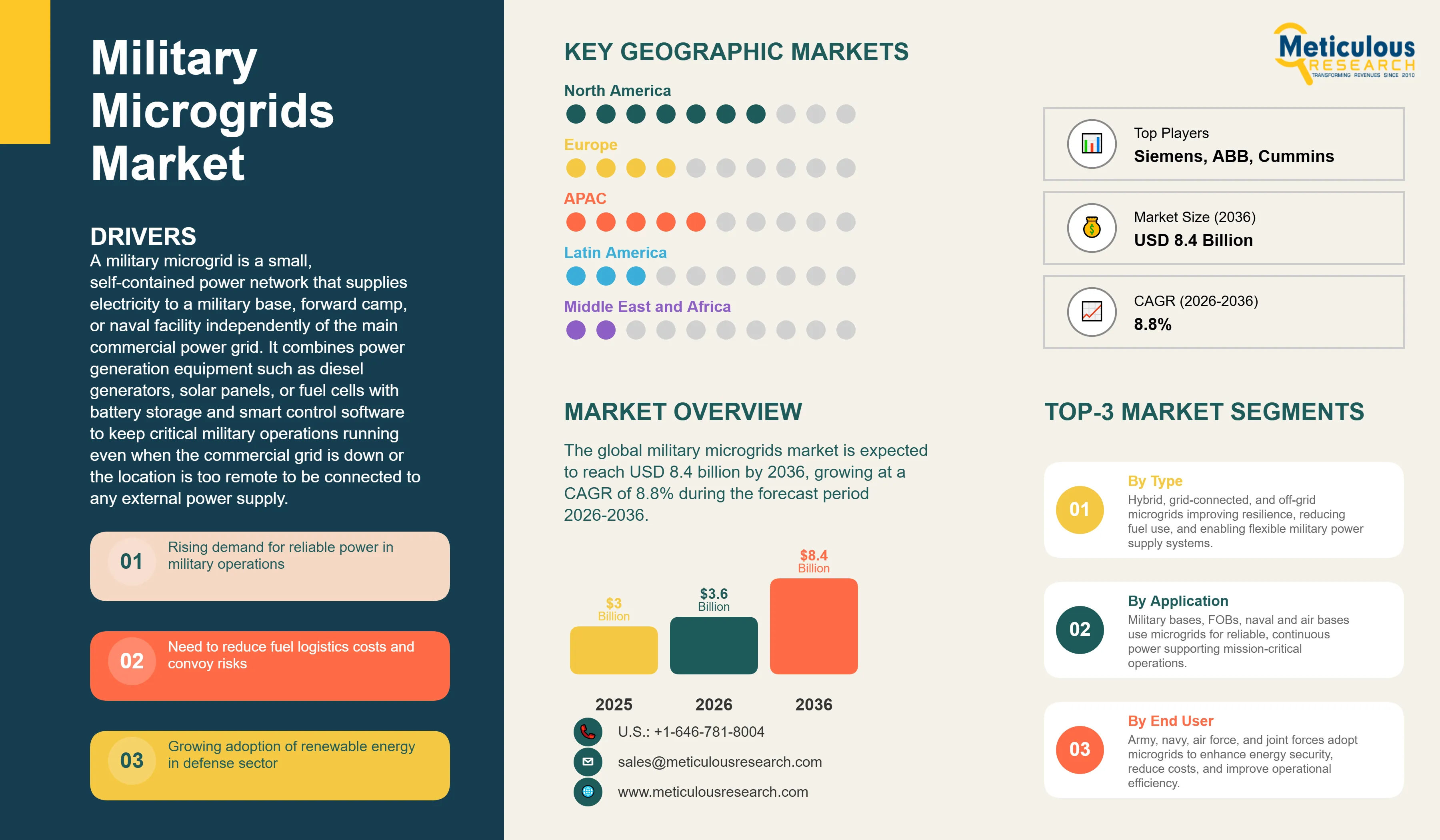
The global military microgrids market was valued at USD 3.0 billion in 2025. This market is expected to reach USD 8.4 billion by 2036 from an estimated USD 3.6 billion in 2026, growing at a CAGR of 8.8% during the forecast period 2026-2036.
- Published
- Apr 2026
- Pages
- 282
- Format
- PDF + Excel
- Report ID
- MR-1910
- Base year
- 2025
- 2025 · BASELINE
- $3.00B
- 2036
- $8.40B
- CAGR 2026–2036
- 8.8%
2025 baseline · 2026–2036 forecast at 8.8% CAGR · hover a bar for the value
Key highlights
The global military microgrids market is projected to reach USD 8.4 billion by 2036.
The market is expected to grow at a CAGR of 8.8% during the forecast period 2026-2036.
The global military microgrids market was valued at USD 3.0 billion in 2025 and is estimated to reach USD 3.6 billion in 2026.
North America is expected to dominate the global military microgrids market with the largest market share in 2026, while Asia-Pacific is projected to register the highest CAGR during the forecast period.
By grid type, the hybrid microgrids segment is expected to hold the largest share of the market in 2026, while the off-grid/islanded microgrids segment is projected to register the highest CAGR during the forecast period.
By power source, the diesel generators segment is expected to hold the largest share in 2026, while the solar PV systems segment is projected to register the highest CAGR during the forecast period.
By component, the generation equipment segment is expected to hold the largest share in 2026, while the energy storage systems segment is projected to register the highest CAGR during the forecast period.
By application, the military bases and installations segment is expected to hold the largest share in 2026, while the forward operating bases segment is projected to register the highest CAGR during the forecast period.
By end user, the army segment is expected to hold the largest share in 2026, while the air force segment is projected to register the highest CAGR during the forecast period.
By deployment type, the fixed microgrids segment is expected to hold the largest share in 2026, while the mobile/containerized microgrids segment is projected to register the highest CAGR during the forecast period.
Report summary
| Particulars | Details |
|---|---|
| Market Size by 2036 | USD 8.4 Billion |
| Market Size in 2026 | USD 3.6 Billion |
| Market Size in 2025 | USD 3.0 Billion |
| Revenue Growth Rate (2026-2036) | CAGR of 8.8% |
| Format | PDF, Excel & Cloud Portal · 282 pages |
| Dominating Grid Type | Hybrid Microgrids |
| Fastest Growing Grid Type | Off-Grid/Islanded Microgrids |
| Dominating Power Source | Diesel Generators |
| Fastest Growing Power Source | Solar PV Systems |
| Dominating Component | Generation Equipment |
| Fastest Growing Component | Energy Storage Systems |
| Dominating Application | Military Bases and Installations |
| Fastest Growing Application | Forward Operating Bases (FOBs) |
| Dominating End User | Army |
| Fastest Growing End User | Air Force |
| Dominating Deployment Type | Fixed Microgrids |
| Fastest Growing Deployment Type | Mobile/Containerized Microgrids |
| Dominating Geography | North America |
| Fastest Growing Geography | Asia-Pacific |
| Base Year | 2025 |
| Forecast Period | 2026 to 2036 |
Report overview
Segments covered: grid type, power source, component, application, end user.
A military microgrid is a small, self-contained power network that supplies electricity to a military base, forward camp, or naval facility independently of the main commercial power grid. It combines power generation equipment such as diesel generators, solar panels, or fuel cells with battery storage and smart control software to keep critical military operations running even when the commercial grid is down or the location is too remote to be connected to any external power supply. The ability to generate, store, and manage power on-site without depending on external supply lines is an important military advantage, particularly for remote forward operating bases where fuel convoys are expensive, dangerous, and vulnerable to attack.
The market is growing because modern military operations depend on electricity more than at any time in history. Radar systems, communication networks, computer systems, medical facilities, and drone charging stations all require reliable power around the clock. A single power failure at a critical base can disrupt communications, disable defense systems, or halt command-and-control operations. At the same time, transporting diesel fuel to remote military bases is one of the most expensive and dangerous parts of running forward operations. Studies by the U.S. Department of Defense have found that a significant proportion of casualties in recent conflicts occurred during fuel convoy operations. Reducing fuel consumption through renewable energy and better energy management is therefore both a safety issue and a major cost-saving opportunity for defense budgets.
Two significant opportunities are driving the next phase of market growth. The addition of solar panels and battery storage to existing diesel-powered military microgrids is becoming much more affordable as the cost of solar and battery technology continues to fall. A hybrid system that combines solar power during daylight hours with batteries for nighttime and cloudy periods can cut diesel consumption at a remote base by 30 to 60 percent, providing a strong financial return while reducing the frequency of dangerous fuel supply runs. In addition, smart energy management software powered by AI can now monitor power consumption across an entire base, predict demand changes, and automatically balance generation and storage to minimize fuel use and ensure critical systems always get priority power, making military microgrids significantly more efficient and reliable than the basic diesel generator systems they replace.
Report infographic
Market dynamics
7 factors across 3 forcesIncreasing Demand for Energy Resilience in Military Operations
Military forces today depend on electricity for nearly every critical function. Communications networks, radar and sensor systems, command and control computers, intelligence processing systems, hospital facilities, and drone operations all require continuous, reliable power. If the power supply to a forward base or a major installation fails, the consequences can range from a communication blackout to the complete shutdown of defensive systems at a critical moment. The growing recognition that reliable power is as important to mission success as weapons and personnel is the primary reason defense ministries are investing in military microgrids that can generate and store electricity on-site without depending on external power lines or continuous fuel deliveries. The U.S. Department of Defense's designation of energy as a critical component of national security, combined with NATO's energy resilience guidelines for allied installations, reflects this understanding and is translating it into funded procurement programs that are the primary demand driver of the military microgrids market.
Rising Need to Reduce Fuel Logistics and Costs
Diesel fuel is expensive to buy, extremely expensive to transport to remote locations, and dangerous to move through conflict zones. The financial burden of fuel logistics is a major item in the operating budgets of military forces with deployed operations, and the security risk created by fuel convoys has resulted in significant casualties in recent conflicts. Every gallon of diesel that can be replaced by solar power or energy efficiency savings directly reduces the number of fuel trucks that need to make supply runs, reducing both cost and risk. For large military establishments with hundreds of installations to power, the potential savings from switching to hybrid renewable microgrids are very large. The U.S. Army has estimated that reducing fuel consumption across its installations by 25 percent would save hundreds of millions of dollars annually. This clear and quantifiable financial benefit is making military microgrid investment easy to justify through normal defense budget processes, creating stable and growing procurement demand that does not depend solely on energy security arguments.
Table of contents
15 chapters · 161 sections · 282 pages · click to expandSegmental analysis
| Segment | Largest share (2026) | Fastest growth (2026–2036) |
|---|---|---|
| By Grid Type | Hybrid Microgrids | Off-grid/islanded microgrids |
| By Power Source | Diesel Generators | Solar PV systems |
| By Component | Generation Equipment | Energy storage systems |
| By Application | Military Bases and Installations | Forward operating bases |
| By End User | Army | Air force |
| By Deployment Type | Fixed Microgrids | Mobile/containerized microgrids |
By Grid Type
- Hybrid Microgrids to Dominate
- The hybrid microgrids segment is expected to account for the largest share of the global military microgrids market.
- Hybrid microgrids combine multiple power sources, typically diesel generators with solar and battery storage, to reduce fuel consumption and improve reliability compared with single-source systems.
- This approach is the most widely adopted in current military programs because it can be built on top of existing diesel generator infrastructure without requiring a complete replacement, making it practical and cost-effective for both new installations and upgrades to existing bases.
- The proven cost savings and fuel reduction benefits of hybrid systems have made them the preferred choice across U.S., European, and Australian military microgrid programs.
- However, the off-grid/islanded microgrids segment is projected to register the highest CAGR during the forecast period.
- The growth of forward operating base deployments in remote areas of Africa, the Indo-Pacific, and Central Asia where there is no commercial grid connection available means that off-grid systems are the fastest-growing deployment category.
- A base that operates entirely on its own self-generated power, with no external grid connection, has the highest level of energy independence and resilience, which is increasingly valued by military planners who have seen how cyber or physical attacks on commercial power grids can disrupt military operations.
By Power Source
- Diesel Generators to Hold the Largest Share
- The diesel generators segment is expected to account for the largest share of the global military microgrids market.
- Diesel generators have been the standard power source for military installations for decades and remain the backbone of military power supply, particularly for large bases and for peak power demand that renewable sources cannot always meet on their own.
- The very large existing installed base of diesel generators at military facilities globally, combined with the ongoing procurement of diesel generators for new installations, makes this the highest-revenue power source segment.
- Diesel also has well-understood logistics, maintenance, and operational characteristics that military procurement and operations teams are experienced with.
- However, the solar PV systems segment is projected to register the highest CAGR during the forecast period.
- Solar power costs have fallen dramatically over the past decade, making solar installation on military bases one of the fastest-paying energy investments available.
- Solar panels require no fuel, produce no emissions, are silent during operation, and reduce the load on diesel generators, cutting both fuel consumption and generator maintenance costs.
- The U.S. Army, U.S. Air Force, and several European militaries have all launched large solar installation programs at their permanent bases, and portable solar panel systems for forward bases are becoming a standard part of deployable power kits.
By Component
- Generation Equipment to Hold the Largest Share
- The generation equipment segment is expected to account for the largest share of the global military microgrids market.
- Generation equipment encompasses the diesel generators, solar panels, wind turbines, and fuel cells that produce electricity, and represents the largest share of the total capital cost of a military microgrid installation.
- The ongoing procurement of generators and solar systems for both new installations and replacements at existing bases makes this the dominant revenue component in the market.
- However, the energy storage systems segment is projected to register the highest CAGR during the forecast period.
- Battery energy storage is the component that enables solar power to be used at night, that provides a buffer against sudden changes in power demand, and that allows a military base to operate without generators for extended periods when tactical situations require silent running or when generator fuel is temporarily unavailable.
- As battery costs continue to fall and military operators experience the operational benefits of energy storage in field deployments, battery procurement for military microgrids is growing rapidly from a relatively small base.
By Application
- Military Bases and Installations to Hold the Largest Share
- The military bases and installations segment is expected to account for the largest share of the global military microgrids market.
- Large permanent military bases and installations represent the highest total power consumption locations in any national defense structure and therefore offer the greatest financial return from microgrid investment.
- A major army or air force base may consume as much electricity as a small town, and even a modest improvement in energy efficiency or reduction in dependence on the commercial grid translates into large cost savings.
- The U.S. DoD's installation energy programs have directed billions of dollars toward microgrid and energy efficiency upgrades at major permanent installations, making this the current revenue leader.
- However, the forward operating bases segment is projected to register the highest CAGR during the forecast period.
- Forward bases are established quickly in active operational areas and often have no access to commercial power infrastructure.
- Their power supply depends entirely on what can be transported and installed by the military unit occupying the location.
- Because every gallon of diesel at a forward base had to be transported through potentially hostile territory, the financial and safety argument for reducing fuel consumption through solar and battery hybrid systems is even stronger at forward bases than at permanent installations.
- The growing number of small forward bases established in Africa, the Middle East, and the Pacific as part of security partnerships and counter-terrorism operations is creating rapidly growing demand for mobile and deployable hybrid microgrid systems.
By End User
- Army to Hold the Largest Share
- The army segment is expected to account for the largest share of the global military microgrids market.
- Armies operate the largest number of fixed and forward bases of any military service, and they have been the most active in deploying microgrids both at permanent installations and at forward operating bases in active mission areas.
- The U.S. Army's energy resilience programs, including its Net Zero Energy installations initiative and tactical microgrid programs for deployed forces, have been the single largest driver of military microgrid procurement globally.
- Army bases are typically the largest power consumers among military installation types, making the financial return from microgrid investment highest for this service.
- However, the air force segment is projected to register the highest CAGR during the forecast period.
- Air force installations have very high and concentrated power demands driven by flight operations, aircraft maintenance systems, radar and air traffic control equipment, weapons storage systems, and the extensive communications infrastructure that modern air operations require.
- The consequences of a power failure at an airbase, including the grounding of aircraft or the shutdown of air defense systems, are particularly severe, making energy resilience investment a high priority.
- Several air forces including the U.S. Air Force, Royal Air Force, and the Israeli Air Force have launched major microgrid investment programs at their most critical installations, and these programs are growing.
By Deployment Type
- Fixed Microgrids to Hold the Largest Share
- The fixed microgrids segment is expected to account for the largest share of the global military microgrids market.
- Fixed microgrids are installed permanently at established military bases and installations, where the investment in foundation-mounted solar panels, permanent battery storage facilities, and grid-connected control infrastructure can be fully amortized over a long service life.
- The large number of permanent military installations globally, each representing a potential microgrid upgrade opportunity, makes fixed installations the current revenue leader by a significant margin.
- However, the mobile/containerized microgrids segment is projected to register the highest CAGR during the forecast period.
- The ability to pack a complete hybrid power system into standard shipping containers that can be transported anywhere in the world and set up within hours is a highly valuable capability for military forces that establish forward bases quickly in response to emerging situations.
- As the cost and size of solar panels and battery systems continue to fall, containerized hybrid microgrid systems are becoming more powerful and more affordable, making them practical for a wider range of forward base applications.
- Defense contractors are developing increasingly capable packaged mobile microgrid products specifically designed to meet military transportability and ruggedness requirements.
Geographic analysis
North America
Largest shareIn 2026, North America is expected to account for the largest share of the global military microgrids market. The United States is by far the world's largest investor in military microgrids, driven by the Department of Defense's formal energy resilience strategy, which classifies energy security as a component of national security and allocates substantial funding to reducing military installations' dependence on the commercial power grid. The U.S. Army's and Air Force's large-scale Net Zero and energy resilience installation programs, the U.S. Navy's energy efficiency initiatives at major naval bases, and DARPA-funded research programs on advanced mobile microgrid technologies collectively make the United States the world's dominant military microgrid market. The presence of major military energy technology suppliers including Lockheed Martin, RTX Corporation, Honeywell, Schneider Electric's North American operations, Eaton, and GE in the U.S. market reinforces North America's leadership position by ensuring a technically advanced and competitive supply base serving the government's large procurement programs.
Asia-Pacific
Fastest growthHowever, the Asia-Pacific military microgrids market is expected to grow at the fastest CAGR during the forecast period. The escalating security tensions in the Indo-Pacific region, particularly around the South China Sea and Taiwan Strait, are driving Japan, South Korea, Australia, India, and several Southeast Asian nations to invest urgently in hardening their military infrastructure, including its power supply. An installation that relies on the commercial grid is vulnerable to cyber or physical attacks on civilian power infrastructure, and this vulnerability is increasingly recognized as a strategic risk by regional military planners. Australia has been one of the most active adopters, with its Defence Energy Program mandating microgrid and renewable energy installations at major bases including those in the Northern Territory that are most relevant to Indo-Pacific operations. India's growing defense budget and its active forward base expansion program along its borders with China and Pakistan are generating significant demand for deployable and fixed military microgrids. China is also a major developer of military microgrid technology for its own armed forces, making Asia-Pacific the most dynamic growth market globally.
Europe
Europe is a growing and increasingly important military microgrids market, driven primarily by the surge in European defense spending that followed Russia's invasion of Ukraine in 2022. European NATO members who increased their defense budgets sharply after 2022 are investing in base hardening and energy resilience as part of their broader force modernization programs, recognizing that the Ukraine conflict demonstrated how attacks on power infrastructure can be a deliberate military strategy. Germany, Poland, and the UK are among the most active European investors in military energy resilience programs. Norway and Sweden, which joined NATO and are upgrading their military infrastructure, are also generating growing microgrid procurement demand. The strong presence of European energy technology companies including Schneider Electric, ABB, Siemens, and Saft in the military microgrid supply chain provides the region with capable domestic suppliers alongside U.S. contractors competing for European defense contracts.
Competitive landscape
- Lockheed Martin Corporation (U.S.)
- RTX Corporation/Raytheon Technologies (U.S.)
- Schneider Electric SE · France
- Siemens AG · Germany
- ABB Ltd. · Switzerland
- Eaton Corporation plc · Ireland
- General Electric Company (U.S.)
- Honeywell International Inc. (U.S.)
- Rolls-Royce plc (UK)
- Caterpillar Inc. (U.S.)
- Cummins Inc. (U.S.)
- PowerSecure/Southern Company (U.S.)
- Saft Groupe S.A. · France
- SFC Energy AG · Germany
- Ampcontrol Pty Ltd. · Australia
Frequently asked questions
The global military microgrids market is expected to reach USD 8.4 billion by 2036 from an estimated USD 3.6 billion in 2026, at a CAGR of 8.8% during the forecast period 2026-2036.
Cite this report
Meticulous Research. (2026). Military Microgrids Market - Global Opportunity Analysis and Industry Forecast (2026-2036) (Report No. MR-1910). Meticulous Market Research Pvt. Ltd. https://www.meticulousresearch.com/product/military-microgrids-market-6593