Resources
About Us
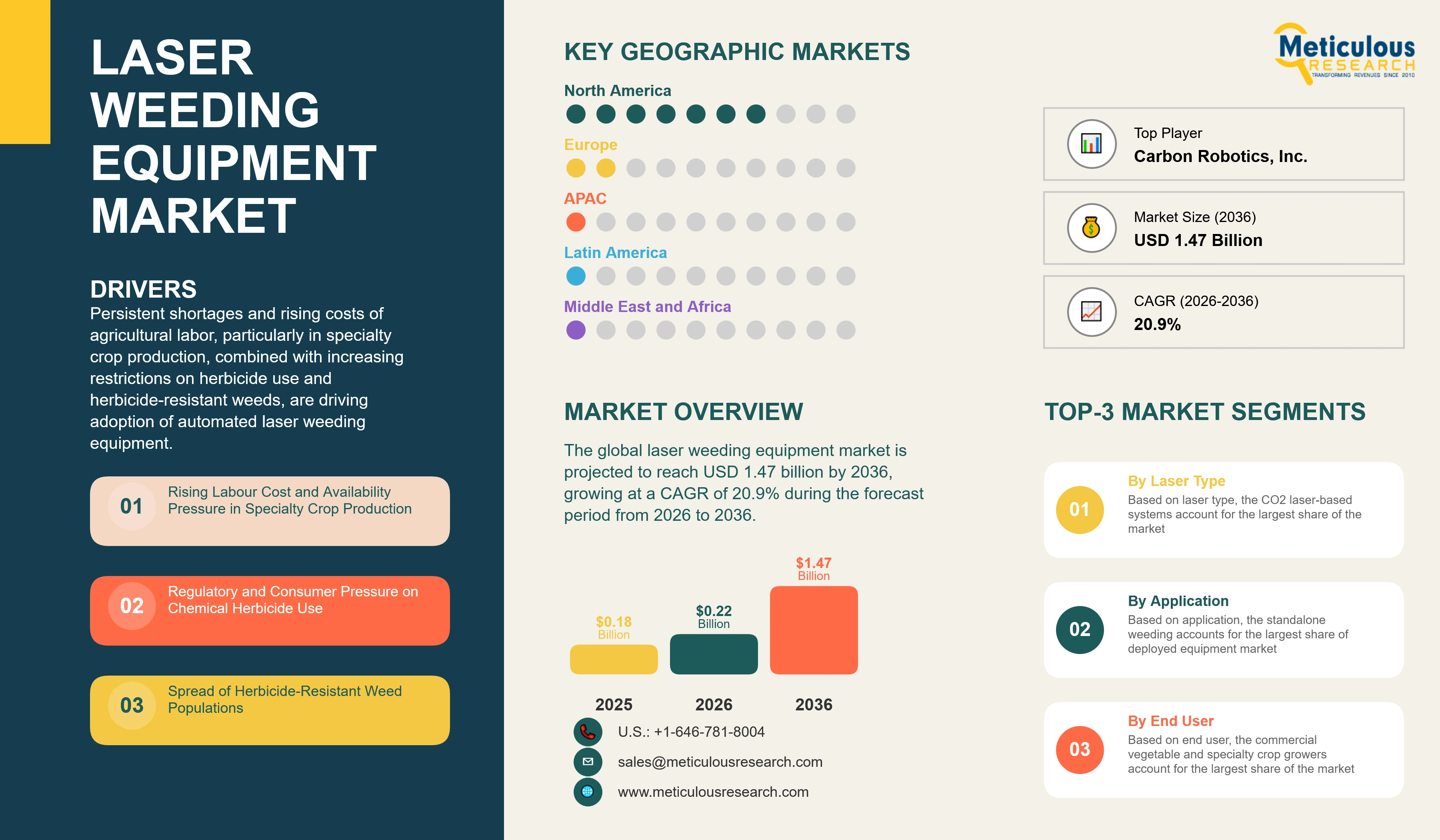
The global laser weeding equipment market is projected to reach USD 1.47 billion by 2036 from an estimated USD 0.22 billion in 2026, at a CAGR of 20.9% during the forecast period from 2026 to 2036. Tractor-mounted and towed laser weeding implements account for the largest share of market value through most of the forecast period, reflecting their compatibility with equipment growers already own, while autonomous self-propelled laser weeding robots represent the fastest-growing platform category as manufacturers extend the technology toward continuous, unattended field operation.
Click here to: Get Free Sample Pages
Laser weeding equipment combines computer vision, artificial intelligence, and precision laser technology to identify individual weeds and direct concentrated laser energy at their growing points, destroying unwanted plants without disturbing the soil or applying herbicides. Unlike conventional chemical spraying, which treats broader areas, laser weeding enables plant-by-plant weed control and can support day and night operations under suitable field conditions.
The market includes multiple laser technologies, particularly CO₂ and diode or visible-spectrum laser systems, although technology configurations vary among manufacturers. Equipment is primarily available as tractor-mounted or trailed implements and autonomous or self-propelled robotic platforms, serving applications ranging from specialty vegetables and organic crops to selected field crops.
The industry has progressed from early demonstrations toward broader commercial development since the early 2020s. Carbon Robotics commercially introduced its LaserWeeder in 2022 and has deployed the technology among growers across North America, Europe, and Australia. Its systems combine high-resolution cameras, AI-based plant recognition, and multiple high-powered lasers for automated weed removal. Escarda Technologies is also advancing commercialization in Europe, with its acquisition by Berlin.Industrial.Group in 2026 supporting series production and wider deployment. Meanwhile, companies including Cyan Force and Harvested Labs are expanding the technology's presence in China and India through self-propelled, trailed, and tractor-mounted systems.
Market demand is primarily supported by rising agricultural labor costs and shortages, particularly in labor-intensive vegetable and specialty crop production. Increasing restrictions on herbicide use, concerns regarding herbicide-resistant weeds, and growing demand for chemical-free and precision agriculture practices are further strengthening interest in laser-based weed control. However, the technology remains at an early stage of commercial adoption compared with established chemical and mechanical weed-control methods.
Rising Labour Cost and Availability Pressure in Specialty Crop Production
Specialty crop farms including fruit, tree nut, vegetable, and nursery operations, carry a far higher labour cost burden than field crop farms. According to USDA's Economic Research Service, labour accounted for close to 40 percent of total cash expenses on U.S. specialty crop farms in 2024, compared with roughly 15 percent across all U.S. farms and just 4 to 6 percent on corn, soybean, or wheat operations, reflecting the far lower mechanisation levels in hand-weeded and hand-harvested crops. This structural cost gap, combined with persistent seasonal labour shortages, has pushed growers such as Hungenberg Produce Co. and Triangle Farms to adopt laser weeding to convert a recurring, variable labour cost into a fixed equipment investment with a reported payback period of one to three years.
Regulatory and Consumer Pressure on Chemical Herbicide Use
Government policy and market demand are increasingly favouring non-chemical weed control. The European Union's Farm to Fork Strategy set a target of reducing chemical pesticide use and risk by 50 percent by 2030, and while the European Commission withdrew the dedicated Sustainable Use Regulation intended to enforce that target in 2024, official EU tracking data still shows a 27 percent reduction in use of the most hazardous pesticides through 2023 relative to baseline. Organic and residue-free food demand in North America and Europe is reinforcing this shift at the retail level, supporting adoption of laser weeding among growers supplying organic and premium specialty crop segments.
Spread of Herbicide-Resistant Weed Populations
The growing prevalence of herbicide-resistant weeds is narrowing the effective chemical toolkit available to growers. The International Herbicide-Resistant Weed Database recorded 548 unique cases of resistance across 275 species globally, with resistance now documented against 21 of 31 known herbicide sites of action. As resistant weed populations spread, particularly in intensively cropped regions of North America and parts of Asia, growers and agronomists are looking toward mechanical and laser-based alternatives that do not select for chemical resistance, positioning laser weeding as a complementary tool within integrated weed management programmes.
High Equipment Cost and Limited Field Throughput
Laser weeding equipment carries a substantially higher upfront cost than conventional sprayers or mechanical cultivators, with commercial units ranging from roughly USD 200,000 to over USD 1 million depending on platform size and laser module count, according to manufacturer pricing disclosures. Field throughput is also constrained relative to broadcast spraying, since each weed must be individually detected and targeted, meaning effective ground speed and working width directly limit the acreage a single machine can cover in a day. These factors currently confine commercial adoption largely to higher-value specialty and organic crops where labour savings and yield improvements can justify the capital outlay, slowing adoption in lower-margin field crop segments.
Expansion from Vegetable Row Crops into Bulb, Flower, and Emerging Field Crop Applications
Early commercial deployment has concentrated on leafy greens, brassicas, and root vegetables, but manufacturers are actively extending laser weeding into adjacent crop categories. Trabotyx has trained its TOR platform on nine vegetable crops alongside three flower bulb crops including lilies, tulips, and peonies, while Carbon Robotics has added combined laser weeding-and-thinning capability across more than 40 crop models. Continued validation across bulb, ornamental, and higher-acreage field crop applications represents a substantial opportunity to broaden the addressable crop base beyond its current specialty vegetable core.
Emerging-Market Adoption Through Domestic Manufacturing in China and India
Chinese and Indian manufacturers are developing laser weeding equipment specifically priced and engineered for domestic farm structures, which differ substantially from the large-scale specialty operations that early North American and European adopters represent. Huagong Tech's Hg LaserWeeder and CyanForce's Guangyun implement are targeting Chinese vegetable production at a claimed fraction of comparable Western equipment cost, while Harvested Labs in India is developing a laser weeder explicitly positioned as more affordable than U.S. platforms for smallholder and mid-size Indian specialty crop farms. Given that India's ICAR-Directorate of Weed Research estimates weed-related losses at roughly USD 11 billion annually, domestically manufactured, lower-cost laser weeding platforms represent a meaningful opportunity to convert an underserved cost burden into commercial demand.
Laser Safety Compliance and Field-Level Operating Constraints
Commercial laser weeding equipment typically operates high-power lasers classified under Class 4 laser product safety standards, which carry specific handling, labelling, and operator-training requirements under occupational safety frameworks such as OSHA and ANSI in the United States and equivalent regimes in the European Union. Manufacturers must design enclosed or interlocked laser housings, train service and field personnel, and navigate machinery-safety certification pathways in each market they sell into, which adds cost and lengthens go-to-market timelines relative to conventional agricultural implements. This compliance burden is particularly acute for newer entrants scaling from prototype to series production, as reflected in the emphasis Escarda Technologies placed on safety systems following its acquisition by an established industrial photonics manufacturer.
Divergence Between CO2 and Diode Laser Technology Approaches
The market is bifurcating between manufacturers using CO2 lasers operating at longer infrared wavelengths, led by Carbon Robotics, and a cluster of European and Chinese manufacturers favouring diode lasers tuned to chlorophyll absorption at shorter wavelengths, including Trabotyx and WeedBot. Diode-laser manufacturers position their approach as lower optical power and lower operating cost for small weeds, while CO2-laser systems are marketed around higher throughput and broader weed-size tolerance. This technology divergence is shaping distinct manufacturer positioning, pricing, and target crop segments across the market.
Shift Toward Combined Weeding-and-Thinning and Higher Laser Module Counts
Manufacturers are increasingly combining weeding with crop thinning on a single platform and increasing the number of laser modules per machine to raise field throughput. Carbon Robotics introduced LaserThinning as a software-enabled capability on its existing LaserWeeder fleet, while Huagong Tech's high-end configuration features up to 32 laser heads, claimed to process up to 320,000 weeds per hour. These developments are aimed at closing the throughput gap between laser weeding and conventional broadcast herbicide application, a key factor in wider commercial adoption.
By Laser Type: CO2 Laser-based Systems Lead in 2026, Diode Laser-based Systems Grow Fastest
Based on laser type, the market is segmented into CO2 laser-based and diode laser-based systems. In 2026, CO2 laser-based systems account for the largest share of the market, supported by Carbon Robotics' established commercial base across North America, Europe, and Australia and by the technology's broader tolerance for larger weed sizes. Diode laser-based systems are projected to grow fastest, driven by a growing cluster of European manufacturers including Trabotyx and WeedBot targeting organic and small-weed-window applications at lower per-module power cost.
By Platform: Tractor-Mounted/Towed Implements Lead in 2026, Autonomous Self-Propelled Robots Grow Fastest
Based on platform, the market is segmented into tractor-mounted or towed implements and autonomous self-propelled robots. In 2026, tractor-mounted and towed implements hold the largest share, reflecting grower preference for equipment compatible with tractors and operating routines they already have in place. Autonomous self-propelled robots are growing fastest, led by platforms such as Trabotyx's TOR and Cropr's Weedr, as manufacturers target continuous, unattended field operation that does not depend on tractor and operator availability.
By Laser Module Capacity: Mid-Capacity Systems Lead in 2026, High-Capacity Systems Grow Fastest
Based on laser module capacity, the market is segmented into low-capacity (up to 10 laser modules), mid-capacity (11 to 20 laser modules), and high-capacity (above 20 laser modules) systems. Mid-capacity systems account for the largest share in 2026, balancing throughput against equipment cost for mid-size specialty crop operations. High-capacity systems are projected to grow fastest as manufacturers such as Huagong Tech and Carbon Robotics scale laser module counts to raise weeding speed and address larger-acreage commercial farms.
By Crop Type: Leafy Greens & Vegetables Hold the Largest Share in 2026, Bulb & Flower Crops Grow Fastest
Based on crop type, the market is segmented into leafy greens and vegetables, root and bulb crops, flower and ornamental crops, and row and field crops. In 2026, leafy greens and vegetables account for the largest share, reflecting the concentration of early commercial deployment in lettuce, spinach, broccoli, and related crops across the United States and Europe. Bulb and flower crops are projected to grow fastest as manufacturers such as Trabotyx extend validated crop models into tulip, lily, and peony cultivation in the Netherlands and neighbouring European bulb-growing regions.
By Application: Weeding Leads in 2026, Combined Weeding & Thinning Grows Fastest
Based on application, the market is segmented into weeding and combined weeding and thinning. In 2026, standalone weeding accounts for the largest share of deployed equipment. Combined weeding and thinning is projected to grow fastest, supported by software-enabled dual functionality on platforms such as Carbon Robotics' LaserWeeder, which allows growers to address crop spacing and weed control within a single field pass.
By End User: Commercial Vegetable & Specialty Crop Growers Dominate the Market in 2026
Based on end user, the market is segmented into commercial vegetable and specialty crop growers, organic and premium-certified farms, contract and weeding-as-a-service operators, and government and institutional research programmes. In 2026, commercial vegetable and specialty crop growers account for the largest share, reflecting the scale of labour-intensive row crop acreage across North America and Europe. Contract and weeding-as-a-service operators are projected to register meaningful growth as manufacturers including Trabotyx explore service-based deployment models that lower the capital barrier for individual farms.
Based on geography, the global laser weeding equipment market is segmented into North America, Europe, Asia-Pacific, Latin America, and the Middle East & Africa. North America holds a leading share in 2026, anchored by Carbon Robotics' commercial base across 17 or more U.S. states and multiple Canadian provinces and by the high labour-cost burden documented on U.S. specialty crop farms by USDA's Economic Research Service.
Europe represents the most manufacturer-dense region globally, with Escarda Technologies (Germany), Trabotyx and Cropr (Netherlands), WeedBot (Latvia), and Farm-ING (Austria) all commercialising distinct laser weeding platforms. The region's adoption is reinforced by EU pesticide-reduction policy, even as the Sustainable Use Regulation's withdrawal in 2024 has left enforcement of the bloc's 50 percent pesticide reduction target without its intended dedicated legislative instrument.
Asia-Pacific is expected to register the fastest CAGR during the forecast period, driven by China's rapid entry into laser weeding manufacturing through established industrial laser producers such as Huagong Tech alongside newer entrants like CyanForce Technology, and by India's emerging domestic laser weeding sector led by Harvested Labs, supported by ICAR's documentation of substantial weed-related crop losses. Latin America and the Middle East & Africa remain earlier-stage markets, with adoption concentrated in pilot programmes and high-value export-oriented specialty crop operations.
Companies active in the global laser weeding equipment market have pursued platform development across CO2 and diode laser technologies, autonomous robotics, and expanded crop-model libraries, alongside strategic acquisitions and geographic expansion, to strengthen their market positions. The competitive set spans an established U.S. commercial leader, a cluster of European specialty manufacturers, large Chinese industrial laser producers entering agriculture, and early-stage Indian and Latvian developers targeting price-sensitive segments of the market.
Prominent players operating in the global laser weeding equipment market include Carbon Robotics, Inc. (U.S.), Escarda Technologies GmbH (Germany), Trabotyx B.V. (Netherlands), WeedBot (Latvia), Farm-ING GmbH (Austria), Cropr B.V. (Netherlands), Huagong Tech Co., Ltd. (China), CyanForce (Shanghai) Technology Co., Ltd. (China), and Harvested Labs (Harvested Robotics) (India).
Laser Weeding Equipment Market: Latest Developments from Key Industry Players
|
Particulars |
Details |
|
Forecast Period |
2026–2036 |
|
Base Year |
2025 |
|
Estimated Year |
2026 |
|
CAGR (Value) |
20.9% |
|
Market Size (Value) in 2026 |
USD 0.22 Billion |
|
Market Size (Value) in 2036 |
USD 0.18 Billion |
|
Segments Covered |
By Laser Type: CO2 Laser-based; Diode Laser-based. By Platform: Tractor-Mounted/Towed Implements; Autonomous Self-Propelled Robots. By Laser Module Capacity: Low-Capacity (up to 10 modules); Mid-Capacity (11–20 modules); High-Capacity (above 20 modules). By Crop Type: Leafy Greens & Vegetables; Root & Bulb Crops; Flower & Ornamental Crops; Row & Field Crops. By Application: Weeding; Combined Weeding & Thinning. By End User: Commercial Vegetable & Specialty Crop Growers; Organic & Premium-Certified Farms; Contract & Weeding-as-a-Service Operators; Government & Institutional Research Programs |
|
Countries Covered |
North America (U.S., Canada), Europe (Germany, Netherlands, Austria, Latvia, France, U.K., and Rest of Europe), Asia-Pacific (China, India, Japan, Australia & New Zealand, and Rest of Asia-Pacific), Latin America (Brazil, Mexico, and Rest of Latin America), and the Middle East & Africa |
|
Key Companies |
Carbon Robotics, Inc. (U.S.), Escarda Technologies GmbH (Germany), Trabotyx B.V. (Netherlands), WeedBot (Latvia), Farm-ING GmbH (Austria), Cropr B.V. (Netherlands), Huagong Tech Co., Ltd. (China), CyanForce (Shanghai) Technology Co., Ltd. (China), Harvested Labs (Harvested Robotics) (India) |
|
Primary Reference Sources |
U.S. Department of Agriculture, Economic Research Service (specialty crop labour cost data); European Commission, Directorate-General for Health and Food Safety (EU pesticide reduction target tracking); ICAR-Directorate of Weed Research, Government of India (weed-related crop loss estimates); International Herbicide-Resistant Weed Database, weedscience.org; company press releases, product documentation, and investor disclosures from Carbon Robotics, Escarda Technologies, Trabotyx, WeedBot, Farm-ING, Cropr, Huagong Tech, and CyanForce Technology; and specialist trade press including Future Farming, AgFunderNews, and BusinessWire |
The global laser weeding equipment market size is estimated at USD 0.22 billion in 2026.
The market is projected to grow from USD 0.22 billion in 2026 to USD 1.47 billion by 2036, at a CAGR of 20.9%.
The laser weeding equipment market is projected to reach USD 1.47 billion by 2036, at a compound annual growth rate of 20.9% from 2026 to 2036.
Key companies include Carbon Robotics, Inc. (U.S.), Escarda Technologies GmbH (Germany), Trabotyx B.V. (Netherlands), WeedBot (Latvia), Farm-ING GmbH (Austria), Cropr B.V. (Netherlands), Huagong Tech Co., Ltd. (China), CyanForce (Shanghai) Technology Co., Ltd. (China), and Harvested Labs (Harvested Robotics) (India), among others.
The divergence between CO2 and diode laser technology approaches, the shift toward combined weeding-and-thinning functionality and higher laser module counts, and continued expansion of manufacturer activity from Europe and North America into China and India are prominent trends in the market.
By laser type, CO2 laser-based systems hold the largest share in 2026 while diode laser-based systems grow fastest; by platform, tractor-mounted and towed implements lead while autonomous self-propelled robots grow fastest; by laser module capacity, mid-capacity systems lead while high-capacity systems grow fastest; by crop type, leafy greens and vegetables lead while bulb and flower crops grow fastest; by application, weeding leads while combined weeding and thinning grows fastest; by end user, commercial vegetable and specialty crop growers lead; and by geography, North America and Europe together command the largest share in 2026.
North America and Europe hold the largest combined share in 2026, supported by high specialty crop labour costs in the United States and a dense cluster of laser weeding manufacturers across Germany, the Netherlands, Latvia, and Austria. Asia-Pacific is expected to register the fastest growth rate, driven by the entry of established Chinese industrial laser manufacturers and emerging Indian laser weeding developers.
Key drivers include rising labour cost and availability pressure in specialty crop production, regulatory and consumer pressure on chemical herbicide use, and the spread of herbicide-resistant weed populations that is narrowing the effective chemical toolkit available to growers.
























Published Date: Mar-2026
Subscribe to get the latest industry updates