Cover Crop Seeds Market (2026-2036)
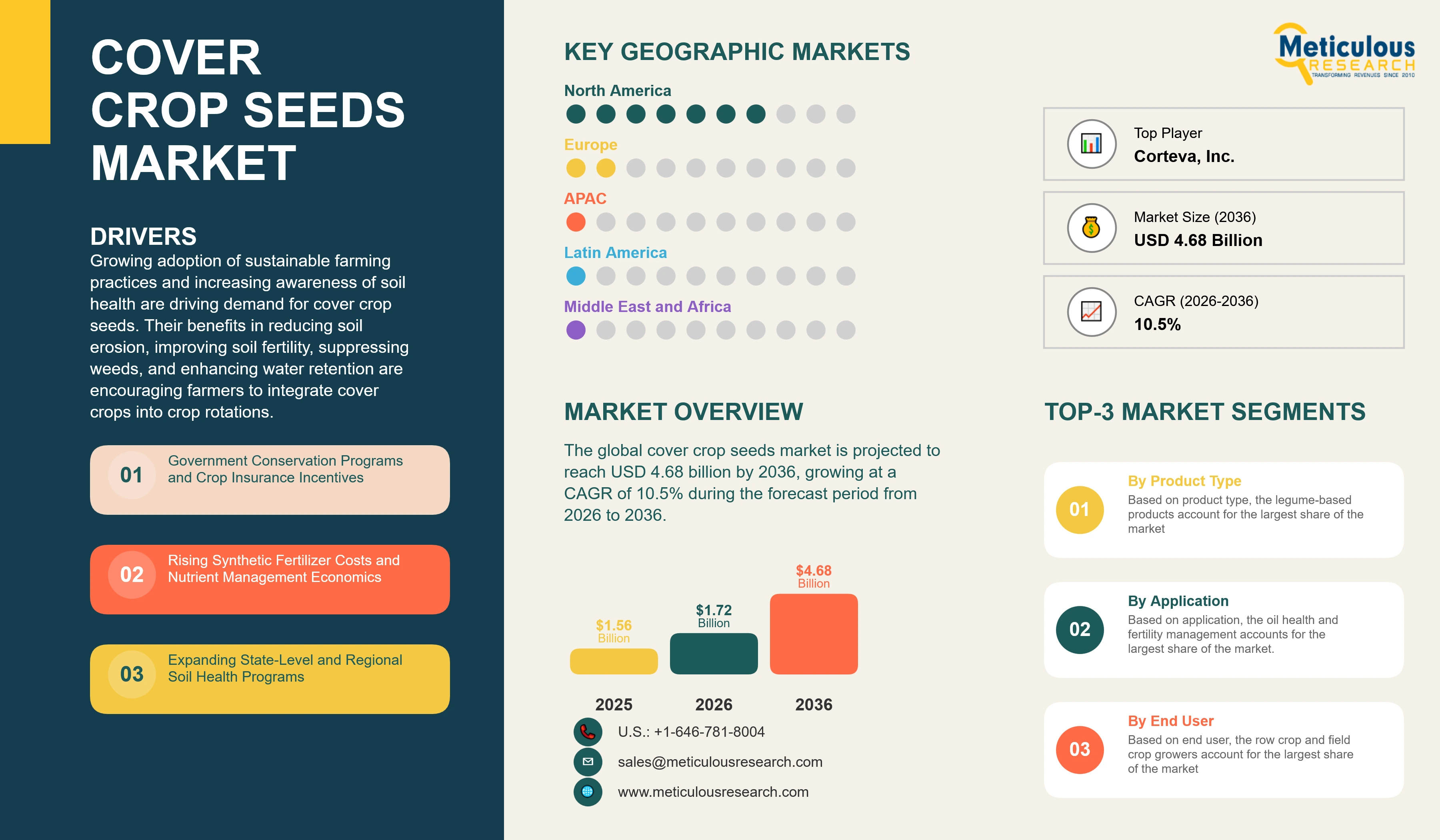
The global cover crop seeds market is projected to reach USD 4.68 billion by 2036 from an estimated USD 1.72 billion in 2026, at a CAGR of 10.5% during the forecast period from 2026 to 2036.
- Published
- Sep 2026
- Pages
- 314
- Format
- PDF + Excel
- Report ID
- MR-2166
- Base year
- 2025
- 2026 · ESTIMATED
- $1.72B
- 2036
- $4.68B
- CAGR 2026–2036
- 10.5%
2025 baseline · 2026–2036 forecast at 10.5% CAGR · hover a bar for the value
Key highlights
The global cover crop seeds market is projected to reach USD 4.68 billion by 2036, growing at a CAGR of 10.5% during 2026–2036, driven by state and federal soil health incentive programs, expanding crop insurance premium discounts tied to cover crop adoption, and rising farmer awareness of input-cost savings from improved soil fertility.
U.S. cropland area planted to cover crops increased 17 percent between 2017 and 2022, from 15,390,674 acres to 17,985,831 acres, meaning cover crops were planted on 4.7 percent of total cropland in 2022, according to USDA Census of Agriculture data.
Texas recorded the largest absolute increase in cover crop acreage of any state, with acreage rising from 1,014,145 acres in 2017 to 1,550,789 acres in 2022, an increase of more than 50 percent.
The competitive landscape spans diversified global forage and turf seed producers such as DLF Seeds A/S, Barenbrug Group, and Corteva, Inc., alongside specialist cover crop seed companies including Green Cover Seed, King's AgriSeeds, Inc., GO Seed, and Roundstone Native Seed, LLC, each building out dedicated multi-species blend programs for row-crop and specialty growers.
The European Union's Common Agricultural Policy conditionality and eco-scheme framework requires minimum soil cover during defined periods on arable land, and updated European Commission guidance on eco-scheme soil coverage conditionality issued in September 2024 clarified species eligibility and seeding windows, a development expected to support continued cover crop seed procurement across EU member states.
USDA's Natural Resources Conservation Service continues to fund cover crop establishment through the Environmental Quality Incentives Program and Conservation Stewardship Program, while the Risk Management Agency's Pandemic Cover Crop Program, which offered a crop insurance premium discount of up to five dollars per acre for planting a cover crop, remained a meaningful driver of grower adoption through the 2022 crop year.
Nine of the ten states with the largest cover crop acreage under the Pandemic Cover Crop Program for the 2021 crop year, led by North Dakota, Texas, Iowa, Indiana, and Missouri, correspond closely to the states driving the bulk of national cover crop acreage growth, underscoring the link between insurance-linked incentives and seed demand.
Consumables tied to annual reseeding account for the largest share of market value, while multi-species blend formulations and inoculated or seed-coated legume products are the fastest-growing revenue categories as growers seek greater agronomic flexibility and improved seedling establishment.
North America holds the largest revenue share in 2026, supported by the scale of row-crop soybean and corn acreage transitioning to cover crop rotations in the Midwest and South, while Europe is expected to register steady growth on the back of CAP conditionality requirements, and Asia-Pacific is expected to register the fastest CAGR as India's natural farming missions and China's black soil conservation initiatives expand cover crop adoption.
Report summary
| Particulars | Details |
|---|---|
| Forecast Period | 2026–2036 |
| Base Year | 2025 |
| Estimated Year | 2026 |
| CAGR (Value) | 10.5% |
| Format | PDF, Excel & Cloud Portal · 314 pages |
| Market Size (Value) in 2026 | USD 1.72 Billion |
| Market Size (Value) in 2036 | USD 4.68 Billion |
| Segments Covered | By Product Type: Legume-based; Grass and Cereal-based; Brassica-based; Multi-Species Blends. By Seed Treatment: Inoculated/Coated; Untreated. By Application: Soil Health and Fertility Management; Erosion Control; Weed Suppression; Livestock Forage. By Distribution Channel: Agricultural Retail and Cooperatives; Direct-to-Farm; Online. By End User: Row Crop and Field Crop Growers; Specialty Crop Growers; Livestock and Integrated Crop-Livestock Operations; Government and Institutional Programs |
| Countries Covered | North America (U.S., Canada), Europe (Germany, U.K., France, Spain, Italy, Netherlands, Nordics, and Rest of Europe), Asia-Pacific (China, India, Japan, South Korea, Australia & New Zealand, and Rest of Asia-Pacific), Latin America (Brazil, Argentina, Mexico, and Rest of Latin America), and the Middle East & Africa (Saudi Arabia, UAE, South Africa, and Rest of Middle East & Africa) |
| Key Companies | DLF Seeds A/S (Denmark), Barenbrug Group (Netherlands), Corteva, Inc. (U.S.), KWS SAAT SE & Co. KGaA (Germany), Allied Seed, LLC. (U.S.), S&W Seed Company (U.S.), Pennington Seed, Inc. (U.S.), Smith Seed Services (U.S.), Green Cover Seed (U.S.), King's AgriSeeds, Inc. (U.S.), GO Seed (U.S.), Millborn Inc. (U.S.), Albert Lea Seed (U.S.), Beck's Hybrids (U.S.), Welter Seed & Honey Co. (U.S.), Seedway, LLC (U.S.). |
| Primary Reference Sources | U.S. Department of Agriculture, National Agricultural Statistics Service (2022 Census of Agriculture, cover crop acreage data); U.S. Department of Agriculture, Economic Research Service (cover crop adoption trend analysis); U.S. Department of Agriculture, Natural Resources Conservation Service (Environmental Quality Incentives Program, Conservation Stewardship Program); U.S. Department of Agriculture, Risk Management Agency (Pandemic Cover Crop Program); European Commission (Common Agricultural Policy conditionality and eco-scheme guidance); company websites, press releases, and product documentation from DLF Seeds A/S, Barenbrug Group, Corteva, Nutrien, Green Cover Seed, King's AgriSeeds, and GO Seed; and university extension research from land-grant institutions including University of Illinois farmdoc |
Report overview
Segments covered: product type, seed treatment, application, distribution channel, end user. Regions: North America, Europe, Asia-Pacific, Latin America, Middle East & Africa.
Legume-based cover crop seeds, including clovers, vetches, and winter peas, account for the largest share of market value through most of the forecast period given their established role in nitrogen contribution to subsequent cash crops, while multi-species blends represent the fastest-growing product category as farmers move away from single-species stands toward diverse mixes that combine erosion control, weed suppression, and fertility benefits in one planting.
A cover crop seed is planting material for a non-cash crop species sown between or within main cropping cycles, including alongside a standing cash crop, primarily to protect and improve soil and support other agronomic objectives rather than to produce a primary cash harvest. Cover crops include legume species such as crimson clover, hairy vetch, and Austrian winter pea, which can biologically fix atmospheric nitrogen; grass and cereal species such as cereal rye, oats, and annual ryegrass, which provide rapid establishment, weed suppression, and residue production; brassica species such as tillage radish and forage turnip, which develop extensive root systems that can help improve soil structure and capture residual nutrients; and multi-species blends that combine two or more functional groups into a single seed mix tailored to soil health, erosion control, nutrient management, or livestock grazing objectives. The market encompasses raw and cleaned seed, inoculated or coated legume seed intended to support nodulation and seed performance, and custom-blended mixes sold in bulk or bagged formats for drilling, broadcasting, aerial seeding, interseeding, and other establishment methods.
The category has expanded beyond its traditional single-species roots, with growing interest in multi-species blends that address several soil and farm-management objectives simultaneously. Cereal rye, oats, clovers, vetches, and other grasses, legumes, and brassicas remain important individual cover-crop species, while diverse mixtures are increasingly used where growers seek combined benefits such as nutrient cycling, erosion control, weed suppression, soil structure improvement, and forage production. Specialist companies such as Green Cover Seed and other regional seed suppliers have developed dedicated cover-crop and custom-mix portfolios, while diversified seed companies such as DLF Seeds A/S, through its La Crosse Seed and Soil First portfolio, and Barenbrug Group offer dedicated cover-crop solutions. DLF's Soil First portfolio, for example, includes legume-based, brassica-based, rooting, grazing, and multi-purpose cover-crop mixes.
Demand is increasingly driven by both farm economics and conservation objectives. Higher and volatile fertilizer and other input costs have increased interest in nitrogen-fixing legumes and species that capture and recycle residual nutrients, although the extent to which cover crops reduce subsequent fertilizer requirements varies by crop, soil conditions, species selection, and management practices. USDA guidance identifies erosion reduction, improved nutrient cycling, greater soil organic matter, improved water infiltration, and weed suppression among the principal benefits of cover crops. Regulatory and policy initiatives provide an additional source of demand. In the European Union, CAP conditionality includes GAEC 6 requirements concerning minimum soil cover, although implementation varies according to national and regional conditions. In the United States, USDA conservation programs provide financial and technical assistance for conservation practices, while NRCS maintains a dedicated Cover Crop Conservation Practice Standard (Code 340). These factors are expected to support continued adoption of cover crops and demand for cover crop seeds through 2036.
Report infographic
Market dynamics
9 factors across 5 forcesGovernment Conservation Programs and Crop Insurance Incentives
Public funding remains one of the strongest levers behind cover crop seed demand in the United States. USDA's Natural Resources Conservation Service supports cover crop establishment through cost-share payments under the Environmental Quality Incentives Program and multi-year stewardship contracts under the Conservation Stewardship Program, while USDA's Risk Management Agency has separately offered crop insurance premium discounts to growers who plant a qualifying cover crop. Nine of the states with the most acres enrolled in the Pandemic Cover Crop Program for the 2021 crop year, led by North Dakota, followed by Texas, Iowa, Indiana, and Missouri, were also among the states with the largest cover crop acreage gains recorded in the 2022 Census of Agriculture. This overlap between insurance-linked incentives and realized acreage growth illustrates the direct commercial impact of federal conservation policy on seed purchasing decisions.
Rising Synthetic Fertilizer Costs and Nutrient Management Economics
Nitrogen-fixing legume species and nutrient-scavenging brassicas offer row-crop growers a partial hedge against synthetic fertilizer cost volatility. As input costs for nitrogen, phosphate, and potash have remained elevated and unpredictable since 2021, growers have increasingly evaluated cover crops as a fertility-management tool rather than a purely conservation practice, favoring legume-heavy blends ahead of corn and other nitrogen-demanding cash crops.
Expanding State-Level and Regional Soil Health Programs
Beyond federal conservation funding, a growing number of U.S. states and Canadian provinces have introduced their own cover crop cost-share, tax credit, or crop insurance discount programs, while private-sector initiatives tied to regenerative agriculture supply chain commitments from major food and agribusiness companies have begun offering direct payments to growers who plant cover crops. This layering of public and private incentive programs is broadening the grower base purchasing cover crop seed beyond early adopters in the conservation and organic segments.
Table of contents
13 chapters · 122 sections · 314 pages · click to expandSegmental analysis
| Segment | Largest share (2026) | Fastest growth (2026–2036) |
|---|---|---|
| By Product Type | Legume-based products | While Multi-Species Blends |
| By Seed Treatment | Untreated seed | Inoculated and Coated Formats |
| By Application | Soil health and fertility management | Erosion Control |
| By Distribution Channel | Agricultural retail and cooperative networks | Direct-to-Farm |
| By End User | Row Crop and Field Crop Growers | — |
By Product Type
- Legume-based Seeds Dominate the Market in 2026, While Multi-Species Blends Grow Fastest
- Legume-based products account for the largest share of the market, supported by their established nitrogen-fixation value ahead of corn and other nitrogen-demanding cash crops and by the scale of established forage legume breeding programs at companies such as DLF Seeds A/S and Barenbrug Group.
- Multi-species blends are projected to grow fastest, as growers increasingly favor mixes that combine erosion control, weed suppression, and fertility benefits over single-species stands.
By Seed Treatment
- Untreated Seed Leads in 2026, Inoculated and Coated Formats Grow Fastest
- Untreated seed holds the largest share, reflecting continued price sensitivity among row-crop growers purchasing at scale.
- Inoculated and coated formats are growing fastest, driven by grower demand for improved legume establishment and by manufacturer investment in seed enhancement technology.
By Application
- Soil health and fertility management accounts for the largest share, reflecting the primary motivation cited by row-crop growers adopting cover crops.
- Erosion control is projected to grow fastest, supported by state and regional conservation program requirements in erosion-prone watersheds.
By Distribution Channel
- Agricultural Retail and Co-operatives Lead in 2026, Direct-to-Farm Grows Fastest
- Agricultural retail and cooperative networks account for the largest share, reflecting the established distribution reach of companies such as Nutrien Ag Solutions and regional seed dealers.
- Direct-to-farm sales are growing fastest, as specialist blenders build customer relationships directly with growers through in-house agronomists and custom mix ordering.
By End User
- Row crop and field crop growers account for the largest share, reflecting the scale of corn, soybean, and small grain acreage across the U.S. Midwest and South.
- Integrated crop-livestock operations are projected to register meaningful growth, driven by rising interest in grazing cover crops as supplemental forage.
Geographic analysis
North America
North America holds a leading share in 2026, reflecting the scale of established cover crop acreage across the Midwest and South. Cover crops were planted on 17,985,831 acres of U.S. cropland in 2022, up from 15,390,674 acres in 2017, an increase of 17 percent, and cover cropping remains more common in the southern and eastern parts of the country because of favorable soil and climate conditions relative to the colder, drier western and northern regions. Continued USDA conservation funding and crop insurance incentive programs are expected to sustain regional demand through the forecast period.
Europe
Europe represents a policy-driven market shaped by Common Agricultural Policy conditionality requirements for minimum soil cover on arable land, with updated European Commission guidance on eco-scheme soil coverage conditionality issued in September 2024 clarifying species eligibility and seeding windows across member states. Demand is concentrated in Germany, France, and the United Kingdom, where mixed arable rotations and nitrate-vulnerable zone regulations support continued cover crop seed procurement.
Asia-Pacific
Fastest growthAsia-Pacific is expected to register the fastest CAGR during the forecast period, driven by India's national natural farming and sustainable agriculture missions and China's black soil conservation initiatives, both of which are promoting cover cropping and green manure practices as alternatives to chemical fertilizer dependence.
Latin America
Latin America, led by Brazil and Argentina, is an emerging market where cover crop adoption is expanding within no-till soybean and corn rotations.
Middle East & Africa
The Middle East and Africa region remains an early-stage market, with growth concentrated in donor-funded and government-backed soil conservation programs.
Competitive landscape
Major companies in the global cover crop seeds market have pursued blend expansion, breeding program investment, distribution network growth, acquisitions, and agronomic service expansion to strengthen their market positions. Diversified global forage and turf seed producers with established breeding and distribution infrastructure compete alongside specialist cover crop blenders built specifically around soil health and custom mix design.
- —
DLF Seeds A/S continued to expand its Soil First cover crop brand and La Crosse Seed distribution network across the U.S. Midwest following its earlier acquisition of La Crosse Seed.
- —
Barenbrug Group continued to extend its forage and cover crop breeding programs, drawing on its established grass and legume genetics base for soil health-focused blends.
- —
Corteva, Inc. continued to expand cover crop seed availability through its retail agronomy network alongside its core crop protection and seed portfolio.
- —
Nutrien Ltd., through its Nutrien Ag Solutions retail division, continued to expand cover crop seed and agronomic advisory offerings for row-crop growers across North America.
- —
Green Cover Seed continued to expand its custom multi-species blend design tools and on-farm test plot research program from its Nebraska base.
- —
GO Seed continued to expand its cover crop and forage breeding and seed production programs from its Pacific Northwest facilities.
- —
King's AgriSeeds, Inc. relocated to a new facility in Leola, Pennsylvania, continuing to expand its cover crop and organic seed line for growers across the Mid-Atlantic and Northeast.
- —
Roundstone Native Seed, LLC continued to expand its native and cover crop seed offerings, including custom pollinator and soil health blends, for growers across the eastern United States.
- DLF Seeds A/S · Denmark
- Barenbrug Group · Netherlands
- Corteva, Inc. (U.S.)
- KWS SAAT SE & Co. KGaA · Germany
- Allied Seed, LLC. (U.S.)
- S&W Seed Company (U.S.)
- Pennington Seed, Inc. (U.S.)
- Smith Seed Services (U.S.)
- Green Cover Seed (U.S.)
- King's AgriSeeds, Inc. (U.S.)
- GO Seed (U.S.)
- Millborn Inc. (U.S.)
- Albert Lea Seed (U.S.)
- Beck's Hybrids (U.S.)
- Welter Seed & Honey Co. (U.S.)
- Seedway, LLC (U.S.)
Frequently asked questions
The global cover crop seeds market size is estimated at USD 1.72 billion in 2026.
Cite this report
Meticulous Research. (2026). Cover Crop Seeds Market - Global Opportunity Analysis and Industry Forecast (2026-2036) (Report No. MR-2166). Meticulous Market Research Pvt. Ltd. https://www.meticulousresearch.com/product/cover-crop-seeds-market-6849