Laser Weeding Equipment Market (2026-2036)
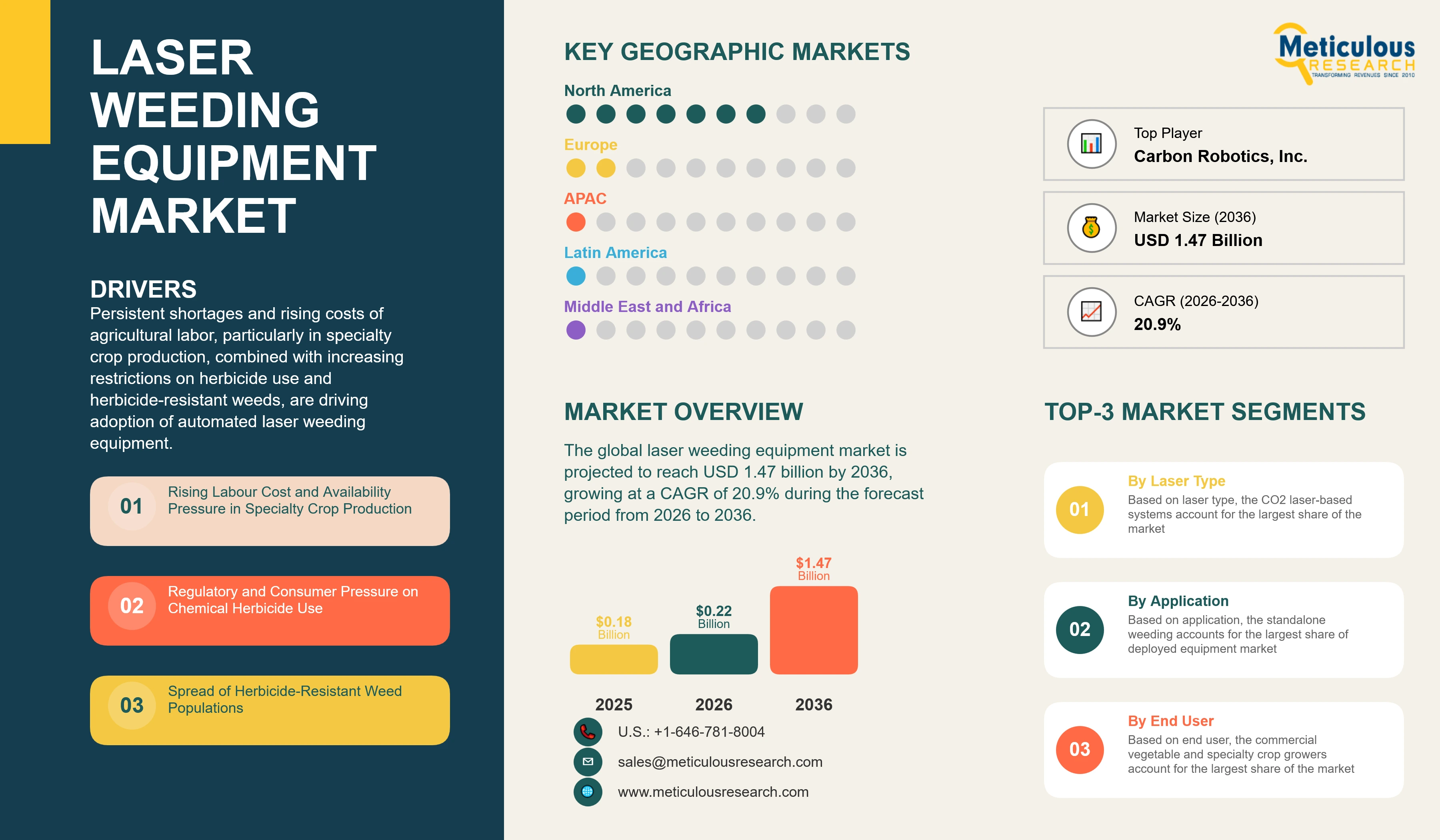
The global laser weeding equipment market is projected to reach USD 1.47 billion by 2036 from an estimated USD 0.22 billion in 2026, at a CAGR of 20.9% during the forecast period from 2026 to 2036.
- Published
- Sep 2026
- Pages
- 276
- Format
- PDF + Excel
- Report ID
- MR-2169
- Base year
- 2025
- 2026 · ESTIMATED
- $220.0M
- 2036
- $1.47B
- CAGR 2026–2036
- 20.9%
2025 baseline · 2026–2036 forecast at 20.9% CAGR · hover a bar for the value
Key highlights
The global laser weeding equipment market is projected to reach USD 1.47 billion by 2036, growing at a CAGR of 20.9% during 2026–2036, driven by rising specialty crop labour costs, tightening pesticide regulation, and the commercial maturation of AI-guided laser weed control.
Labour costs accounted for about 40 cents of every dollar of cash expenses on U.S. specialty crop farms in 2024, nearly three times the all-farm average of roughly 15 percent, according to USDA's Economic Research Service, underscoring the labour-cost pressure that supports laser weeding adoption in vegetable, fruit, and nursery production.
The competitive landscape spans North American, European, Chinese, and Indian manufacturers. Carbon Robotics' LaserWeeder is deployed with more than 100 growers across North America, Europe, and Australia, while Escarda Technologies (Germany), Trabotyx (Netherlands), WeedBot (Latvia), and Farm-ING (Austria) are commercialising laser weeding implements and robots across European specialty crop and organic farming segments.
China's Huagong Tech Co., Ltd. unveiled its Hg LaserWeeder in Wuhan in mid-2025, with field trials completed in Yunnan and Heilongjiang provinces and mass production targeted for 2026, while Shanghai-based CyanForce Technology began pre-orders for its trailed Guangyun laser weeding implement in late 2025.
In India, Hyderabad-based Harvested Labs (Harvested Robotics) raised a seed round in 2025 backed by Arali Ventures and individual investors including Anand Mahindra, developing a tractor-mounted laser weeder branded RAKSHAK for domestic specialty crop farms.
The European Commission's own pesticide-use tracking shows a 27 percent decrease in the use of more hazardous chemical pesticides across the EU between the 2015–2017 baseline and 2023, though the dedicated Sustainable Use Regulation intended to enforce the bloc's 50 percent reduction target by 2030 was withdrawn by the Commission in early 2024, leaving the target in place without its primary legislative vehicle.
The International Herbicide-Resistant Weed Database recorded 548 unique cases of herbicide resistance across 275 weed species globally as of its latest count, spanning resistance to 21 of 31 known herbicide sites of action, a trend that is narrowing the chemical options available to growers in row and specialty crops alike.
According to India's ICAR-Directorate of Weed Research, uncontrolled weeds cost Indian agriculture an estimated USD 11 billion annually, a figure that is shaping government and private-sector interest in non-chemical weed control alternatives in South Asia.
Diode-laser platforms, which target chlorophyll absorption at lower optical power, and CO2-laser platforms, which operate at higher wavelengths for thermal weed destruction, represent the two dominant technology approaches in commercial use, each suited to different weed sizes, crop types, and power-cost trade-offs.
North America and Europe hold the largest revenue share in 2026, supported by early commercial scale-up in U.S. and Canadian specialty crop production and by EU pesticide-reduction policy alongside a dense cluster of European laser weeding manufacturers, while Asia-Pacific is expected to register the fastest CAGR as Chinese and Indian manufacturers move from pilot to commercial-scale deployment.
Report summary
| Particulars | Details |
|---|---|
| Forecast Period | 2026–2036 |
| Base Year | 2025 |
| Estimated Year | 2026 |
| CAGR (Value) | 20.9% |
| Format | PDF, Excel & Cloud Portal · 276 pages |
| Market Size (Value) in 2026 | USD 0.22 Billion |
| Market Size (Value) in 2036 | USD 0.18 Billion |
| Segments Covered | By Laser Type: CO2 Laser-based; Diode Laser-based. By Platform: Tractor-Mounted/Towed Implements; Autonomous Self-Propelled Robots. By Laser Module Capacity: Low-Capacity (up to 10 modules); Mid-Capacity (11–20 modules); High-Capacity (above 20 modules). By Crop Type: Leafy Greens & Vegetables; Root & Bulb Crops; Flower & Ornamental Crops; Row & Field Crops. By Application: Weeding; Combined Weeding & Thinning. By End User: Commercial Vegetable & Specialty Crop Growers; Organic & Premium-Certified Farms; Contract & Weeding-as-a-Service Operators; Government & Institutional Research Programs |
| Countries Covered | North America (U.S., Canada), Europe (Germany, Netherlands, Austria, Latvia, France, U.K., and Rest of Europe), Asia-Pacific (China, India, Japan, Australia & New Zealand, and Rest of Asia-Pacific), Latin America (Brazil, Mexico, and Rest of Latin America), and the Middle East & Africa |
| Key Companies | Carbon Robotics, Inc. (U.S.), Escarda Technologies GmbH (Germany), Trabotyx B.V. (Netherlands), WeedBot (Latvia), Farm-ING GmbH (Austria), Cropr B.V. (Netherlands), Huagong Tech Co., Ltd. (China), CyanForce (Shanghai) Technology Co., Ltd. (China), Harvested Labs (Harvested Robotics) (India) |
| Primary Reference Sources | U.S. Department of Agriculture, Economic Research Service (specialty crop labour cost data); European Commission, Directorate-General for Health and Food Safety (EU pesticide reduction target tracking); ICAR-Directorate of Weed Research, Government of India (weed-related crop loss estimates); International Herbicide-Resistant Weed Database, weedscience.org; company press releases, product documentation, and investor disclosures from Carbon Robotics, Escarda Technologies, Trabotyx, WeedBot, Farm-ING, Cropr, Huagong Tech, and CyanForce Technology; and specialist trade press including Future Farming, AgFunderNews, and BusinessWire |
Report overview
Segments covered: laser type, platform, laser module capacity, crop type, application, end user. Regions: North America, Europe, Asia-Pacific, Latin America.
Tractor-mounted and towed laser weeding implements account for the largest share of market value through most of the forecast period, reflecting their compatibility with equipment growers already own, while autonomous self-propelled laser weeding robots represent the fastest-growing platform category as manufacturers extend the technology toward continuous, unattended field operation.
Laser weeding equipment combines computer vision, artificial intelligence, and precision laser technology to identify individual weeds and direct concentrated laser energy at their growing points, destroying unwanted plants without disturbing the soil or applying herbicides. Unlike conventional chemical spraying, which treats broader areas, laser weeding enables plant-by-plant weed control and can support day and night operations under suitable field conditions.
The market includes multiple laser technologies, particularly CO₂ and diode or visible-spectrum laser systems, although technology configurations vary among manufacturers. Equipment is primarily available as tractor-mounted or trailed implements and autonomous or self-propelled robotic platforms, serving applications ranging from specialty vegetables and organic crops to selected field crops.
The industry has progressed from early demonstrations toward broader commercial development since the early 2020s. Carbon Robotics commercially introduced its LaserWeeder in 2022 and has deployed the technology among growers across North America, Europe, and Australia. Its systems combine high-resolution cameras, AI-based plant recognition, and multiple high-powered lasers for automated weed removal. Escarda Technologies is also advancing commercialization in Europe, with its acquisition by Berlin.Industrial.Group in 2026 supporting series production and wider deployment. Meanwhile, companies including Cyan Force and Harvested Labs are expanding the technology's presence in China and India through self-propelled, trailed, and tractor-mounted systems.
Market demand is primarily supported by rising agricultural labor costs and shortages, particularly in labor-intensive vegetable and specialty crop production. Increasing restrictions on herbicide use, concerns regarding herbicide-resistant weeds, and growing demand for chemical-free and precision agriculture practices are further strengthening interest in laser-based weed control. However, the technology remains at an early stage of commercial adoption compared with established chemical and mechanical weed-control methods.
Report infographic
Market dynamics
9 factors across 5 forcesRising Labour Cost and Availability Pressure in Specialty Crop Production
Specialty crop farms including fruit, tree nut, vegetable, and nursery operations, carry a far higher labour cost burden than field crop farms. According to USDA's Economic Research Service, labour accounted for close to 40 percent of total cash expenses on U.S. specialty crop farms in 2024, compared with roughly 15 percent across all U.S. farms and just 4 to 6 percent on corn, soybean, or wheat operations, reflecting the far lower mechanisation levels in hand-weeded and hand-harvested crops. This structural cost gap, combined with persistent seasonal labour shortages, has pushed growers such as Hungenberg Produce Co. and Triangle Farms to adopt laser weeding to convert a recurring, variable labour cost into a fixed equipment investment with a reported payback period of one to three years.
Regulatory and Consumer Pressure on Chemical Herbicide Use
Government policy and market demand are increasingly favouring non-chemical weed control. The European Union's Farm to Fork Strategy set a target of reducing chemical pesticide use and risk by 50 percent by 2030, and while the European Commission withdrew the dedicated Sustainable Use Regulation intended to enforce that target in 2024, official EU tracking data still shows a 27 percent reduction in use of the most hazardous pesticides through 2023 relative to baseline. Organic and residue-free food demand in North America and Europe is reinforcing this shift at the retail level, supporting adoption of laser weeding among growers supplying organic and premium specialty crop segments.
Spread of Herbicide-Resistant Weed Populations
The growing prevalence of herbicide-resistant weeds is narrowing the effective chemical toolkit available to growers. The International Herbicide-Resistant Weed Database recorded 548 unique cases of resistance across 275 species globally, with resistance now documented against 21 of 31 known herbicide sites of action. As resistant weed populations spread, particularly in intensively cropped regions of North America and parts of Asia, growers and agronomists are looking toward mechanical and laser-based alternatives that do not select for chemical resistance, positioning laser weeding as a complementary tool within integrated weed management programmes.
Table of contents
14 chapters · 116 sections · 276 pages · click to expandSegmental analysis
| Segment | Largest share (2026) | Fastest growth (2026–2036) |
|---|---|---|
| By Laser Type | CO2 laser-based systems | Diode Laser-based Systems |
| By Platform | Tractor-mounted and towed implements | Autonomous Self-Propelled Robots |
| By Laser Module Capacity | Mid-capacity systems | High-Capacity Systems |
| By Crop Type | Leafy greens and vegetables | Bulb & Flower Crops |
| By Application | Standalone weeding | Combined Weeding & Thinning |
| By End User | Commercial Vegetable & Specialty Crop Growers | — |
By Laser Type
- CO2 Laser-based Systems Lead in 2026, Diode Laser-based Systems Grow Fastest
- CO2 laser-based systems account for the largest share of the market, supported by Carbon Robotics' established commercial base across North America, Europe, and Australia and by the technology's broader tolerance for larger weed sizes.
- Diode laser-based systems are projected to grow fastest, driven by a growing cluster of European manufacturers including Trabotyx and WeedBot targeting organic and small-weed-window applications at lower per-module power cost.
By Platform
- Tractor-Mounted/Towed Implements Lead in 2026, Autonomous Self-Propelled Robots Grow Fastest
- Tractor-mounted and towed implements hold the largest share, reflecting grower preference for equipment compatible with tractors and operating routines they already have in place.
- Autonomous self-propelled robots are growing fastest, led by platforms such as Trabotyx's TOR and Cropr's Weedr, as manufacturers target continuous, unattended field operation that does not depend on tractor and operator availability.
By Laser Module Capacity
- Mid-Capacity Systems Lead in 2026, High-Capacity Systems Grow Fastest
- Mid-capacity systems account for the largest share in 2026, balancing throughput against equipment cost for mid-size specialty crop operations.
- High-capacity systems are projected to grow fastest as manufacturers such as Huagong Tech and Carbon Robotics scale laser module counts to raise weeding speed and address larger-acreage commercial farms.
By Crop Type
- Leafy Greens & Vegetables Hold the Largest Share in 2026, Bulb & Flower Crops Grow Fastest
- Leafy greens and vegetables account for the largest share, reflecting the concentration of early commercial deployment in lettuce, spinach, broccoli, and related crops across the United States and Europe.
- Bulb and flower crops are projected to grow fastest as manufacturers such as Trabotyx extend validated crop models into tulip, lily, and peony cultivation in the Netherlands and neighbouring European bulb-growing regions.
By Application
- Weeding Leads in 2026, Combined Weeding & Thinning Grows Fastest
- Standalone weeding accounts for the largest share of deployed equipment.
- Combined weeding and thinning is projected to grow fastest, supported by software-enabled dual functionality on platforms such as Carbon Robotics' LaserWeeder, which allows growers to address crop spacing and weed control within a single field pass.
By End User
- Commercial Vegetable & Specialty Crop Growers Dominate the Market in 2026
- Commercial vegetable and specialty crop growers account for the largest share, reflecting the scale of labour-intensive row crop acreage across North America and Europe.
- Contract and weeding-as-a-service operators are projected to register meaningful growth as manufacturers including Trabotyx explore service-based deployment models that lower the capital barrier for individual farms.
Geographic analysis
North America
North America holds a leading share in 2026, anchored by Carbon Robotics' commercial base across 17 or more U.S. states and multiple Canadian provinces and by the high labour-cost burden documented on U.S. specialty crop farms by USDA's Economic Research Service.
Europe
Europe represents the most manufacturer-dense region globally, with Escarda Technologies (Germany), Trabotyx and Cropr (Netherlands), WeedBot (Latvia), and Farm-ING (Austria) all commercialising distinct laser weeding platforms. The region's adoption is reinforced by EU pesticide-reduction policy, even as the Sustainable Use Regulation's withdrawal in 2024 has left enforcement of the bloc's 50 percent pesticide reduction target without its intended dedicated legislative instrument.
Asia-Pacific
Fastest growthAsia-Pacific is expected to register the fastest CAGR during the forecast period, driven by China's rapid entry into laser weeding manufacturing through established industrial laser producers such as Huagong Tech alongside newer entrants like CyanForce Technology, and by India's emerging domestic laser weeding sector led by Harvested Labs, supported by ICAR's documentation of substantial weed-related crop losses.
Latin America
Latin America and the Middle East & Africa remain earlier-stage markets, with adoption concentrated in pilot programmes and high-value export-oriented specialty crop operations.
Competitive landscape
Companies active in the global laser weeding equipment market have pursued platform development across CO2 and diode laser technologies, autonomous robotics, and expanded crop-model libraries, alongside strategic acquisitions and geographic expansion, to strengthen their market positions. The competitive set spans an established U.S. commercial leader, a cluster of European specialty manufacturers, large Chinese industrial laser producers entering agriculture, and early-stage Indian and Latvian developers targeting price-sensitive segments of the market.
- —
Carbon Robotics introduced the LaserWeeder G2 with enhanced optics, always-on connectivity, and expanded crop model coverage, and unveiled the Carbon ATK (Autonomous Tractor Kit) at the 2026 World Ag Expo, converting existing Deere 6R, 8R, 8RX, and 8RT tractors into autonomous platforms.
- —
Escarda Technologies was fully acquired by Berlin.Industrial.Group in 2026, a move the company says will accelerate series production and strengthen safety systems and aftersales support for its AI-powered laser weeding platform.
- —
Trabotyx launched TOR, the first commercially available Dutch laser weeder, in June 2025, offering three working-width configurations and trained crop models spanning nine vegetable and three flower bulb crops, with 2026 season production capped at ten machines.
- —
Farm-ING added a tractor-mounted laser weeding option, LaserING, to its existing mechanical hoeing and spot-spraying range, with commercial availability targeted for 2026 following a 2025 Agritechnica prototype showing.
- —
Cropr launched its autonomous Weedr laser weeder in the Netherlands, combining machine vision, AI, and laser technology on a tractor-independent platform.
- —
Huagong Tech unveiled the Hg LaserWeeder at a Wuhan launch event in mid-2025, with field trials completed in Yunnan and Heilongjiang provinces and international pre-orders open ahead of targeted 2026 mass production.
- —
CyanForce (Shanghai) Technology exhibited its Guangyun C1 trailed laser weeding implement at the Foire de Libramont in Belgium in July 2026, marking what the company describes as the first showing by a Chinese laser weeding manufacturer at a major European agricultural fair.
- —
Harvested Labs raised a seed funding round in 2025 led by Arali Ventures, with participation from Anand Mahindra and Chakradhar Gade, to advance its RAKSHAK tractor-mounted laser weeder for the Indian market.
- Carbon Robotics, Inc. (U.S.)
- Escarda Technologies GmbH · Germany
- Trabotyx B.V. · Netherlands
- WeedBot · Latvia
- Farm-ING GmbH · Austria
- Cropr B.V. · Netherlands
- Huagong Tech Co., Ltd. · China
- CyanForce (Shanghai) Technology Co., Ltd. · China
- Harvested Labs (Harvested Robotics) · India
Frequently asked questions
The global laser weeding equipment market size is estimated at USD 0.22 billion in 2026.
Cite this report
Meticulous Research. (2026). Laser Weeding Equipment Market - Global Opportunity Analysis and Industry Forecast (2026-2036) (Report No. MR-2169). Meticulous Market Research Pvt. Ltd. https://www.meticulousresearch.com/product/laser-weeding-equipment-market-6852