IoT Medical Devices Market (2026-2036)
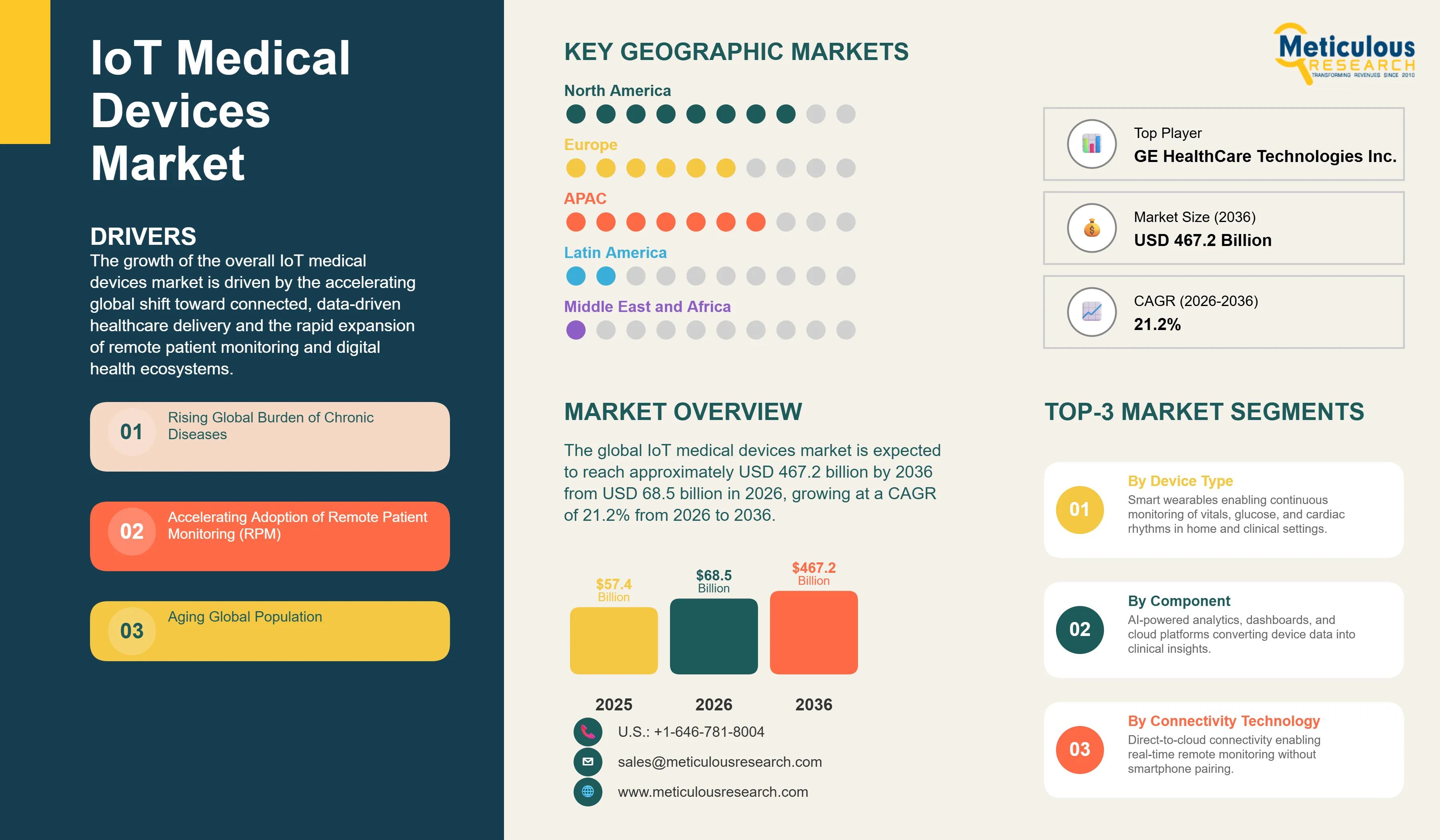
The global IoT medical devices market was valued at USD 57.4 billion in 2025. The market is expected to reach approximately USD 467.2 billion by 2036 from USD 68.5 billion in 2026, growing at a CAGR of 21.2% from 2026 to 2036.
- Published
- Feb 2026
- Pages
- 278
- Format
- PDF + Excel
- Report ID
- MR-1792
- Base year
- 2025
- 2025 · BASELINE
- $57.40B
- 2036
- $467.2B
- CAGR 2026–2036
- 21.2%
2025 baseline · 2026–2036 forecast at 21.2% CAGR · hover a bar for the value
Key highlights
In terms of revenue, the global IoT medical devices market is projected to reach USD 467.2 billion by 2036.
The market is expected to grow at a CAGR of 21.2% from 2026 to 2036.
North America dominates the global IoT medical devices market with the largest market share in 2026, driven by high healthcare expenditure, widespread adoption of remote patient monitoring programs, and the presence of leading MedTech manufacturers in the U.S.
Asia-Pacific is expected to witness the fastest growth during the forecast period, supported by expanding healthcare infrastructure, rising digital health investments, and government-led initiatives promoting connected healthcare in China, India, Japan, and Southeast Asia.
By device type, the wearable medical devices segment holds the largest market share in 2026, driven by their widespread use in continuous vital sign monitoring, chronic disease management, and expanding consumer acceptance of health-tracking technologies.
By component, the hardware segment holds the largest market share in 2026, reflecting the foundational role of connected sensors, processing units, and wireless communication modules in IoT medical device ecosystems.
By connectivity technology, the Bluetooth/BLE segment holds the largest market share in 2026, owing to its low power consumption, cost efficiency, and widespread compatibility with wearable and portable medical devices.
By application, the patient monitoring segment holds the largest share of the overall market in 2026.
By end user, the hospitals & clinics segment holds the largest share of the overall market in 2026.
Report summary
| Particulars | Details |
|---|---|
| Market Size by 2036 | USD 467.2 Billion |
| Market Size in 2026 | USD 68.5 Billion |
| Market Size in 2025 | USD 57.4 Billion |
| Market Growth Rate (2026–2036) | CAGR of 21.2% |
| Format | PDF, Excel & Cloud Portal · 278 pages |
| Dominating Region | North America |
| Fastest Growing Region | Asia-Pacific |
| Base Year | 2025 |
| Forecast Period | 2026 to 2036 |
| Segments Covered | Device Type, Component, Connectivity Technology, Application, End User, and Region |
| Regions Covered | North America, Europe, Asia-Pacific, Latin America, and Middle East & Africa |
Report overview
Segments covered: device type, component, connectivity technology, application, end user.
The growth of the overall IoT medical devices market is driven by the accelerating global shift toward connected, data-driven healthcare delivery and the rapid expansion of remote patient monitoring and digital health ecosystems. As healthcare providers seek to integrate continuous monitoring capabilities and intelligent analytics into clinical and home care workflows, IoT-enabled medical devices have become essential for improving patient outcomes, reducing hospital readmissions, and lowering the overall cost of care. The rapid expansion of chronic disease populations, aging demographics, and the growing preference for home-based healthcare continue to fuel significant growth of this market across all major geographic regions.
IoT medical devices are connected healthcare instruments that leverage embedded sensors, wireless communication, and cloud-based analytics to enable real-time health data collection, transmission, and actionable insights across clinical and home care environments. These devices encompass a broad spectrum of technologies, including wearable vital sign monitors, smart implantables, connected imaging systems, and stationary hospital-grade monitoring platforms, all designed to support continuous patient oversight and data-driven clinical decision-making. The market is defined by high-precision technologies such as continuous glucose monitoring (CGM) systems, AI-enabled cardiac monitors, and 5G-connected patient tracking platforms, which significantly enhance diagnostic accuracy and care coordination across complex healthcare networks. These systems have become indispensable for healthcare organizations seeking to shift from reactive, episodic care to proactive, personalized treatment models.
The market includes a diverse range of solutions, from consumer-grade fitness wearables and remote blood pressure monitors for home healthcare settings to sophisticated implantable cardiac defibrillators and neurostimulation systems for long-term chronic disease management. These devices are increasingly integrated with advanced components such as AI-powered predictive analytics engines, secure cloud storage platforms, and interoperable electronic health record (EHR) systems to deliver services such as real-time arrhythmia detection, continuous glucose trend reporting, and remote therapeutic adjustments. The ability to provide continuous, high-quality health data while enabling timely clinical interventions has made IoT medical technology the preferred choice for institutions where patient safety, operational efficiency, and care quality are paramount.
The global healthcare sector is under sustained pressure to modernize care delivery capabilities, driven by the dual goals of improving patient outcomes and reducing systemic cost burdens. This pressure has accelerated the adoption of connected health solutions, with advanced IoT medical devices helping to bridge the gap between in-hospital and out-of-hospital care for conditions ranging from diabetes and heart failure to chronic obstructive pulmonary disease (COPD) and hypertension. At the same time, the rapid proliferation of telehealth platforms, the expansion of value-based care reimbursement models, and the surge in AI-driven health analytics are intensifying the demand for high-reliability, interoperable connected medical device solutions.
Report infographic
Market dynamics
4 factors across 3 forcesRising Chronic Disease Burden and the Accelerating Shift to Remote Patient Monitoring
A key driver of the IoT medical devices market is the mounting global prevalence of chronic diseases, which is creating an urgent and sustained need for continuous, connected health monitoring solutions. According to the World Health Organization (WHO), chronic non-communicable diseases including cardiovascular disease, diabetes, chronic respiratory disease, and cancer account for approximately 74% of all global deaths annually, with the burden expected to intensify as populations age. The International Diabetes Federation projects that the number of adults living with diabetes globally will rise from 537 million in 2021 to 783 million by 2045, creating enormous demand for connected glucose monitoring systems, smart insulin delivery devices, and remote endocrinology support platforms. This epidemiological reality is fundamentally reshaping healthcare delivery models, pushing providers, payers, and governments to invest in scalable remote patient monitoring infrastructure. IoT medical devices, with their ability to generate continuous streams of actionable health data outside the hospital, are uniquely positioned to address this demand, enabling healthcare systems to manage larger patient populations more effectively without proportionate increases in clinical staffing or facility costs.
Table of contents
12 chapters · 137 sections · 278 pages · click to expandSegmental analysis
| Segment | Largest share (2026) | Fastest growth (2026–2036) |
|---|---|---|
| By Device Type | Wearable Medical Devices | Implantable medical devices |
| By Component | Hardware | Software |
| By Connectivity Technology | Bluetooth/BLE | — |
| By Application | Patient Monitoring | Disease management application |
| By End User | Hospitals & Clinics | Home healthcare |
By Device Type
- The wearable medical devices segment accounts for a significant portion of the overall IoT medical devices market in 2026.
- This is primarily attributed to the widespread adoption of wearable technologies for continuous monitoring of vital signs, cardiac rhythms, and metabolic markers across both clinical and consumer health settings.
- These devices offer the most accessible and patient-friendly approach to continuous health data collection, operating seamlessly in daily life without disrupting normal patient activity.
- The chronic disease management and remote cardiac monitoring segments alone consume a substantial share of wearable IoT medical devices, with leading products including the Dexcom G7 CGM, the Abbott FreeStyle Libre 3, and the iRhythm Zio Patch demonstrating the technology's capability to deliver clinical-grade continuous monitoring at scale.
- However, the implantable medical devices segment is expected to grow at the fastest CAGR during the forecast period, driven by increasing adoption of smart cardiac implants, connected neurostimulation systems, and advanced drug-delivery implants that require long-term physiological monitoring with minimal patient burden.
By Component
- The hardware segment holds the largest share of the overall IoT medical devices market in 2026.
- This is primarily due to the foundational role of connected sensors, microprocessors, wireless communication modules, and power management units in enabling the core data collection and transmission functions of all IoT medical device categories.
- The hardware ecosystem continues to evolve rapidly, with miniaturization of high-performance biosensors and the development of low-power, high-bandwidth wireless chipsets driving both clinical-grade accuracy and extended device battery life improvements.
- The software segment is expected to witness the fastest growth during the forecast period.
- The proliferation of AI-powered health analytics platforms, cloud-based remote monitoring dashboards, and interoperable data management systems is increasingly differentiating IoT medical device offerings, as manufacturers compete on the intelligence and usability of their software layers rather than hardware specifications alone.
- Integration of machine learning algorithms capable of detecting early physiological deterioration and personalized health trend analysis is emerging as a primary differentiator across both wearable and implantable device categories.
By Connectivity Technology
- The Bluetooth/Bluetooth Low Energy (BLE) segment commands the largest share of the global IoT medical devices market by connectivity technology in 2026.
- This dominance is driven by BLE's optimal combination of low power consumption, affordable hardware implementation costs, and broad compatibility with smartphones, tablets, and dedicated medical monitoring hubs.
- Wearable vital sign monitors, continuous glucose monitors, cardiac patches, and home blood pressure devices overwhelmingly rely on BLE for short-range data transmission to paired patient-facing devices or clinical data hubs.
- The cellular segment encompassing both 4G LTE and emerging 5G connectivity is expected to be the fastest-growing connectivity technology during the forecast period, driven by the expansion of dedicated-connectivity medical devices designed for direct-to-cloud data transmission without dependency on a paired smartphone or local gateway device.
By Application
- The patient monitoring segment commands the largest share of the global IoT medical devices application market in 2026.
- This dominance reflects the fundamental value proposition of IoT medical devices: continuous, real-time health data capture enabling timely clinical intervention.
- Large-scale deployments in intensive care units, post-surgical recovery wards, and chronic disease home monitoring programs drive demand, with advanced monitoring platforms from providers such as Philips Healthcare, GE HealthCare, and Masimo Corporation enabling reliable performance across complex, multi-parameter clinical monitoring environments.
- However, the disease management application segment is poised for rapid growth through 2036, fueled by the expanding use of connected devices for end-to-end chronic condition management across diabetes, cardiovascular disease, and respiratory disorders.
By End User
- The hospitals & clinics segment commands the largest share of the global IoT medical devices end user market in 2026.
- This dominance stems from hospitals' superior capacity to deploy, manage, and integrate large-scale connected device networks within established clinical workflows, and from the high density of IoT devices from smart infusion pumps and connected imaging systems to bedside patient monitoring platforms and asset tracking solutions — required to support complex inpatient care environments.
- Large-scale healthcare network deployments and institutional digital transformation programs drive significant volume demand, with integrated solutions from providers like Drägerwerk AG & Co. KGaA and Baxter International enabling reliable connected device performance across critical and acute care settings.
- However, the home healthcare segment is poised for the fastest growth through 2036, fueled by expanding remote patient monitoring reimbursement frameworks, rising patient preference for home-based care, and the increasing clinical acceptance of consumer-grade wearable devices delivering medically validated continuous health data.
Geographic analysis
North America
Largest shareNorth America holds the largest share of the global IoT medical devices market in 2026. This leadership position is primarily attributed to the combination of high healthcare expenditure, a well-established digital health infrastructure, and the presence of the world's leading MedTech innovators, particularly in the United States. The U.S. alone accounts for a substantial portion of global IoT medical device adoption, supported by progressive CMS reimbursement policies for remote patient monitoring services, active FDA Digital Health Center of Excellence (DHCoE) guidance facilitating faster regulatory pathways for connected devices, and the concentrated presence of leading manufacturers including Medtronic plc, Abbott Laboratories, Dexcom, Inc., Masimo Corporation, and Boston Scientific Corporation. The structured integration of IoT device data into interoperable electronic health record platforms and the strong institutional focus on value-based care outcomes further reinforce North America's market leadership position.
Europe
Europe accounts for a substantial share of the global IoT medical devices market. The growth of the European market is primarily driven by progressive national digital health strategies, including Germany's Digital Healthcare Act (Digitale-Versorgung-Gesetz), which has established formal reimbursement pathways for certified digital health applications and connected medical devices. The U.K.'s NHS Long Term Plan and similar frameworks across France, the Netherlands, and the Nordic countries are actively driving large-scale remote patient monitoring deployments in chronic disease management programs. The presence of leading European medical device manufacturers, including Siemens Healthineers AG, Koninklijke Philips N.V., and Drägerwerk AG & Co. KGaA, combined with rigorous EU Medical Device Regulation (MDR) compliance standards, further strengthens the region's market foundation.
Asia-Pacific
Fastest growthAsia-Pacific is expected to be the fastest-growing regional market during the forecast period. The rapid expansion of healthcare infrastructure across China, India, Japan, and South Korea, combined with aggressive government investment in national digital health initiatives, is creating significant demand for IoT medical device solutions across both hospital and community care settings. China's Healthy China 2030 initiative and India's Ayushman Bharat Digital Mission are directly stimulating connected health technology adoption at scale. The region also benefits from a large and growing patient population managing chronic conditions, including the world's largest diabetes patient base, creating structural long-term demand for connected monitoring and disease management solutions.
Competitive landscape
- Medtronic plc
- Koninklijke Philips N.V.
- GE HealthCare Technologies Inc.
- Abbott Laboratories
Frequently asked questions
The global IoT medical devices market is expected to grow from USD 68.5 billion in 2026 to USD 467.2 billion by 2036.
Cite this report
Meticulous Research. (2026). IoT Medical Devices Market - Global Opportunity Analysis and Industry Forecast (2026-2036) (Report No. MR-1792). Meticulous Market Research Pvt. Ltd. https://www.meticulousresearch.com/product/iot-medical-devices-market-6475