Resources
About Us

Industrial Valves Market by Type (Ball, Butterfly, Gate, Globe, Check), End-User (Oil & Gas, Power, Chemical, Water), and Geography – Global Forecast to 2036
Report ID: MRSE - 1041808 Pages: 279 Feb-2026 Formats*: PDF Category: Semiconductor and Electronics Delivery: 24 to 72 Hours Download Free Sample Report
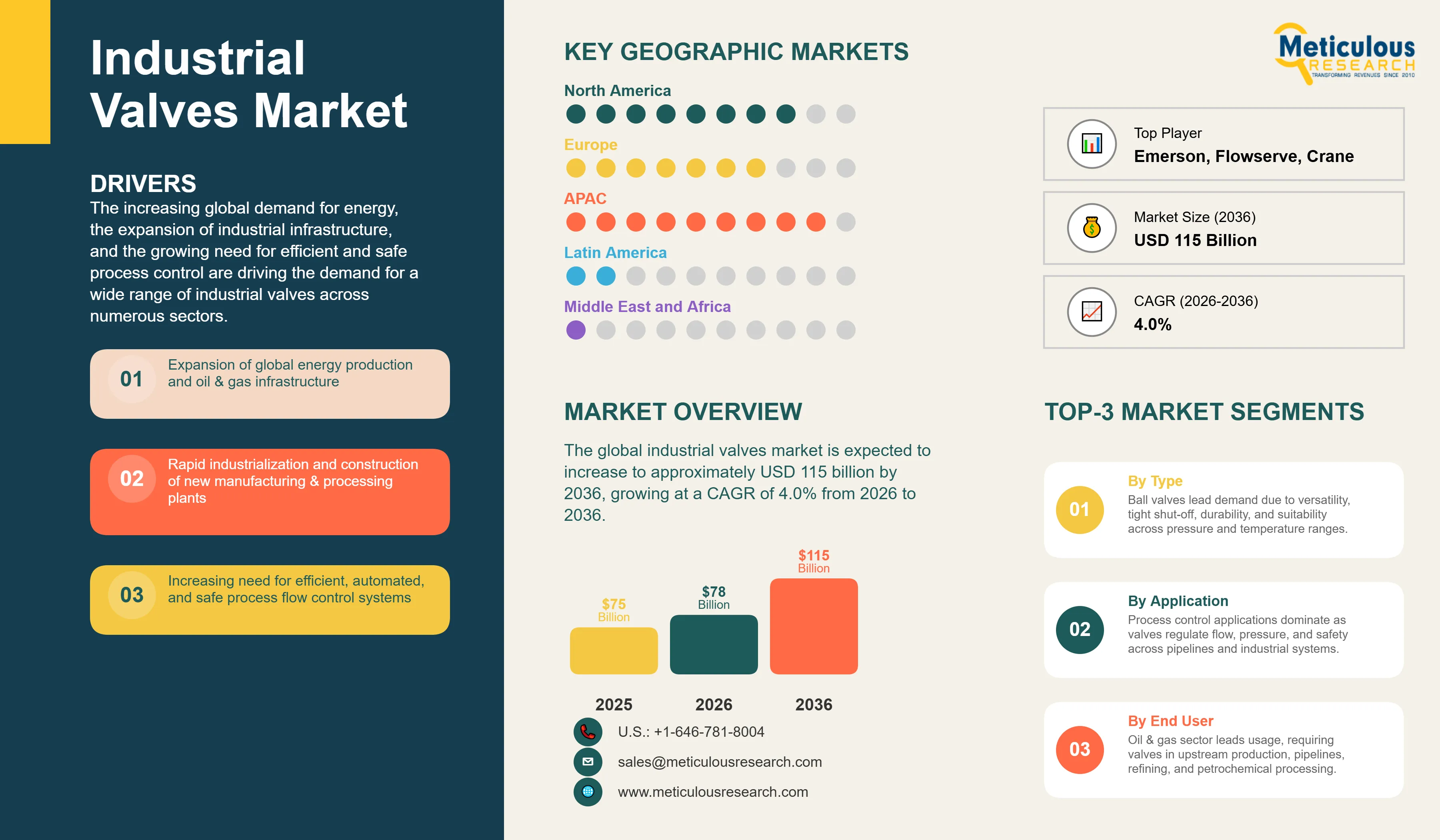
The global industrial valves market size was valued at USD 75 billion in 2025. This market is expected to reach USD 115 billion by 2036 from USD 78 billion in 2026, at a CAGR of 4% from 2026 to 2036. The increasing global demand for energy, the expansion of industrial infrastructure, and the growing need for efficient and safe process control are driving the demand for a wide range of industrial valves across numerous sectors.
Click here to: Get Free Sample Pages of this Report
An industrial valve is a mechanical device designed to control, direct, and regulate the flow of liquids, gases, and vapors within piping systems and industrial processes. These critical components serve as the gatekeepers of fluid movement, enabling the safe, efficient, and reliable operation of industrial systems across virtually every sector of the economy. The fundamental purpose of an industrial valve is to open, close, or partially obstruct a passageway to manage fluid flow, pressure, and direction. A valve accomplishes this through the use of a movable element (such as a ball, disc, plug, or gate) that can be positioned to allow, restrict, or prevent flow. The design, materials, and operating principles of industrial valves vary widely depending on the specific application, fluid being handled, pressure and temperature conditions, and performance requirements. According to technical documentation from leading manufacturers like Emerson Electric, Flowserve Corporation, and Baker Hughes, industrial valves have become increasingly sophisticated, incorporating advanced materials, automation, and digital monitoring capabilities to meet the demanding requirements of modern industrial operations.
The market for industrial valves encompasses a vast array of valve types, each with specific design characteristics and applications. The industry is characterized by high technical complexity, stringent regulatory requirements, and the need for reliability and safety in critical applications. The global industrial valve market is driven by the expansion of industrial infrastructure, the growth of energy production and distribution, the development of chemical and petrochemical facilities, and the modernization of water treatment and wastewater management systems. The market is also influenced by technological advancements that improve valve performance, reduce maintenance requirements, and enable better process control and monitoring.
Digital Transformation and the Rise of Smart Valves: A dominant trend is the digital transformation of the industrial valve market, with a strong focus on the development and adoption of smart valves. These valves are equipped with sensors, microprocessors, and communication capabilities that allow them to monitor their own performance, diagnose potential problems, and communicate their status to a central control system. This enables predictive maintenance, where potential issues can be identified and addressed before they lead to a failure, reducing downtime and improving plant safety. The data generated by smart valves can also be used to optimize process performance and energy efficiency.
Increasing Demand for Customized and Application-Specific Solutions: As industrial processes become more complex and specialized, there is a growing demand for customized, application-specific valve solutions. Generic, off-the-shelf valves are often not sufficient to meet the unique performance requirements of demanding applications. Manufacturers are increasingly working closely with end-users to design and engineer valves that are tailored to their specific needs, taking into account factors such as fluid characteristics, operating conditions, and safety requirements. This trend is driving innovation in valve design and materials and is leading to the development of highly specialized products for niche markets.
|
Report Coverage |
Details |
|
Market Size by 2036 |
USD 115 Billion |
|
Market Size in 2026 |
USD 78 Billion |
|
Market Growth Rate from 2026 to 2036 |
CAGR of 4.0% |
|
Dominating Region |
Asia-Pacific |
|
Fastest Growing Region |
Middle East & Africa |
|
Base Year |
2025 |
|
Forecast Period |
2026 to 2036 |
|
Segments Covered |
Type, End-User, and Geography |
|
Regions and Countries Covered |
North America (U.S., Canada, Mexico), Europe (Germany, France, U.K., Italy, Spain, Russia, Rest of Europe), Asia-Pacific (China, India, Japan, South Korea, Australia, Rest of Asia-Pacific), Latin America (Brazil, Argentina, Rest of Latin America), and Middle East & Africa |
Expansion of Industrial Infrastructure and Energy Production
The most significant driver for the industrial valves market is the ongoing global expansion of industrial infrastructure and the increasing demand for energy. Rapid industrialization in emerging economies, particularly in Asia and the Middle East, is fueling the construction of new power plants, refineries, chemical plants, and manufacturing facilities, all of which require extensive networks of piping and valves. The global quest for energy security is also driving investment in oil and gas exploration and production, as well as the development of renewable energy sources like geothermal and concentrated solar power, all of which rely on specialized valve technologies. This sustained investment in industrial and energy infrastructure creates a continuous and growing demand for a wide range of industrial valves.
Modernization and Replacement of Aging Infrastructure
In mature industrial economies like North America and Europe, a significant portion of the industrial infrastructure is aging and in need of modernization. Many power plants, refineries, and chemical plants have been in operation for several decades, and their original equipment is reaching the end of its service life. The need to replace this aging infrastructure, driven by concerns about safety, reliability, and efficiency, is a major driver for the valve market. The replacement of old, inefficient valves with modern, high-performance, and digitally-enabled valves can lead to significant improvements in plant performance and safety. This ongoing cycle of replacement and modernization provides a stable and consistent source of demand for industrial valves.
Increasing Focus on Process Efficiency and Automation
In today's competitive global market, industrial operators are under constant pressure to improve process efficiency, reduce costs, and maximize output. Industrial valves play a critical role in achieving these goals. The adoption of advanced process control and automation technologies is a major trend across all industries, and this is driving the demand for more sophisticated and intelligent valve solutions. Automated valves with precise control capabilities can help to optimize process parameters, reduce energy consumption, and minimize product waste. The ability to remotely monitor and control valve operation also improves operational efficiency and reduces the need for manual intervention.
Stringent Safety and Environmental Regulations
Industrial operations are subject to a growing body of stringent safety and environmental regulations. These regulations, which are designed to protect workers, the public, and the environment, often have a direct impact on the design and selection of industrial valves. For example, regulations aimed at reducing fugitive emissions from industrial facilities are driving the demand for low-emission valve designs with advanced sealing technologies. Similarly, safety regulations require the use of reliable and certified valves in critical applications to prevent accidents and protect against catastrophic failures. Compliance with these regulations is a major driver for the adoption of high-quality, high-performance industrial valves.
High Capital Investment and Long Project Cycles
The high initial capital investment required for industrial valve systems can be a significant restraint, particularly for large-scale projects. The cost of the valves themselves, as well as the associated piping, actuators, and control systems, can be substantial. In addition, industrial projects often have long development and approval cycles, which can delay investment decisions and create uncertainty in the market. During periods of economic downturn, capital spending on new projects and infrastructure upgrades may be reduced, which can have a negative impact on the demand for industrial valves.
Corrosion, Erosion, and Other Material Challenges
Industrial valves are often exposed to harsh operating conditions, including corrosive fluids, high temperatures, and high pressures. These conditions can lead to material degradation, such as corrosion and erosion, which can compromise the performance and reliability of the valve. The need to use specialized, corrosion-resistant materials and coatings can significantly increase the cost of the valve. The development of new materials and manufacturing processes is an ongoing challenge for the industry, as manufacturers strive to create valves that can withstand increasingly demanding operating conditions.
Digital Transformation and the Rise of Smart Valve Systems
The digital transformation of industry, often referred to as Industry 4.0, presents a massive opportunity for the industrial valves market. The integration of sensors, data analytics, and IoT connectivity into valve systems is creating a new generation of smart valves that can provide real-time insights into process performance and equipment health. These smart valves can enable predictive maintenance, reduce downtime, and improve overall plant efficiency. The ability to collect and analyze data from a network of smart valves can also provide valuable insights that can be used to optimize process performance and improve decision-making.
Expansion in Emerging Markets
The rapid industrialization and infrastructure development in emerging markets, particularly in Asia, Africa, and Latin America, represents a significant growth opportunity for the industrial valves market. As these regions continue to develop their energy, manufacturing, and water infrastructure, there will be a strong and growing demand for a wide range of industrial valves. Manufacturers who can establish a strong presence in these markets and offer products that are tailored to the local needs and conditions will be well-positioned for future growth.
Why are Ball Valves so Widely Used?
Ball valves are one of the most widely used types of industrial valves due to their simple design, reliability, and versatility. They are a quarter-turn valve, which means they can be opened or closed with a 90-degree turn of the handle, making them easy to operate. They provide a tight shut-off and have a low pressure drop when fully open. Ball valves are available in a wide range of sizes, materials, and pressure ratings, making them suitable for a broad spectrum of applications, from simple on-off service to more demanding high-pressure and high-temperature applications. Their combination of performance, reliability, and cost-effectiveness makes them a popular choice across many industries.
What are the Key Differences Between Gate and Globe Valves?
Gate and globe valves are both linear motion valves, but they are designed for different purposes. Gate valves are primarily designed for on-off service, where they are either fully open or fully closed. They have a low pressure drop when fully open, making them ideal for applications where an unobstructed flow path is important. Globe valves, on the other hand, are designed for throttling and flow regulation. Their design allows for precise control of the flow rate, but it also results in a higher pressure drop. The choice between a gate and a globe valve depends on the specific application and whether the primary requirement is for on-off service or flow regulation.
How is the Oil & Gas Sector Driving the Market?
The oil and gas industry is the largest and most demanding end-user of industrial valves. Valves are used in every stage of the oil and gas value chain, from upstream exploration and production to midstream transportation and downstream refining and processing. The industry requires a wide range of specialized valves that can handle high pressures, high temperatures, and corrosive fluids. The ongoing global demand for oil and gas, as well as the development of new and more challenging reserves, continues to drive the demand for high-performance industrial valves. The industry's focus on safety and environmental performance also drives the demand for reliable, low-emission valve solutions.
What are the Key Valve Applications in the Power Generation Sector?
The power generation sector is another major end-user of industrial valves. Valves are used extensively in power plants to control the flow of steam, water, and other fluids. In thermal power plants, valves are used to control the flow of steam to the turbines, regulate the flow of cooling water, and isolate equipment for maintenance. In nuclear power plants, valves play a critical role in ensuring the safety and reliability of the reactor systems. The power generation industry requires valves that can operate reliably in high-temperature and high-pressure environments. The global shift towards cleaner energy sources, such as natural gas and renewables, is also creating new opportunities for specialized valve applications in the power sector.
Asia-Pacific
Asia-Pacific is the largest and fastest-growing market for industrial valves, driven by the region's rapid industrialization, urbanization, and infrastructure development. Countries like China and India are making massive investments in their energy, manufacturing, and water infrastructure, creating a huge demand for industrial valves. The region is also a major manufacturing hub, with a large and growing number of industrial facilities that require a wide range of valve products. The increasing focus on environmental protection and process efficiency in the region is also driving the demand for more advanced and high-performance valve solutions. The key companies operating in the Asia-Pacific market include a mix of global manufacturers and a growing number of strong local players.
North America
North America is a mature and technologically advanced market for industrial valves. The region has a large and sophisticated industrial base, with a strong presence in the oil and gas, chemical, and power generation sectors. The market is characterized by a high demand for high-performance, specialized valve solutions that can meet the stringent safety and environmental regulations in the region. The ongoing modernization of aging infrastructure and the development of new energy sources, such as shale gas and renewables, are key drivers for the market. The key companies operating in the North American market are some of the world's leading valve manufacturers, who have a strong presence in the region and a deep understanding of the local market needs.
Europe
The European market for industrial valves is characterized by a strong focus on quality, reliability, and environmental performance. The region has a highly regulated industrial environment, with stringent standards for safety, emissions, and energy efficiency. This drives the demand for high-quality, certified valve products that can meet these demanding requirements. The chemical, pharmaceutical, and food and beverage industries are major end-users of industrial valves in Europe. The region is also a leader in the development of renewable energy technologies, which is creating new opportunities for specialized valve applications. The key companies operating in the European market are a mix of large global players and a number of highly specialized, family-owned companies that are leaders in their respective niche markets.
Middle East & Africa
The Middle East & Africa is a significant and growing market for industrial valves, driven primarily by the region's vast oil and gas reserves. The region is a major producer and exporter of oil and gas, and there is ongoing investment in the development of new fields and the expansion of existing facilities. The petrochemical industry is also a major end-user of industrial valves in the region. The increasing focus on economic diversification and industrial development in the region is also creating new opportunities for the valve market in other sectors, such as water and wastewater, power generation, and manufacturing. The key companies operating in the Middle East & Africa market are the major global valve manufacturers, who have a strong presence in the region and work closely with the national oil companies and other major industrial players.
By Type
By End-User
By Geography
The industrial valves market is expected to increase from USD 78 billion in 2026 to USD 115 billion by 2036.
The industrial valves market is expected to grow at a CAGR of 4.0% from 2026 to 2036.
The major players in the industrial valves market include Emerson Electric Co., Flowserve Corporation, Baker Hughes Company, and other leading manufacturers of industrial valves and flow control solutions.
The key driving factors for the market are the expansion of industrial infrastructure, the modernization of aging facilities, the increasing focus on process efficiency and automation, and stringent safety and environmental regulations.
The Asia-Pacific region is expected to lead the global industrial valves market during the forecast period, while the Middle East & Africa is projected to be a key growth region.
























Published Date: May-2026
Published Date: Oct-2024
Published Date: Jan-2023
Published Date: Apr-2022
Please enter your corporate email id here to view sample report.
Subscribe to get the latest industry updates


