
Gate Valves Market (2026-2036)
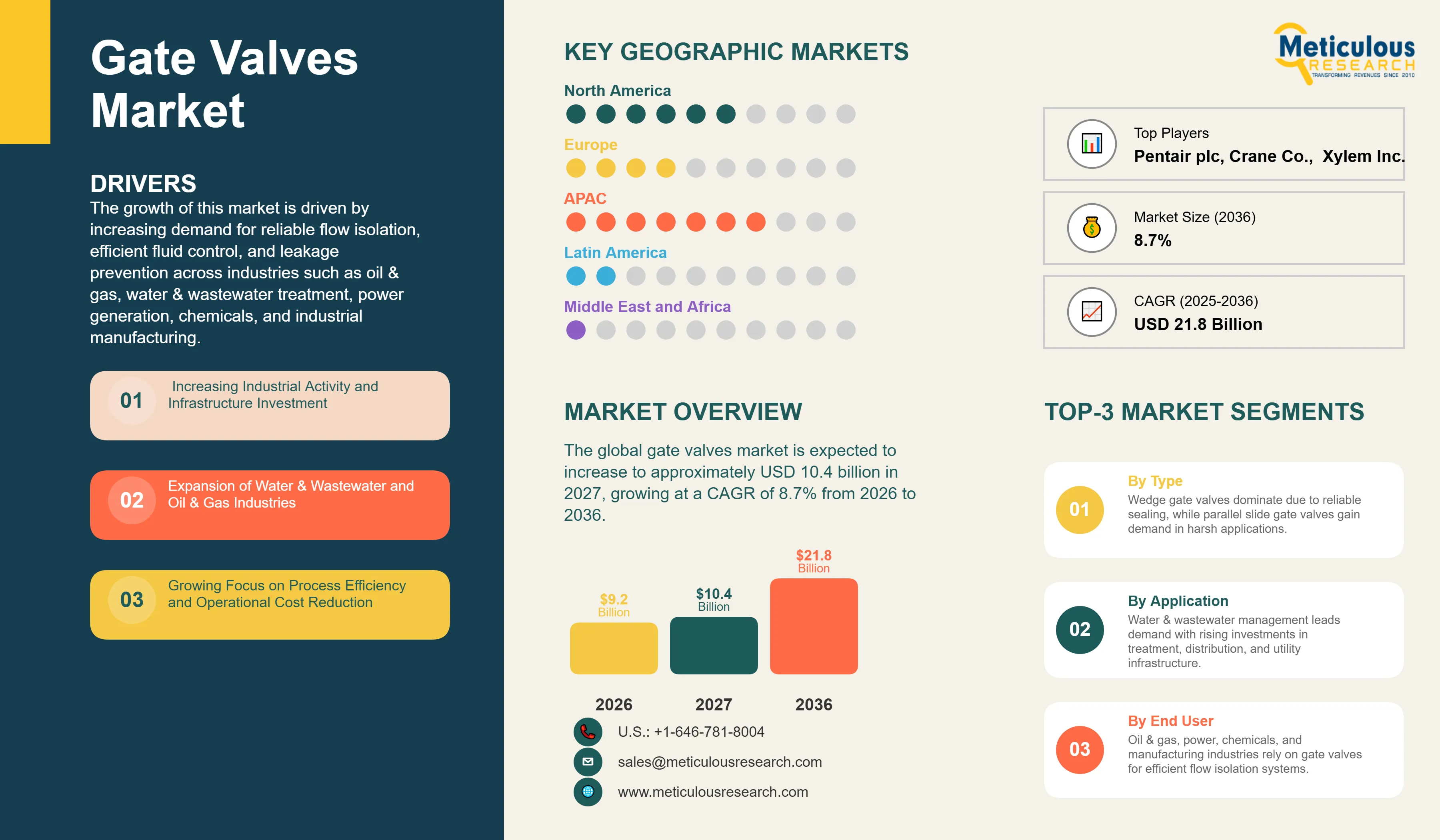
The global gate valves market size was valued at USD 9.2 billion in 2026 and is expected to increase to approximately USD 10.4 billion in 2027, then expand to around USD 21.8 billion by 2036, growing at a CAGR of 8.7% from 2026 to 2036.
- Published
- May 2026
- Pages
- 285
- Format
- PDF + Excel
- Report ID
- MR-1995
- Base year
- 2025
- 2026 · ESTIMATED
- $9.20B
- 2036
- $21.80B
- CAGR 2026–2036
- 8.7%
2025 baseline · 2026–2036 forecast at 8.7% CAGR · hover a bar for the value
Key highlights
In terms of revenue, the global gate valves market is valued at USD 10.4 billion in 2027 and is projected to reach USD 21.8 billion by 2036.
The market is expected to grow at a CAGR of 8.7% from 2026 to 2036.
Asia-Pacific dominates the global gate valves market with the largest market share of 47-51% in 2026.
North America is expected to witness steady growth during the forecast period, driven by infrastructure modernization and maintenance replacement.
By type, the wedge gate valves segment holds the largest market share of 56-61% in 2026.
By type, the parallel slide gate valves segment is expected to witness the fastest CAGR of 10.2% during the forecast period.
By application, the water & wastewater management segment contributes the highest market share of 38-43% in 2026.
By application, the oil & gas segment is expected to witness the fastest CAGR during the forecast period.
Report summary
| Particulars | Details |
|---|---|
| Market Size by 2036 | USD 21.8 Billion |
| Market Size in 2026 | USD 9.2 Billion |
| Market Size in 2027 | USD 10.4 Billion |
| Market Growth Rate (CAGR) 2026 to 2036 | 8.7% |
| Format | PDF, Excel & Cloud Portal · 285 pages |
| Dominating Region | Asia-Pacific |
| Fastest Growing Region | Asia-Pacific |
| Base Year | 2025 |
| Forecast Period | 2026 to 2036 |
| Segments Covered | Type, Application, and Region |
| Regions Covered | North America, Europe, Asia-Pacific, Latin America, and Middle East & Africa |
Report overview
Segments covered: type, application.
The growth of this market is driven by increasing demand for reliable flow isolation, efficient fluid control, and leakage prevention across industries such as oil & gas, water & wastewater treatment, power generation, chemicals, and industrial manufacturing. According to the International Energy Agency (IEA), global energy demand continues to rise, with industrial activity and infrastructure investments increasing pressure on fluid handling and process control systems. In addition, the United Nations estimates that global water demand could increase by 20–30% by 2050, supporting investments in water infrastructure and valve systems for efficient distribution and treatment networks. These trends are strengthening demand for advanced gate valves designed to improve operational reliability and system efficiency.
Growing adoption of industrial automation, smart monitoring technologies, and predictive maintenance systems is further accelerating the deployment of advanced gate valves with enhanced durability, remote monitoring capabilities, and improved safety performance. Increasing investments in infrastructure modernization, energy projects, and industrial process optimization are creating opportunities for manufacturers offering high-performance gate valves capable of seamless integration with modern industrial systems.
The gate valves market encompasses the design, manufacturing, installation, and maintenance of gate valves used for isolation and on-off flow control in industrial applications. Gate valves are essential components in fluid handling systems, engineered to provide reliable isolation, minimal leakage, and long service life. These valves are used across diverse industrial environments to control the flow of liquids, gases, and slurries. Gate valves are engineered to provide reliable isolation, minimize leakage, and ensure compliance with safety and environmental standards in diverse industrial environments.
The market includes various valve types designed for specific applications and performance requirements. Wedge gate valves use a wedge-shaped gate for reliable sealing. Parallel slide gate valves use parallel gates for improved performance. Double disc gate valves provide enhanced sealing capability. Knife gate valves handle slurry and viscous fluids. Slab gate valves provide simplified operation. Rising stem gate valves offer visual indication of valve position. Non-rising stem gate valves provide compact installation. These systems find critical applications in water & wastewater management, oil & gas, power generation, chemical processing, and mining industries where reliable isolation is essential.
The market is primarily driven by increasing industrial activity, growing infrastructure investment, expansion of process industries, and the need for efficient fluid management. These systems are fundamental to modern industrial operations.
Technology is fundamentally transforming the gate valves market by introducing advanced materials, improved sealing technologies, and enhanced monitoring capabilities. New systems enable superior isolation and reduced leakage. Advanced gate materials enable better durability and corrosion resistance. Improved sealing designs enable longer service life. These technological innovations enable gate valves to operate reliably in increasingly demanding industrial environments.
Artificial intelligence and machine learning algorithms are enabling gate valves to optimize isolation performance based on real-time process conditions and operational requirements. Deep learning networks enable advanced condition monitoring. AI-powered systems enable autonomous performance optimization. Predictive algorithms enable sophisticated maintenance planning. These AI technologies are expanding the capabilities and applications of gate valves.
Advanced materials including stainless steel, exotic alloys, and composite materials are enabling more durable and corrosion-resistant gate valves. High-performance materials reduce maintenance requirements and extend service life. Advanced designs enable operation in harsh environments. Improved reliability enables longer operational life. These material innovations are enhancing system performance and reducing operational costs.
IoT connectivity and cloud-based management systems enable remote monitoring of valve performance, predictive maintenance, and optimization of isolation operations. Mobile applications enable operators to monitor valve status from anywhere. Integration with process control systems enables seamless integration with industrial operations. Digital twins and simulation technologies enable virtual testing and optimization of systems before field implementation.
Integration with Smart Manufacturing and Process Automation:
A significant trend in the gate valves market is the growing integration with smart manufacturing and process automation systems. Smart factories require sophisticated isolation systems that can be monitored and controlled remotely. Gate valves with IoT connectivity and advanced sensors are increasingly being deployed to support Industry 4.0 initiatives. The development of standardized communication protocols and automation standards has improved interoperability and reduced integration complexity.
The growing shift toward digital transformation and industrial automation is accelerating demand for advanced valve technologies with enhanced automation capabilities. According to the International Federation of Robotics (IFR) World Robotics 2025 report, 542,000 industrial robots were installed globally in 2024, marking the fourth consecutive year with installations exceeding 500,000 units, while global robot deployments have more than doubled over the past decade. Asia accounted for 74% of new robot installations in 2024, highlighting accelerating industrial automation adoption. These trends are increasing demand for interoperable industrial equipment, including smart valves designed for integration with automated manufacturing systems. Growing investments in connected factories, predictive maintenance, and digital process optimization are expected to create significant growth opportunities for manufacturers offering intelligent and automated gate valve solutions.
Shift Towards Environmentally Sustainable and Zero-Leakage Valve Solutions: Another important trend driving growth in the gate valves market is the increasing adoption of environmentally sustainable and zero-leakage valve solutions. Environmental regulations are becoming increasingly stringent, requiring industries to minimize emissions and prevent leakage of hazardous materials. Gate valves with advanced sealing technologies and zero-leakage designs are in high demand. These advanced solutions enable compliance with environmental regulations while reducing operational costs through improved efficiency.
The trend toward sustainability and emissions reduction is accelerating adoption of advanced valve technologies. According to the International Energy Agency (IEA) 2025 Global Methane Tracker, the energy sector emitted nearly 120 million tonnes of methane in 2024, with oil and gas operations remaining a major source of emissions. The IEA estimates that around 70% of methane emissions from fossil fuel operations could be reduced using existing technologies, increasing demand for leak prevention and emissions control equipment, including advanced valve systems. These developments are driving investment in high-performance sealing materials, intelligent monitoring systems, and predictive maintenance technologies, creating significant opportunities for manufacturers offering environmentally sustainable and zero-leakage valve solutions.
Report infographic
Market dynamics
7 factors across 4 forcesIncreasing Industrial Activity and Infrastructure Investment
A key factor driving the growth of the gate valves market is the increasing industrial activity and infrastructure investment globally. Expansion in manufacturing, energy, water infrastructure, and process industries is creating sustained demand for advanced fluid handling systems. According to the IMF’s 2025 World Economic Outlook, global economic growth is projected at 3.0% in 2025, supported by continued industrial production and infrastructure development across emerging and developed economies. Rising investments in industrial facilities, utilities, and transportation infrastructure are increasing demand for reliable flow control components, including gate valves used in critical process operations.
The trend toward infrastructure modernization and facility expansion is further driving adoption of advanced valve technologies. According to the International Energy Agency (IEA), annual global investment in energy infrastructure is expected to exceed USD 3.3 trillion in 2025, with substantial spending directed toward power generation, oil & gas, and industrial systems requiring fluid control equipment. In addition, expanding manufacturing activity in emerging markets and increasing investments in water treatment and industrial processing facilities are creating significant demand for high-performance valve systems. These infrastructure investment trends are expected to generate sustained growth opportunities for gate valve manufacturers worldwide.
Expansion of Water & Wastewater and Oil & Gas Industries
The expansion of the water & wastewater and oil & gas industries is a major driver of the gate valves market. These industries rely heavily on gate valves for flow isolation, pressure management, and process control across production, treatment, transportation, and distribution operations. Increasing investments in water infrastructure, particularly in emerging economies, are creating substantial demand for reliable valve systems. According to the United Nations, global water demand is projected to increase by 20–30% by 2050, accelerating investments in water treatment and distribution infrastructure. In parallel, oil & gas facilities require advanced gate valves to ensure safe, efficient, and leak-resistant operations under demanding process conditions.
The trend toward capacity expansion and infrastructure development is further strengthening demand for advanced valve technologies. According to the International Energy Agency (IEA), global energy investment is expected to exceed USD 3.3 trillion in 2025, with significant spending directed toward oil & gas infrastructure, industrial facilities, and energy systems. In addition, the development of new production facilities, expansion of water infrastructure, and increasing focus on process efficiency and emissions reduction are driving adoption of sophisticated valve systems. These trends are expected to create sustained demand for high-performance gate valves across critical industrial applications.
Growing Focus on Process Efficiency and Operational Cost Reduction
The growing focus on process efficiency and operational cost reduction is driving significant growth in the gate valves market. Industrial gate valves with lower leakage rates reduce operational costs and improve profitability. Efficient valve systems reduce energy consumption and improve process efficiency. The payback period for efficient valve investments is typically short, making them attractive investments for cost-conscious organizations.
The trend toward process optimization and operational cost reduction is driving demand for efficient valve solutions. The development of advanced valve designs has enabled more efficient systems. The growing focus on sustainability is driving adoption of efficient valve systems. The expansion of industrial operations globally is creating demand for systems that improve process efficiency. The trend toward operational excellence drives investment in advanced gate valve technology.
Table of contents
11 chapters · 126 sections · 285 pages · click to expandSegmental analysis
| Segment | Largest share (2026) | Fastest growth (2026–2036) |
|---|---|---|
| By Type | Wedge gate valves | Parallel slide gate valves |
| By Application | Water & wastewater management | Oil & gas |
By Type
- The wedge gate valves segment is expected to command the largest share of the overall gate valves market in 2026.
- Wedge gate valves lead the market because they offer proven and reliable designs, provide excellent performance for many applications, have well-established service networks, and offer competitive cost.
- These systems provide efficient isolation at reasonable cost.
- This proven technology makes wedge gate valves ideal for general isolation, standard industrial applications, and diverse fluid handling environments where reliable control is critical.
- Wedge gate valves work exceptionally well for conventional isolation requiring efficient on-off operation.
- They are widely used in industrial facilities for flow management.
- Industrial operations rely on wedge gate valves for reliable isolation.
- Manufacturing operations rely on wedge gate valves for efficient fluid management.
- Their proven design means they are reliable, require well-understood maintenance, and have extensive service networks across the industry.
- The availability of standardized designs allows for easy integration with different industrial systems.
- Improvements in technology have enhanced wedge gate valve performance through better gate materials that improve durability, improved sealing designs that reduce leakage, and advanced monitoring that improves performance.
- The development of wedge gate valves with connectivity capabilities has improved their applicability to modern industrial systems.
- These factors have contributed to widespread acceptance of wedge gate valves across diverse applications.
- However, parallel slide gate valves are expected to witness the fastest CAGR during the forecast period.
- Parallel slide gate valves are gaining rapid adoption due to their superior performance in challenging applications, their ability to handle diverse operating conditions, and their advanced design capabilities compared to traditional systems.
- These systems provide reliable isolation with reduced maintenance.
- Parallel slide gate valves are particularly valuable for applications requiring superior sealing or demanding service conditions.
- The water & wastewater and oil & gas industries rely heavily on parallel slide gate valves for reliable isolation.
- The trend toward improved performance and reduced maintenance is driving adoption of parallel slide gate valve technology.
- Advances in valve design have improved reliability and reduced costs, making parallel slide systems increasingly attractive for broader applications.
- The ability to provide superior isolation makes parallel slide gate valves increasingly valuable in diverse applications.
- The growing demand for improved performance and demanding service applications is driving adoption of parallel slide gate valve technology.
By Application
- The water & wastewater management segment is expected to hold the largest share of the gate valves market in 2026.
- This dominance reflects the critical importance of isolation in water and wastewater operations.
- Water & wastewater facilities use gate valves extensively for flow control and system isolation.
- Water & wastewater operations require sophisticated systems for reliable and efficient operations.
- The expansion of water infrastructure globally is creating significant demand for gate valve equipment.
- The trend toward water infrastructure modernization and cost reduction is driving demand for advanced valve systems.
- The development of new water treatment facilities and the modernization of existing systems drive demand for advanced equipment.
- The trend toward advanced process control is driving demand for high-performance systems.
- The expansion of water infrastructure in emerging markets is creating significant demand for systems.
- The trend toward operational excellence drives investment in advanced gate valve technology.
- The oil & gas segment is expected to witness the fastest CAGR during the forecast period.
- The oil & gas segment's growth is driven by expanding production operations, development of new facilities, and increasing demand for reliable isolation.
- Oil & gas facilities require systems for efficient isolation and process management.
- Upstream and downstream operations require specialized systems for advanced flow management.
- The trend toward oil & gas expansion is creating demand for specialized systems for reliable isolation.
- The development of new oil & gas facilities creates demand for advanced equipment.
- The expansion of oil & gas operations globally is creating significant demand for isolation equipment.
- The growing demand for reliable and efficient operations drives demand for advanced valve systems.
- The trend toward production optimization and advanced operations adoption requires advanced gate valve equipment.
Geographic analysis
North America
North America represents a significant market for gate valves driven by substantial water infrastructure, operational standards, and advanced system modernization. Water & wastewater facilities in North America are among the world's largest, with significant operations requiring sophisticated isolation. The water & wastewater sector in North America is well-developed with major isolation requirements. Stringent regulatory requirements including safety standards and environmental regulations drive facilities to invest in advanced equipment that ensures compliance and efficiency. The North America market benefits from a well-developed infrastructure including equipment manufacturers, integrators, and technical expertise. The presence of major water utilities and industrial companies creates demand for high-performance equipment. The trend toward modernization and efficiency improvement is driving adoption of advanced valve systems with monitoring capabilities. Investment in facility upgrades and modernization continues to support market growth. North America Gate Valves Market Size and Growth 2026 to 2036
Asia-Pacific
Largest shareAsia-Pacific is expected to hold the largest share of the global gate valves market in 2026. This dominance comes from rapid industrial expansion, significant water infrastructure development, and growing infrastructure investment across the region. China is experiencing massive water infrastructure development, creating enormous demand for gate valves. The expansion of water systems in China to serve the growing population drives significant equipment demand. India's water infrastructure sector is expanding rapidly, creating demand for valve equipment. Vietnam, Indonesia, Thailand, and other Southeast Asian countries are experiencing rapid water infrastructure growth driven by economic development and rising water demand. The growing water infrastructure across Asia-Pacific are creating substantial demand for gate valves. Government initiatives promoting water infrastructure development and expansion are attracting investment and facility development. Infrastructure improvements including reliable water supply, transportation networks, and distribution systems are making these regions increasingly attractive for infrastructure investments. The region benefits from lower infrastructure costs and growing water infrastructure capacity, which makes it attractive for water system development. The presence of major multinational corporations establishing or expanding operations in the region is driving demand for modern equipment that meets global standards. The expansion of water infrastructure in Asia-Pacific is creating demand for advanced systems. The trend toward infrastructure modernization is creating demand for intelligent valve systems with advanced capabilities.
Competitive landscape
- Emerson Electric Co.
- Crane Company
- Pentair plc
- Flowserve Corporation
- Schlumberger (SLB)
- IMI plc
- KITZ Corporation
- Velan Inc.
- Weir Group PLC
- Watts Water Technologies
- Xylem Inc.
- AVK Group
- Bray International
- KSB SE & Co. KGaA
- Mueller Water Products
- Flomatic Corporation
Frequently asked questions
The global gate valves market is expected to grow from USD 9.2 billion in 2026 to USD 21.8 billion by 2036.
Cite this report
Meticulous Research. (2026). Gate Valves Market - Global Opportunity Analysis and Industry Forecast (2026-2036) (Report No. MR-1995). Meticulous Market Research Pvt. Ltd. https://www.meticulousresearch.com/product/gate-valves-market-6678