
Industrial Couplings Market (2026-2036)
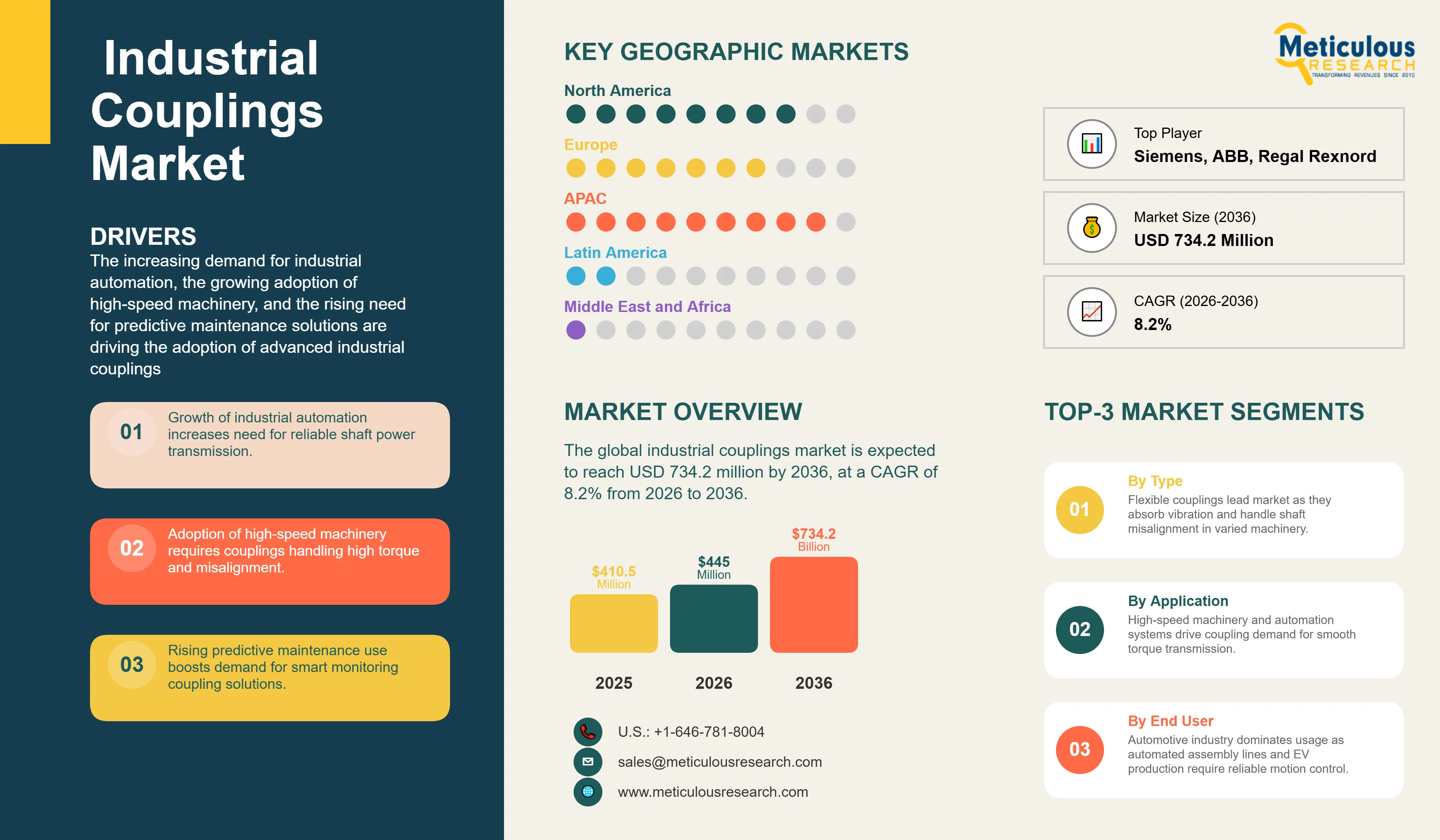
The global industrial couplings market was valued at USD 410.5 million in 2025. This market is expected to reach USD 734.2 million by 2036 from USD 445.7 million in 2026, at a CAGR of 8.2% from 2026 to 2036.
- Published
- Feb 2026
- Pages
- 198
- Format
- PDF + Excel
- Report ID
- MR-1774
- Base year
- 2025
- 2025 · BASELINE
- $410.5M
- 2036
- $734.2M
- CAGR 2026–2036
- 8.2%
2025 baseline · 2026–2036 forecast at 8.2% CAGR · hover a bar for the value
Key highlights
In terms of revenue, the global industrial couplings market is valued at USD 445.7 million in 2026 and is projected to reach USD 734.2 million by 2036.
The market is expected to grow at a CAGR of 8.2% from 2026 to 2036.
Asia-Pacific dominates the global industrial couplings market with the largest market share of 40-45% in 2026.
The Middle East is expected to witness the fastest CAGR during the forecast period.
By type, the Flexible Couplings segment holds the largest market share of 45-50% in 2026.
By type, the Magnetic Couplings segment is also expected to witness the fastest CAGR of 9.2% during the forecast period.
By end-user industry, the Automotive segment contributes the highest market share in 2026.
By end-user industry, the Healthcare segment is expected to witness the fastest CAGR during the forecast period.
Report summary
| Particulars | Details |
|---|---|
| Report Coverage | Details |
| Market Size by 2036 | USD 734.2 Million |
| Market Size in 2026 | USD 445.7 Million |
| Market Growth Rate from 2026 to 2036 | CAGR of 8.2% |
| Format | PDF, Excel & Cloud Portal · 198 pages |
| Dominating Region | Asia-Pacific |
| Fastest Growing Region | Middle East |
| Base Year | 2025 |
| Forecast Period | 2026 to 2036 |
| Segments Covered | Type, Material, Torque Range, End-User Industry, and Geography |
| Regions Covered | North America, Europe, Asia-Pacific, Latin America, and Middle East & Africa |
Report overview
Segments covered: type, material, torque range, end-user industry.
The increasing demand for industrial automation, the growing adoption of high-speed machinery, and the rising need for predictive maintenance solutions are driving the adoption of advanced industrial couplings in a wide range of applications, including manufacturing, oil & gas, power generation, automotive, and aerospace.
The industrial couplings are essential for accommodating misalignment between shafts, absorbing shock and vibration, and ensuring the reliable and efficient operation of machinery. The market offers a wide array of coupling types, including flexible, rigid, fluid, and magnetic couplings, each designed for specific application requirements. These couplings are manufactured from various materials such as carbon steel, stainless steel, aluminum, and advanced composites to meet diverse operational demands in terms of torque, speed, and environmental conditions.
The market is primarily driven by the increasing adoption of industrial automation, the expansion of manufacturing activities in emerging economies, and the growing emphasis on predictive maintenance to minimize downtime and enhance operational efficiency. The increasing adoption of high-speed machinery in sectors like automotive, aerospace, and power generation further fuels the demand for high-performance couplings. Additionally, the rise of renewable energy projects, such as wind turbines and solar trackers, presents new growth avenues for specialized coupling solutions. These couplings are integral to a wide range of end-user industries, including manufacturing, oil & gas, power generation, automotive, aerospace, and healthcare, where they play a critical role in ensuring the smooth and reliable operation of equipment.
Report infographic
Market dynamics
5 factors across 4 forcesIncreasing Industrial Automation and Adoption of High-Speed Machinery
A key driver for the industrial couplings market is the continuous growth of industrial automation and the increasing adoption of high-speed machinery across various sectors. As manufacturers strive to enhance productivity, improve efficiency, and reduce operational costs, they are increasingly investing in automated systems and high-performance equipment. This trend is particularly evident in the manufacturing, automotive, and logistics industries, where robotics, automated assembly lines, and high-speed conveyors are becoming commonplace. These advanced systems require reliable and efficient power transmission components, such as industrial couplings, to ensure smooth and precise operation. The demand for couplings that can handle higher speeds, greater torque, and increased misalignment is growing, pushing manufacturers to innovate and develop more advanced solutions.
Table of contents
13 chapters · 152 sections · 198 pages · click to expandSegmental analysis
| Segment | Largest share (2026) | Fastest growth (2026–2036) |
|---|---|---|
| By Type | Flexible couplings | Magnetic Couplings |
| By End-User Industry | Automotive Industry | At the same time, the healthcare |
By Type
- The flexible couplings segment commands the largest share of the industrial couplings market in 2026.
- This is due to their versatility and ability to accommodate various types of misalignment (angular, parallel, and axial) between shafts.
- This flexibility makes them suitable for a wide range of applications across numerous industries, from general industrial machinery to more demanding applications in the oil & gas and power generation sectors.
- The ability of flexible couplings to absorb shock and vibration also helps to protect connected equipment from damage, thereby extending its operational life.
- The wide availability of different types of flexible couplings, such as gear, grid, and elastomeric couplings, further contributes to their widespread adoption.
By End-User Industry
- The automotive industry holds the largest share of the industrial couplings market in 2026.
- Couplings are used extensively in various automotive manufacturing processes, including on assembly lines, in robotics, and in paint shops.
- The high volume of vehicle production globally, coupled with the increasing automation in automotive plants, drives the demand for a wide range of industrial couplings.
- Furthermore, the shift towards electric vehicles is creating new applications for specialized couplings in EV powertrain systems and battery manufacturing processes.
- The stringent quality and reliability requirements of the automotive industry also push coupling manufacturers to innovate and produce high-performance products.
- At the same time, the healthcare segment is expected to grow at the fastest CAGR during the forecast period.
- The increasing use of advanced medical devices, such as robotic surgical systems, MRI machines, and diagnostic equipment, is fueling the demand for high-precision and miniature couplings.
- These applications require couplings that can provide zero-backlash performance, high torsional stiffness, and reliable operation in a cleanroom environment.
- The growing investment in healthcare infrastructure and the rising demand for advanced medical technologies are expected to continue to drive the growth of the industrial couplings market in the healthcare sector.
- The industrial couplings market in the Middle East is expected to grow at the fastest CAGR from 2026 to 2036.
- This growth is primarily driven by the region's massive investments in infrastructure development, oil & gas projects, and the diversification of economies away from a sole reliance on hydrocarbons.
- The construction of new cities, industrial zones, and transportation networks is creating a significant demand for a wide range of industrial machinery and equipment, which in turn drives the demand for industrial couplings.
- The oil & gas sector, a cornerstone of the Middle Eastern economy, continues to be a major consumer of high-performance couplings for drilling, pumping, and refining applications.
- Additionally, the growing focus on renewable energy, particularly solar power, is creating new opportunities for specialized coupling solutions in the region.
Geographic analysis
North America
The U.S. industrial couplings market is projected to be worth around USD 231.5 million by 2036, growing at a CAGR of 6.9% from 2026 to 2036. U.S. Industrial Couplings Market Size and Growth 2026 to 2036 North America
Asia-Pacific
Largest shareAsia-Pacific is expected to hold the largest share of the global industrial couplings market in 2026. This dominance is attributed to the rapid industrialization and manufacturing growth in countries like China and India. The region is a major hub for manufacturing in various sectors, including automotive, electronics, and heavy industry, all of which are significant consumers of industrial couplings. Government initiatives to promote domestic manufacturing, such as "Make in India" and "Made in China 2025," are further bolstering the demand for industrial components, including couplings. The presence of a large number of small and medium-sized enterprises (SMEs) in the region also contributes to the market growth, as these companies are increasingly adopting automation to enhance their competitiveness. By Geography
Competitive landscape
- Regal Rexnord Corporation
- Timken Company
- Parker Hannifin Corporation
- Voith GmbH & Co. KGaA
- Tsubakimoto Chain Co.
- Siemens AG
- ABB Ltd.
- R+W Antriebselemente GmbH
- NBK Corporation
- KTR Systems GmbH
Frequently asked questions
The industrial couplings market is expected to increase from USD 445.7 million in 2026 to USD 734.2 million by 2036.
Cite this report
Meticulous Research. (2026). Industrial Couplings Market - Global Opportunity Analysis and Industry Forecast (2026-2036) (Report No. MR-1774). Meticulous Market Research Pvt. Ltd. https://www.meticulousresearch.com/product/industrial-couplings-market-6457