Industrial Thermal Management Market (2025-2035)
The global industrial thermal management market was valued at USD 9.1 billion in 2024. It is expected to reach USD 20.2 billion by 2035 from USD 9.8 billion in 2025, at a CAGR of 7.5% from 2025 to 2035.
- Published
- Oct 2025
- Pages
- 245
- Format
- PDF + Excel
- Report ID
- MR-1613
- Base year
- 2024
- 2024 · BASELINE
- $9.10B
- 2035
- $20.20B
- CAGR 2025–2035
- 7.5%
2024 baseline · 2025–2035 forecast at 7.5% CAGR · hover a bar for the value
Key highlights
The global industrial thermal management market was valued at USD 9.1 billion in 2024.
It is expected to reach USD 20.2 billion by 2035 from USD 9.8 billion in 2025, at a CAGR of 7.5% from 2025 to 2035.
The U.S. industrial thermal management market is projected to be worth around USD 5.28 billion by 2035, growing at a CAGR of 7.5% from 2025 to 2035.
Asia Pacific holds the largest share of the global industrial thermal management market in 2025 with around 35-40% share in 2025.
Report summary
| Particulars | Details |
|---|---|
| Report Coverage | Details |
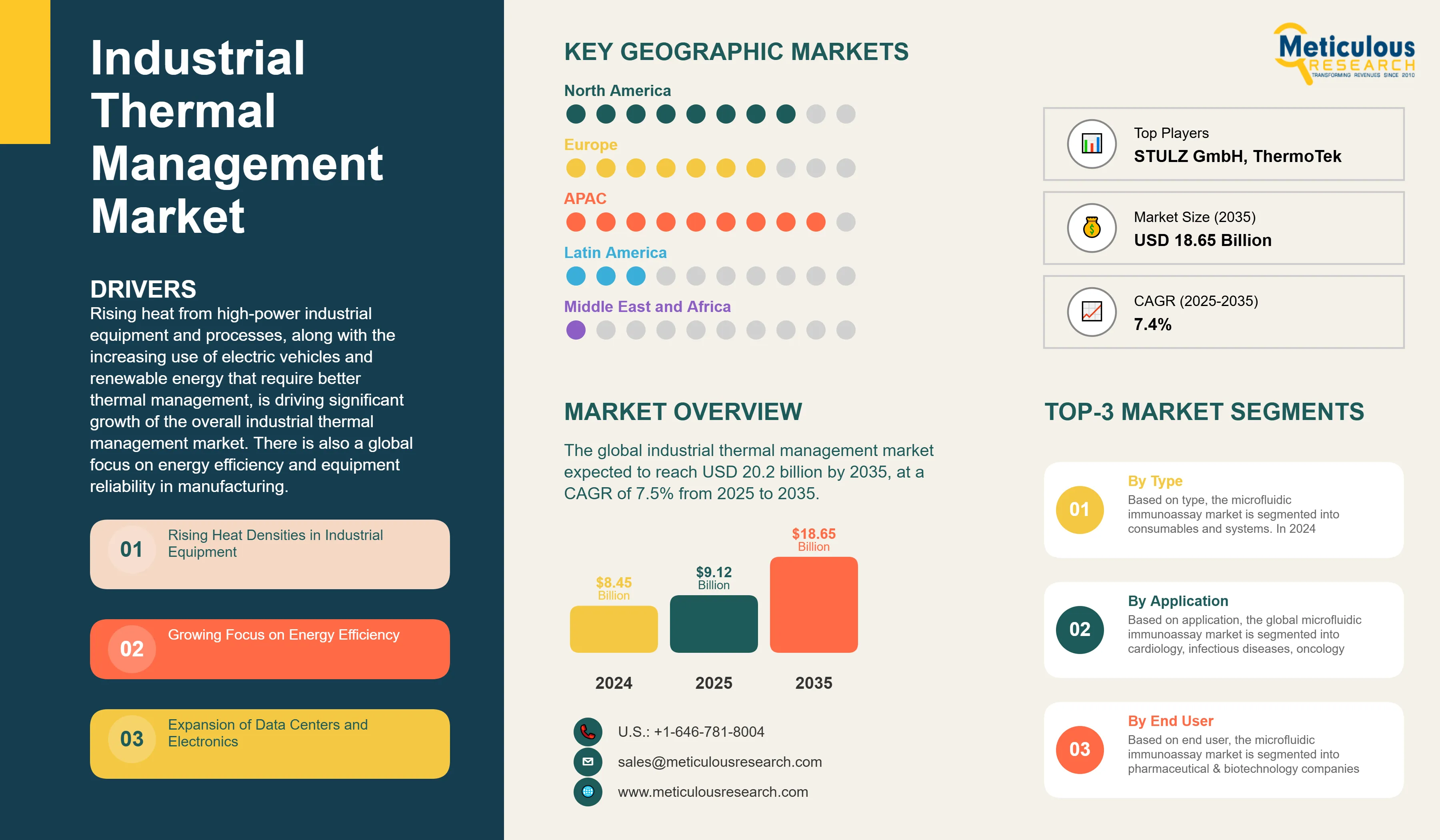
| Market Size by 2035 | USD 18.65 Billion |
| Market Size in 2025 | USD 9.12 Billion |
| Market Size in 2024 | USD 8.45 Billion |
| Market Growth Rate from 2025 to 2035 | CAGR of 7.4% |
| Format | PDF, Excel & Cloud Portal · 245 pages |
| Dominating Region | Asia Pacific |
| Fastest Growing Region | North America |
| Base Year | 2024 |
| Forecast Period | 2025 to 2035 |
| Segments Covered | Component, Cooling Type, Technology, Temperature Range, Application, End User, and Region |
| Regions Covered | North America, Europe, Asia-Pacific, Latin America, and Middle East & Africa |
Report overview
Segments covered: component, cooling type, technology, temperature range, application, end user.
Rising heat from high-power industrial equipment and processes, along with the increasing use of electric vehicles and renewable energy that require better thermal management, is driving significant growth of the overall industrial thermal management market. There is also a global focus on energy efficiency and equipment reliability in manufacturing.
In terms of revenue, the global industrial thermal management market is valued at USD 9.8 billion in 2025 and is projected to reach USD 20.2 billion by 2035.
The market is expected to grow at a CAGR of 7.5% from 2025 to 2035.
Asia Pacific dominates the global industrial thermal management market with the largest market share of 40% in 2025.
North America is expected to witness the fastest CAGR during the forecast period.
By component, the hardware segment captures the largest market share of 65-70% in 2025.
By component, the software & services segment is expected to witness the fastest CAGR through 2035.
By cooling type, the liquid cooling segment holds the largest share of 45-50% in 2025.
By cooling type, the hybrid cooling segment is expected to witness the fastest CAGR from 2025 to 2035.
By technology, the active cooling segment holds the largest share of the overall industrial thermal management market in 2025.
By technology, the phase change materials segment is expected to witness the fastest CAGR through 2035.
By temperature range, the 0°C to 100°C segment commands the largest share of 40-45% in 2025.
By temperature range, the below -40°C segment is expected to witness the fastest CAGR during the forecast period.
By application, the electronics cooling segment accounts for the largest share of 30-35% in 2025.
By application, the battery thermal management segment is expected to witness the fastest CAGR from 2025 to 2035.
By end user, the manufacturing segment holds the largest market share of 25-30% in 2025.
By end user, the data centers segment is expected to witness the fastest CAGR during the forecast period.
The industrial thermal management market involves the design, production, and maintenance of systems that control temperature and remove heat from industrial equipment, processes, and facilities. This includes cooling technologies such as heat exchangers, chillers, cooling towers, heat pipes, thermal interface materials, and modern phase change materials, along with heating solutions to maintain accurate temperature control. Unlike standard commercial HVAC systems, these manage extreme temperatures, high heat loads, and challenging conditions, which helps protect equipment and improve process efficiency.
Market growth comes from increasing power densities in electronics and machinery, higher automation and Industry 4.0 demands for dependable thermal control, expanding data centers with significant cooling needs, tougher efficiency and emissions regulations, progress in cooling technologies and materials, and a better understanding of how thermal management impacts equipment lifespan and operational costs.
AI integration is transforming industrial thermal management by allowing smarter, predictive, and autonomous control. By analyzing real-time data from thousands of sensors, AI can predict hot spots and thermal failures before they occur, helping to avoid costly equipment damage and production downtime. Machine learning adjusts cooling operations, such as fan speeds and pump flows, based on expected heat loads. This saves 20-30% energy while maintaining optimal temperatures.
AI-driven digital twins simulate thermal behavior in various scenarios, speeding up design and testing by 40%. Predictive maintenance algorithms detect wear in cooling systems early, allowing repairs to be scheduled before problems happen. By combining computer vision with thermal imaging, AI can automatically find thermal anomalies. It accurately identifies normal fluctuations and potential issues, increasing reliability by 25-35%.
Immersion cooling and direct-to-chip solutions: Immersion cooling and direct-to-chip liquid cooling are becoming significant trends in industrial thermal management, especially for high-density applications like data centers and power electronics. These methods remove heat up to 1,000 times more effectively than air cooling. This allows for higher power densities and better efficiency. Using dielectric fluids and two-phase immersion systems can reduce energy use by half compared to traditional air cooling. They also eliminate the need for raised floors and complicated air circulation systems.
Sustainable and eco-friendly cooling technologies: Sustainability is shaping the market, with a growing focus on eco-friendly cooling solutions. Companies are using natural refrigerants, waste heat recovery, and renewable energy to cut their carbon footprint. Technologies like free cooling, thermal energy storage with phase change materials, and absorption cooling powered by waste heat help lower operational costs. Closed-loop water systems, dry cooling, and low-GWP refrigerants are increasingly used to meet strict environmental regulations and sustainability goals.
North America industrial thermal management market is expected to grow at the fastest CAGR between 2025 and 2035. This surge is mainly due to significant investments in data center infrastructure from large cloud providers looking for better cooling solutions. The reshoring of manufacturing, particularly in semiconductors and pharmaceuticals, is increasing the demand for modern thermal management systems. A strong focus on sustainability and energy efficiency is promoting the use of waste heat recovery and new cooling technologies.
The top tech companies and research institutions in the region are continuing to drive innovation in thermal management. Strict rules on refrigerants and energy efficiency are leading to upgrades and replacements of equipment. Additionally, the rise in electric vehicle production and charging networks is creating a need for advanced thermal solutions. High-tech industries such as aerospace, defense, and biotechnology also depend on precise temperature control systems, which further boosts market growth.
Component Manufacturing and Material Development This includes producing heat exchangers, cooling components, thermal interface materials, and control systems for thermal management applications. Key Players: 3M Company, Honeywell International, Parker Hannifin, DuPont
Key Players: Johnson Controls International plc
Schneider Electric SE
Honeywell International Inc.
Emerson Electric Co.
Vertiv Holdings Co.
Rittal GmbH & Co. KG
Airedale International
Boyd Corporation
Advanced Cooling Technologies Inc.
Lytron Inc. (Boyd Corporation)
Laird Thermal Systems
Delta Electronics Inc.
Asetek A/S
CoolIT Systems Inc.
Motivair Corporation
Nortek Air Solutions
STULZ GmbH
Swegon Group AB
ThermoTek Inc.
Aqua Cooling Solutions
Report infographic
Market dynamics
15 factors across 3 forcesRising Heat Densities and Electrification Trends
A major factor driving the global industrial thermal management market is the sharp increase in heat produced by modern equipment. This is mainly due to higher power densities, quicker processing, and the widespread use of electricity. The manufacturing machines, power electronics, and automation systems can create heat fluxes above 1000 W/cm², which demands improved cooling to prevent failures. The move to electric vehicles and renewable energy fuels strong demand for thermal solutions in batteries, power converters, and charging stations.
Data centers around the world consume over 200 TWh each year, and cooling makes up 40% of that energy use. This pushes for innovation in efficient thermal management. The rise of Industrial IoT and edge computing also requires reliable cooling to keep billions of connected devices operating smoothly. As electronic components become smaller yet more powerful, new thermal challenges arise. This situation needs new materials and cooling methods. High-power applications like laser processing, induction heating, and plasma systems create additional demand for specialized thermal management solutions.
Table of contents
15 chapters · 186 sections · 245 pages · click to expandGeographic analysis
North America
The U.S. industrial thermal management market is projected to be worth around USD 5.28 billion by 2035, growing at a CAGR of 7.5% from 2025 to 2035. U.S. Industrial Thermal Management Market Size and Growth 2025 to 2035 North America
Asia-Pacific
Largest shareAsia Pacific holds the largest share of the global industrial thermal management market in 2025 with around 35-40% share in 2025. This is primarily attributed to the vast manufacturing base in China, Japan, South Korea, and Southeast Asia. Rapid industrial growth and infrastructure development in emerging economies drive strong demand for thermal management systems. The region leads in electronics manufacturing, from semiconductors to consumer devices, which increases the use of improved cooling technologies. Growing automotive production, particularly electric vehicles in China and Japan, creates a demand for effective battery thermal management. The rise in data center capacity to support the digital economy also boosts the need for efficient cooling solutions. Government programs that focus on energy efficiency and industrial modernization speed up system upgrades. With lower manufacturing costs and strong supply chains, Asia Pacific stays highly competitive in producing thermal management equipment. By Region Asia-Pacific
Competitive landscape
- —
October 2025: Shell launched its DLC Fluid S3, a new direct liquid cooling fluid designed for high-performance computing and AI data centers. It improves power usage effectiveness by up to 27% by targeting hot components like CPUs and GPUs while meeting Open Compute Project coolant standards.
- —
July 2024: Airedale by Modine launched the Cooling System Optimizer in the US. This system is an intelligent controls layer for chilled water systems that manage up to 20MW cooling loads. It improves resilience, redundancy, and energy efficiency in data center cooling by unifying indoor and outdoor equipment using predictive and adaptive controls.
- —
October 2024: Prestone introduced new low-conductivity, corrosion-protectant thermal management fluids for electric vehicles. These fluids meet new EV coolant safety standards, extend battery life, and provide corrosion protection that works well with advanced materials in EV cooling systems.
Frequently asked questions
The industrial thermal management market is expected to grow from USD 9.8 billion in 2025 to USD 20.2 billion by 2035.
Cite this report
Meticulous Research. (2025). Industrial Thermal Management Market - Global Opportunity Analysis and Industry Forecast (2025-2035) (Report No. MR-1613). Meticulous Market Research Pvt. Ltd. https://www.meticulousresearch.com/product/industrial-thermal-management-market-6296