Industrial Fume Extraction Systems Market (2026-2036)
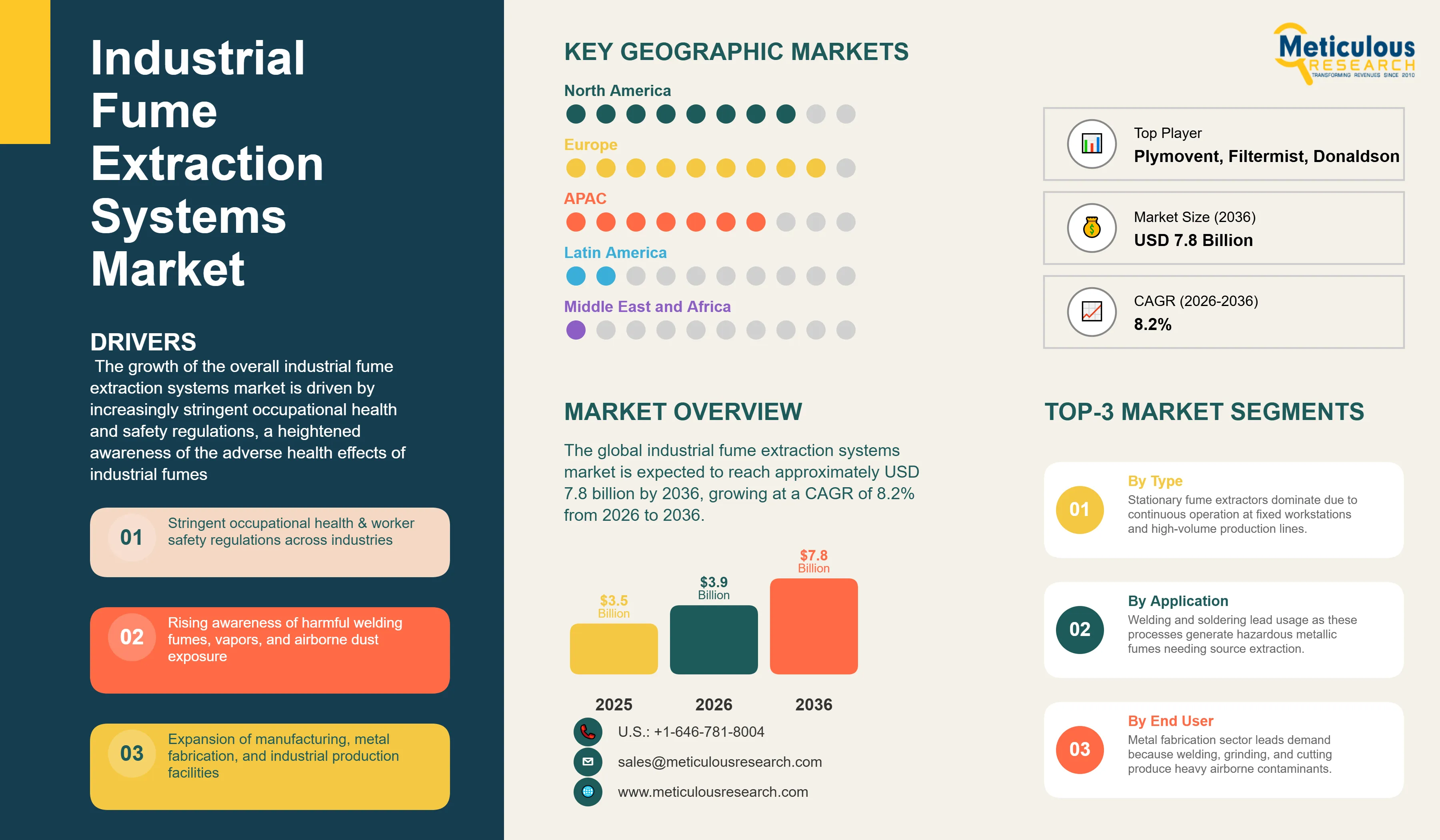
The global industrial fume extraction systems market was valued at USD 3.5 billion in 2025. The market is expected to reach approximately USD 7.8 billion by 2036 from USD 3.9 billion in 2026, growing at a CAGR of 8.2% from 2026 to 2036.
- Published
- Feb 2026
- Pages
- 270
- Format
- PDF + Excel
- Report ID
- MR-1815
- Base year
- 2025
- 2025 · BASELINE
- $3.50B
- 2036
- $7.80B
- CAGR 2026–2036
- 8.2%
2025 baseline · 2026–2036 forecast at 8.2% CAGR · hover a bar for the value
Key highlights
In terms of revenue, the global industrial fume extraction systems market is projected to reach USD 7.8 billion by 2036.
The market is expected to grow at a CAGR of 8.2% from 2026 to 2036.
Europe dominates the global industrial fume extraction systems market with the largest market share in 2026, supported by stringent environmental and occupational safety regulations, a mature industrial base, and a strong focus on worker protection.
Asia-Pacific is expected to witness the fastest growth during the forecast period, fueled by rapid industrialization, expanding manufacturing sectors, and increasing government initiatives to improve workplace air quality in emerging economies like China and India.
By type, the stationary fume extractors segment holds the largest market share in 2026, driven by their widespread use in fixed workstations and production lines requiring continuous fume removal.
By technology, the cartridge filters segment holds the largest market share in 2026, attributed to their high filtration efficiency, ease of maintenance, and suitability for various industrial dust and fume applications.
By end-use vertical, the metal fabrication segment holds the largest share of the overall market in 2026, given the extensive generation of hazardous fumes from welding, grinding, and cutting processes in this industry.
Report summary
| Particulars | Details |
|---|---|
| Market Size by 2036 | USD 7.8 Billion |
| Market Size in 2026 | USD 3.9 Billion |
| Market Size in 2025 | USD 3.5 Billion |
| Market Growth Rate (2026–2036) | CAGR of 8.2% |
| Format | PDF, Excel & Cloud Portal · 270 pages |
| Dominating Region | Europe |
| Fastest Growing Region | Asia-Pacific |
| Base Year | 2025 |
| Forecast Period | 2026 to 2036 |
| Segments Covered | Type, Technology, Application, End-use Vertical, and Region |
| Regions Covered | North America, Europe, Asia-Pacific, Latin America, and Middle East & Africa |
Report overview
Segments covered: type, technology, application, end-use vertical.
The growth of the overall industrial fume extraction systems market is driven by increasingly stringent occupational health and safety regulations, a heightened awareness of the adverse health effects of industrial fumes, and the continuous expansion of manufacturing and industrial activities globally. As industries strive to protect their workforce from hazardous airborne contaminants such as welding fumes, chemical vapors, and dust, the demand for efficient and reliable fume extraction solutions is escalating. Furthermore, technological advancements in filtration media, fan design, and smart control systems are enhancing the performance and energy efficiency of these systems, making them more attractive to a wider range of industrial applications. The integration of IoT for real-time monitoring and predictive maintenance is also contributing to market expansion.
Industrial fume extraction systems are essential engineering controls designed to capture and remove hazardous airborne contaminants, such as fumes, dust, and gases, generated during various industrial processes. These systems play a critical role in ensuring a safe and healthy working environment, protecting workers from respiratory illnesses, and complying with stringent occupational health and safety regulations. The market encompasses a diverse range of solutions, including portable fume extractors for flexible applications, stationary units for fixed workstations, and centralized systems for large-scale facilities, each tailored to specific industrial needs and contaminant types.
The market is characterized by continuous innovation, driven by the need for greater filtration efficiency, energy conservation, and smart monitoring capabilities. Modern fume extraction systems often integrate advanced filtration technologies, such as HEPA filters for fine particulate removal, activated carbon filters for gas and odor absorption, and electrostatic precipitators for sub-micron particle capture. Furthermore, the incorporation of variable speed drives, smart sensors, and IoT connectivity allows for real-time air quality monitoring, optimized airflow management, and predictive maintenance, thereby enhancing system performance and reducing operational costs. The modular design and customization options offered by manufacturers provide flexibility to address the unique challenges of diverse industrial environments.
The global industrial landscape is undergoing significant transformations, marked by rapid technological advancements in manufacturing processes, increasing automation, and a heightened focus on environmental protection and worker well-being. These factors are collectively accelerating the demand for sophisticated fume extraction systems. Traditional ventilation methods are often insufficient to meet the challenges posed by new industrial processes and stricter regulatory frameworks. Consequently, organizations are prioritizing investments in advanced fume extraction technologies to ensure a safe, compliant, and productive working environment, solidifying the market’s position as an indispensable element of modern industrial infrastructure.
Report infographic
Market dynamics
4 factors across 3 forcesStringent Occupational Health and Safety Regulations
A primary driver for the industrial fume extraction systems market is the increasing enforcement of stringent occupational health and safety (OHS) regulations worldwide. Government bodies and international organizations, such as OSHA (Occupational Safety and Health Administration) in the U.S., HSE (Health and Safety Executive) in the UK, and various EU directives, impose strict limits on worker exposure to hazardous airborne contaminants. These regulations mandate employers to provide a safe working environment, often requiring the implementation of effective engineering controls like fume extraction systems. Non-compliance can lead to severe penalties, legal liabilities, and reputational damage. This regulatory pressure compels industries across sectors like metal fabrication, automotive, and pharmaceuticals to invest in advanced fume extraction solutions to protect their workforce and ensure compliance, thereby continuously fueling market growth.
Table of contents
11 chapters · 92 sections · 270 pages · click to expandSegmental analysis
| Segment | Largest share (2026) | Fastest growth (2026–2036) |
|---|---|---|
| By Type | Stationary Fume Extractors | Portable Fume Extractors |
| By Technology | Cartridge Filters Segment Maintain Its | — |
| By Application | Welding & Soldering | — |
| By End-use Vertical | Metal Fabrication | — |
By Type
- The Stationary Fume Extractors segment accounts for the largest share of the overall industrial fume extraction systems market in 2026.
- This dominance is primarily driven by their widespread use in fixed workstations and production lines that require continuous and robust fume removal.
- Industries such as metal fabrication, welding shops, and chemical processing facilities often have dedicated areas where hazardous fumes are consistently generated.
- Stationary units, which are typically larger and more powerful, are designed for high-volume extraction and can be integrated directly into the facility’s ventilation infrastructure.
- Their ability to provide consistent, high-performance air purification for specific, ongoing processes makes them an indispensable component in maintaining safe and compliant industrial environments.
- The Portable Fume Extractors segment is expected to witness the fastest growth during the forecast period.
- This growth is fueled by the increasing demand for flexible and mobile fume extraction solutions that can be easily moved to different workstations or temporary job sites.
- Industries requiring versatility, such as construction, maintenance, and small-scale workshops, benefit significantly from portable units.
- Their ease of use, compact design, and ability to provide localized fume capture make them ideal for applications where fixed systems are impractical or insufficient.
- The growing emphasis on worker mobility and adaptable manufacturing layouts further drives the adoption of portable fume extractors.
By Technology
- The Cartridge Filters segment holds the largest market share in 2026.
- This dominance is attributed to their high filtration efficiency, large surface area, and ease of maintenance, making them a versatile and cost-effective solution for capturing a wide range of industrial dust and fumes.
- Cartridge filters are widely used in various fume extraction systems due to their ability to handle high dust loads and provide effective particulate removal.
- Their compact design allows for more efficient use of space within the extractor unit, and their quick-change mechanism simplifies replacement, reducing downtime and labor costs.
- The continuous innovation in filter media, offering improved efficiency and longer lifespan, further reinforces their leading position across diverse industrial applications.
- The HEPA Filters segment is expected to witness significant growth, particularly in industries requiring ultra-clean air and stringent particulate control, such as pharmaceutical manufacturing, electronics assembly, and laboratories.
- HEPA (High-Efficiency Particulate Air) filters are designed to capture 99.97% of particles 0.3 microns in size, making them crucial for applications where even microscopic contaminants can compromise product quality or worker health.
- The increasing focus on cleanroom standards and the rising demand for sterile environments are driving the rapid adoption of HEPA filtration in fume extraction systems.
By Application
- The Welding & Soldering segment commands the largest share of the global industrial fume extraction systems market in 2026.
- This leadership stems from the extensive generation of hazardous fumes, gases, and particulate matter during welding, soldering, and brazing processes across numerous industries, including metal fabrication, automotive, and construction.
- These fumes contain toxic metals, gases, and fine particles that pose significant health risks to workers, such as respiratory diseases and neurological damage.
- Stringent regulations from occupational health authorities mandate effective fume extraction in these environments.
- Dedicated fume extraction systems, including local exhaust ventilation (LEV) arms and portable units, are essential for capturing these contaminants at the source, thereby protecting welders and other personnel from exposure.
- The continuous growth in manufacturing and construction activities globally ensures a sustained demand for fume extraction solutions in this critical application.
- The Laser Cutting & Engraving segment is poised for significant growth, driven by the increasing adoption of laser technology in various manufacturing processes.
- Laser operations generate fine dust, fumes, and gaseous byproducts that require specialized extraction systems to maintain air quality and protect sensitive equipment.
- The Chemical Processing segment also represents a crucial application, where precise control of chemical vapors and corrosive fumes is essential for safety and process integrity.
- The Pharmaceutical Manufacturing segment is experiencing increasing demand for fume extraction systems that ensure product purity and protect workers from active pharmaceutical ingredients (APIs) and other hazardous substances.
By End-use Vertical
- The Metal Fabrication vertical commands the largest share of the global industrial fume extraction systems market in 2026.
- This leadership is primarily due to the extensive and diverse range of processes within metal fabrication—including welding, grinding, cutting, and polishing—that inherently generate significant quantities of hazardous fumes, dust, and particulate matter.
- These contaminants pose severe health risks to workers and can damage machinery, necessitating robust and efficient fume extraction solutions.
- The global demand for fabricated metal products across industries like automotive, construction, and machinery manufacturing ensures a continuous need for these systems.
- Compliance with stringent occupational health and safety regulations, coupled with the imperative to maintain a clean and safe working environment, further solidifies the metal fabrication sector’s dominance in the market.
- The Automotive vertical is poised for significant growth, driven by the extensive use of welding, painting, and assembly processes in vehicle manufacturing, all of which generate various fumes and airborne particles.
- The Electronics vertical also represents a crucial application, where precise fume extraction is essential during soldering, circuit board manufacturing, and component assembly to protect sensitive electronics and ensure worker health.
- The Pharmaceuticals and Food & Beverage verticals are experiencing increasing demand for fume extraction systems that ensure product purity, prevent cross-contamination, and comply with strict hygiene and safety standards.
Geographic analysis
Europe
Largest shareEurope holds the largest share of the global industrial fume extraction systems market in 2026. This dominance is primarily attributable to the region’s highly stringent environmental and occupational health and safety regulations, a mature and diversified industrial base, and a strong cultural emphasis on worker protection. Countries such as Germany, the United Kingdom, and France have well-established regulatory frameworks (e.g., EU directives on worker exposure to chemical agents and carcinogens) that mandate the implementation of effective fume extraction solutions. The presence of leading global manufacturers of industrial ventilation and filtration systems, coupled with continuous innovation in energy-efficient and smart technologies, further solidifies Europe’s leading position. The ongoing modernization of industrial facilities and the adoption of advanced manufacturing techniques also contribute to sustained demand.
Asia-Pacific
Fastest growthAsia-Pacific is the fastest-growing regional market for industrial fume extraction systems during the forecast period, driven by rapid industrialization, expanding manufacturing sectors, and increasing government initiatives to improve workplace air quality in emerging economies. Countries like China, India, Japan, and South Korea are experiencing massive investments in new factories and industrial infrastructure, leading to a surge in demand for fume extraction solutions. The region’s growing awareness regarding worker health and safety, coupled with the adoption of international industrial standards, is accelerating the deployment of advanced fume extraction systems across various industrial applications. The sheer scale of manufacturing output and the continuous establishment of new production facilities ensure a robust growth trajectory for this market.
North America
North America represents a substantial and steadily growing share of the global industrial fume extraction systems market, shaped by stringent federal and state-level regulations (e.g., OSHA standards), a strong focus on worker safety, and a technologically advanced industrial sector. The United States and Canada are key markets, driven by continuous investments in manufacturing, metal fabrication, and automotive industries, all of which require effective fume control. The region benefits from a well-established ecosystem of OHS professionals, technology providers, and industrial firms collaborating to develop and deploy innovative and compliant fume extraction solutions. The emphasis on upgrading aging infrastructure and adopting smart factory initiatives also fuels market expansion.
Latin America
Latin America is an emerging market for industrial fume extraction systems, with countries like Brazil, Mexico, and Argentina showing increasing interest in adopting advanced industrial air quality solutions. The region’s growing industrialization, particularly in sectors like automotive, metalworking, and mining, is driving initial investments in fume extraction systems. While adoption is currently lower compared to developed regions, the potential for growth is significant as economic conditions improve and awareness of the benefits of effective fume control increases.
Middle East & Africa
The Middle East & Africa region is also experiencing nascent growth in the industrial fume extraction systems market, primarily driven by large-scale industrial projects in the GCC countries (e.g., Saudi Arabia, UAE) and South Africa. These projects, often characterized by ambitious timelines and a demand for cutting-edge technologies, are creating opportunities for the deployment of modern fume extraction systems. The region’s focus on diversifying economies, investing in industrial infrastructure, and attracting foreign manufacturing investments is expected to fuel further adoption of fume extraction solutions in various industrial sectors.
Competitive landscape
- Nederman Holding AB
- Donaldson Company, Inc.
- Filtermist International Limited
- Plymovent
- Absolent Group AB
Frequently asked questions
The global industrial fume extraction systems market is expected to grow from USD 3.9 billion in 2026 to USD 7.8 billion by 2036.
Cite this report
Meticulous Research. (2026). Industrial Fume Extraction Systems Market - Global Opportunity Analysis and Industry Forecast (2026-2036) (Report No. MR-1815). Meticulous Market Research Pvt. Ltd. https://www.meticulousresearch.com/product/industrial-fume-extraction-systems-market-6498