
Embodied AI for Manufacturing Market (2026-2036)
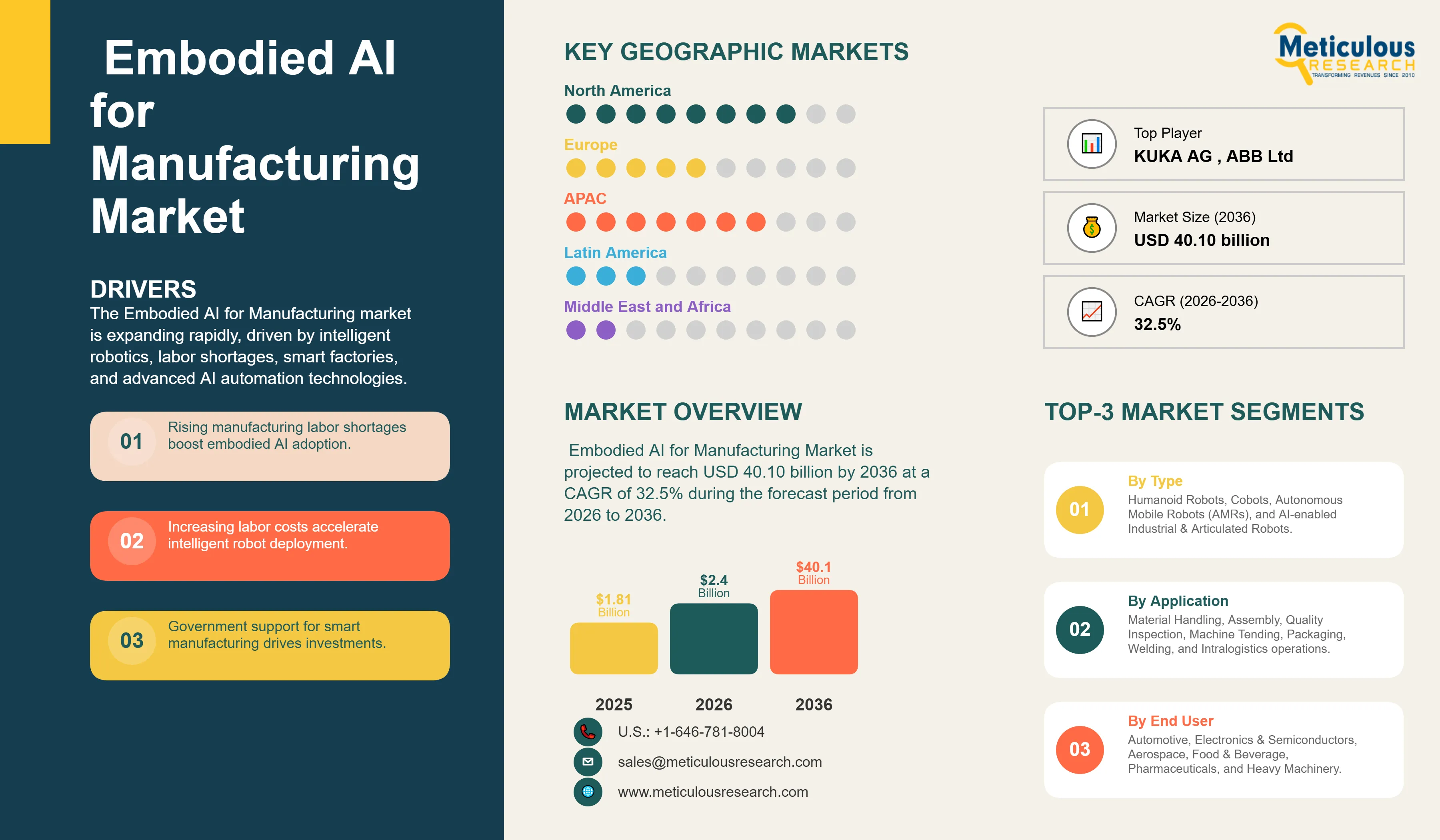
The global Embodied AI for Manufacturing Market is projected to reach USD 40.10 billion by 2036 from an estimated USD 2.40 billion in 2026, at a CAGR of 32.5% during the forecast period from 2026 to 2036.
- Published
- Jul 2026
- Pages
- 175
- Format
- PDF + Excel
- Report ID
- MR-2105
- Base year
- 2025
- 2026 · ESTIMATED
- $2.40B
- 2036
- $40.10B
- CAGR 2026–2036
- 32.5%
2025 baseline · 2026–2036 forecast at 32.5% CAGR · hover a bar for the value
Key highlights
The global embodied AI for manufacturing market is projected to reach USD 40.10 billion by 2036, growing at a CAGR of 32.5% during 2026 to 2036.
Severe manufacturing labor shortages and rising labor costs are the main reasons factories are turning to AI-driven robots that can work alongside people.
A clear and fast return on investment, with measurable savings per shift and yield gains, makes the case for these systems easy for buyers to approve.
Reshoring and government support for advanced manufacturing in the U.S., Europe, and Asia are pulling investment into physical AI.
The hardware segment holds the largest market share in 2026, while software and AI models are expected to grow the fastest.
The AI-enabled industrial and articulated robots segment holds the largest share in 2026, while humanoid robots are expected to grow the fastest.
The computer vision & perception technology segment holds the largest share in 2026, while foundation and vision-language-action models are expected to grow the fastest.
The material handling & intralogistics application holds the largest share in 2026, while assembly is expected to grow the fastest.
The edge/on-robot deployment segment holds the largest share in 2026, while hybrid deployment is expected to grow the fastest.
The automotive industry holds the largest share in 2026, while electronics and semiconductors is expected to grow the fastest.
North America accounts for the largest share of the global market in 2026, supported by leading physical-AI developers and strong investment.
Asia-Pacific is expected to witness the fastest growth over the forecast period, driven by large-scale robot deployment across China, Japan, and South Korea.
Report summary
| Particulars | Details |
|---|---|
| Forecast Period | 2026 to 2036 |
| Base Year | 2025 |
| Estimated Year | 2026 |
| CAGR (Value) | 32.5% |
| Format | PDF, Excel & Cloud Portal · 175 pages |
| Market Size (Value) in 2026 | USD 2.40 Billion |
| Market Size (Value) in 2036 | USD 40.10 Billion |
| Segments Covered | By Offering · - Hardware (Robots & Embodiments, Sensors, Edge AI · Compute, Actuators) · - Software & AI Models · - Services · By Robot Type · - Humanoid Robots, Cobots, AMRs, AI-Enabled Industrial/ · Articulated Robots, Other Embodiments · By Technology · - Foundation & VLA Models, Computer Vision & Perception, · Reinforcement & Robot Learning, Simulation & Digital Twins, Others · By Application · - Assembly, Material Handling & Intralogistics, Quality · Inspection, Machine Tending, Welding, Packaging, Others · By Deployment · - Edge/On-robot, Cloud, Hybrid · By End-Use Industry · - Automotive, Electronics & Semiconductors, Aerospace & · Defense, Metals & Heavy Machinery, Food & Beverage, · Pharma & Medical Devices, Others |
| Countries Covered | North America (U.S., Canada), Europe (Germany, U.K., France, Italy, and Rest of Europe), Asia-Pacific (China, Japan, South Korea, India, and Rest of Asia-Pacific), Latin America (Brazil, Mexico, and Rest of Latin America), and the Middle East & Africa (Saudi Arabia, UAE, South Africa, and Rest of Middle East & Africa) |
| Key Companies | NVIDIA Corporation (U.S.), Figure AI, Inc. (U.S.), Tesla, Inc. (U.S.), Agility Robotics, Inc. (U.S.), Boston Dynamics, Inc. (Hyundai Motor Group) (U.S.), Apptronik, Inc. (U.S.), ABB Ltd (Switzerland), FANUC Corporation (Japan), KUKA AG (Germany), Yaskawa Electric Corporation (Japan), Universal Robots A/S (Teradyne) (Denmark), Siemens AG (Germany), Shanghai AgiBot Innovation Technology (AGIBOT) (China), Skild AI, Inc. (U.S.), and NEURA Robotics GmbH (Germany) |
Report overview
Segments covered: offering, robot type, technology, application, deployment, end-use industry. Regions: North America, Europe, Asia-Pacific, Latin America, Middle East & Africa.
Embodied AI, often called physical AI, is artificial intelligence that lives inside a physical machine and lets it perceive its surroundings, reason about what to do, and act in the real world. In manufacturing, that machine is usually a robot, whether a humanoid, a collaborative arm, an autonomous mobile robot, or a traditional industrial arm given new AI capabilities. What sets embodied AI apart from earlier factory automation is flexibility. Instead of being programmed for one fixed task, an embodied-AI robot can handle change, learn new jobs, and work in the messy, unstructured parts of a factory that used to need a person.
The field has moved quickly from research to the factory floor over the past two years. NVIDIA, whose chips and software underpin much of the industry, described the shift at its 2026 GPU Technology Conference as the beginning of a new industrial era, with AI turning factories into what its chief executive called intelligent thinking machines. Automakers have taken the lead. BMW has begun putting humanoid robots to work in its plants, Mercedes-Benz and Amazon have run humanoids in their operations, and Tesla is scaling up its own Optimus robot inside its factories. These are no longer demonstrations but early production deployments.
Three forces are driving adoption at once. The first is labor. Manufacturers across North America, Europe, and Asia struggle to fill repetitive and physically demanding jobs, and embodied AI offers a way to keep lines running with fewer people. The second is a clear return on investment, since each robot placed against a defined task produces measurable savings per shift or a measurable gain in quality, which makes the purchase easy to justify. The third is policy, as governments back reshoring and advanced manufacturing with funding and incentives.
The technology is improving fast, which widens what these robots can do. New foundation models and vision-language-action models give robots something closer to general reasoning, letting one machine learn many tasks rather than one. Simulation and digital twins let developers train and test robots virtually before they ever touch a real line, cutting development time sharply. Costs are falling too, with humanoid prices dropping steeply over the past few years. With labor scarce, the payback clear, and the technology maturing, the embodied AI for manufacturing market is set for very strong growth over the coming decade, even as reliability and battery life remain real hurdles.
Report infographic
Market dynamics
3 factors across 2 forcesSevere Manufacturing Labor Shortages and Rising Labor Costs
The strongest driver of the embodied AI for manufacturing market is the growing shortage of skilled manufacturing labor and the continued rise in labor costs. Manufacturers across North America, Europe, and Asia-Pacific are facing increasing difficulty in recruiting and retaining workers for repetitive, physically demanding, and hazardous production tasks. According to the National Association of Manufacturers (NAM) and The Manufacturing Institute, the U.S. manufacturing sector could face up to 1.9 million unfilled jobs by 2033 if current workforce trends continue. Similarly, the International Federation of Robotics (IFR) reports that labor shortages remain one of the primary factors accelerating industrial robot adoption across major manufacturing economies, particularly in automotive, electronics, metal processing, and logistics.
Embodied AI offers manufacturers a new level of workforce flexibility beyond traditional industrial automation. Unlike conventional robots programmed for fixed and repetitive operations, embodied AI systems combine computer vision, multimodal perception, foundation models, and autonomous decision-making to perform complex tasks in dynamic manufacturing environments. These capabilities enable humanoid robots and intelligent mobile manipulators to carry out material handling, machine tending, assembly, inspection, warehouse logistics, and intralogistics operations while adapting to changing production conditions. For example, in February 2026, BMW Group announced the deployment of Hexagon Robotics' AEON humanoid robot at its Leipzig manufacturing plant to support battery assembly and component manufacturing, while Siemens AG and Humanoid successfully demonstrated autonomous logistics operations using the HMND 01 Alpha humanoid robot at Siemens' electronics factory in Erlangen, Germany, in April 2026.
Rising labor costs further strengthen the business case for embodied AI. According to the U.S. Bureau of Labor Statistics, average hourly compensation for manufacturing employees has continued to increase in recent years, while manufacturers worldwide continue to invest in automation to improve productivity and operational resilience. The International Federation of Robotics reported that 4.28 million industrial robots were operating in factories worldwide at the end of 2023, representing a record installed base and reflecting manufacturers' continued investment in advanced automation technologies. As labor shortages persist and production environments become increasingly complex, embodied AI is expected to play a critical role in enabling flexible automation, improving workforce productivity, and sustaining manufacturing competitiveness.
Reshoring, Reindustrialization, and Government Support
Another major driver of the embodied AI for manufacturing market is the global push toward reshoring, reindustrialization, and advanced manufacturing, supported by government policies and public investment. Supply chain disruptions, geopolitical tensions, and growing concerns over industrial resilience have prompted governments across North America, Europe, and Asia-Pacific to strengthen domestic manufacturing capabilities. In the United States, legislation such as the CHIPS and Science Act and the Inflation Reduction Act (IRA) has committed hundreds of billions of dollars toward semiconductor manufacturing, clean energy technologies, and advanced industrial production. Similarly, the European Union's Net-Zero Industry Act and European Chips Act are accelerating investment in strategic manufacturing sectors, while countries including Japan and South Korea continue expanding incentives for robotics, semiconductor, and advanced manufacturing industries.
Embodied AI is emerging as a critical technology for enabling economically viable domestic manufacturing. By combining autonomous perception, intelligent manipulation, and adaptive decision-making, embodied AI allows manufacturers to automate complex production, material handling, inspection, and intralogistics tasks that have traditionally depended on human labor. In March 2026, NVIDIA Corporation described the beginning of the "Physical AI" era at GTC 2026, unveiling new Cosmos world models and Isaac GR00T foundation models while expanding collaborations with industrial robotics leaders including ABB, FANUC, KUKA, Yaskawa, and Universal Robots to accelerate AI-powered manufacturing automation. Likewise, BMW Group announced the deployment of Hexagon Robotics' AEON humanoid robot at its Leipzig manufacturing plant in February 2026, supporting battery assembly and component manufacturing as part of its next-generation manufacturing strategy.
Government investment is further accelerating commercialization. The European Commission has committed €10 billion through the European Chips Act to strengthen Europe's semiconductor ecosystem and stimulate public and private investment exceeding €43 billion, while the U.S. CHIPS and Science Act provides approximately USD 52.7 billion in incentives for domestic semiconductor manufacturing and research. These initiatives are driving new factory construction, digital manufacturing, and industrial automation investments that increasingly require flexible, AI-enabled robotic systems. As countries continue investing in resilient and competitive domestic manufacturing, embodied AI is expected to become a foundational technology supporting next-generation smart factories and industrial productivity.
Table of contents
14 chapters · 131 sections · 175 pages · click to expandSegmental analysis
| Segment | Largest share (2026) | Fastest growth (2026–2036) |
|---|---|---|
| By Offering | Hardware | Software and AI models |
| By Robot Type | AI-Enabled Industrial & Articulated Robots | Humanoid robots |
| By Technology | Computer Vision & Perception | Foundation and vision-language-action models |
| By Application | Material Handling & Intralogistics | Assembly |
| By Deployment | Edge/On-robot | Hybrid deployment |
| By End-Use Industry | Automotive | Electronics and semiconductors |
By Offering
- Hardware Leads the Market in 2026
- Hardware holds the largest share in 2026, at roughly 62%.
- The robots themselves, along with their sensors, edge computing modules, and actuators, make up most of the cost of an embodied-AI system, and actuators alone can account for a large share of a humanoid robot's price, so hardware dominates spending.
- Software and AI models are expected to grow the fastest through 2036.
- As the intelligence that lets a robot perceive, reason, and act becomes the main point of difference between systems, and as vendors move toward selling models and updates over time, this segment is growing quickly and capturing more of the value.
By Robot Type
- AI-Enabled Industrial & Articulated Robots Lead the Market in 2026
- AI-enabled industrial and articulated robots hold the largest share in 2026, at close to 44%.
- The large installed base of robotic arms in factories, now being upgraded with AI so they can handle variation and switch tasks without lengthy reprogramming, makes this the biggest source of revenue today.
- Humanoid robots are expected to grow the fastest.
- Their human-like form lets them work in spaces and on tasks built for people, and high-profile deployments in automotive plants and logistics operations are driving intense interest and investment, which is lifting this segment quickly from a small base.
By Technology
- Computer Vision & Perception Leads the Market in 2026
- Computer vision and perception holds the largest share in 2026, at about 34%.
- Letting a robot see and understand its surroundings is the foundation of any physical task, and vision is already widely deployed for guidance, inspection, and navigation, so it accounts for the most spending.
- Foundation and vision-language-action models are expected to grow the fastest.
- These models give robots general reasoning and the ability to learn many tasks, and their rapid progress, described by some in the industry as a turning point for robotics, is driving quick growth as developers adopt them.
By Application
- Material Handling & Intralogistics Leads the Market in 2026
- Material handling and intralogistics holds the largest share in 2026, at roughly 28%.
- Moving parts, totes, and materials around a plant is one of the most common and easiest tasks to automate, and it is where many early embodied-AI robots, including humanoids handling totes, have first gone to work.
- Assembly is expected to grow the fastest.
- As robots gain the dexterity and reasoning to handle multi-step tasks that require full-body coordination, manufacturers are beginning to use them for assembly work that fixed automation could never manage, which is driving rapid growth in this application.
By Deployment
- Edge/On-robot Leads the Market in 2026
- Edge and on-robot deployment holds the largest share in 2026, at about 56%.
- A robot must sense and react in real time to work safely alongside people and machines, and that requires processing on the robot itself rather than waiting on a distant server, so on-robot compute leads.
- Hybrid deployment is expected to grow the fastest.
- As companies train and improve their models in the cloud while running them on the robot at the edge, the combined approach is becoming the norm, which is driving quick growth in hybrid setups.
By End-Use Industry
- Automotive Leads the Market in 2026
- Automotive holds the largest share in 2026, at close to 32%.
- Carmakers have led the adoption of embodied AI, running humanoids and AI-driven robots in their plants for assembly and logistics, so the industry accounts for the most spending.
- Electronics and semiconductors are expected to grow the fastest.
- The push for precise, high-volume assembly and inspection in chip fabs and electronics plants, along with active adoption by leading manufacturers, is driving quick growth in this industry.
Geographic analysis
North America
Largest shareNorth America holds the largest share in 2026, at roughly 37%. North America's lead rests on its concentration of leading physical-AI developers, strong private and public investment, and a policy push toward reindustrialization. The United States is the dominant national market, home to companies such as NVIDIA, Figure AI, Tesla, Agility Robotics, and Boston Dynamics, and to automakers and logistics operators running some of the earliest large-scale deployments. This is where much of the value in the market is captured, even as more robots are deployed elsewhere. North America Leads the Market in 2026
Asia-Pacific
Fastest growthAsia-Pacific is expected to record the fastest growth over the forecast period. China operates by far the largest base of factory robots and is home to fast-scaling humanoid makers such as AGIBOT, while Japan and South Korea bring deep strength in industrial robotics and electronics. Heavy investment and rapid deployment across the region are driving quick growth.
Europe
Europe remains an important market, led by Germany, where automakers and industrial firms such as BMW, Siemens, ABB, and KUKA are early adopters of humanoids and AI-driven automation.
Competitive landscape
Leading companies in the market have grown through new product launches, partnerships, pilot deployments, and acquisitions. Building robot foundation models and simulation platforms, running early factory deployments with major manufacturers, and partnering across the hardware and software stack have been the most common ways players strengthen their position.
- March 2026
At GTC 2026, NVIDIA Corporation unveiled new Cosmos world models, expanded the Isaac robotics platform, and introduced new Isaac GR00T foundation models for humanoid robots. The company also expanded collaborations with industrial robotics leaders including ABB, FANUC, KUKA, Yaskawa, Universal Robots, Figure AI, Agility Robotics, Boston Dynamics, Hexagon Robotics, and AGIBOT, accelerating the development and deployment of embodied AI for manufacturing.
- April 2026
Siemens AG and Humanoid successfully deployed the HMND 01 Alpha wheeled humanoid robot at Siemens' electronics factory in Erlangen, Germany, where it autonomously performed industrial logistics operations in an initial production proof of concept using NVIDIA's Jetson Thor edge AI platform.
- February 2026
BMW Group announced the deployment of AEON, the humanoid robot developed by Hexagon Robotics, at its Leipzig plant in Germany. The deployment includes integration testing followed by a production pilot supporting high-voltage battery assembly and component manufacturing.
- April 2026
At Hannover Messe 2026, NVIDIA Corporation, together with partners including Siemens AG, ABB Ltd., Dassault Systèmes SE, SAP SE, and Agile Robots SE, demonstrated AI-driven manufacturing solutions combining digital twins, physical AI, robotics, and industrial AI agents to accelerate autonomous factory operations. This marked one of the largest industrial showcases of embodied AI technologies in manufacturing.
- June 2026
Shanghai AgiBot Innovation Technology Co., Ltd. (AGIBOT) reached a major commercialization milestone by producing its 15,000th embodied AI robot. The company also demonstrated continuous industrial deployment of its humanoid robots for automated quality inspection on electronics production lines, highlighting the growing adoption of embodied AI in manufacturing environments.
- NVIDIA Corporation (U.S.)
- Figure AI, Inc. (U.S.)
- Tesla, Inc. (U.S.)
- Agility Robotics, Inc. (U.S.)
- Boston Dynamics, Inc. (Hyundai Motor Group) (U.S.)
- Apptronik, Inc. (U.S.)
- ABB Ltd · Switzerland
- FANUC Corporation · Japan
- KUKA AG · Germany
- Yaskawa Electric Corporation · Japan
- Universal Robots A/S (Teradyne, Inc.) · Denmark
- Siemens AG · Germany
- Shanghai AgiBot Innovation Technology (AGIBOT) · China
- Skild AI, Inc. (U.S.)
- NEURA Robotics GmbH · Germany
Frequently asked questions
The global embodied AI for manufacturing market size is estimated at USD 2.40 billion in 2026.
Cite this report
Meticulous Research. (2026). Embodied AI for Manufacturing Market - Global Opportunity Analysis and Industry Forecast (2026-2036) (Report No. MR-2105). Meticulous Market Research Pvt. Ltd. https://www.meticulousresearch.com/product/embodied-ai-for-manufacturing-market-6788