AI in Supply Chain Market (2024-2031)
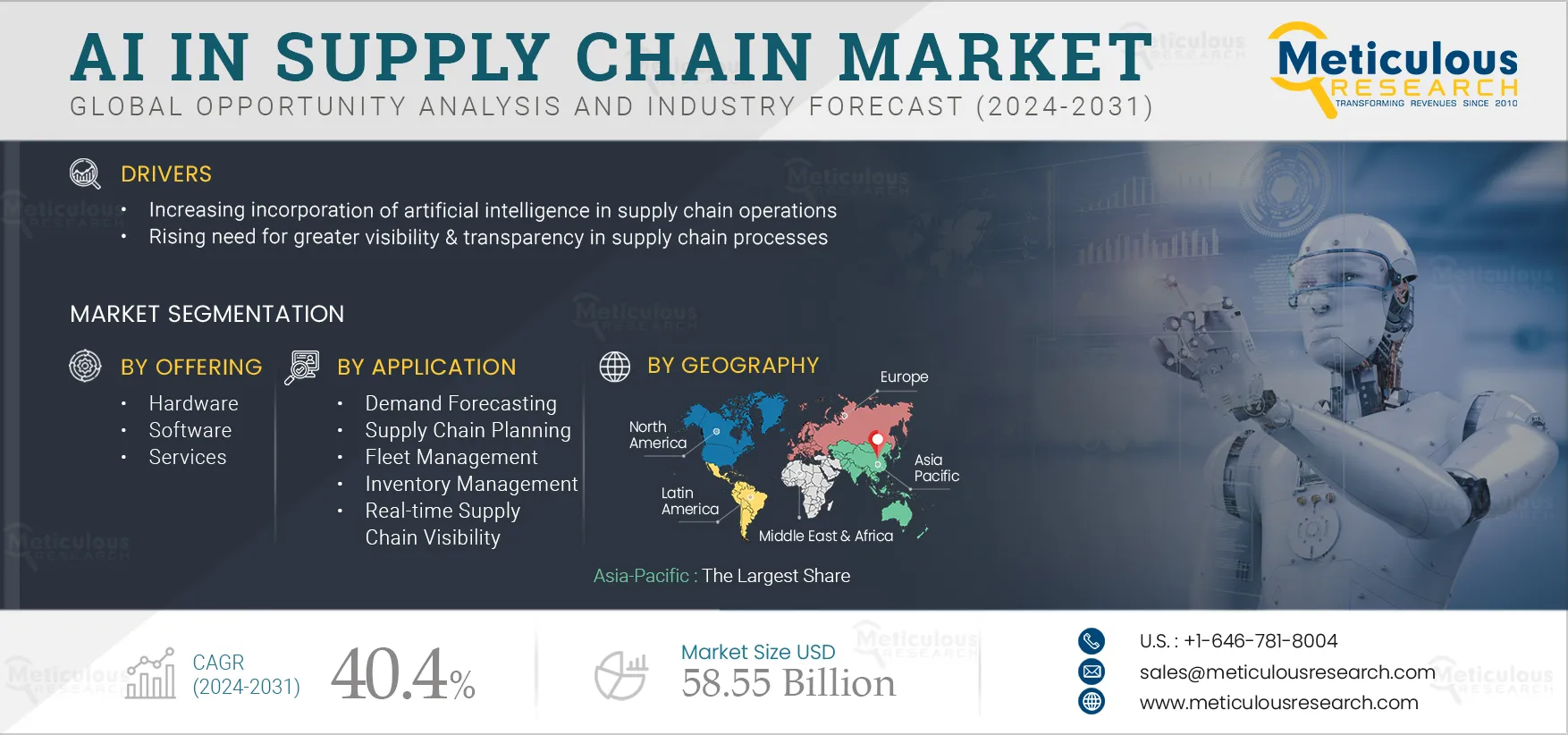
The AI in Supply Chain Market is expected to reach $58.55 billion by 2031, at a CAGR of 40.4% from 2024 to 2031.
- Published
- May 2024
- Pages
- 282
- Format
- PDF + Excel
- Report ID
- MRICT - 104365
- Base year
- 2023
- 2031 · FORECAST
- $58.55B
- 2031
- $58.55B
- CAGR 2024–2031
- 40.4%
2023 baseline · 2024–2031 forecast at 40.4% CAGR · hover a bar for the value
Key highlights
By Offering: In 2024, the Hardware Segment to Dominate the AI in Supply Chain Market
By Technology: In 2024, the Machine Learning Segment to Dominate the AI in Supply Chain Market
By Deployment Mode: In 2024, the Cloud-based Deployments Segment to Dominate the AI in Supply Chain Market
By Application: The Real-time Supply Chain Visibility Segment to Witness Highest Demand During the Forecast Period
By End-use Industry: In 2024, the Manufacturing Segment to Dominate the AI in Supply Chain Market
Report summary
| Particulars | Details |
|---|---|
| Number of Pages | 282 |
| Format | |
| Forecast Period | 2024–2031 |
| Base Year | 2023 |
| CAGR (Value) | 40.4% |
| Market Size (Value) | USD 58.55 Billion by 2031 |
| Segments Covered | By Offering · Hardware · Processors · Networking · Storage · Software · Services · Deployment & Integration Services · Support & Maintenance Services · Consulting Services · Connectivity Services · By Technology · Machine Learning · Computer Vision · Natural Language Processing · Context-aware Computing · Robotic Process Automation · By Deployment Mode · Cloud-based Deployments · On-premise Deployments · By Application · Demand Forecasting · Supply Chain Planning · Warehouse Management · Fleet Management · Inventory Management · Real-time Supply Chain Visibility · Other Applications · By End-use Industry · Manufacturing · Food and Beverage · Healthcare & Pharmaceuticals · Automotive · Retail · Building & Construction · Medical Devices & Consumables · Aerospace & Defense · Other End-use Industries |
| Countries Covered | North America (U.S., Canada), Europe (Germany, U.K., France, Italy, Spain, Sweden, Rest of Europe), Asia-Pacific (China, Japan, India, South Korea, Singapore, Rest of Asia-Pacific), Latin America (Brazil, Mexico, Rest of Latin America) Middle East & Africa (UAE, Israel, Rest of the Middle East & Africa) |
| Key Companies | IBM Corporation (U.S.), SAP SE (Germany), Microsoft Corporation (U.S.), Google LLC (U.S.), Amazon Web Services, Inc. (U.S.), Intel Corporation (U.S.), NVIDIA Corporation (U.S.), Oracle Corporation (U.S.), C3.ai, Inc. (U.S.), Samsung SDS CO., Ltd. (South Korea), Coupa Software Inc. (U.S.), Micron Technology, Inc. (U.S.), Advanced Micro Devices, Inc. (U.S.), FedEx Corporation (U.S.), and Deutsche Post DHL Group (Germany). |
Report overview
Segments covered: offering, technology, deployment mode, application. Regions: North America, Europe, Asia-Pacific, Latin America.
The growth of the AI in supply chain market is driven by the increasing incorporation of artificial intelligence in supply chain operations and the rising need for greater visibility & transparency in supply chain processes. However, the high procurement & operating costs of AI-based supply chain solutions and the lack of supporting infrastructure restrain the growth of this market.
Furthermore, the growing demand for AI-based business automation solutions is expected to generate growth opportunities for the players operating in this market. However, performance issues in integrating data from multiple sources and data security & privacy concerns are major challenges impacting market growth. Additionally, the rising demand for cloud-based supply chain solutions is a prominent trend in the AI in supply chain market.
Report infographic
Market dynamics
4 factors across 3 forcesIncreasing Incorporation of AI in Supply Chain Operations Driving Market Growth
Customer experience and satisfaction are largely influenced by the complexity of returns processes, delivery times & accuracy, and visibility into stock levels. These factors can be optimized by leveraging AI capabilities. The players in this market are focused on expanding AI-supported features in their supply chain management solutions.
Furthermore, machine learning approaches, such as deep analytics and real-time monitoring, significantly improve supply chain visibility, allowing businesses to offer enhanced customer experiences and meet delivery schedules. Market players are launching AI-based supply chain management solutions to offer enterprises better efficiency and productivity. For instance, in February 2023, XPDEL (U.S.), a leading omnichannel fulfillment and logistics services company, launched its AI-enabled shipping solution in India. The solution helps enterprises choose the best rates and the fastest delivery methods based on product dimensions, delivery distance, and service levels, enhancing customer experience. Thus, companies’ rising focus on optimizing supply chain operations using AI to enhance customer experience and satisfaction is driving the growth of the AI in supply chain market.
Rising Need for Greater Visibility & Transparency in Supply Chain Processes Driving the Demand for AI-Based Solutions
Modern-day businesses have realized the importance of collecting and sharing supply chain information with trading partners and customers. By increasing supply chain transparency, companies can connect with customers, build trust, and gain better visibility into all stages of their supply chains to drive process improvements and react faster and more effectively when problems occur.
There are numerous advantages to supply chain transparency, such as increasing confidence among companies that their suppliers, materials, and products are genuine, acquired honestly, and live up to company standards. Market players are focused on product launches and partnerships to offer enhanced supply chain visibility. For instance:
- In June 2023, FourKites, Inc. (U.S.), a supply chain visibility company, expanded its partnership with NFI Industries (U.S.) to provide transportation partners with enhanced visibility and more granular data points. The company’s tools deliver valuable insights, allowing partners to take action and continuously improve performance and customer relationships.
- In June 2023, Vizion, Inc. (U.S.), a supply chain visibility solutions provider, launched an intermodal tracking tool to offer greater supply chain transparency.
Table of contents
13 chapters · 127 sections · 282 pages · click to expandSegmental analysis
| Segment | Largest share (2024) | Fastest growth (2024–2031) |
|---|---|---|
| By Offering | Hardware | Software |
| By Technology | Machine Learning | Robotic process automation |
| By Deployment Mode | Cloud-based Deployments | Cloud-based deployments |
| By Application | Demand forecasting | Real-time supply chain visibility |
| By End-use Industry | Manufacturing | Retail |
By Offering
- The Hardware Segment to Dominate the AI in Supply Chain Market
- The hardware segment is expected to account for the largest share of 44.4% of the AI in supply chain market.
- The large market share of this segment is attributed to advancements in data center capabilities, the growing need for storage hardware due to increasing storage requirements for AI applications, the crucial need for constant connectivity in the supply chain operations, and the emphasis on product development and enhancement by manufacturers.
- For instance, in January 2023, Intel Corporation launched its 4th Gen Intel Xeon Scalable processors (code-named Sapphire Rapids), the Intel Xeon CPU Max Series (code-named Sapphire Rapids HBM), and the Intel Data Center GPU Max Series (code-named Ponte Vecchio).
- These new processors deliver significant improvements in data center performance, efficiency, security, and AI capabilities.
- However, the software segment is expected to record the highest CAGR of 43.2% during the forecast period.
- This segment's growth is driven by the rising focus on product development and the enhancement of supply chain software and the benefits offered by supply chain software in facilitating supply chain visibility and centralized operations.
By Technology
- The Machine Learning Segment to Dominate the AI in Supply Chain Market
- The machine learning segment is expected to account for the largest share of 63.0% of the AI in supply chain market.
- The large market share of this segment is attributed to the advancements in data center capabilities, increasing deployment of machine learning solutions and its ability to perform tasks without relying on human input, and the rapid adoption of cloud-based technology across several industries.
- For instance, in June 2022, FedEx Corporation (U.S.) invested in FourKites, Inc. (U.S.), a supply chain visibility startup.
- This strategic collaboration allows FedEx to leverage its machine learning and AI capabilities with data from FedEx, enhancing its operational efficiency and visibility.
- However, the robotic process automation segment is expected to record the highest CAGR of 42.9% during the forecast period.
- The growth of this segment is driven by the increased adoption of RPA across various industries and the rising demand for automating business processes to meet heightened customer expectations.
By Deployment Mode
- The cloud-based deployments segment is expected to account for the larger share of 75.6% of the AI in supply chain market.
- The large market share of this segment is attributed to the increasing avenues for cloud-based deployments, the superior flexibility and affordability offered by cloud-based deployments, and the increasing adoption of cloud-based solutions by small & medium-sized enterprises.
- Moreover, the cloud-based deployments segment is expected to record the highest CAGR during the forecast period.
- The rapid development of new security measures for cloud-based deployments is expected to drive this segment's growth in the coming years.
By Application
- The Real-time Supply Chain Visibility Segment to Witness Highest Demand During the Forecast Period
- The demand forecasting segment is expected to account for the largest share of 25.2% of the AI in supply chain market.
- The large market share of this segment is attributed to the rising initiatives to integrate AI capabilities in supply chain solutions, dynamic changes in customer behaviors and expectations, and the rising need to achieve accuracy and resilience in the supply chain.
- For instance, in March 2023, Zionex, Inc. (South Korea), a prominent provider of advanced supply chain and integrated business planning platforms, launched PlanNEL Beta.
- This AI-powered SaaS platform is designed for demand forecasting and inventory optimization.
- However, the real-time supply chain visibility segment is expected to record the highest CAGR during the forecast period.
- This segment's growth is driven by the rising integration of AI capabilities into supply chains to obtain real-time data on them.
By End-use Industry
- The Manufacturing Segment to Dominate the AI in Supply Chain Market
- The manufacturing segment is expected to account for the largest share of 23.1% of the AI in supply chain market.
- The large market share of this segment is attributed to the increasing number of manufacturing companies, favorable initiatives to integrate artificial capabilities in the supply chain, and the increasing focus on achieving accuracy and resilience in the supply chain among manufacturers.
- However, the retail segment is expected to record the highest CAGR of 47.8% during the forecast period.
- This segment's growth is driven by the rising integration of AI capabilities in the retail supply chain to forecast inventory and demand and retailers' growing focus on meeting consumer expectations.
Geographic analysis
Asia-Pacific
Largest shareIn 2024, Asia-Pacific is expected to account for the largest share of 36.9% of the AI in supply chain market. The large market share of this region is attributed to the rapid pace of digitalization and modernization across industries, the advent of Industry 4.0, and the growing adoption of advanced technologies across various businesses. Moreover, the Asia-Pacific region is projected to record the highest CAGR of 42.7% during the forecast period. This market's growth is driven by the proliferation of advanced supply chain solutions, the rising deployment of AI tools across the region, and efforts by major market players to implement AI technology across various sectors. By Geography: In 2024, the Asia-Pacific Region to Dominate the AI in Supply Chain Market
Competitive landscape
- March 2024
Oracle Corporation (U.S.) announced Oracle Smart Operations, new supply chain execution capabilities in Oracle Fusion Cloud Supply Chain & Manufacturing (SCM). Powered by advanced technologies like artificial intelligence (AI), the new capabilities within Oracle Fusion Cloud Manufacturing and Oracle Fusion Cloud Maintenance can help customers improve factory output by increasing productivity, enhancing quality, reducing unplanned downtime, and improving visibility across operations.
- November 2023
IBM Corporation (U.S.) extended a partnership with Amazon Web Services, Inc. (U.S.) to help more mutual clients operationalize and derive value from the latest technologies, including generative artificial intelligence (AI). It includes offering to introduce a virtual assistant that can help accelerate and augment the work of supply chain professionals as they aim to deliver on customer expectations, optimize inventories, reduce costs, streamline logistics, and assess supply chain risks.
- November 2023
Amazon Web Services, Inc. (U.S.) launched Amazon Q, a new type of generative AI-powered assistant that is specifically for work and can be tailored to a customer’s business. Amazon Q brings generative AI-powered assistance to customers building on AWS, working internally, and using AWS applications for business intelligence (BI), contact centers, and supply chain management to help organizations of all sizes and across industries use generative AI safely.
- April 2023
SAP SE (Germany) upgraded its supply chain solutions with new advancements that generate data-driven insights to enable risk-resilient and sustainable supply chain operations. This includes AI embedded into the SAP Digital Manufacturing solution, 3D product and operations viewer capabilities in manufacturing, service, and maintenance processes, and adherence to sustainable packaging guidelines in the SAP Responsible Design and Production solution.
- IBM Corporation (U.S.)
- SAP SE · Germany
- Microsoft Corporation (U.S.)
- Google LLC (U.S.)
- Amazon Web Services, Inc. (U.S.)
- Intel Corporation (U.S.)
- NVIDIA Corporation (U.S.)
- Oracle Corporation (U.S.)
- C3.ai, Inc. (U.S.)
- Samsung SDS CO., Ltd. · South Korea
- Coupa Software Inc. (U.S.)
- Micron Technology, Inc. (U.S.)
- Advanced Micro Devices, Inc. (U.S.)
- FedEx Corporation (U.S.)
- Deutsche Post DHL Group · Germany
Frequently asked questions
The AI in supply chain market study focuses on market assessment and opportunity analysis through the sales of AI in supply chain solutions across different regions and countries across different market segmentations. This study is also focused on competitive analysis for the AI in supply chain market based on an extensive assessment of the leading players’ product portfolios, geographic presence, and key growth strategies.
Cite this report
Meticulous Research. (2024). AI in Supply Chain Market - Global Opportunity Analysis and Industry Forecast (2024-2031) (Report No. MRICT - 104365). Meticulous Market Research Pvt. Ltd. https://www.meticulousresearch.com/product/ai-in-supply-chain-market-5064